
selection guide
Digital PCR partitions and precision
Choose digital PCR when you need a presence count from partitions, and see why that precision tracks partition number and the rare-event fraction.
- Author
- EVRINTH Editorial Team
- Published
- 8 October 2026
- Updated
- 8 October 2026
- Reading time
- 8 min
Digital PCR splits one reaction into many separate compartments, called partitions, and then asks each partition a yes-or-no question. Droplets in an emulsion and wells on a chip are the two common physical classes. After a PCR programme, you count the partitions that amplified. Precision comes from how many partitions you measured and from the fraction that were positive, especially when positives are rare. It does not come from a curve that climbed higher. This selection guide is about when that count is the right research tool. The underlying cycle is the one in how polymerase chain reaction works.
Reagents and plastic still have to match the instrument. Start from the molecular biology catalogue and put the scientific requirement in the quote request. Nothing here is a clinical claim, and this page does not invent a limit of detection.
When the partition count is the result you need
Choose digital PCR when the sentence you want to write is a count, or a rare-event fraction, and you can dilute the sample so that some partitions contain the target and many do not. A low-abundance sequence against a large background, a careful comparison of copy number where a standard curve is hard to defend, or a methods check on whether a bulk assay is near saturation, are research reasons that fit.
Stay with endpoint PCR when you need a band of a known size to clone or to sequence. Stay with real-time PCR when a relative comparison, with a standard or a reference-gene plan, answers the question and you already trust the efficiency. A brighter amplification curve is not a cheaper digital result. It is a different measurement, taken while the reaction is still climbing, and it saturates for a different reason.
Refuse the method when every partition will be positive. A plate or an emulsion that lights up everywhere has left the useful part of the counting range. Dilute and repeat. Also refuse it when you cannot name the partition number the instrument actually produced. A brochure count from a different machine is not your denominator.
How a presence count becomes a concentration
Molecules dispensed at random do not fill partitions evenly. At a low average load, most partitions are empty, a minority hold one copy, and a few hold more than one. You cannot see the doubles directly if the assay only reports "amplified" or "not". What you can see is the empty fraction. Poisson statistics connect that empty fraction to the average number of copies per partition. Multiply by the number of partitions, and account for the volume of each partition, and you have a concentration. The conceptual point is enough for a selection decision: the information lives in the pattern of presence and absence, not in how fluorescent a positive partition became.
The rare-event fraction is the share of partitions called positive. When that share is very small, you are counting uncommon events, and the uncertainty is the uncertainty of a rare count. More partitions give you more chances to observe those events, which is why precision tracks partition number. When the rare-event fraction gets large and almost every partition is positive, the empty wells that the calculation needs start to disappear, and the estimate becomes coarse again. The useful window is a partial fill. Your instrument software implements a particular form of this model. Read that manual. Do not replace it with a mental average of fluorescence.
Each partition still runs a thermal cycle. Denaturation, annealing and extension happen in a droplet or a well, on the programme the polymerase requires. Partitioning is the step added before that programme. It is not an isothermal shortcut.
What you have to choose before the run
Pick the partition class the laboratory can actually run. Droplet methods disperse the reaction in oil and read the emulsion afterwards. Well or chip methods fill a fixed array of chambers. Both are partitions. They differ in how volume is defined, how many compartments you get, and how a bubble or a missed fill shows up. Use the number you measured on that plate, including partitions the software rejected for bad shape or low volume. Rejected partitions shrink the denominator.
Primers and probes stay specific. A dye that simply binds double-stranded DNA will call a partition positive if any product forms, including a primer-dimer. A hydrolysis probe calls a partition positive only if its target sequence is copied. For a rare-event count, that difference matters. Check candidate primers with a tool such as NCBI Primer-BLAST and then on the digital instrument, because a side product that is invisible on a bulk gel can still flip thousands of tiny reactions.
Template load is a selection criterion, not an afterthought. Start from a dilution you expect to leave a large empty fraction. The enzyme card and the instrument guide state the input range they were built for. Follow those, including the master mix sold for that partition chemistry. A mix formulated for a 20 microlitre tube on a teaching cycler is not automatically a droplet mix. Magnesium, detergent and polymerase concentration all affect whether a single copy can push a partition over the threshold.
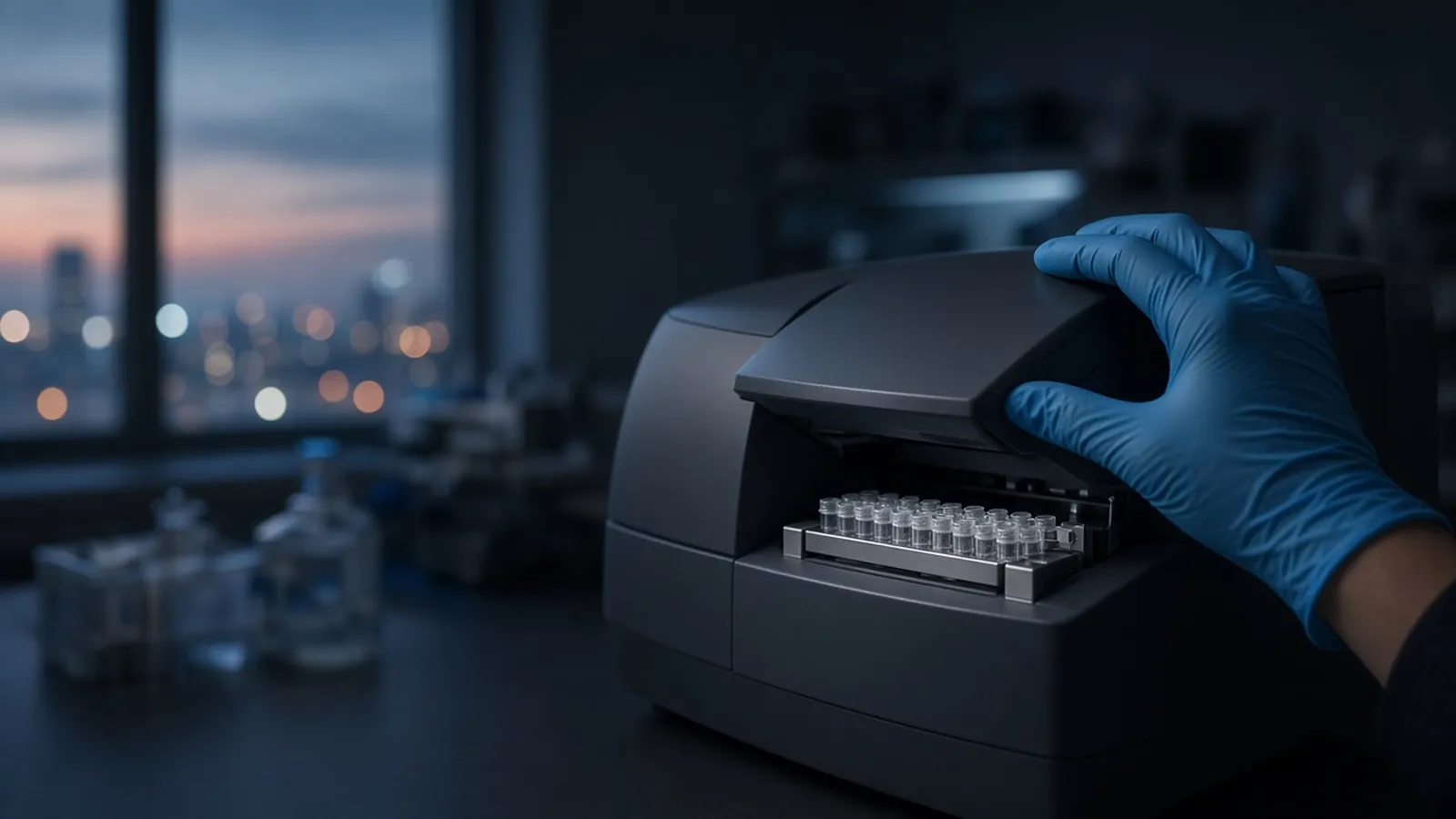
Some workflows cycle on a block like the one in the photograph, a gloved hand closing a strip of tubes, then move partitions to a reader. A dried partition is counted as empty for a physical reason, so the seal still matters.
A workflow with a saturation branch
State the count you need and the matrix it lives in. Design the assay so a positive partition means the sequence you named. Prepare the mix in a clean area. Dilute the template so the planned run sits in a partial-occupancy window. Include a no-template set of partitions. Include a positive of known behaviour if you have one, at a load that should not saturate.
Generate the partitions, cycle them, and read. Look at the two clusters before you look at the reported concentration. A clean gap between negative and positive, a no-template reaction with almost no positive partitions, and a sample inside the partial-fill window are the conditions for reading the number.
If the no-template partitions show a spray of positives, stop. You have contamination or a primer artefact, and the sample count is not interpretable. If the sample is nearly all positive, dilute and rerun. If the positive control partitions fail, fix the mix or the programme before you interpret a low sample count as biology.
| Your situation | Selection | Why the precision does or does not appear |
|---|---|---|
| You need a molecule count and can leave many partitions empty | Digital PCR | The empty fraction feeds the Poisson estimate |
| Positives are a small share of a large partition set | Stay with partitions | Rare events are counted directly, and more partitions tighten that count |
| Almost every partition is positive | Dilute, or leave digital | The empty fraction has vanished and the count goes coarse |
| You need a cloneable band | Endpoint PCR | A partition call does not hand you a discrete fragment |
| The curve is merely brighter on a real-time run | Do not call that digital | Height is not a presence count |
When the count lies
Inhibition can empty a partition that held a real target. The software then treats a failure as an absence, and the concentration falls. Clues are a positive cluster with unusually low amplitude, partitions strung between the clusters, or a sample that yields more positives after you dilute it. Dilution is a test, not a decoration. If a diluted aliquot gives a higher estimated concentration than the neat one, believe the inhibition story and repeat from a cleaner template. The cleanup belongs to the extraction method. The selection decision here is simply: do not report the dead partitions as biology.
Merges, foam and volume rejects change the denominator. A run that quietly drops a large share of partitions is a less precise run even if the concentration looks tidy. Record the accepted partition count beside the result.
Threshold placement is a human or a software choice. A threshold drawn through a smear will invent positives. Set it where the instrument's two populations actually separate, and keep the no-template reaction in the same analysis so you can see whether the threshold is eating noise.
Two instruments with different partition volumes and different counts will not hand you the same raw positive fraction for the same tube. Compare concentrations only after each run has been converted with its own volume and its own accepted count. A shared displayed temperature on two cyclers, upstream of that conversion, still does not make the blocks identical.
Safety and research limits
The hazards are the hot block, the oil or the chip chemistry described on the safety data you hold, and the biological matrix you partitioned. Institutional biosafety rules decide containment. This guide does not set a clinical limit of detection, a diagnostic cut-off, or a forensic threshold. A research count is a research count, bounded by the partitions you measured and the controls that stayed clean.
What to send when you enquire
State that you need partitioning, name droplet or well if you know which class the laboratory can run, give the amplicon length, the primer or probe plan, the template matrix, and whether the sample is inhibitor-rich. Say that you need the partition chemistry matched to the instrument, and that the result is a research count. The nucleic acid analysis pathway is the surrounding workflow. If several targets must share a partition, the multiplex PCR enquiry reference is a place to ask the design question. Ask whether a quotation is possible. This page does not supply a detection limit.
Questions from the bench
Does a brighter partition mean more copies inside it?
In the usual digital reading, a partition is scored present or absent once it crosses a threshold. Extra brightness is not extra counts. The quantity is how many partitions are called positive, read against how many were measured, through a Poisson model of random occupancy.
Why can inhibition look like a low concentration?
A partition that contains a target molecule and still fails to amplify is counted as empty. Empty partitions pull the estimated concentration down. A positive cluster that sits lower than usual, or a cloud of droplets between the two clusters, is a reason to suspect inhibition before you trust the rare-event fraction.
Do I still need primers and a thermal programme?
Yes. Partitioning changes how you count. It does not replace primer specificity or the temperature cycle the enzyme expects. A sloppy primer pair becomes many sloppy small reactions. Design and anneal with the same care you would give an endpoint assay, then confirm the product behaviour on the instrument you have.
Can I quote a limit of detection from this page?
No. This guide does not state a limit of detection, and it is not a clinical validation. Any detection claim belongs to the assay, the partition number you actually measured, and the quality system your institution requires. Copying a figure from a different instrument is not that work.
References
Manufacturer names identify published method classes. Trademarks remain with their owners. Catalogue records on this site are independent references for enquiry. They are not a statement of inventory, distribution rights or a supply commitment. This page is educational. It is not medical advice, a diagnostic protocol or a biosafety approval.
Catalogue
Related products and categories
These links follow the subject of the article into published manufacturer references. A listing is a reference for an enquiry, not a statement of stock or distribution rights.
Continue in this cluster
Related reading
How polymerase chain reaction worksHow PCR copies a chosen DNA segment: the temperature cycle, reagents, controls and what a band on a gel does and does not prove.A glossary of PCR termsPlan a PCR by defining amplicon, Tm, Ta, hot-start, plateau, master mix, NTC, inhibition, fidelity and multiplex before you mix.Choosing an annealing temperatureWhy annealing temperature is not the Tm printed on a tube, and how salt, magnesium, additives, and a short gradient locate the real window.