
guide
How to read a plasmid map
A decision procedure for reading origin class, resistance marker, promoter arrow, MCS, tags and cutters on a plasmid map before you order an enzyme.
- Author
- EVRINTH Editorial Team
- Published
- 8 October 2026
- Updated
- 8 October 2026
- Reading time
- 11 min
A plasmid map is a claim about a circular DNA molecule. It is worth reading before you order an enzyme, pour a plate or trust a colony, because the drawing is where copy number, drug resistance, promoter direction and cut sites are supposed to be written down. This page is a decision procedure for that reading. The path from a checked map to an archived colony sits in plasmid cloning from insert to colony. Use the page for research cloning. It does not approve a diagnostic result or a biosafety level.
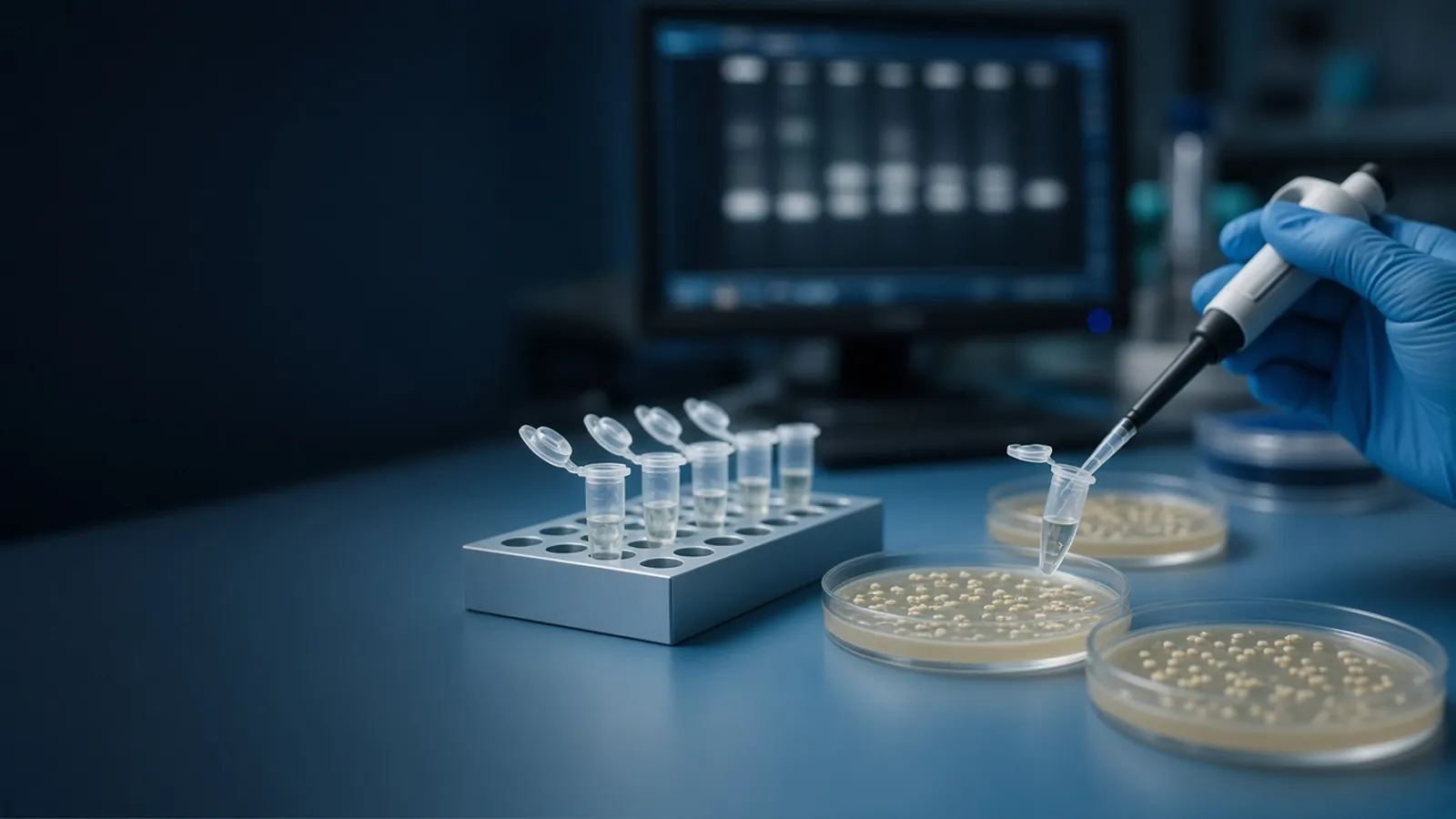
The photograph shows a gloved hand pipetting beside a cold block, plates and a gel image. The map is the document that should agree with those objects. Enzymes and backbone classes can be raised against the molecular biology catalogue. The file itself belongs in the quote request.
What you are allowed to decide from a map
Read a map when you are about to cut, assemble, transform or name a clone. The decision it supports is narrow. You can say which origin class you think you have, which drug the marker matches, which way a promoter points, and whether a named enzyme should cut once or twice on this sequence. You cannot say the colony on yesterday's plate matches the file. Colonies come later. Sequence comes later. A beautiful circular drawing is not a chromatogram.
Start from a sequence file or an accession, not from a slide that someone cropped. NCBI GenBank and the NCBI Nucleotide database are public places a backbone record may live. If the laboratory map and the accession disagree, stop and find out which base is in the tube. Ordering an enzyme against the wrong version is how a unique site turns out to be absent.
Origin and copy number, as classes
The origin of replication is the stretch the host uses to copy the plasmid. Copy number is a property of that origin in that host, not a moral quality of the insert. Three classes cover most routine E. coli cloning maps, and they are classes, not a single number you should memorise.
ColE1-like origins are the high-copy class. Within it, a pUC-type origin sits at the high end, often because rop is missing and a point mutation pushes copy number up. A ColE1 origin that still carries rop is the quieter end of the same class. Both get called ColE1-like on casual slides. The annotation on your file is the one that matters when the insert is a burden or when you expected a thick miniprep and got a thin one.
p15A-like origins are the lower-copy class. They are often chosen when a second plasmid must coexist with a ColE1-like plasmid, because the two origins are compatible if the markers differ. Expect a thinner prep than a pUC backbone, and do not interpret that thin prep as a failed purification until you have read the origin.
pSC101-like origins are the low-copy class, on the order of a handful of copies per cell in ordinary descriptions of the class. People use them when a high-copy plasmid would overproduce something the cell dislikes. Screening and sequencing still work. They simply start from less DNA, so a protocol written for a high-copy prep can look empty for reasons that have nothing to do with the insert.
If the map only says ori and does not name the class, look at the sequence notes or the backbone paper before you plan a prep or a toxic insert. Addgene's molecular biology reference is one public place laboratories record how they talk about these features. It is orientation, not a copy-number certificate for your aliquot.
Marker, promoter arrow, MCS and tags
The resistance marker is the gene that lets you use a drug to keep the plasmid. Read the gene name, not the colour of the arc. Ampicillin, kanamycin and chloramphenicol markers are different drugs and different failure modes. A map that says bla needs ampicillin or a related beta-lactam in the plate. A map that says aph or kanR needs kanamycin. Pouring the drug you happen to have, because the plates were already on the bench, selects for a plasmid you do not hold.
The promoter arrow is a direction. Follow it into the multiple cloning site and ask whether your insert's open reading frame will point the same way. The resistance gene usually has its own promoter elsewhere on the circle. That is why a backward insert still forms a colony. If the map has no promoter, say so in the plan. Expression is then a different experiment from propagation.
The multiple cloning site is a cluster of restriction sites placed for inserting DNA. A site drawn there is a candidate cutter only if it occurs once in the whole molecule, or twice if you mean to excise a piece. Tags drawn beside the site, such as a polyhistidine run, a FLAG peptide or a fusion partner, are amino-acid claims. They are in the protein only when the reading frame crosses the junction intact. The map can label a tag on a feature track while the bases underneath are shifted by one. Count codons before you treat the label as real.
Unique cutters and sites that cut twice
A unique cutter is an enzyme whose recognition site appears once. One cut opens the circle into a single linear molecule. On a gel you expect one band, larger than any fragment you would release by cutting twice, and matching the full plasmid length.
A site that cuts twice does not linearise in that same sense. It releases two pieces. People who order the enzyme because the empty-vector cartoon showed one tick mark, then digest a recombinant that inherited a second site from the insert, see two bands and call the digest a failure. The digest reported the sequence. The map reading was incomplete.
Also separate isoschizomers and neoschizomers in your notes if the card you are about to order is not the enzyme name printed on the map. The recognition sequence can match while the cut position or the methylation sensitivity does not. The enzyme card is the place that sensitivity is documented. Do not build a private list of blocked enzymes from memory and paste it into the order.
Before you order, write three lines: enzyme name, number of sites on this sequence, expected fragment sizes. If you cannot fill in the sizes, you are not ready to order. The join that uses those ends is a later choice, described with restriction ligation and overlap methods in the cloning path already linked above.
| Map feature | What you write down | Decision it changes |
|---|---|---|
| Origin class | ColE1-like, p15A-like, or pSC101-like, including rop if shown | Whether a thin prep or a sick culture is surprising |
| Resistance marker | Gene name and the drug that matches it | Which plate is allowed to grow a colony |
| Promoter arrow | Direction into the cloning site versus the insert ORF | Whether resistance can be mistaken for expression |
| Tag annotation | Where the tag sits, then a codon count | Whether the label is a protein feature or a drawing |
| Cutter count | Once, or twice, on this molecule | One full-length band versus two fragments |
A reading order before the enzyme is ordered
Work around the circle in a fixed order so a cropped picture cannot skip a feature. Origin first, because it decides whether the backbone is a fair home for the insert. Marker second, because it decides the plate. Promoter third, if expression is the point of the construct. Multiple cloning site fourth, with a search for every occurrence of each enzyme you might use. Tags last, with a frame count you can show a colleague.
Then ask what DNA is actually in the freezer. A map of the empty vector does not describe yesterday's ligation. A map downloaded under a similar plasmid name may differ by a linker. Colony screening and insert orientation, which the rest of this cluster covers, are tests you plan from the map. They are not substitutes for having read it.
If the construct will be built by overlap assembly rather than by restriction, the map still has a job. You need the bases on either side of the junction so the overlap is a real sequence, and you need to know the marker so the plate matches. Gibson-style joins do not excuse a missing origin annotation.
When the drawing and the digest disagree
If the gel shows two bands and the map promised one, recount sites on the recombinant sequence before you blame the enzyme. If the gel shows a full-length supercoiled band that never opened, the site may be absent, methylated on this host, or the enzyme may be dead. Methylation sensitivity is an enzyme-card fact. Come back to it when you choose the site, and do not invent a blocked-enzyme list on the margin of the map.
If colonies grow on the wrong drug, you read the marker from habit. If a protein is missing and the colony is resistant, compare the promoter arrow with the insert before you change induction conditions. The map is allowed to catch that earlier.
Version mix-ups are the quiet failure. Two files named after the same gene, one with a tag and one without, produce confident colonies and the wrong protein. Put a short hash, an accession, or a date in the tube label. Addgene's protocol collection shows how public cloning notes keep map and plasmid together. Follow your own record system. Their pages are not your inventory.
Safety and what the map does not authorise
A map does not decide containment. The strain you transform, and whether the insert encodes something hazardous, is an institutional biosafety decision. Reading a commercial backbone's drawing does not make an unknown insert harmless. Keep the organism inside the rules your institution already set.
This page is research education. It is not a clinical genotyping method and it is not permission to skip sequence confirmation when the clone will be trusted.
Writing the specification so the map survives the order
In a shared laboratory the map often travels as a screenshot in a chat message. Cropping removes the origin or the second cutter. When you raise an enzyme or a backbone as a sourcing question, paste the origin class, the marker, the enzyme names and the expected sizes into the specification itself. A spoken enzyme name across a noisy bench is how an isoschizomer with different methylation behaviour arrives. Humidity and heat do not change the sequence. They do make people rush a verbal order. Write it down while the file is open.
What to put in the enquiry
Name the backbone, the origin class, the marker and the enzymes, and attach the sequence file. If you need a synthetic insert designed to that map, use the custom gene synthesis enquiry reference as a way to frame the file. If you will later ask for a read of the clone, use the Sanger sequencing enquiry reference the same way. Both are enquiry references. They are not a statement that EVRINTH synthesises genes or runs sequencing, and they are not a supply commitment. Send the scientific requirement with the quote request and ask whether a quotation is possible.
Read a plasmid map before you order an enzyme
- 01Name the origin class and the markerWrite down whether the origin is annotated as ColE1-like, p15A-like or pSC101-like, and which resistance gene the backbone actually carries. Those two lines decide copy number class and which drug belongs in the agar.
- 02Find the promoter arrow relative to the insert windowTrace the promoter arrow into the multiple cloning site and compare it with the open reading frame you intend to insert. A marker that sits elsewhere on the circle will still work if that arrow and the insert disagree.
- 03Count each cutter on the molecule you will digestMark sites that occur once, and mark sites that occur twice. Order an enzyme only after you know whether one cut should linearise the plasmid or two cuts should release a fragment.
- 04Attach the map version to the enzyme requestPut the backbone name, the accession or file you trusted, the enzyme names and the expected band sizes in the same note. A screenshot that crops the origin or the methylation warning is not an enzyme order.
Questions from the bench
Does a high-copy annotation mean every ColE1-like plasmid behaves the same?
No. ColE1-like is a class, and maps inside it differ. A pUC-type origin is the very high end of that class, while a ColE1 origin that still carries rop is quieter. Read the origin annotation on the file you have, and treat a remembered copy number as a hint until the map says which variant it is.
A site is drawn once on the empty-vector map. Can I assume it is unique after I add the insert?
Only if you recount on the recombinant. The insert can bring a second copy of the same site, and the cloning step can delete a site that used to sit in the multiple cloning site. Uniqueness belongs to the molecule you will cut, not to the parent drawing.
The map shows a His tag next to my gene. Is the tag in frame?
The drawing does not prove the frame. A tag is in frame only when the codons from the start you will actually use run in threes through the junction into the tag or the insert. One extra base shifts every downstream codon. Check the sequence, not the colour of the arrow.
What should a map-based enzyme enquiry include?
Include the backbone name, the origin class, the resistance marker, each enzyme, whether the site must be unique, and the fragment sizes you expect on a gel. If a synthetic insert is part of the plan, point to the file. The catalogue and the enquiry pages are places to ask. They do not show that a given enzyme is on a shelf.
References
Manufacturer names identify published method classes. Trademarks remain with their owners. Catalogue records on this site are independent references for enquiry. They are not a statement of inventory, distribution rights or a supply commitment. This page is educational. It is not medical advice, a diagnostic protocol or a biosafety approval.
Catalogue
Related products and categories
These links follow the subject of the article into published manufacturer references. A listing is a reference for an enquiry, not a statement of stock or distribution rights.
Continue in this cluster
Related reading
Plasmid cloning from insert to colonyHow an insert becomes a plasmid, a colony and a verified clone, and which checkpoint fails when the plate is empty or the insert is wrong.A glossary of cloning termsRead a cloning plan and mark vector, insert, MCS, ends, ligase, phosphatase, transformation, and clone against the map before you mix a tube.Antibiotic selection is not proof of an insertWhat selection, marker, satellite and clone mean on an antibiotic plate, and why a colony can grow with no insert, the wrong insert or only a parent vector.