
comparison
Loop-mediated isothermal amplification overview
Compare loop-mediated isothermal amplification with endpoint PCR on equipment, primer count and what a positive signal means before you choose.
- Author
- EVRINTH Editorial Team
- Published
- 8 October 2026
- Updated
- 8 October 2026
- Reading time
- 8 min
Loop-mediated isothermal amplification, usually called LAMP, copies a chosen DNA region at one temperature. It uses a strand-displacing polymerase and four to six primers, and it reports a bulk signal such as turbidity or a dye change. The decision this overview supports is whether that package fits the research question better than endpoint PCR. The thermal cycle itself is explained in how polymerase chain reaction works. What follows is the comparison: equipment, primer burden, and what a positive is allowed to mean.
If you are ordering a polymerase, nucleotides or vessels for either method, start from the molecular biology catalogue and send the scientific requirement with the quote request. A family name on a catalogue page is not a recipe.
Who should even consider LAMP
Choose the comparison when you need a research presence result and you are willing to carry a heavier primer design in exchange for a single-temperature hold. A teaching demonstration, a methods comparison, or a closed-tube screen of a cloned template can be honest uses. A clinical or field diagnosis is a different claim, and this page does not grant it.
Stay with endpoint PCR when the answer you need is a discrete fragment of a known size that you will cut, clone or sequence. LAMP's product is a family of long stem-loop molecules. It is a poor sequencing template and a poor size marker. If identity is the claim, a band of the expected length, followed by a sequence, remains the clearer path.
What the isothermal reaction is doing
Endpoint PCR separates the strands with heat, lets two primers anneal, and extends them with a polymerase that usually waits for the next melt before the new strand can be copied again. LAMP asks a strand-displacing polymerase to peel the downstream DNA out of the way as it synthesises. The inner primers are long composites: each carries a sequence that will later fold back and prime from the loop it just created. Once those loops exist, copying can continue at the same temperature. There is no programmed march through denature, anneal and extend.
Some workflows heat the template once at the start so the first primers can invade a difficult duplex, then drop to the hold temperature and stay there. That initial heat is still not a cycle. The copying phase is the hold. For enzymes in the strand-displacing class used for LAMP, the hold is often planned somewhere around 60 to 65 Celsius, for a time on the order of half an hour to an hour. Engineered polymerases publish their own windows. Follow the enzyme you actually have.
The product grows into long concatemers of inverted repeats. On a gel, if you open the tube, you typically see a ladder or a smear. That smear is a weak identity check. The useful readout happens while the tube is still closed: turbidity from magnesium pyrophosphate, a dye that responds to the pH drop or to the fall in free magnesium, or fluorescence read through the plastic. Discard a positive tube closed when you can.
Primers, polymerase and the instrument
A LAMP set has two outer primers and two inner primers. The outer pair displaces the first new strands. The inner pair both primes and supplies the sequences that fold into loops. Loop primers, one on each side, are the optional fifth and sixth oligos. They give the enzyme extra places to start, so the signal often appears sooner. They also give you two more sequences that can mis-prime. Four primers is the minimum architecture. Six is common and is a larger design and a larger contamination surface.
Design software written for two PCR primers will not place these sites. NCBI Primer-BLAST remains a public check for ordinary PCR pairs. A LAMP set needs a designer that understands the spacing and the direction of the six regions, and it still needs a local test against the template you hold. A set copied from a paper can fail because your sequence differs in one of the inner sites, or because your salt is not theirs.
The polymerase has to displace strands. A standard Taq used for endpoint PCR is the wrong class. Buy or request the strand-displacing class the method expects, and keep its storage temperature. Magnesium and the dye, if the dye is the readout, come from that enzyme's protocol. Do not paste a PCR master-mix table underneath a LAMP primer set.
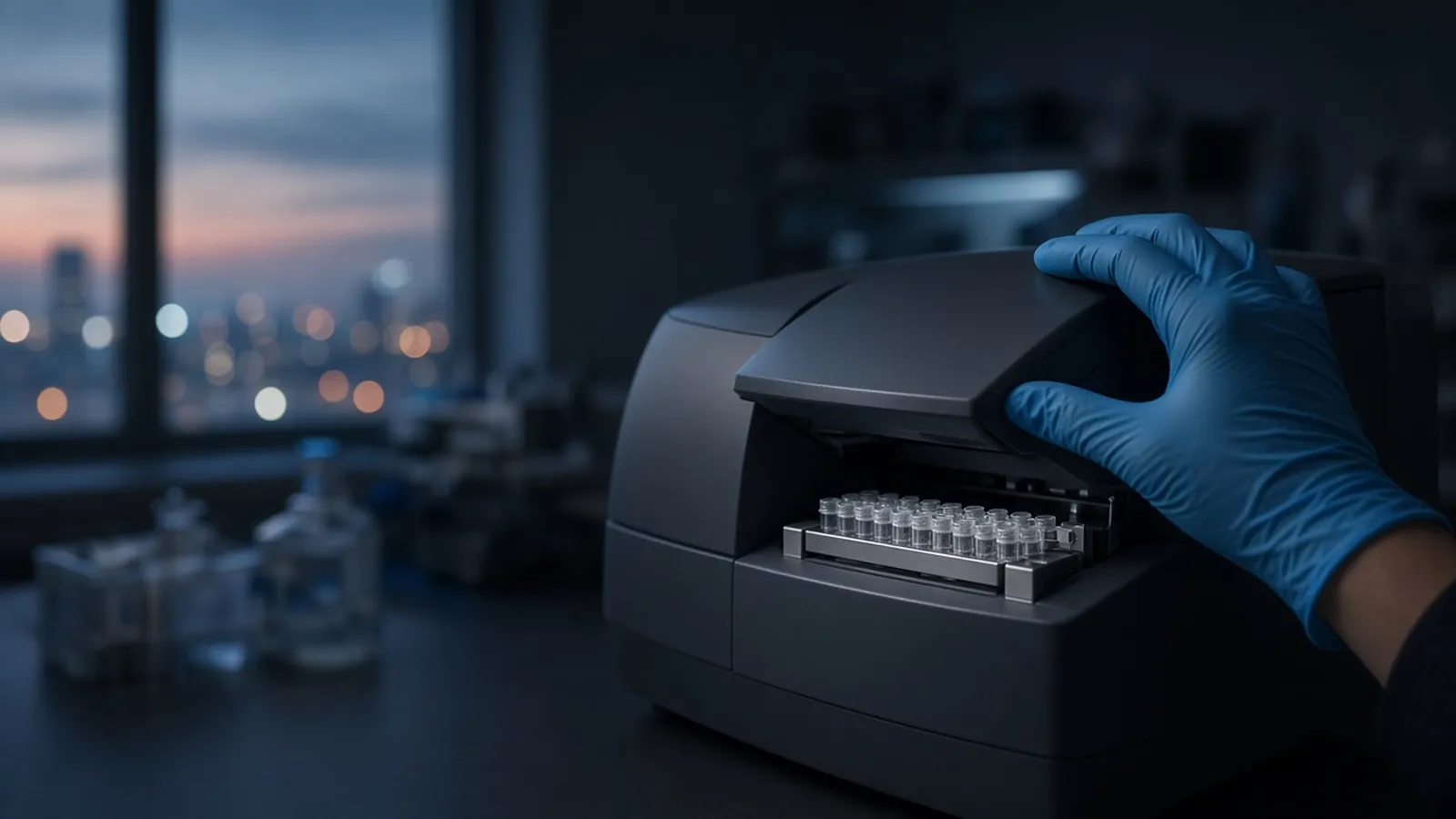
The instrument can be a heat block, a water bath, or a cycler held at one temperature. The photograph shows a gloved hand closing a benchtop cycler, which can run the hold or an endpoint programme. The hold still has to match the temperature that enzyme was validated at. Two blocks that display the same number can differ, so the first transfer of the assay includes a trusted control.
A workflow with a branch for the closed tube
Write the biological question as a presence question. Name the template and state that a positive will be a closed-tube signal, not a sequenced fragment. Design or retrieve the four-to-six primer set and record which regions are inner, outer and loop.
Set the no-template control before any template is open. Include a positive of a trusted, modest amount if you have one. Add sample last among the unknowns, and keep the positive from bathing the blank. Close every tube before the hold starts. Start the single temperature. Read turbidity or dye at the end, or watch a real-time trace if the instrument provides one, without cracking the lid.
If the no-template tube changes colour or becomes turbid, stop. The run cannot be interpreted. Retire the primer aliquot and the water, and treat the bench as contaminated with LAMP product. Do not "check" the failure by opening every tube onto a gel in the same room where you will set up tomorrow.
If the positive stays negative and the blank stays negative, the enzyme, the temperature or the primer set is the first suspect. Do not call the samples negative. If the positive signals and a sample does not, you have a research negative only inside the controls you ran, including an inhibition check when the matrix is dirty. You do not have a diagnostic negative.
| Decision | Endpoint PCR | LAMP |
|---|---|---|
| Equipment | A thermal cycler running a temperature programme | A block, bath or cycler that holds one temperature |
| Primer burden | Two primers around one interval | Four primers, or six when loop primers are added |
| What a positive means | A product whose size matches the design, beside controls | Turbidity, a dye change, or fluorescence in a tube you did not open |
| What you can do next | Cut, clone or sequence a discrete fragment | Very little that needs a single clean molecule |
| How a false positive spreads | A few copies of a short amplicon can seed the next mix | Opening the tube releases a huge, already-primed product into the room |
Failure modes that belong to this chemistry
The false-positive mode that separates LAMP from PCR is the product itself. PCR carryover is serious because a short amplicon already has primer sites at both ends. LAMP carryover is harder to live with because the tube contains an enormous amount of that kind of molecule, folded and concatenated, and the usual way to "see what happened" is to open it. Once the room has seen an opened positive, later blanks become difficult to trust. Plan the readout so a positive tube never has to be opened in the setup room.
A second failure is a signal from the wrong DNA. Six binding sites can still mis-fire, and a non-specific product can precipitate pyrophosphate or shift a dye. A no-template control catches reagent artefacts. A sample signal still needs a separate identity check if the named sequence is the claim.
A third failure is temperature or a loose cap. Strand displacement has a window, and volume loss changes both the enzyme and the dye. A dried tube is a failed vessel. Blood, soil and a dirty elution can also suppress the polymerase. Dilute or spike before you call that sample negative.
Safety and the limit of the claim
Hot blocks, dyes and any template from an infectious source are the practical hazards. A closed tube of LAMP product is a contamination hazard even when the organism itself is absent. Your institutional biosafety rules decide containment. The WHO laboratory biosafety manual is background reading. This comparison does not authorise a field test, a clinical report, or a forensic result.
A shared cycler and a simpler heater
Where the thermal cycler is booked out, a checked heat block can hold the temperature, which is why the method is sometimes chosen. The block still needs a known set-point and a seal that lasts the full time. After a power cut, confirm that set-point with a positive and a no-template tube before a precious set.
Several targets in one tube multiply the primer count. The multiplex PCR enquiry reference is a prompt for that design question. The nucleic acid analysis pathway is the wider context when amplification sits between extraction and a result.
What to put in an enquiry
Name the enzyme class as strand-displacing, the primer count you intend (four or six), the readout (turbidity, a named dye class, or fluorescence), the template matrix, and the hold temperature the enzyme card asks for. Say that the result is a research presence call with closed tubes. Ask whether a quotation is possible for the polymerase, the nucleotides and the plastic. Leave diagnostic claims out of the note.
Questions from the bench
Does a LAMP colour change prove the intended sequence was copied?
A colour change, a rise in turbidity, or a fluorescence signal shows that a lot of DNA was made in that closed tube. It does not by itself name the sequence. Specificity still depends on the primer set, the temperature you actually held, and controls that include a no-template tube.
Why is opening a LAMP tube a different contamination problem from opening a PCR tube?
The product is a huge mass of looped, repeated DNA that is already an excellent template for the same primers. A small aerosol from one opened tube can seed later reactions across a room. Closed-tube readout exists so you can score the result while the product stays inside.
Can four primers be enough, or do you always need six?
The core set is four: two outer primers and two inner primers that carry the loop-forming sequences. Two extra loop primers are often added because they speed the reaction. Follow the design you validated, and treat a six-primer set as a heavier specificity problem, not as a free upgrade.
Is a LAMP result from a research bench a field diagnosis?
No. This overview is research education. A diagnostic or field claim needs a validated assay, a quality system, and the legal framework that applies where the result would be reported. A single-temperature block does not supply that approval.
References
Manufacturer names identify published method classes. Trademarks remain with their owners. Catalogue records on this site are independent references for enquiry. They are not a statement of inventory, distribution rights or a supply commitment. This page is educational. It is not medical advice, a diagnostic protocol or a biosafety approval.
Catalogue
Related products and categories
These links follow the subject of the article into published manufacturer references. A listing is a reference for an enquiry, not a statement of stock or distribution rights.
Continue in this cluster
Related reading
How polymerase chain reaction worksHow PCR copies a chosen DNA segment: the temperature cycle, reagents, controls and what a band on a gel does and does not prove.A glossary of PCR termsPlan a PCR by defining amplicon, Tm, Ta, hot-start, plateau, master mix, NTC, inhibition, fidelity and multiplex before you mix.Choosing an annealing temperatureWhy annealing temperature is not the Tm printed on a tube, and how salt, magnesium, additives, and a short gradient locate the real window.