
explainer
Thermal cycler checks after a power cut
Check whether a thermal cycler finished, restarted at cycle one, or lost its heated-lid set-point before you trust a precious plate.
- Author
- EVRINTH Editorial Team
- Published
- 8 October 2026
- Updated
- 8 October 2026
- Reading time
- 8 min
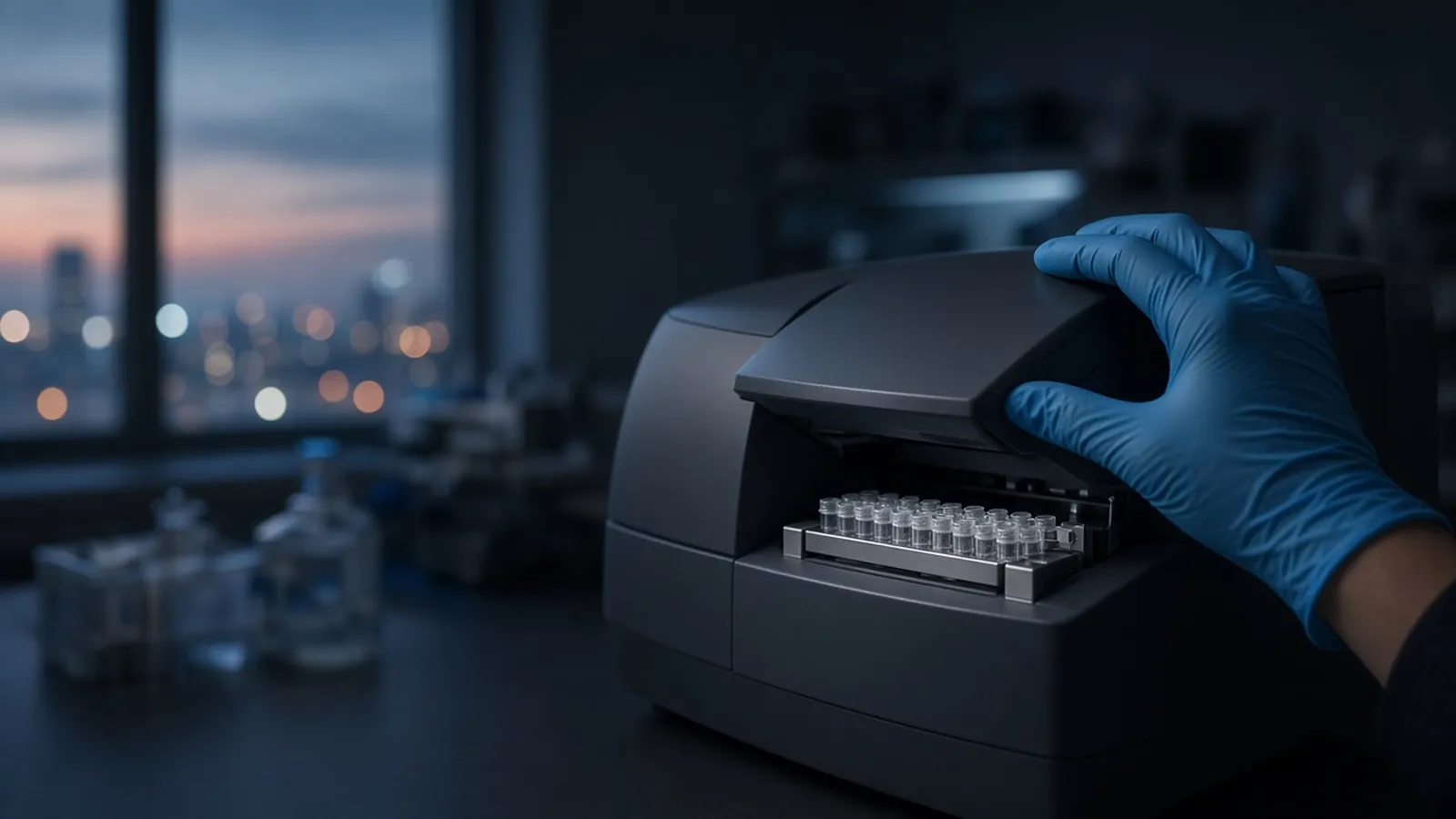
After a power cut, the number on a thermal cycler screen is a claim about a sensor, not proof that your programme finished. This explainer is the check. Did the block complete the run, did the programme start again at cycle one, and is the heated lid still at the set-point the method named? Only then do you decide whether a precious plate can go on that machine. The programme you are trying to protect is the cycle in how polymerase chain reaction works.
The photograph shows a gloved hand closing the lid of a benchtop cycler on a strip of tubes, with city lights beyond the glass. That lid is part of the instrument you have to re-trust. Instruments and plastic are specified through the molecular biology catalogue and the quote request. This page does not assign a calibration number.
What actually stops when the power stops
A cycler is three systems that must agree. The block heats and cools the tubes through a listed series of holds. A counter remembers which cycle and which step it is in. The heated lid, a separate heater, stays warmer than the sample so water does not park on the caps and leave the reaction. A power cut removes energy from all three. Fans stop, displays go dark, and any step that was in progress is incomplete.
When power returns, instruments do not share one behaviour. Some resume the step they were in. Some abort and sit at a safe hold. Some reboot and wait for a person. Some can be set to start a stored protocol from the first cycle. You cannot see which of those happened from a single temperature flashing on the screen. The manual for the model you have is the authority for that model's resume logic. Read it once, before the next outage, and write the expected behaviour into the laboratory note.
Did the block finish?
Look at the run log, the cycle counter and the clock, not only at the block temperature. If the log shows the final extension or the final hold starting before the outage, the thermal programme may have finished, and the remaining question is whether the tubes sat hot or cold for a long time afterwards. A long hot soak can degrade product or dry a poor seal. A long cold sit is usually kinder to the DNA and still does not repair a run that had already failed.
If the log stops mid-cycle, the block did not finish. Samples experienced an unknown partial cycle: perhaps a denaturation without the matching extension, or an extension cut short. Endpoint product may be weak, mixed, or absent for a reason that has nothing to do with the template. Do not interpret those lanes as biological negatives. Repeat them once the instrument has been checked.
Write down what the display said at the moment power returned, including any error text. Memories of "it looked normal" are how a restarted cycle disappears from the record.
Did the programme restart at cycle one?
A restart is a different failure from an abort. The counter returns to the beginning and the samples receive extra cycles. Endpoint PCR already stops being quantitative once reactions plateau, because primers, nucleotides and enzyme are finite. Extra cycles push tubes deeper into that plateau, grow primer-dimer, and can turn a barely specific anneal into a visible side band. A real-time run that restarts has a trace you cannot line up with the samples that ran uninterrupted.
Compare the log's start time with the time of the outage. A start time after the power returned means this execution began again. A cycle count that is higher than the programme you loaded means something added cycles. Either finding is enough to quarantine the plate's interpretation. The tubes might still contain usable product for a low-stakes check. They are not a precious result.
Is the lid still at its set-point?
The heated lid has its own set-point, often planned somewhere around 100 to 105 Celsius on many instruments, always as the manufacturer specifies for that model. After a reboot the lid heater may be off while the block heater reports a familiar sample temperature. Caps then run cooler than the liquid. Water condenses under the cap, and in a small volume a share of the reaction can leave the bottom of the tube. If cycling continues in that state, magnesium, primers and dNTPs concentrate in whatever liquid remains. Late cycles run in a different mixture from the one you pipetted.
Read the lid temperature on the display and compare it with the set-point stored in the programme you intended to run. Compare it also with the laboratory's calibration or service record for that instrument. If the display and the set-point disagree, do not "correct" the lid by typing a number you invented. Service the instrument, or follow the manufacturer's recovery steps, and then prove the block with controls.
Two cyclers, one displayed temperature
Blocks differ in geometry, sensor placement, lid pressure and wear. Plastic that fits one block rocks in another. A calibration certificate, where the institution has one, is a record of a test done on a date, by a method, with an outcome. It is not a universal offset you can copy from this article onto a second machine. National measurement practice, of the kind a body such as NIST describes for weights and measures, is a reminder that a number without a record is not a calibration. Your laboratory's service sheet is the record that counts.
So a cycler that "shows 58 degrees, same as the other one" can still anneal differently. After an outage, the functional check is a known positive and a no-template control, in the plastic you will use for the real samples, on the programme you will use, on the block that lost power. The positive shows that this mix and this block can still amplify. The no-template control shows that you did not declare the cycler healthy by contaminating the test. If the positive fails, the precious set waits. If the blank shows the assay product, the outage is no longer your only problem, and the reagents need the same suspicion as the block.
| Check | Evidence that passes | Evidence that stops a precious set |
|---|---|---|
| Block finished | Log shows the final hold began before the cut | Log ends mid-cycle, or the clock does not match |
| Restart | Start time and cycle count match the run you launched | A new start after power returned, or extra cycles |
| Heated lid | Lid display matches the programme set-point | Lid off, or a default that is not your set-point |
| Functional assay | Known positive amplifies, no-template stays clean | Positive fails, or the blank shows the product |
What you may conclude
A log that shows a completed programme, a lid that matches its set-point, a positive that amplifies, and a no-template control that stays clean are the conditions for trusting the next precious set on that block. Any one failure sends you back to a repeat, not to a corrected story about the samples that were on the machine during the cut.
A UPS, a generator transfer, or a policy of never starting a precious plate in a storm window are institutional equipment decisions. This explainer does not require them and does not forbid them. It asks you to treat the outage as a break in the thermal history until the log and the controls say otherwise.
Safety and the limit of the claim
Blocks and lids stay hot after a short outage and can be burn hazards when power returns unexpectedly. Do not lean on a lid that is recovering. Research results remain research results. A cycler that passed today's checks is still not a diagnostic platform.
In buildings where supply interruptions are part of ordinary working life, write the resume behaviour of each cycler into the induction note while the power is on. The note is free. Reconstructing it from a dark screen is not.
What to send with an enquiry
If you are specifying a cycler or a replacement block, state that you need a run log a person can read after an interruption, a heated-lid set-point you can display, and plastic that matches the block. Name endpoint or real-time use, vessel profile, and the control habit you will use to re-qualify the instrument: a known positive and a no-template control. The nucleic acid analysis pathway is the workflow around the instrument. Ask whether a quotation is possible. Do not ask the seller to invent a calibration offset the institution has not measured.
Questions from the bench
If the block shows the right temperature after the power returns, is the run valid?
A displayed temperature says the sensor is reporting that number now. It does not say whether the programme finished, restarted at cycle one, or sat for an unknown time with the heated lid off. Read the run log and the cycle counter before you accept the plate.
What is wrong with a programme that quietly starts again at cycle one?
The samples receive a second set of cycles, or a partial set plus a full restart, so an endpoint reaction is pushed further into plateau and non-specific products have more time to grow. The thermal history is no longer the programme you wrote down. Treat a restarted run as an unknown history and verify the block before a precious set.
Why check the heated lid separately from the block?
The lid is a second heater with its own set-point. After a reboot it may be off, or sitting at a default, while the block looks plausible. A cold lid lets water condense and then leave small reactions, which changes salt for whatever cycles remain. Compare the lid display with the set-point stored in the programme.
Can I write a correction factor for the cycler from this article?
No. Calibration is an institutional record: a date, a method, and the outcome your laboratory or its service contractor logged. Two cyclers that display the same temperature can still differ. This page tells you which checks to make. It does not supply a number to add to the set-point.
References
Manufacturer names identify published method classes. Trademarks remain with their owners. Catalogue records on this site are independent references for enquiry. They are not a statement of inventory, distribution rights or a supply commitment. This page is educational. It is not medical advice, a diagnostic protocol or a biosafety approval.
Catalogue
Related products and categories
These links follow the subject of the article into published manufacturer references. A listing is a reference for an enquiry, not a statement of stock or distribution rights.
Continue in this cluster
Related reading
How polymerase chain reaction worksHow PCR copies a chosen DNA segment: the temperature cycle, reagents, controls and what a band on a gel does and does not prove.A glossary of PCR termsPlan a PCR by defining amplicon, Tm, Ta, hot-start, plateau, master mix, NTC, inhibition, fidelity and multiplex before you mix.Choosing an annealing temperatureWhy annealing temperature is not the Tm printed on a tube, and how salt, magnesium, additives, and a short gradient locate the real window.