
Pillar guide
Bacterial culture and transformation
How non-pathogenic E. coli cloning strains are grown and how plasmid DNA is introduced, with the controls that make a colony meaningful.
- Author
- EVRINTH Editorial Team
- Published
- 8 October 2026
- Updated
- 8 October 2026
- Reading time
- 10 min
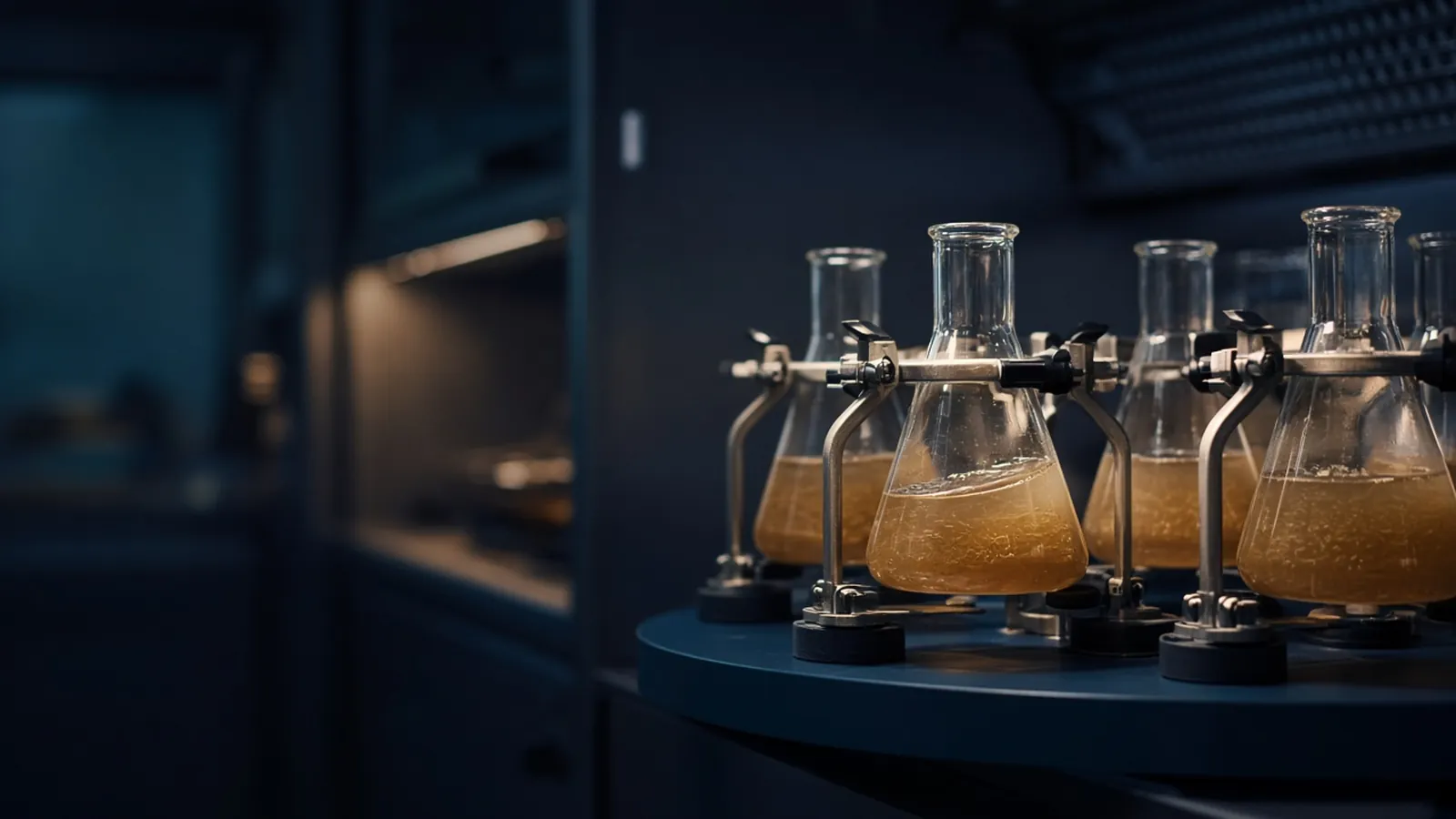
Bacterial culture and transformation, in a molecular cloning room, means growing a non-pathogenic laboratory strain of Escherichia coli and persuading a few of those cells to take up plasmid DNA. The decision this page supports is whether the strain, the medium, the competence method and the antibiotic agree with each other before anyone thaws a tube. A colony is a candidate. It is not, by itself, a correct construct. Colour screening and the limits of a white colony are the companion note on antibiotic selection and blue-white screening.
Media, antibiotics and competent-cell classes can be specified from the reagents and chemicals catalogue. Sequence design questions can be framed against the custom gene synthesis reference, which is an enquiry prompt, not a statement that EVRINTH runs that chemistry. The surrounding workflow sits on the molecular biology pathway. A sourcing note goes to the quote request.
What this culture is allowed to be
This explainer stays with K-12-style cloning and protein-expression strains. They are used because their genotypes are published, they grow on ordinary rich medium, and decades of plasmid work have been done in them. They are not a model for cultivating a pathogen, and nothing here is a recipe for a clinical or environmental isolate. If the organism is not already on your institutional list as a cloning strain, stop and take the risk assessment to the people who own it. The CDC BMBL is one public reference those people use. It is not applied to your building by this article.
Within that boundary the strain still has to match the job. A cloning host is often chosen for efficient transformation, reduced recombination, and an endonuclease genotype that leaves plasmid DNA intact when you prep it. An expression host is chosen for the promoter and the tags you will induce, and it is often a poorer cloning host. Swapping them because a box was closer is how a "simple" plasmid becomes a mixed population. Write the genotype you need. If you must confirm a feature, a public sequence record in GenBank is a place to check what a named gene is, not a place to invent a strain pedigree.
How a cloning strain grows
In rich broth the cells consume peptides, yeast extract and a little carbohydrate, and they divide while oxygen and nutrients allow it. An Erlenmeyer flask on an orbital shaker is the usual vessel because the culture needs air and the flask must not be filled to the neck. A flask that is more than about a fifth to a quarter full often becomes oxygen-poor; the culture then grows slowly, acidifies, and can lose a plasmid it was supposed to keep. That fill fraction is a planning habit, not a law of a particular shaker brand.
Turbidity at 600 nanometres is a convenient reading of cloudiness. It is not a cell count until your laboratory has related it to colony-forming units for that strain and that spectrophotometer. Early log-phase cells are the usual source if you are making competent cells yourself. Stationary cultures are a poor start for that job and a common start for a plasmid prep, because the yield of biomass is higher. Do not harvest "whenever it looks cloudy" if the downstream step cares about phase.
A single colony is the inoculum that keeps a culture clonal. Streaking to isolation is the step that makes that sentence true. A loop dipped into a glycerol stock and dropped into broth can carry a mixture, including a cell that lost the plasmid and a cell that kept it. Solid medium with the correct antibiotic is where you see the difference. ATCC culture guides describe how culture collections expect recipients to revive and check the material they ship. Read them as handling context for bona fide collection strains, not as permission to grow something else.
What goes into the flask and onto the plate
Medium is a class of recipe. Lysogeny broth is the familiar one: a peptide source, yeast extract and sodium chloride. Richer or buffered formulations exist for expression. Agar is the same liquid plus a gelling agent, poured after sterilisation. Antibiotics that do not survive heat are added only after the agar or the broth has cooled to a temperature you can hold, then mixed and poured or aliquoted. Adding them before the autoclave is a reliable way to pour plates that look selective and are not.
The antibiotic must be the one the plasmid's marker gene actually resists. Ampicillin, kanamycin, chloramphenicol and tetracycline are different chemistry classes. A bla plasmid on a kanamycin plate is a no-DNA experiment that you did not mean to run. Concentration belongs on the plasmid map and the antibiotic's research-use note. This page will not paste a microlitre table, because the number that is right for one copy-number plasmid can be wrong for another.
Competent cells are a reagent with a storage rule. Chemical competence usually means washed cells in a divalent-cation buffer, kept frozen, thawed on ice, mixed with DNA, held cold, given a brief heat pulse, and returned to ice. Electrocompetence means washed cells in a low-salt buffer, a pulse in a cuvette, and immediate recovery medium. The heat-shock temperature and the pulse settings belong to the cell preparation you have. Copying a number from a paper that used a different preparation is how viability collapses. Public method notes collected by Addgene are a reasonable place to see the shape of these workflows. They are not a substitute for the sheet that came with the cells in your freezer.
Enzymes and master mixes used upstream of the cells, ligases and assembly mixes among them, are method classes. A supplier catalogue such as the NEB product list can orient you to those classes. It is not a protocol to transcribe, and it is not a statement about any distributor relationship.
From DNA to a colony
Keep DNA and cells cold while you set up a chemical transformation. Add a defined amount of DNA. Too much ligation mixture can inhibit; too little supercoiled plasmid can look like a failure of the cells when the cells were fine. For electroporation, the DNA must be in water or a very low-salt buffer. Salt arcs. An arc is a failed pulse, not a mysterious strain problem.
After the pulse or the heat shock, recover in non-selective broth for the time the method asks. The resistance protein has to be made before the cell meets the drug. Plating immediately onto antibiotic is a classic way to obtain zero colonies from a reaction that would have worked an hour later. Spread a measured fraction of the recovery. If you expect a ligation to be inefficient, plate more. If you expect a pure supercoiled plasmid to be efficient, plate less, or you will not be able to pick single colonies.
Incubate plates inverted at the temperature the strain expects, often 37 Celsius for routine K-12 work, lower if you are nursing a toxic construct. Read them when colonies are discrete. Tiny colonies that appear only after a very long incubation, clustered around a large one, are a warning about exhausted antibiotic rather than a gift of extra clones.
Controls, and what a plate can support
| Plate | Clean result | What it does not prove |
|---|---|---|
| No DNA, plus antibiotic | Cells alone do not form colonies on this batch of plates | That every later colony has the intended insert |
| Known intact plasmid | This cell lot and this method can produce transformants | That a ligation is equally efficient |
| Ligation or assembly | Candidates exist and can be picked | Sequence, orientation or reading frame |
| No antibiotic | Cells were alive enough to form a lawn or a heavy growth | Anything about plasmid uptake |
If the known plasmid fails and the no-DNA plate is clear, blame the cells, the heat block, the cuvette or the recovery before you blame every DNA sample. If the no-DNA plate has colonies, the plates or the technique are not selective, and sample plates cannot be read. If both controls behave and the ligation is empty, the upstream assembly is the next place to look.
Picking is its own discipline. Touch one colony, inoculate one tube, and do not sweep a region of small satellites. Confirm the construct by restriction digest, colony PCR or sequencing before you build a story on it. Blue-white colour, where the vector offers it, is only a screen.
Failure modes worth separating
No colonies at all, with a dead positive control: cells thawed warm, a heat block that was not at temperature, an electroporation arc, recovery skipped, or the wrong antibiotic. No colonies with a healthy positive control: the new DNA was absent, inhibitory, or cut in a way that cannot circularise. Colonies on every plate including no DNA: antibiotic omitted, destroyed by heat, expired in a warm drawer, or the strain was already resistant. Mucoid or odd colonies that do not match the strain's look: treat them as contamination, not as interesting clones. Do not passage an unknown morphology "to see".
Plasmid loss during a long liquid culture without antibiotic is ordinary biology. The cells that drop the plasmid can outgrow the cells that keep a burdensome one. Selection belongs in the culture you intend to prep, unless you have a specific reason to omit it and a way to check that you still have the plasmid.
Safety stays an institutional decision
K-12 laboratory strains are handled under the biosafety rules your institution has already set for them. Those rules still include no mouth pipetting, disinfection of spills, and waste that is inactivated before it leaves the laboratory. They are not a dare to scale a culture of a different organism because the shaker is free. Disinfectants and antibiotics are chemicals with their own hazards. This page is not medical advice and not an approval to change containment.
Heat, cold chain and power
Competent cells are a cold-chain reagent. A shipment that arrives warm is a different reagent from the one that was frozen. In a hot building, "thaw on ice" fails if the ice is a shallow pan in a 30 Celsius room and the tubes sit there while you label plates. Keep the ice generous and the wait short. Plates dry out in a fierce incubator airflow and sweat in a humid cold room; either one changes how colonies look. A power cut stops the shaker. A culture that sat warm and still for hours is not the oxygenated log-phase flask you planned. Cool it, and decide from a backup or a fresh inoculum rather than pretending the growth curve continued. Write incubator temperature and shake speed down. Two rooms that both say 37 Celsius can still differ.
What to put in an enquiry
Name the strain class, the marker, cloning versus expression, chemical competence versus electroporation, and the cold-chain constraint. Ask for confirmation of medium composition or enzyme class rather than assuming a family name is one recipe. Use the quote request for that specification. The custom gene synthesis page can prompt questions if the DNA itself must be designed. Read it as an independent reference. Do not read it as a claim that the synthesis is already being performed.
Plan a cloning-strain culture and a transformation before you thaw cells
- 01Name the strain and the jobWrite the strain, the plasmid marker, and whether you need a cloning host or an expression host. A K-12 laboratory strain chosen for plasmid work is not a stand-in for a clinical isolate.
- 02Set the selective condition from the plasmid mapMatch the resistance gene to the antibiotic, and confirm the host is sensitive without that plasmid. Add heat-labile antibiotics only after sterilised medium has cooled.
- 03Include a no-DNA plate and a known plasmidThe no-DNA control shows what the cells and the plates do alone. A trusted intact plasmid shows that this batch of competent cells can still take up DNA.
- 04Read the plate against those controlsColonies on the no-DNA plate, or a lawn on every plate, stop the interpretation. A empty no-DNA plate plus colonies only where DNA was added is permission to pick candidates, not proof the insert is correct.
Questions from the bench
Which bacteria is this page about?
Laboratory cloning and expression strains derived from non-pathogenic Escherichia coli K-12, the sort used to copy plasmids or to express a recombinant protein. Examples of that class include common recA-deficient cloning hosts and BL21-type expression hosts. Clinical isolates, environmental pathogens and risk-group organisms are a different assessment and are outside this explainer.
Does a lawn of colonies mean the transformation worked well?
Usually it means selection failed or far too many cells were plated. A true transformant is a discrete colony on a plate where the no-DNA control stayed clear. A lawn can come from omitted antibiotic, a degraded drug, a resistant contaminant, or cells that were never sensitive to that marker.
Why do chemically competent cells and electrocompetent cells dislike the same DNA prep?
Chemical transformation tolerates a little salt and a ligation mixture better than electroporation does. Residual salt in an electroporation cuvette causes arcing and kills the pulse. The DNA cleanup has to match the competence method, not a generic 'it is DNA' label.
What should a reagent enquiry for this work include?
Strain class, antibiotic marker, whether you need cloning or expression, chemical competence or electroporation, and any cold-chain limit on the shipment. Ask for the specification of the medium or the enzyme class. A catalogue family is not evidence of a particular lot, and this site does not state that a gene-synthesis service is already running.
References
Manufacturer names identify published method classes. Trademarks remain with their owners. Catalogue records on this site are independent references for enquiry. They are not a statement of inventory, distribution rights or a supply commitment. This page is educational. It is not medical advice, a diagnostic protocol or a biosafety approval.
Catalogue
Related products and categories
These links follow the subject of the article into published manufacturer references. A listing is a reference for an enquiry, not a statement of stock or distribution rights.
Continue in this cluster
Related reading
 Antibiotic selection and blue-white screeningHow antibiotic plates keep a plasmid in a cloning strain, and why a white colony on X-gal is a candidate rather than proof of the insert.A glossary of bench microbiology termsPlain definitions of colony, lawn, streak, pellet, transformant and the other bench words a cloning afternoon depends on.Antibiotic stocks and outdated platesHow to retire antibiotic stocks and agar plates for cloning strains when heat, age or drying would fake a lawn or an empty plate.