
comparison
Chromatography before the mass spectrometer
Reversed-phase C18 is the usual peptide separation before electrospray. Trap-elute or direct injection, and nano versus higher flow, are column specification
- Author
- EVRINTH Editorial Team
- Published
- 8 October 2026
- Updated
- 8 October 2026
- Reading time
- 8 min
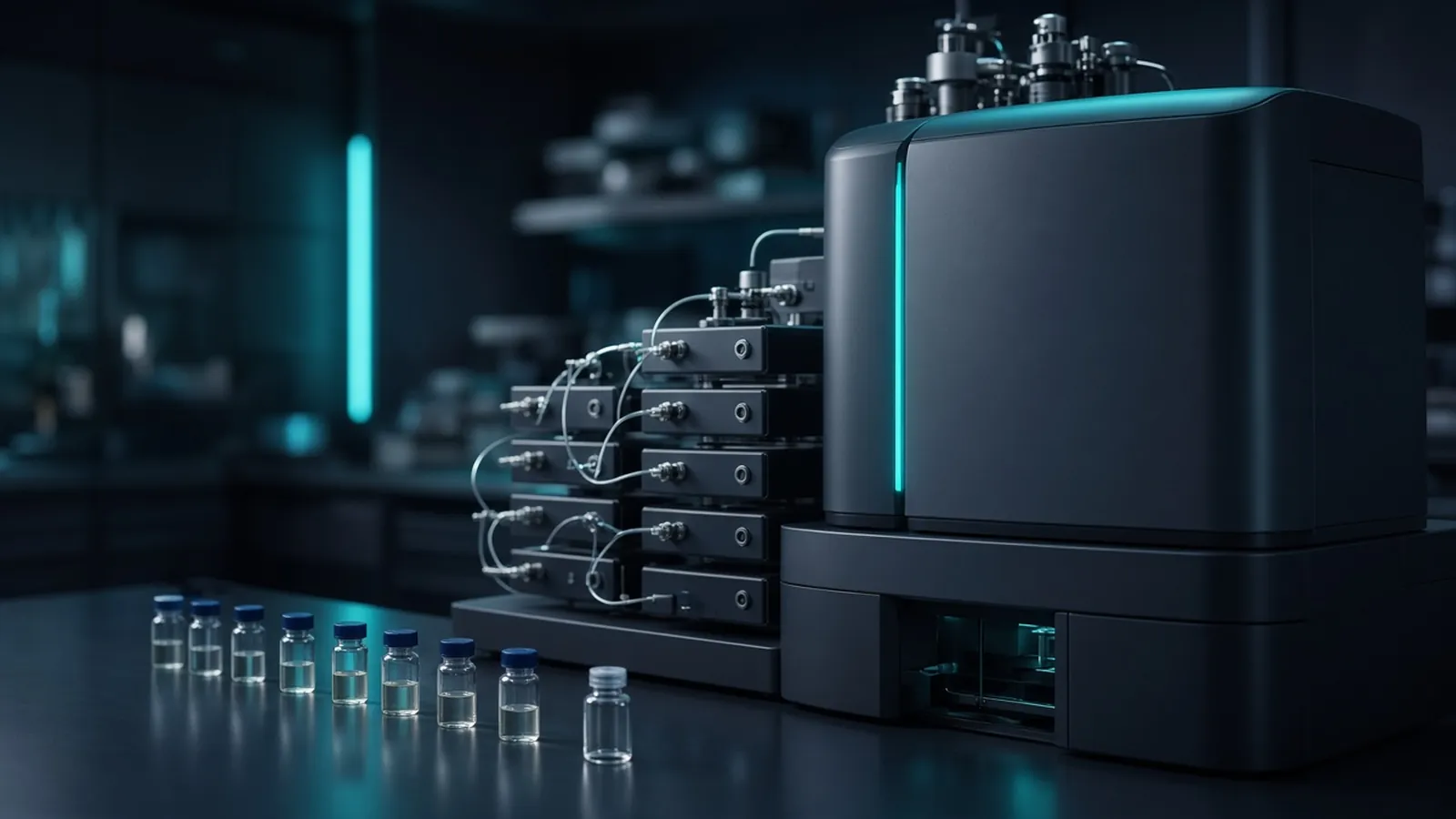
The mass spectrometer never sees the vial. It sees whatever the chromatography presents at the emitter, in the order the gradient releases it. Buying that chromatography is a specification problem: particle class, diameter, length, and whether the flow is nano, capillary or analytical. Bottom-up proteomics in plain language starts once fragments exist. This comparison is about the column and the plumbing in front of them. There is no single best column to name, and this page will not invent one or attach a price.
Why acidic C18 is the default
Reversed-phase C18 retains peptides mainly by hydrophobicity. At the start of the gradient the solvent is mostly water with a small amount of acid. Peptides stick. As acetonitrile rises, they leave in a rough order from more polar to more hydrophobic. The acid, commonly formic acid at a low level the method specifies, also helps electrospray by providing protons. Trifluoroacetic acid often gives sharper ultraviolet peaks and suppresses electrospray more strongly, which is why peptide mass spectrometry methods usually prefer formic acid even when a protein-chromatography habit prefers the other acid. Follow the method paired to the column. A tenth-of-a-percent planning figure is typical for formic acid. The bottle and the method file are the instruction.
Particle class belongs in the purchase. Fully porous particles and superficially porous particles differ in backpressure and efficiency. Pore size has to suit peptides rather than intact antibodies. A column sold for large proteins can disappoint on a tryptic digest, and the reverse is also true. Diameter and length set load, sensitivity and pressure. None of those dimensions edit the sequence of the protein. They edit how much of the digest you can see before peaks merge.
Affinity and ion exchange protein purification is a different chromatography, aimed at intact proteins before any digest. Do not copy an ion-exchange salt gradient from that world into the online peptide separation. The online separation that feeds electrospray is almost always reversed phase.
Trap-elute or direct injection
Trap-elute adds a short column and a valve. You load quickly, relative to nano flow, onto the trap. Hydrophilic salts wash to waste. The valve turns, and a gradient elutes peptides from the trap onto the analytical column and out through the emitter. The analytical column stays cleaner. The price is extra surfaces. A dirty trap, or a valve groove, remembers the previous sample and releases it as carryover. The trap's load capacity and the analytical column's load capacity are not the same number. Specify both.
Direct injection removes the trap. Plumbing is shorter, dead volume can be lower, and a fault is easier to see. Salts, detergents and particles meet the analytical column immediately. For a well-desalted standard, direct injection can be the cleaner specification. For a digest that is only mostly desalted, the trap is doing a job you will miss when the analytical column dies early.
Emitters are part of the chromatography even though they are also part of the ion source. A clogged emitter looks like a failed column: pressure up, spray unstable, identifications down. When you specify a system, say whether the emitter is separate or integrated, and what you will do when it blocks. That sentence saves a week of blaming the gradient.
Flow regime is a purchase, not a prestige
Nanoflow, often through columns of very small internal diameter, gives high sensitivity because the peptides elute in a small volume and the spray is efficient. It also clogs, it is slow to load unless a trap is used, and it punishes particles. Capillary flow sits in between. Analytical flow, through wider columns, uses more sample, tolerates dirt better, and is often easier to keep running. A facility that must inject hundreds of samples may prefer the robust regime. A facility chasing a scarce immunoprecipitation may need the sensitive one. Writing "nano" out of habit, when the instrument and the sample amount do not support it, buys downtime.
The instrument expects a flow. Sources, heaters and transfer lines are built around a regime. A specification that names a column the source cannot spray is a specification that cannot be run. Ask what the installed source accepts before you name a diameter.
Upstream fractionation is optional depth
Strong cation exchange, and high-pH reversed phase used offline, cut a digest into fractions that are each run on the online acidic C18. Concatenating non-adjacent high-pH fractions is a common way to spread peptides without running every fraction as its own long queue. This is how studies buy identifications when one gradient is not enough. It multiplies injections, multiplies carryover risk, and multiplies the chance that a batch effect lands inside the fraction set. Specify it when the question needs that depth. Do not specify it as a default accessory to every identification.
The online column remains C18 in ordinary designs. The offline step is not a replacement for it. protocols.io methods that show both steps are easier to read when they say which column is online. Copy the distinction.
Nanoflow and higher flow, side by side
| Nanoflow | Higher flow, capillary or analytical | |
|---|---|---|
| Sample use | Small peptide mass can be enough to see a signal | More peptide mass is typically required for a comparable signal |
| Robustness | Sensitive to particles, emitter clogs and small leaks | Generally more tolerant of dirty samples and long queues |
| Suitability | Scarce samples, when the source and the operator support the regime | Higher throughput and harsher matrices, when you can spend the sample |
| What to specify | Internal diameter, length, trap or direct, emitter style, expected backpressure | The same list, plus confirmation the source is built for that flow |
| What not to expect | That a nano specification repairs a detergent-filled digest | That a robust column reveals a complete proteome from one short run |
NIST measurement guidance is a reminder to specify the system that generated a number. A retention time without a column diameter and a gradient is not a transferable fact. Proteomics Standards Initiative formats exist so methods can be deposited with the files. Use that spirit in a purchase specification even when you are not depositing anything. HUPO community practice is the scientific context, not a brand preference.
When the plumbing choice is the failure
Carryover that tracks the valve, and disappears when the trap is replaced, is a trap-elute failure. A column that dies on the third dirty injection is a direct-injection failure, or a desalting failure upstream. Rising pressure at the emitter with a healthy column pressure trace is an emitter clog. Specify which pressure you will monitor so the diagnosis is possible.
A gradient that is too fast for the column length merges peptides and makes identification look like a search problem. Lengthen the useful gradient or accept a shallower proteome. A gradient that is very slow on a nano system without enough sample simply wastes time. Match time to the amount and the question.
Solvent quality belongs in the same purchase. Water and acetonitrile of a grade suited to mass spectrometry, and acid from a bottle reserved for that use, are part of the chromatography. A buffer habit carried over from gel tanks will fill the baseline with ions.
Safety and research use
Acetonitrile is flammable. Formic acid and any stronger acid used in related methods are corrosive. High-pressure fittings can spray solvent if a run is started with a blocked line. Follow the instrument training and the safety data sheet. The separation is a research method. It does not create a diagnostic device, and it does not change the biosafety decision that applied to the material before digestion. A nano source does not make a sample non-infectious.
Writing dimensions into a request that can be quoted
State particle class, internal diameter, length, and the flow regime the instrument expects. State trap-elute or direct injection. State how many injections, and whether the samples are cleaned standards or dirty biological digests. State whether offline fractionation is in scope. Ask the method discussion to confirm that the source can accept the flow, and to name a loading class consistent with the diameter. Leave brand and price out of the scientific sentence. Product lines change, and a column that is fashionable in a paper may be the wrong geometry for your source.
In a warm building, backpressure and retention drift when the column temperature is whatever the room happens to be. Specify a column temperature the oven can hold, and a maximum pressure you will not run past. That pair is more useful than a slogan about sensitivity.
What the quote request should carry
Flow regime, column dimensions, trap or direct, injection count, dirty versus clean samples, and whether depth fractionation is required. The protein identification by LC-MS/MS reference, the shotgun discovery proteomics reference and the differential abundance reference describe the studies this plumbing serves. Send the geometry with the quote request. A method can be discussed as a specification. The reply you want names a flow and a column class the installed source can actually run.
Questions from the bench
Why is C18 reversed phase the default before electrospray?
Peptides bind a hydrophobic C18 surface in mostly aqueous acid and release as the organic solvent, usually acetonitrile, rises. That spread in time is what lets the mass spectrometer fragment one small group of peptides after another. Other chemistries exist for special separations. For a general bottom-up mixture, C18 under acidic conditions is the comparison point a specification should start from.
What is the practical difference between trap-elute and direct injection?
Trap-elute loads the sample onto a short trap, sends salts to waste, then switches a valve so peptides elute onto the analytical column and the emitter. Direct injection sends the sample straight to the analytical column. The trap protects the analytical column and adds valve and trap surfaces that can carry over. Direct injection is simpler plumbing and puts dirt on the column you care about most.
Does a longer or narrower column change the biology?
It changes sensitivity, load, backpressure and how many peptides you resolve. It does not change which proteins were in the vial. A nano column can see less peptide mass and clogs more easily. A higher-flow column uses more sample and is often more robust. Choose for the instrument and the sample cleanliness, then keep the biological claim tied to the peptides, not to the hardware.
Where do ion exchange and high-pH fractionation fit?
They are optional upstream separations that cut a complex digest into fractions before the online C18 run. That is how a study buys depth. They are not a substitute for the column that feeds the electrospray, and they are not required for every identification. Specify them only when the question needs more depth than one online gradient can give.
References
Manufacturer names identify published method classes. Trademarks remain with their owners. Catalogue records on this site are independent references for enquiry. They are not a statement of inventory, distribution rights or a supply commitment. This page is educational. It is not medical advice, a diagnostic protocol or a biosafety approval.
Catalogue
Related products and categories
These links follow the subject of the article into published manufacturer references. A listing is a reference for an enquiry, not a statement of stock or distribution rights.
Continue in this cluster
Related reading
Bottom-up proteomics in plain languageBottom-up proteomics in plain language: proteins are digested to peptides, a mass spectrometer fragments them, and a database search names candidates. Affinity and ion-exchange protein purificationHow affinity capture and ion exchange pull a protein from a lysate, and why each collected fraction still needs an identity check.Injection amounts and column loadingToo little peptide yields sparse identifications. Too much broadens peaks, saturates the detector and carries into the next blank. Load follows the column, not