
application
Colony PCR versus diagnostic digest
When to triage colonies by PCR and when a miniprep digest is worth it, including false positives from agar DNA, orientation, and why neither is a sequence.
- Author
- EVRINTH Editorial Team
- Published
- 8 October 2026
- Updated
- 8 October 2026
- Reading time
- 8 min
Colony PCR and a diagnostic digest answer overlapping questions at different cost, and they stop at different places. Colony PCR asks whether a primer pair can amplify a fragment of the expected size from material you picked off a plate. A diagnostic digest asks whether plasmid DNA grown from that colony cuts into the pieces the map predicts. Use the first when you have many colonies and need a cheap triage. Use the second when you already need a miniprep, or when orientation depends on fragment lengths. Neither is a full sequence. How those candidates fit the path to an archived clone is in plasmid cloning from insert to colony. What an endpoint PCR band does and does not mean is in how polymerase chain reaction works.
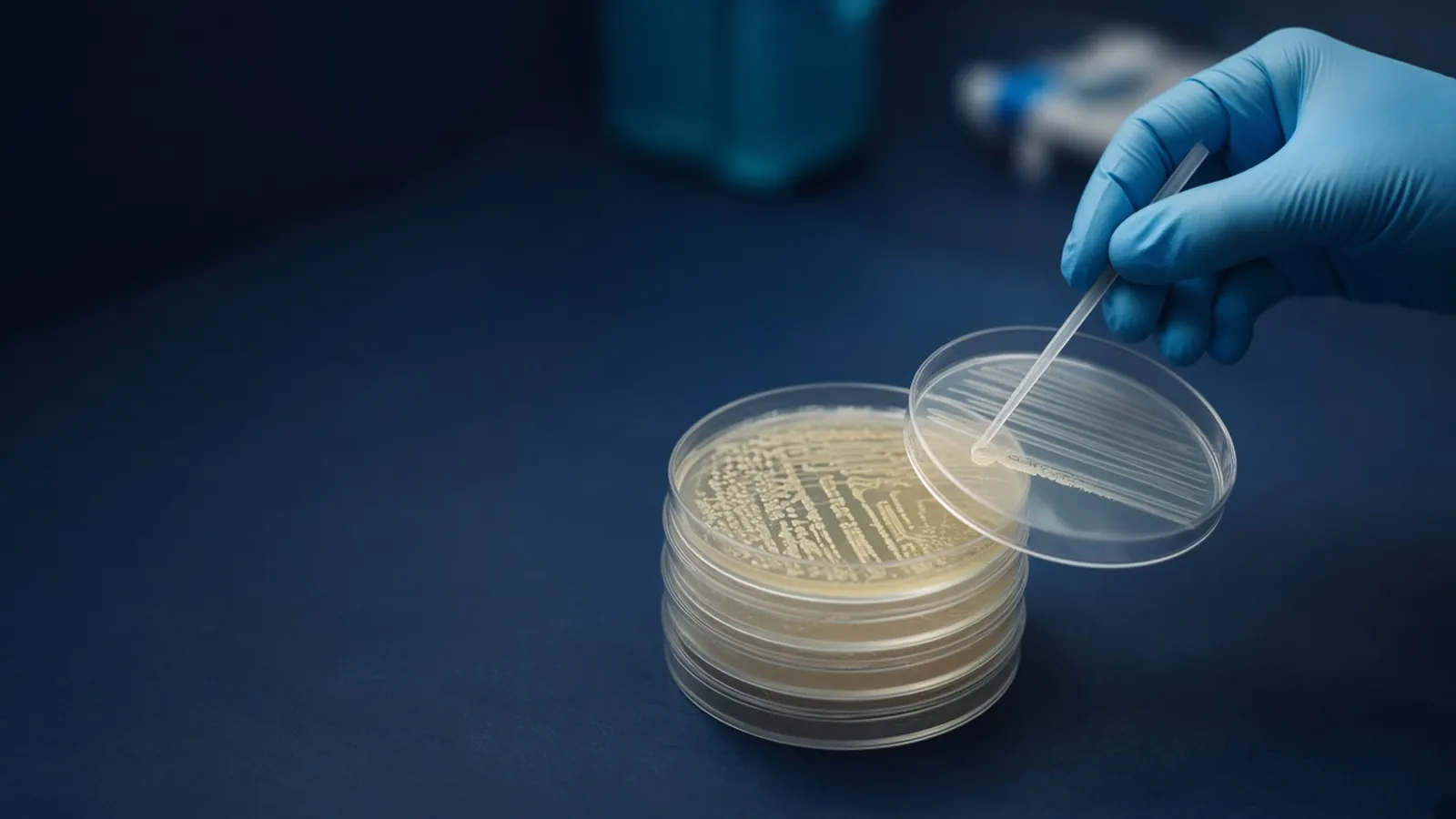
The photograph shows a gloved hand streaking an agar plate with a loop, beside a stack of plates. That streak is the right habit before either screen if the original colony was crowded. Primers, enzymes and miniprep reagents are sourcing questions for the molecular biology catalogue.
When the application is colony PCR
Reach for colony PCR when the plate has more colonies than you are willing to miniprep, and when empty vector is a likely guest. Eight to sixteen picks is a common planning range. The number is not magic. It is enough to see a pattern. If the first eight are all parent-sized, a ninth from the same ligation is less informative than repeating the join.
Design the primers for the claim. One primer on the vector and one in the insert reports a junction and, if the insert primer is directional, a hint of orientation. Two primers that flank the cloning site report size only, and they amplify empty vector as a shorter band you must actually resolve. Check the pair with NCBI Primer-BLAST against the map you intend, so you know what a successful length is. Addgene's PCR notes are a public reminder of controls. A no-template tube still belongs in the run. So does DNA from bare agar.
The speed is real. You can discard obvious misses before you grow cultures. The cost is false positives. Residual plasmid and ligation product sit on the agar surface after you spread the transformation. Touch that surface and the polymerase copies DNA that is not inside the colony. A neighbouring colony on a wet plate does the same through mixing. A band is then a property of the plate, not of the clone. Restreak a positive, repeat the PCR on the isolated colony, or go straight to a miniprep of that restreak. Do not archive the original pick on the strength of one band.
Stop the colony PCR when the bare-agar control produces the same band. Further picks will not become cleaner. Stop it when every colony matches empty vector. The ligation, not the screen, is what failed. Stop it when you have two or three candidates of the right size and you are about to miniprep them anyway.
When the application is a diagnostic digest
A diagnostic digest starts from a real miniprep: cells that replicated a plasmid, lysed, and gave you DNA you can cut. Residual ligation DNA from the original plate has been diluted by growth. That is the main reason the digest is slower and more trustworthy as a physical object. It costs an overnight culture, a prep, and a gel.
Choose enzymes from the recombinant map. A release digest, cutting on both sides of the insert, shows whether a fragment of the expected length is present. It does not show direction if the insert is a cassette with identical flanks. An asymmetric digest does. Put one site in the backbone and one site well off the midpoint of the insert, predict both orientations' fragment sizes, and let the gel choose. If the internal site sits in the middle, the two orientations look alike and you have asked the wrong question of a good enzyme.
Incomplete digests mimic missing inserts. Always include uncut miniprep in a neighbouring lane so supercoiled, linear and cut species are not confused. Star activity and a site that the host methylates will add or remove bands. Those are enzyme-card problems, not evidence that the colony PCR which you skipped would have been wiser. The Addgene restriction digest protocol and the gel electrophoresis protocol describe the public shape of this check. Follow the enzyme card for buffer and time.
Go straight to this screen when you have only a handful of colonies, when you already plan to sequence the miniprep, or when orientation is the actual question. Colony PCR that cannot see orientation, followed by a digest that can, is two afternoons. One digest is one.
Decide from the number of colonies
Count before you choose. A plate with no colonies is a transformation or ligation problem. Screening will not invent a band. A plate with a few isolated colonies is a miniprep problem: digest them all. A plate with dozens or hundreds, especially after a single-enzyme ligation, is a colony PCR problem, with a bare-agar control, followed by minipreps of the positives only. A plate that is a lawn is an antibiotic problem. Do not pick it.
If the question is insert orientation, bias toward the asymmetric digest or a junction primer that can amplify only one direction. A flanking colony PCR that gives the same size either way will send you to the digest later. Do that later step now if the colony count is small.
| Situation | Screen that matches | Stop when |
|---|---|---|
| Many colonies, empty vector likely | Colony PCR plus a bare-agar control | The blank amplifies, or the first set is all empty |
| Few colonies, DNA needed next anyway | Miniprep and diagnostic digest | The pattern matches, then sequence if the insert was copied by PCR |
| Direction is the claim | Asymmetric digest, or a junction PCR | Fragment sizes or the junction match one orientation |
| One pretty band and a precious clone | Either screen, then sequence | You are about to archive; size is no longer enough |
False confidence the two methods share
A colony PCR false positive from agar DNA and a digest of a mixed miniprep fail differently. The PCR lies by copying DNA that was never inside the cell. The digest tells the truth about whatever plasmids grew, including two plasmids in one colony. Double bands you cannot explain are a reason to restreak, not to average the sizes in your head. A deletion that removes fifty bases can hide inside a "right sized" PCR product and inside a digest whose fragments still look roughly correct next to a wide marker. Run the gel far enough to see the difference you claim, as any careful agarose practice requires.
Point mutations are invisible to both. If the insert was a PCR product, the screen's job is to choose which two colonies to sequence across the whole insert. One pretty band is a bad place to stop.
Safety
Colony PCR heats cells. A diagnostic digest does not make a preparation non-infectious if the host or the insert was hazardous to begin with. Follow your institution's rules for the strain. Ethidium bromide and alternative stains still need the safety data for the bottle in hand, and ultraviolet light is a hazard to eyes, skin and the DNA. This comparison is research screening. It is not a diagnostic identification.
Condensate on a stack of plates
The photograph's stack of plates is a normal sight, and in humid weather it is also a contamination path. Plates that come out of the cold sweat. Condensate drips from a lid onto neighbouring colonies, and a colony PCR of the smear becomes a mixture that looks like a double insert. Dry the lid, pick a single colony with a fresh tip, and do not rest that lid on the next plate down. If colonies already touch, streak them apart before you trust either screen. The digest will not sort out a pick that was three colonies.
What to ask for
Say how many colonies you expect, whether you need orientation or only size, the primer sequences or the enzyme names, and the fragment sizes on the map. If the insert itself is still a design, use the custom gene synthesis enquiry reference as an enquiry, not as a claim that a gene has been made. When the screen has chosen a DNA prep, the Sanger sequencing enquiry reference is the place to frame a read. It does not mean EVRINTH runs sequencing. Send the reagent side of the screen through the quote request and ask whether a quotation is possible.
Questions from the bench
Why can a colony that has no plasmid still give a PCR band?
The transformation spread ligation DNA across the agar. A polymerase reaction will copy that residual DNA if your pick touches it, even when the living cell never took up the plasmid. Satellites and empty cells can look positive. Include a pick from bare agar on the same plate. If that blank amplifies, the colony bands are not evidence about the cells.
Does a diagnostic digest show orientation?
It does when the cut sites are asymmetric. An enzyme that cuts once in the backbone and once off-centre in the insert produces different fragment lengths for the two directions. A pair of enzymes that only flank the insert shows whether a piece of about the right size is present. That pattern looks the same if the piece is backward. Choose the enzyme for the question you are asking.
I have six colonies. Should I bother with colony PCR?
Usually no. Six minipreps and a digest finish the screen in the time you would spend optimising a colony PCR and then miniprepping the positives anyway. Colony PCR earns its place when there are many colonies and you expect a high empty-vector background. Match the method to the count, not to habit.
Can either method replace sequencing the insert?
No. Both report size, and a well-chosen digest or junction PCR can report direction. A point mutation from PCR cloning, a one-base frameshift at a junction, and a small deletion between the primers survive both screens. Sequence the insert when it was amplified or when the clone will be trusted. Use the screen to decide which DNA to send.
References
Manufacturer names identify published method classes. Trademarks remain with their owners. Catalogue records on this site are independent references for enquiry. They are not a statement of inventory, distribution rights or a supply commitment. This page is educational. It is not medical advice, a diagnostic protocol or a biosafety approval.
Catalogue
Related products and categories
These links follow the subject of the article into published manufacturer references. A listing is a reference for an enquiry, not a statement of stock or distribution rights.
Continue in this cluster
Related reading
 Plasmid cloning from insert to colonyHow an insert becomes a plasmid, a colony and a verified clone, and which checkpoint fails when the plate is empty or the insert is wrong.A glossary of cloning termsRead a cloning plan and mark vector, insert, MCS, ends, ligase, phosphatase, transformation, and clone against the map before you mix a tube.Antibiotic selection is not proof of an insertWhat selection, marker, satellite and clone mean on an antibiotic plate, and why a colony can grow with no insert, the wrong insert or only a parent vector.