
explainer
Comparing chemical and electrocompetent cells
Chemical competence uses salt and a heat shock. Electrocompetence uses a low-salt cell and a pulse. The DNA cleanup has to match the method you chose.
- Author
- EVRINTH Editorial Team
- Published
- 8 October 2026
- Updated
- 8 October 2026
- Reading time
- 9 min
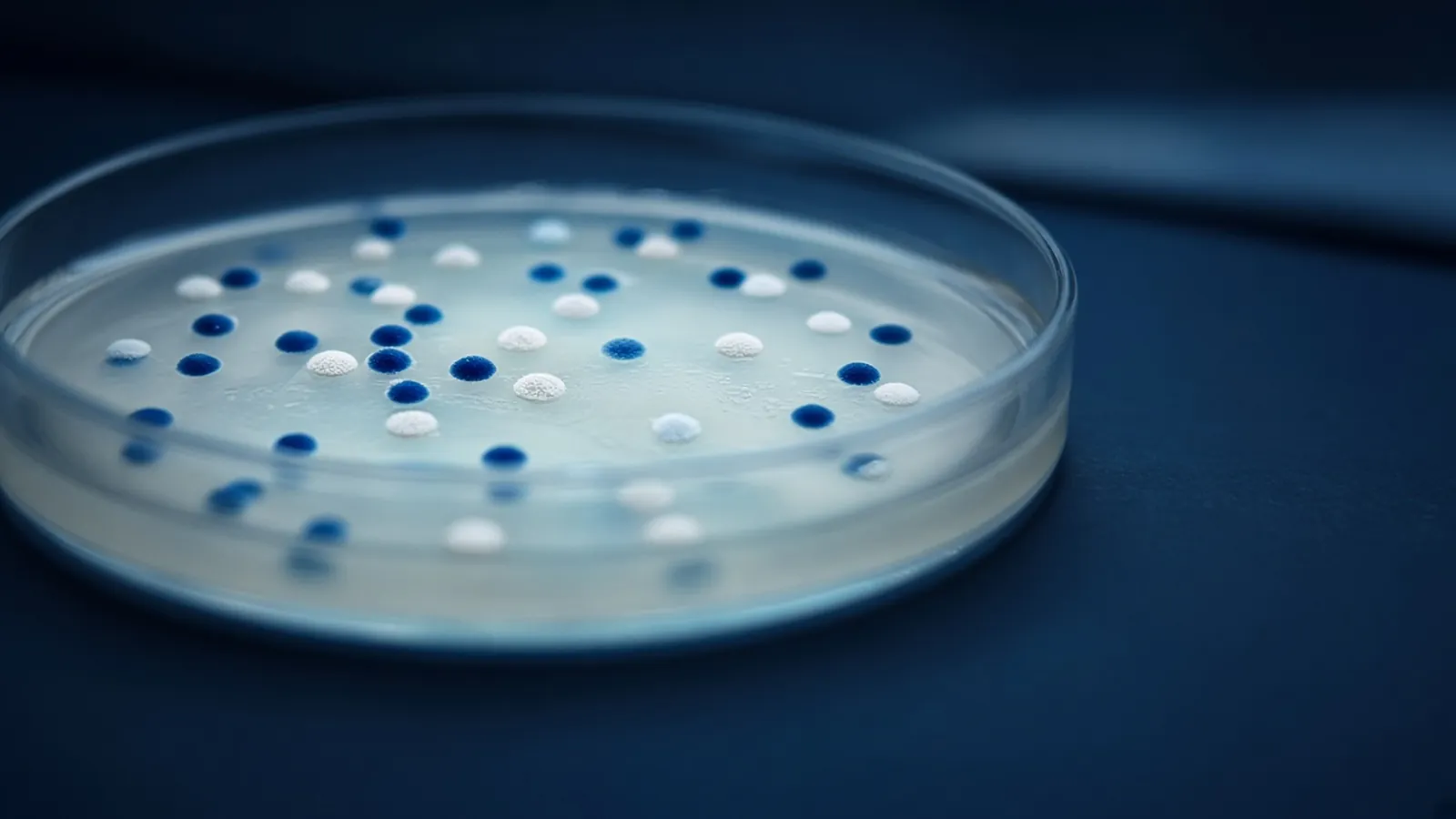
The plate in the hero photograph, blue and white colonies on a screening dish, is where both competence methods hope to arrive. It does not tell you which method can get a given DNA there. Chemical competence is a salt-and-heat-shock class. Electrocompetence is a washed, low-salt cell and a brief electrical pulse. The decision is which class matches the DNA you actually have, and which mistakes each class punishes. The shared culture steps, the recovery, and the antibiotic plate are in bacterial culture and transformation. How an insert becomes a candidate colony after that plate exists is plasmid cloning from insert to colony.
Cell and reagent classes can be named from the reagents and chemicals catalogue. The surrounding path is the molecular biology pathway. If the construct is still a design, custom gene synthesis is an enquiry reference, not a statement that DNA is already being made. A specification for the cell class goes through the quote request.
Two ways of making a membrane admit a plasmid
A working picture of chemical competence, the one the method is built on, is that cold cells in a divalent-cation buffer, often a calcium chloride class, sometimes with other salts or with additives the manufacturer lists, have their envelope prepared so a short heat shock lets plasmid DNA in. The heat shock used with many commercial preparations is a brief step near 42 Celsius. The time and the exact temperature belong to the preparation in your freezer. Copying a number from a paper that used a different preparation is how viability collapses. After the shock the cells go back on ice, then into rich broth with no antibiotic, for long enough that the resistance protein can be made before the drug is encountered.
Electrocompetence starts from the opposite ionic condition. Cells are washed in cold water or a very low-salt buffer until the suspending medium barely conducts. They are mixed with DNA that is itself in water, placed between the electrodes of a cuvette, and given a short high-voltage pulse. The field is what the method uses to drive DNA across the envelope. Immediate recovery medium then dilutes and feeds the cells. Settings, including the voltage class for a given cuvette gap, belong to the instrument and the cell sheet. This explainer will not print a pulse table to copy.
Efficiency is a lot property, usually discussed as colonies from a stated mass of a standard supercoiled plasmid. Electrocompetent lots are often chosen when that class must be high: large plasmids, which transform less readily, and library ligations, where the molecule you want is rare. A routine retransformation of a pure plasmid often succeeds with chemical cells and a simpler setup. The lot sheet wins every argument about the number. Public shapes of both workflows are collected in the Addgene bacterial transformation protocol and among Promega protocols.
What each tube is allowed to contain
Chemical cells expect salt. Their buffer is salty. A small volume of a typical ligation can be added, and many ligations are transformed this way without a cleanup, up to the volume where the ligation chemistry starts to inhibit colony formation. The manufacturer's ceiling on DNA volume is the ceiling. More DNA is not more kindness.
Electrocompetent cells are ruined by the ions a ligation buffer was designed to provide. Salt lowers resistance. The pulse, instead of a controlled field, becomes an arc: a pop, a flash, a dead time constant on instruments that report one, and cells that do not recover. Tris-EDTA storage buffer is already saltier than these cells want. A "few microlitres" of an uncleaned ligation can be enough. Polymers used in some assembly mixes do not rescue the ionic problem. The cleanup that matches this method is DNA in water or in a buffer the cell sheet names as low conductivity, at a volume the sheet allows.
Air bubbles in the cuvette gap and a cuvette that is warm or wet on the outside are mechanical ways to spoil a pulse that the DNA itself did not spoil. Reused cuvettes that were not cleaned and dried as the manufacturer allows carry the salts of the previous sample. Chemical tubes have their own mechanical failures: a heat block that was never at temperature, a water bath that was, and a timer that became a conversation.
The Addgene molecular biology reference is a public place to see ligations and transformations discussed as classes. Method repositories such as protocols.io show how laboratories record their own sheets. The sheet shipped with the cells remains the one you run.
When the control plasmid and the new DNA disagree
Plate a known intact plasmid beside the new DNA, and plate cells with no DNA, on the same antibiotic batch. Read the pair as a method check, not as a hunt through every upstream enzyme.
If the known plasmid and the new DNA both fail, and the no-DNA plate is clear, the cells, the heat block, the cuvette or the recovery are the common cause. An arc on the electroporator is a finding you can write down. A chemical tube that sat thawed in a rack while plates were labelled is a finding too. Thaw on ice, in a deep pan, and start the protocol clock.
If the known plasmid in water gives colonies and the ligation arcs or gives none, the salt and the volume are the difference. Clean the ligation or switch that sample to chemical cells that the salt does not forbid. If the known plasmid fails only when you add a mock ligation buffer, you have demonstrated the ionic problem without spending the real DNA.
If the no-DNA plate grows, stop comparing competence methods. The plates are not selective, and neither cell class can be judged. That branch belongs to the antibiotic and the pour, not to the pulse.
Recovery is shared and non-negotiable in both methods. Plating immediately onto drug, before the resistance protein exists, produces an empty plate from cells that did take up DNA. The recovery time is the one the cell sheet names. Rich broth, no antibiotic, then a measured plating.
Method, DNA, and the thing that ruins it
| Chemical competence | Electroporation | |
|---|---|---|
| Method class | Divalent-cation buffer and a brief heat shock, then ice and a recovery | Washed low-salt cells and a short high-voltage pulse, then immediate recovery |
| DNA it suits | Routine plasmids and many ligations still in their buffer, within the volume the sheet allows | Large plasmids and rare library products, already in water or a very low-salt buffer |
| What ruins it | A warm thaw, a heat block off temperature, skipped recovery, detergent residue, the wrong drug | Salt from ligation or tris-EDTA, too large a salty volume, an arc, bubbles, a warm cuvette |
| What the plate photograph shows | A downstream colony screen, if the vector offers one | The same downstream screen. The pulse already succeeded or failed |
Handling that is shared, and handling that is not
Both classes are frozen reagents. Thaw them on ice and use them the day the sheet allows. Refreezing a thawed aliquot is a different, usually worse, reagent. Both need a recovery without antibiotic. Both are judged with a no-DNA plate and a known plasmid. Both fail if the antibiotic does not match the marker.
They part company on the DNA cleanup and on the physical tool. Chemical work needs a heat source you have checked that morning. Electroporation needs cuvettes of the gap the programme expects, a pulser someone has maintained, and DNA whose ionic strength you can defend. A library ligation cleaned into water is a different sample from the same ligation scooped from its buffer. Write which one you have on the tube before you book the machine.
Detergent left in a "clean" tube lyses either kind of cell. Autoclaved water that was actually tris buffer will arc. Labels are part of the method.
Research-use limits
These are non-pathogenic cloning strains under the institutional assessment you already have. Nothing here is a method for introducing DNA into a pathogen or into a strain the committee has not seen. Voltages and heat are hazards to the operator as well as variables in a protocol. Follow the instrument training. This page is not medical advice and not a pulse programme.
Ice in a hot room
A shallow ice pan in a room that is already hot becomes water while you label plates. Chemical cells lose competence as they warm. Electrocompetent cells, low in salt and high in density, are often the first to die in that wait. Keep the ice deep, the tubes buried, and the cuvettes cold for the interval the sheet allows. A shipment that arrives thawed is not the lot whose efficiency was printed. In an enquiry, state frozen storage, the shipping temperature class, and that electroporation DNA will be supplied in water if that is the method. A warm courier handoff should be visible in the packaging specification, not discovered when the arc is the first result.
What the enquiry should name
Name the strain genotype, chemical or electrocompetent, the storage class, and whether you need the higher efficiency class because the plasmid is large or the ligation is a library. Ask for the lot specification of efficiency and for the DNA buffer the cells expect. The method can be discussed against that sheet. Send the note through the quote request. Upstream assembly choices that decide how salty the DNA will be can be lined up with the molecular biology pathway, and any sequence that still has to be designed stays on the custom gene synthesis reference as a question, not as a run in progress.
Questions from the bench
Which method suits a large plasmid or a library ligation?
Electroporation is often chosen for those jobs because the efficiency class of a well-washed electrocompetent lot is higher, so rare molecules are more likely to produce a colony. The number on the lot sheet is the number that counts, and this article will not invent one. The DNA still has to be in water or a very low-salt buffer or the pulse arcs.
Why does a ligation buffer that helped the enzyme ruin the cuvette?
Ligation buffers are salty on purpose, and some assembly mixes carry polymers as well. Those ions lower the resistance of an electroporation mix, the current spikes, and the arc kills the cells. The same microlitres can be a modest, acceptable addition in a chemical transformation that was built around salt. Clean the DNA, or choose the chemical method, before you blame the strain.
Does the photograph of blue and white colonies tell the two methods apart?
No. The hero image is a screening plate, which is a downstream readout either method can feed. Colour reports alpha-complementation after a colony exists. It does not report whether the DNA entered by a heat shock or by a pulse. Choose the method from the DNA's salt and from the efficiency class you need.
How cold is cold enough to write into an enquiry?
State a frozen storage class and a shipping temperature class, and say the cells must still be frozen on arrival. Chemical and electrocompetent lots are both harmed by a warm thaw, and electrocompetent cells are usually the less forgiving of a wait on a shallow ice pan. Ask for the lot specification rather than a slogan about hardiness.
References
Manufacturer names identify published method classes. Trademarks remain with their owners. Catalogue records on this site are independent references for enquiry. They are not a statement of inventory, distribution rights or a supply commitment. This page is educational. It is not medical advice, a diagnostic protocol or a biosafety approval.
Catalogue
Related products and categories
These links follow the subject of the article into published manufacturer references. A listing is a reference for an enquiry, not a statement of stock or distribution rights.
Continue in this cluster
Related reading
 Bacterial culture and transformationHow non-pathogenic E. coli cloning strains are grown and how plasmid DNA is introduced, with the controls that make a colony meaningful.
 Plasmid cloning from insert to colonyHow an insert becomes a plasmid, a colony and a verified clone, and which checkpoint fails when the plate is empty or the insert is wrong.A glossary of bench microbiology termsPlain definitions of colony, lawn, streak, pellet, transformant and the other bench words a cloning afternoon depends on.