
selection guide
Competent cells and transformation controls
How to choose chemical competence or electroporation, and which plates report efficiency, no-DNA background and a ligation that had no insert.
- Author
- EVRINTH Editorial Team
- Published
- 8 October 2026
- Updated
- 8 October 2026
- Reading time
- 8 min

Competent cells are E. coli prepared to take up plasmid DNA. The preparation is either a chemical treatment, usually a calcium-class wash plus a heat shock, or electroporation, a high-voltage pulse across cells washed nearly free of salt. Choosing between them, and plating the controls that make the choice readable, is the decision this page supports. How a cloning strain is grown in the first place is in bacterial culture and transformation. What you do with a colony you trust is in plasmid cloning from insert to colony.
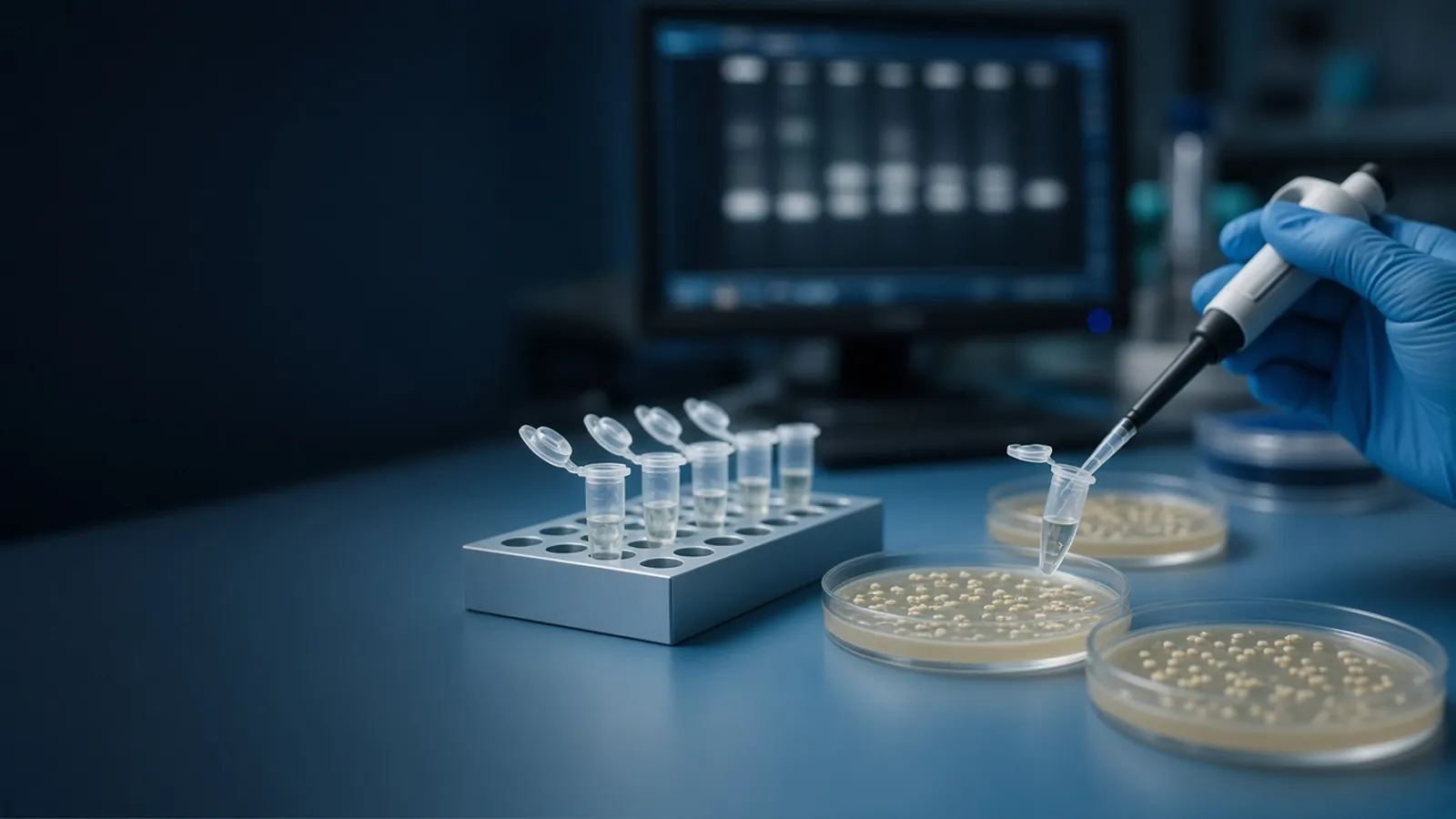
The photograph at the top is a Petri dish with blue and white bacterial colonies. It does not show a person. Blue and white are a colour screen, not proof that your cells, your drug or your ligation worked. Read the controls below before you read the colour.
Cell classes and related reagents can be specified from the molecular biology catalogue. Ratings on a label are colonies per microgram of a stated control plasmid. They are a class of performance to shop against, not a promise about your ligation.
Criteria you can apply before the cells thaw
Choose chemical competence when the DNA is a standard ligation or assembly in a salty buffer, the plasmid is an ordinary cloning size, and you need enough colonies to screen rather than a library. The method tolerates a small volume of ligation buffer because the cells are not waiting for a high-voltage pulse. It asks you for ice, a timed heat shock, and a recovery step without antibiotic.
Choose electroporation when the DNA is clean and low-salt, you have cuvettes and a pulser, and you need more colonies from less DNA. Large plasmids and rare assemblies are the usual reasons. The method fails closed when salt travels with the DNA: the pulse arcs, the cuvette cracks or pops, and that aliquot of cells is dead. Desalt, or dilute only within the limit the cell instructions allow. A Gibson mix or a ligation dropped straight into an electroporation cuvette is a salt problem until you have removed the salt.
Match the strain to the plasmid. A cloning strain used to build a T7 construct is not automatically an expression strain. Resistance already on the chromosome makes the antibiotic plate meaningless. Read the genotype before you buy a high-efficiency lot of the wrong host.
The three controls, and the number they are allowed to be
Plate a known circular plasmid of known mass on the same antibiotic, using the same cells and the same heat shock or pulse. Count colonies, correct for how much of the transformation you plated, and divide by the micrograms you added. That quotient is efficiency. It belongs to the control plasmid. Write the mass down at the time. A guessed mass is not a denominator.
Plate cells with no DNA on the same antibiotic. The plate should be empty at the density you can inspect. Colonies here cancel the other plates. They mean the drug never held, the cells were contaminated with a resistant strain, or you plated the wrong antibiotic for this marker.
Ligate or assemble the vector without insert, and transform that reaction in parallel with the real one. The colony count is self-ligation or self-assembly background. Your real plate means something only when it is clearly richer than this control, or when a later screen shows the insert in spite of a modest background. A no-insert plate as full as the test plate means you are about to screen parent vector. Stop and fix the join.
Recovery broth must not contain the antibiotic. The marker has to be expressed before the drug is fair. Then spread on selective agar. Plating the entire recovery onto one dish can exhaust the drug or produce a lawn of satellites on ampicillin. Plate a defined fraction so the controls are countable.
The Addgene bacterial transformation protocol shows how public notes lay out these controls. Times and voltages stay with the cells you thawed. protocols.io is a place those variants get written down. Neither is your pulse setting.
| Control | What you plate | A usable result | If it fails |
|---|---|---|---|
| Known plasmid | A stated mass of circular control DNA | Colonies per microgram you can calculate | Blame cells, heat shock or pulse, or the plates, before the ligation |
| No DNA | Cells and buffer only, same drug | No colonies | The antibiotic or the strain is not selective; discard the set |
| Ligation without insert | Vector joined in the absence of insert | Far fewer colonies than the plus-insert plate | Self-closure dominates; fix the join, do not screen harder |
| Plus insert | The real reaction | Candidates, richer than the no-insert plate or confirmed by a screen | Empty, with a live control plasmid, points at the DNA join |
Heat shock timing and warm plates
Chemical competence depends on a cold incubation and a short heat pulse. Many laboratory strains are shocked near 42 Celsius. The number of seconds is a property of that cell protocol. Thirty seconds, forty-five seconds and longer pulses are all in use on different lots. Transfer the tubes when the bath is actually at the set point, start the clock then, and return them to ice as the protocol says. A pulse that runs long because the tubes were forgotten does not become a better efficiency. A bath that never reached the set point is a different reaction. Record the seconds you truly used.
Plates should be warm and dry enough that a 50 to 100 microlitre spread soaks in instead of beading. Cold plates from a refrigerator cut the colony count of the control plasmid and of the ligation together, which looks like incompetent cells. Wet plates smear colonies into one another so the no-DNA sector is no longer a clean control. Warm the plates at the incubation temperature with the lid handled so condensation does not drip back, and do not add a heat-labile antibiotic until the agar itself has cooled below the point that damages the drug.
Electroporation has its own timing. The pulse is milliseconds, set on the instrument for that cuvette gap. Recovery is still required before antibiotic. An arc is not a low-efficiency transformation you should plate anyway. Discard the arced cuvette, desalt the DNA, and repeat. Salt is what you are removing. More DNA in ligation buffer makes the arc more likely, not less.
How to reason when the plate is empty or carpeted
If the known plasmid gave no colonies, stop. The ligation cannot be interpreted. Check the antibiotic identity against the marker, the heat-shock clock, the expiry and storage of the cells, and whether the plates were cold. If the known plasmid grew and both ligations did not, the cells are fine and the join is not. If the no-DNA plate grew, none of the counts are efficiencies. If only the plus-insert plate grew, you still have candidates, not confirmed clones. Colony screening and insert orientation come after this gate. They do not replace it.
A carpet of growth is a lawn. It means selection did not happen. Do not pick "colonies" out of a lawn and call them transformants.
Safety
Treat the strain as your biosafety rules already classified it. The WHO Laboratory biosafety manual, 4th edition is background reading, not permission to choose a containment level. Non-pathogenic K-12 cloning strains are the context of this page. An insert that encodes a hazard does not become safe because the cells were competent. This is research practice, not a clinical susceptibility test.
Heat, ice and wet agar
In a hot room an ice bath becomes water while you label tubes, and a shallow beaker used as a 42 degree bath can run hotter than the thermometer at the edge. Hold competent cells on ice that still contains ice, and check the heat-shock bath in the liquid the tubes occupy, not in the air above it. On a humid day, agar poured and left covered sweats. Condensation on the lid drips across the no-DNA sector and drags cells with it. Dry the plates and the lids before you spread. Those two checks decide whether a poor colony count is the DNA or the room.
What to put in an enquiry
State chemical competence or electroporation, the strain genotype, the antibiotic marker, the approximate plasmid size, and whether the DNA will be a salty ligation or a desalted sample. Ask for the control-plasmid rating as a class, then plan to measure your own. A construct someone else will build can be discussed through the custom gene synthesis enquiry reference. A later sequence check can be framed with the Sanger sequencing enquiry reference. Neither page means EVRINTH makes the cells competent, synthesises the gene or runs sequencing. Send the requirement with the quote request and ask whether a quotation is possible.
Questions from the bench
Can I report my ligation's colony count as transformation efficiency?
No. Transformation efficiency is colonies per microgram of a control plasmid whose mass you know, corrected for the fraction of the mixture you plated. A ligation is a different molecule, often a mixture of circles and linear DNA at an unknown concentration. Use the control plasmid for the efficiency number. Use the ligation plates only to compare plus-insert, no-insert and no-DNA.
The no-DNA plate has colonies. What can I conclude about the ligation?
Nothing about the insert. Colonies without DNA mean the antibiotic was inactive, the strain was already resistant, or cells from an earlier experiment reached the plate. Discard the interpretation of every plate poured from that batch. Remake the agar with antibiotic added only after the medium has cooled, and confirm the host genotype does not already carry the marker.
When should I stop using chemical cells and switch to electroporation?
Switch when you need many colonies from a small amount of clean DNA, such as a rare assembly or a large plasmid, and you can desalt the sample. Stay with chemical competence when the DNA is a routine ligation in ligase buffer and the cells are rated for that job. Salt in a ligation buffer causes an arc in an electroporation cuvette. Do not move a salty ligation onto electrocompetent cells without a cleanup the cell instructions allow.
Does a white colony on the photograph's style of plate prove the control worked?
The photograph on this page is a Petri dish of blue and white colonies. Colour is a separate screen that needs the right vector and the right host. It is not the efficiency control, the no-DNA control or the no-insert ligation. A white colony can still be empty vector or a satellite. Count the control plates before you read colour, and treat colour as a hint that still needs an insert test.
References
Manufacturer names identify published method classes. Trademarks remain with their owners. Catalogue records on this site are independent references for enquiry. They are not a statement of inventory, distribution rights or a supply commitment. This page is educational. It is not medical advice, a diagnostic protocol or a biosafety approval.
Catalogue
Related products and categories
These links follow the subject of the article into published manufacturer references. A listing is a reference for an enquiry, not a statement of stock or distribution rights.
Continue in this cluster
Related reading
 Plasmid cloning from insert to colonyHow an insert becomes a plasmid, a colony and a verified clone, and which checkpoint fails when the plate is empty or the insert is wrong.A glossary of cloning termsRead a cloning plan and mark vector, insert, MCS, ends, ligase, phosphatase, transformation, and clone against the map before you mix a tube.Antibiotic selection is not proof of an insertWhat selection, marker, satellite and clone mean on an antibiotic plate, and why a colony can grow with no insert, the wrong insert or only a parent vector.