
troubleshooting
Endpoint PCR compared with qPCR
Trace the failure when endpoint band brightness is treated as a quantity, or a qPCR Cq is used with no standard and no reference-gene plan.
- Author
- EVRINTH Editorial Team
- Published
- 8 October 2026
- Updated
- 8 October 2026
- Reading time
- 8 min
The failure this page traces is a number taken from the wrong assay. Endpoint brightness is a picture of a reaction that has usually already plateaued. A qPCR Cq is a cycle number on a fluorescence curve. Using the first as a quantity, or using the second with no standard curve and no reference-gene plan, produces a result the experiment did not measure. The troubleshooting path is to name which of those two mistakes you made, then to rebuild the assay so the sentence matches the chemistry. The shared cycle is described in how polymerase chain reaction works. If the sentence was a fold change in a transcript, the plan for reference genes lives in RT-qPCR for relative expression.
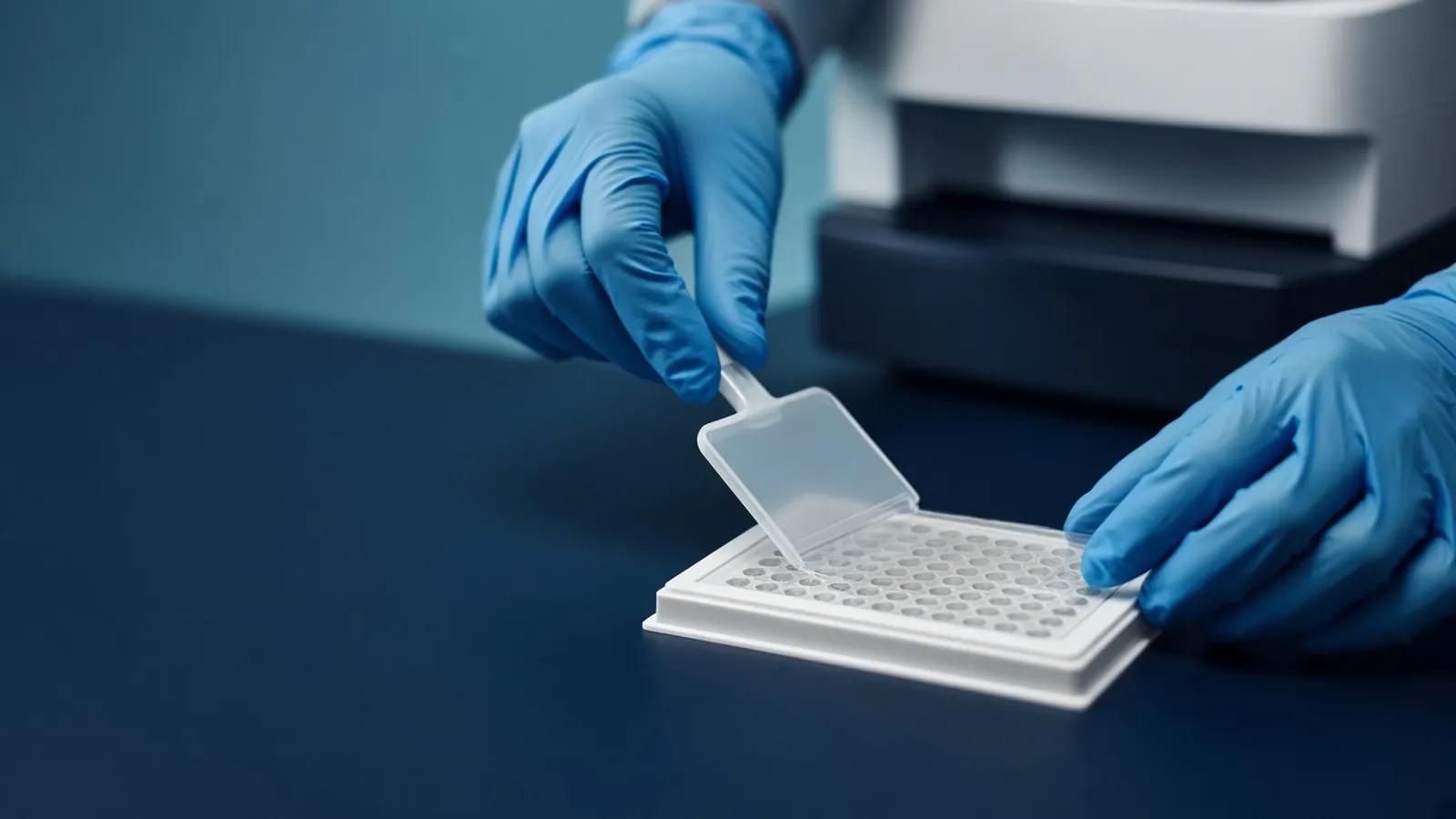
The photograph shows gloved hands sealing a white qPCR plate with optical film. That film is the readout window for a real-time run. An endpoint reaction often never sees it. It goes to a gel. Reagents for either path start at the molecular biology catalogue and the quote request.
Symptom first
You have a gel, and the sample you care about is brighter than the control, and someone has written a fold change next to the image. That is the endpoint mistake. Or you have a spreadsheet of Cq values, and someone has subtracted them and called the difference a biological ratio, without a standard curve and without a reference transcript whose stability you checked. That is the qPCR mistake. Both can sit in the same project. Fix them separately.
A third symptom is language. People say the qPCR "band" or the endpoint "Cq". A Cq is not a band. A band is not a Cq. If the notebook uses one word for both, the analysis has already mixed a size assay with a cycle assay.
What endpoint brightness is actually showing
Endpoint PCR copies the region between two primers until you stop the cycler, then you look at the DNA. Late cycles often sit on a plateau: product stops doubling because primers, dNTPs or active polymerase run short, or because the product strands anneal to each other. A tube that started with a little template and a tube that started with a lot can arrive at similar product levels if both had enough cycles. The gel then adds loading volume, stain and photograph exposure. A bright band supports presence and a size that matches the marker. It does not support "three times as much starting DNA".
Use endpoint PCR when that limited claim is the one you need: a yes, a size, a fragment to clone, a template to sequence. Keep a no-template control and read it first. Keep a marker. If the band will be trusted as a particular sequence, sequence it or cut it. Do not squeeze a quantity out of the pixel values.
If you already published brightness as a quantity, the repair is to stop and rerun with a method that measures during exponential growth, or to rewrite the claim as presence and size. There is no honest conversion factor from a plateau gel to a starting copy number.
What a Cq is, and what it still needs
qPCR watches fluorescence each cycle. The Cq is the cycle where the signal crosses a threshold. Earlier crossing, under comparable efficiency and the same threshold rule, means more starting target. Instruments also say Ct or Cp for the same idea. The number moves if you move the threshold, change the master mix, or change how much material you added. A Cq copied from a paper is not a concentration in your laboratory.
Two plans make a Cq into a quantity. A standard curve of known amounts turns Cq into an estimate of copy number or of mass, if the standard is the same chemical class as the unknown and the efficiencies match closely enough for the model you stated. A reference-gene plan, for expression work, compares the target with transcripts you have shown are stable across the conditions, and it still needs an efficiency check. The relative-expression article walks through that second plan. A raw Cq, alone, is neither plan. It is an instrument event.
A melt curve, used with dyes that bind double-stranded DNA, plots the loss of fluorescence as the product is heated. One peak suggests one dominant duplex. It is not a sequence. Two different products can share a melting temperature. A primer-dimer often melts lower, which is useful, and a clean peak can still be the wrong amplicon of a similar length and composition. Probe-based assays add a sequence-specific oligo and often skip the melt. They still do not replace a sequencing read when the claim is the exact base order.
A no-template control belongs on the qPCR plate as it does on a gel. Amplification in that well means the Cq values on the plate are not interpretable. A melt peak in the blank is a primer artefact until you show otherwise.
A path through the two failures
Start by writing the sentence you want. If it contains a fold change, a copy number, or "more than", endpoint brightness cannot carry it. Move to qPCR and choose standard curve or reference genes before you pipette. If the sentence is "the fragment is present at this size", qPCR is optional machinery. An endpoint gel with a marker and a clean no-template control is enough, and a Cq would not have given you the size.
If you are already holding qPCR data with no standard and no reference plan, do not compute a ratio to make the figure look finished. Either add the missing plan on a new run, or report the Cq values as uncalibrated cycle numbers with the threshold rule written beside them. Uncalibrated cycle numbers are a troubleshooting clue. They are a weak final result.
If a melt curve is the only identity evidence, and the claim needs sequence, send the product to sequencing after cleanup. Do not let a single peak close that question.
| What you see | The mistake | The repair |
|---|---|---|
| Fold change written on a gel image | Endpoint brightness used as a quantity | Rewrite as presence and size, or rerun during exponential growth |
| Similar band intensities, very different inputs | Plateau has compressed the range | Stop adding cycles to "bring up" the faint lane and calling that a ratio |
| A table of Cq with no standard and no reference gene | An instrument event reported as biology | Add a standard curve, or a reference-gene plan you have checked |
| "The qPCR band" in the notebook | A Cq treated as a gel result | Report cycle, threshold and assay chemistry, and run a gel only if you need size |
| One melt peak called a sequence | A dissociation curve treated as base order | Sequence, or cut with a diagnostic enzyme, when identity matters |
| Blank well amplifies | Contamination or primer-dimer read as data | Stop. The sample Cq values on that plate are not interpretable |
Adjacent failures that imitate these two
A dirty no-template well makes both assays fail, and the repair is contamination control, not a new calculation. Inhibition makes a qPCR Cq later or absent and can blank an endpoint lane. Dilute or spike before you call that sample low or negative. Poor optical film, the object in the photograph, can invent noisy qPCR curves. A wrinkled seal is an instrument problem. It is not a low-expression result.
Annealing still depends on primers, salt and magnesium. A Ta that worked in an endpoint mix can fail in a real-time mix that contains a different dye or a different magnesium. Re-find the window when you change chemistry. Hot-start reduces extension during the long setup a 96-well plate requires. It does not turn a Cq into a calibrated quantity.
Safety and claims
Hot blocks, optical instruments and stains remain ordinary hazards. A research qPCR ratio is not a clinical measurement. Nothing in the troubleshooting path validates a diagnostic test. If the original mistake was a clinical-sounding fold change from a teaching gel, the repair includes deleting that claim.
What to put in an enquiry
Say which failure you are leaving behind. Either you need an endpoint enzyme and a gel-compatible mix for presence and size, or you need a real-time mix, optical plastic, and a plan that is standard-curve or reference-gene. Give amplicon length, template matrix, hot-start, and the control set. The nucleic acid analysis pathway is the surrounding workflow. For several targets in one well, the multiplex PCR enquiry reference is a question prompt, not a statement that an assay is running. Ask whether a quotation is possible. Do not ask for a fold change to be calculated from a photograph of a gel.
Questions from the bench
Why can two endpoint bands look equally bright from very different starting amounts?
After enough cycles the reactions reach plateau. Primers, nucleotides or active enzyme run out, and tubes that began far apart can finish with similar product. Stain, loading volume and the camera exposure then change the picture again. Brightness at the end is a poor record of the starting copy number.
Is a Cq a kind of band?
A Cq, also called Ct or Cp on some instruments, is the cycle at which fluorescence crosses a threshold you or the software set. A band is stained DNA on a gel after the run is over. They are different observations. A Cq without the threshold rule, the baseline and the efficiency is not yet a quantity, and it is not a size.
Does one peak on a melt curve prove the sequence?
A melt curve shows how fluorescence falls as the product is heated, which is evidence about how uniform the duplexes in that well are. One peak is consistent with one product and still compatible with two products that melt alike, or with a product that is the wrong sequence. Identity is a sequence, or a diagnostic cut, when identity is the claim.
When is endpoint PCR the right assay and qPCR the wrong one?
Endpoint PCR is the right assay when you need presence, a size, a clone or a sequencing template, and you will not report a fold change. qPCR becomes the wrong assay when you publish a raw Cq as if it were a copy number or a biological ratio, with no standard curve and no reference-gene plan. Match the assay to the sentence.
References
Manufacturer names identify published method classes. Trademarks remain with their owners. Catalogue records on this site are independent references for enquiry. They are not a statement of inventory, distribution rights or a supply commitment. This page is educational. It is not medical advice, a diagnostic protocol or a biosafety approval.
Catalogue
Related products and categories
These links follow the subject of the article into published manufacturer references. A listing is a reference for an enquiry, not a statement of stock or distribution rights.
Continue in this cluster
Related reading
 How polymerase chain reaction worksHow PCR copies a chosen DNA segment: the temperature cycle, reagents, controls and what a band on a gel does and does not prove.A glossary of PCR termsPlan a PCR by defining amplicon, Tm, Ta, hot-start, plateau, master mix, NTC, inhibition, fidelity and multiplex before you mix.Choosing an annealing temperatureWhy annealing temperature is not the Tm printed on a tube, and how salt, magnesium, additives, and a short gradient locate the real window.