
guide
RT-qPCR for relative expression
How RT-qPCR for relative expression compares transcripts, using reference genes, efficiency checks and controls that keep a fold change honest.
- Author
- EVRINTH Editorial Team
- Published
- 8 October 2026
- Updated
- 8 October 2026
- Reading time
- 8 min
RT-qPCR for relative expression asks whether a transcript is more or less abundant in one sample than in another, after you account for how much RNA you actually measured. It does not, by itself, count molecules per cell. That stronger claim needs a calibration with known copies. This page explains the relative comparison: reverse transcription, the quantification cycle, reference transcripts, and the controls that make a fold change meaningful. The surrounding design, from harvest to the choice of assay, is in from cells to a gene expression result.
The comparison you are really making
You pick a calibrator sample. You measure the target transcript and one or more reference transcripts in every sample, including the calibrator. The usual arithmetic subtracts the reference cycle from the target cycle, then subtracts the calibrator's value, then converts the cycle difference into a fold change on a log scale. The familiar power-of-two conversion assumes that each cycle doubles the product. If the reactions are less efficient, that conversion overstates the fold. Measure efficiency. Do not borrow it from a methods sentence in another paper.
The MIQE guidelines set out what a published real-time experiment should report, including efficiency, the reference-gene justification, and negative controls. They are a reporting discipline. They are not a master-mix recipe.
What happens in the tube
Reverse transcription copies RNA into complementary DNA. The priming strategy changes which molecules you see. Oligo(dT) priming follows polyadenylated tails and will under-represent broken RNA and many non-polyadenylated transcripts. Random primers copy more broadly and can also copy ribosomal RNA. Gene-specific primers are narrow and useful when one assay is the whole experiment. The enzyme class, the temperature, and the time belong to the enzyme you have. Write them down from that label.
The quantitative PCR step watches the product every cycle. A dye that binds double-stranded DNA, in the SYBR Green family, fluoresces whenever any duplex forms. It is simple, and it will also score primer-dimer and any off-target amplicon. A hydrolysis probe fluoresces when a particular internal sequence is copied. It is more specific and still fails if the probe design is wrong or the well is inhibited. The quantification cycle, often called Cq or Ct, is the cycle at which the signal crosses a threshold you define. A lower cycle means more starting template only when the efficiencies match and the threshold rule is shared.
Primers carry the specificity. Design them on a stated transcript from a browser such as Ensembl, and check what else they might bind with NCBI Primer-BLAST. Where the gene has introns, an exon-exon junction primer pair lets genomic DNA fail to amplify at the same size. That design is a help, not a waiver of the no-reverse-transcription control.
Reagent and plate classes
A reverse transcriptase, an RNase inhibitor, dNTPs and a buffer are the functional reverse-transcription mix. A hot-start polymerase and a fluorescent chemistry are the functional qPCR mix. Some suppliers combine them in one step. One-step and two-step formats answer different practical needs: two-step lets you archive cDNA and run many genes from one transcription; one-step reduces handling and also commits the RNA to a single assay. Enzyme catalogues such as the NEB product pages illustrate those classes. Match the enzyme you actually open.
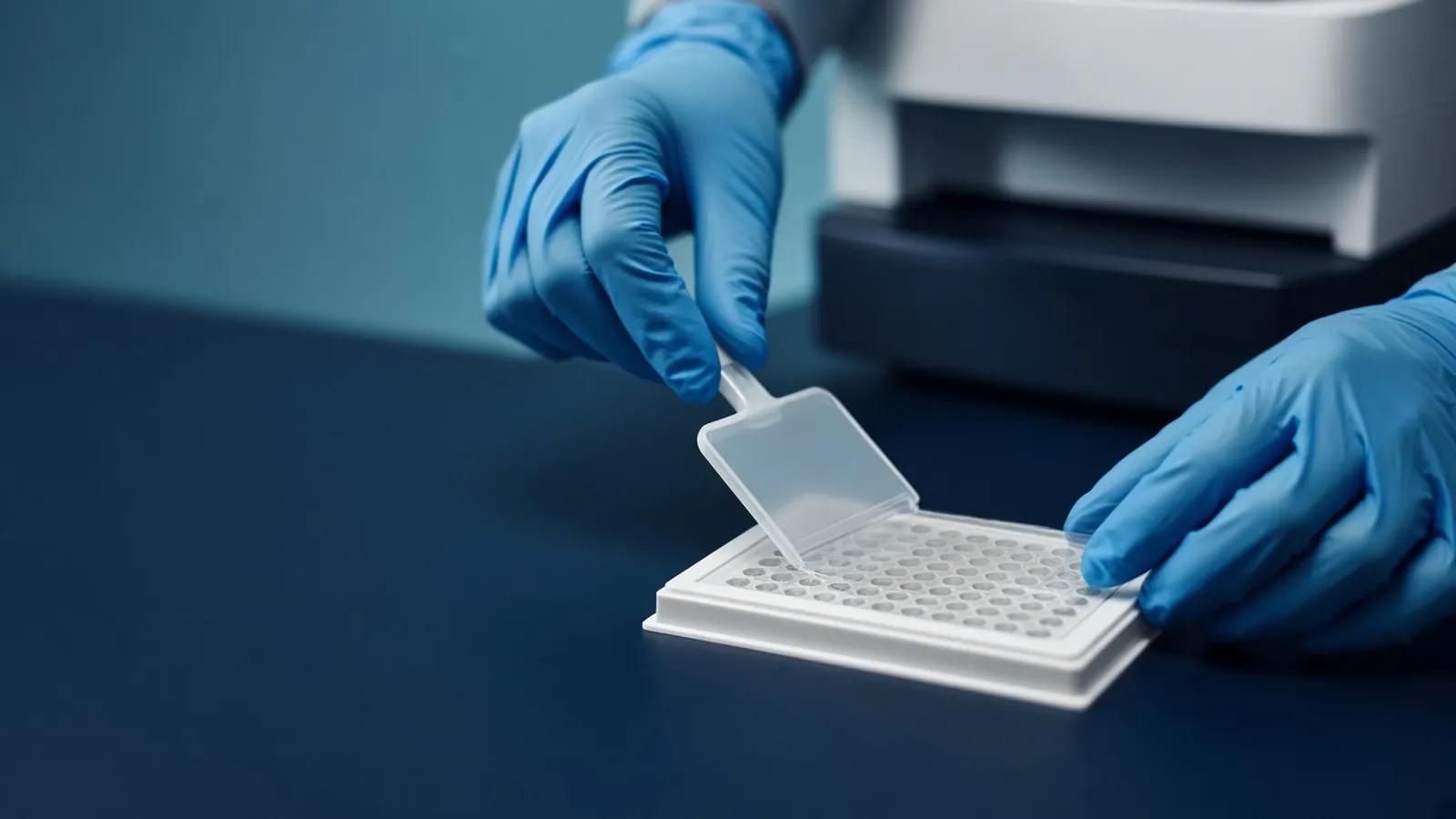
Plasticware is optical. White plates and clear plates change the signal the instrument collects. Sealing film must be optical and flat. A fingerprint, a crease, or a poorly seated seal becomes a well that looks like biology. The photograph of a sealed plate is a reminder that the seal is a reagent.
Reference genes are not a universal set. A housekeeping gene is simply a transcript that has been stable in somebody's conditions. Test candidate references across your own treatments. If the treatment changes the reference, every target you normalise to it will shift, including targets that did not change.
Branch points when a control fails
No-template controls contain every reagent except nucleic acid. Amplification there means contamination or a primer artefact. The plate's sample wells do not get a fold change that day. No-reverse-transcription controls contain RNA and the qPCR reagents without the reverse transcriptase. Amplification there means genomic DNA or a contaminated enzyme. Redesign the primers or repeat the DNase step. Do not subtract a little and carry on unless you have shown the contribution is negligible in a way you can document.
A dilution series of a representative cDNA gives you efficiency. Plot Cq against the log of the template amount. A reaction that doubles each cycle has a slope near minus 3.3. Laboratories often accept a window around that ideal and still report the measured efficiency. If the target and the reference differ sharply, the simple fold-change formula is the wrong model. Use a method that takes the measured efficiencies into account, or fix the assays.
Melt curves, for dye chemistries, should show one product at the temperature you expect. A second peak is a second product. A probe assay skips the melt and still needs evidence that the amplicon is the one you designed, at least when the assay is new.
| Control | Clean behaviour | If it fails |
|---|---|---|
| No template | No amplification through the last cycle | Stop. Find the contaminant or the dimer before samples are interpreted |
| No reverse transcription | No amplification from RNA | Treat the signal as DNA until you have removed it |
| Dilution series | A straight slope shared by target and reference | Do not use the two-fold formula blindly |
| Reference across treatments | Stable Cq after equal RNA input | Choose different references or move to a broader method |
| Melt or probe | One specific product | Quantify only after the extra product is gone |
Where RNA-seq takes over
RNA-seq is the better tool when you do not yet know which transcripts matter, or when you suspect the references themselves are moving and you need a transcriptome-wide view. It is a different measurement, with library bias and a different statistical model. A single RT-qPCR assay can still be the right confirmation of a candidate that came from a sequencing table. The two methods agreeing is stronger than either one quoted alone. They will not agree to the decimal if the biases differ. Look for the same direction and a design that can support it.
Failure modes that mimic a fold change
Inhibition makes Cq later. A dirty sample looks weakly expressed. Dilute the cDNA or spike a control template into the sample matrix. If the spike is also late, you are measuring dirt. Saturation and a threshold set inside noise make early cycles meaningless. Set the threshold in the exponential region and use the same rule for every well in the comparison.
Pipetting error between the target plate and the reference plate becomes a false fold. Technical replicates catch gross misses. They do not create biological replication. If you have one culture, you have one biological result, however many wells you filled.
Safety, climate and the enquiry
The everyday hazards are the RNA extraction chemicals upstream, hot blocks, and any infectious source material. Follow institutional biosafety rules for the cells. This assay does not diagnose infection or disease.
In humid weather, plates that wait unsealed concentrate or pick up condensation. Seal them and spin droplets down before the run. A cycler that rebooted after a power cut needs a completed run with controls before you trust a half-written file. Enzymes follow their own storage labels. A warm shipping day is a reason to check a known positive RNA, not a reason to adjust the threshold until a fold change appears.
For a sourcing question, name the organism, the transcripts, one-step or two-step, dye or probe, the reference strategy, and whether you also need a transcriptome-wide method. The nucleic acid analysis pathway places the assay in that wider route. The mRNA sequencing reference and the differential expression analysis reference are independent pages for a conversation about RNA-seq when the gene list outgrows qPCR. Use the quote request to ask whether a quotation is possible. Those pages do not say that EVRINTH operates the assay or holds a particular master mix.
Run a relative RT-qPCR comparison you can defend
- 01Name the calibrator and the referencesState which sample is the baseline and which transcripts will normalise the target. A housekeeping gene copied from another tissue is a hypothesis, not yet a normaliser.
- 02Prove the RNA and the reverse transcriptionRecord integrity, treat genomic DNA as a risk, and include a no-reverse-transcription control. If that control amplifies, stop and fix the assay before you calculate a fold change.
- 03Check efficiency and specificityUse a dilution series for the target and the references, and a melt curve or a probe design that can reveal extra products. Similar efficiency is an assumption you measure.
- 04Calculate only inside the controlsCompute the comparison with the method you stated, keep the replicate structure visible, and do not report a fold change from a well that failed the blank or the melt.
Questions from the bench
What is a housekeeping gene actually for?
It is a transcript you hope is stable across the conditions, so it can normalise loading and reverse-transcription differences. Stability is an experimental result. GAPDH or actin can move when the treatment hits metabolism or the cytoskeleton.
Why do my Cq values disagree with a paper that used the same primers?
Cq depends on threshold setting, master mix, instrument and how much RNA you put in. Compare samples run together, with the same threshold rule. Do not treat a published Cq as a universal concentration.
When should I switch from RT-qPCR to RNA-seq?
When the gene list is no longer the question, or when you need to see whether the reference transcripts themselves changed across the transcriptome. RNA-seq answers a broader question and asks for a different design. The path is outlined in the pillar on expression results.
Can I use a research RT-qPCR fold change as a clinical result?
No. A research relative-expression assay is not a validated diagnostic test. Clinical use needs the quality system and the legal framework that apply where the result would be reported.
References
Manufacturer names identify published method classes. Trademarks remain with their owners. Catalogue records on this site are independent references for enquiry. They are not a statement of inventory, distribution rights or a supply commitment. This page is educational. It is not medical advice, a diagnostic protocol or a biosafety approval.
Catalogue
Related products and categories
These links follow the subject of the article into published manufacturer references. A listing is a reference for an enquiry, not a statement of stock or distribution rights.
Continue in this cluster
Related reading
 From cells to a gene expression resultHow a laboratory goes from cells to a gene expression result, and how RNA quality decides between a focused RT-qPCR assay and RNA-seq.A glossary of expression termsPlain definitions of Cq, TPM, counts, FDR, UMIs and the other expression words that cause arguments when they are used loosely.A heatmap is a picture not a conclusionHow clustering, colour scale and row scaling change a gene-expression heatmap, and why the differential table and the contrast remain the result.