
Pillar guide
From cells to a gene expression result
How a laboratory goes from cells to a gene expression result, and how RNA quality decides between a focused RT-qPCR assay and RNA-seq.
- Author
- EVRINTH Editorial Team
- Published
- 8 October 2026
- Updated
- 8 October 2026
- Reading time
- 7 min
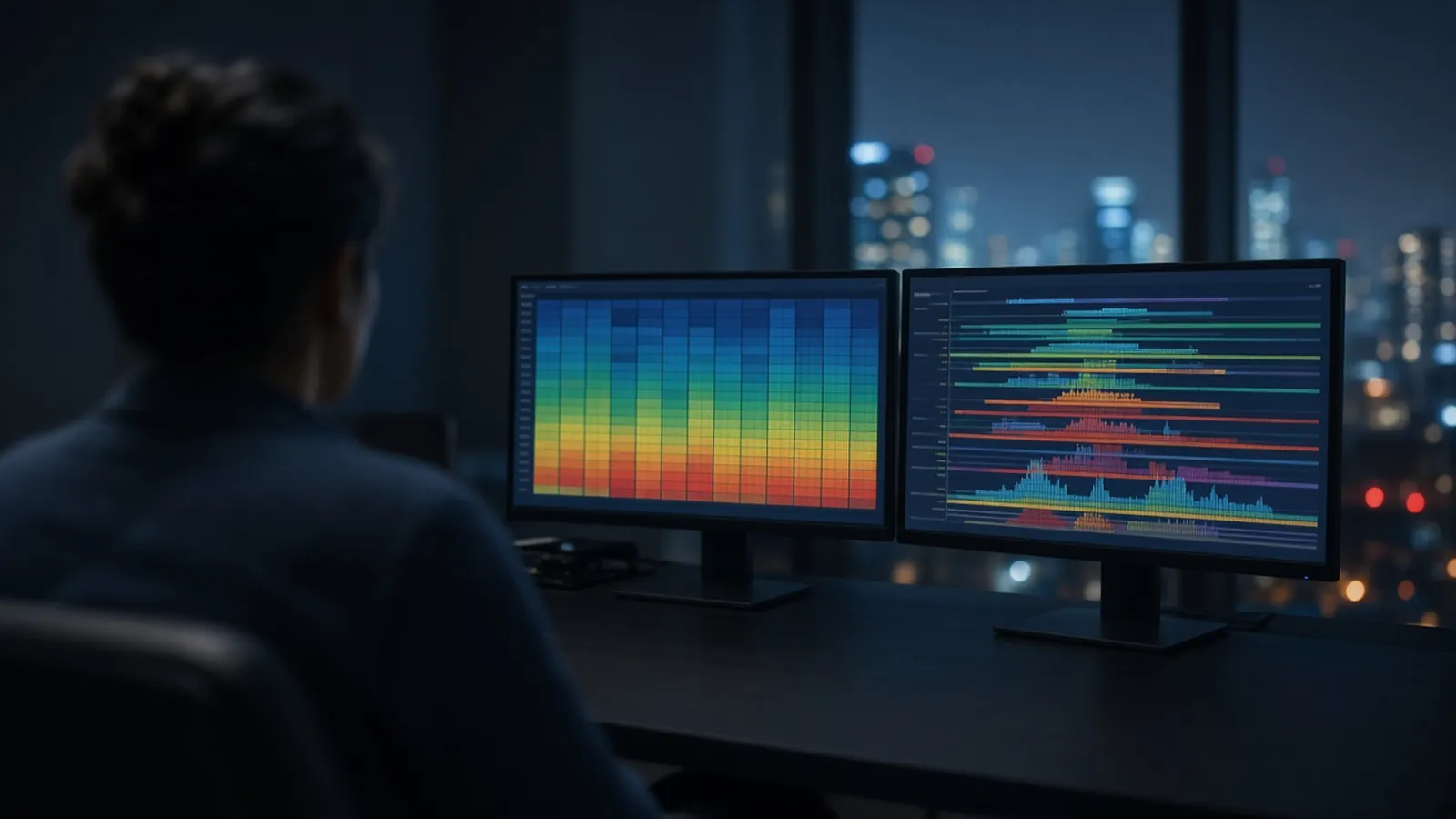
From cells to a gene expression result is a chain of biological and analytical choices. Cells make RNA, the laboratory tries to preserve a snapshot of that RNA, and an assay turns the snapshot into a comparison. The comparison is useful when the design, the RNA quality and the analysis agree. It is decorative when any one of those is missing. This page is the pillar for that path. The focused assay is described in RT-qPCR for relative expression. Nothing here is a diagnostic method or a kit insert.
What the result is allowed to mean
Gene expression, in the assays most benches run, means steady-state RNA abundance. It does not automatically mean the rate of transcription, and it does not automatically mean the amount of protein. A higher count can come from more transcription, from slower RNA decay, or from a shift in which cells are present in the tube. Say which of those your design can separate.
The unit matters. A relative RT-qPCR result is a fold comparison under stated assumptions. An RNA-seq result is a count, or a normalised abundance, for a feature in a particular annotation. Neither number is a concentration in the cell unless you built a calibration that earns that unit.
Keeping the snapshot honest
RNA is chemically fragile and biologically short-lived. The interval between the stimulus and the harvest is part of the experiment. So is the way you stop degradation. Cultured cells can go into a lysis buffer that inactivates RNases. Tissues often need to be frozen or placed in a stabiliser immediately, because a warm delay rewrites the transcriptome you meant to measure.
Extraction method is a class choice: organic extraction, silica columns, or magnetic beads, each with a bias for small RNAs or for large ones. Whichever you use, record yield and a purity estimate, and remember that absorbance ratios do not prove the RNA is intact. Integrity is a separate observation. Electrophoretic traces that show ribosomal peaks, or a score computed from those traces, tell you whether the sample is fit for the assay you chose. A badly degraded sample can still produce a number. The number will favour fragments that survived.
Genomic DNA rides along in many RNA preps. It will occupy primers that are not intron-spanning, and it will look like expression. A DNase treatment is a step, not a belief. A no-reverse-transcription control later is the check that the treatment worked.
Annotation comes from a stated genome. Ensembl is one public place to confirm gene models, transcript structure and which exons exist in the species you actually cultured. A primer or a count that assumes the wrong species build will be tidy and wrong.
Two assays, two kinds of claim
RT-qPCR measures the transcripts you already named. You reverse-transcribe the RNA, amplify a short amplicon, and compare quantification cycles between samples after normalising to reference transcripts. It is the right tool when the gene list is short, the material is limited but intact, and you need a comparison you can run locally. It cannot tell you about a gene you did not assay. The minimum information worth recording for a real-time experiment is discussed in the MIQE guidelines. Use that paper as a reporting standard, not as a recipe you paste over your own enzyme.
RNA-seq counts many transcripts at once by sequencing a library made from the RNA. The library type is a scientific choice. A poly(A) selection follows mature polyadenylated RNA and will miss much of the bacterial transcriptome and many non-polyadenylated species. A ribosomal-RNA depletion keeps a broader RNA population and asks for more sequencing and a more careful ribosomal leftover check. Stranded libraries preserve which DNA strand the transcript came from. None of these choices can be repaired in software if you picked the wrong one for the organism.
Sequencing itself is a technology class. A public orientation to one widely used short-read chemistry is the Illumina sequencing overview. Long-read transcript methods answer isoform questions with different library rules. After the reads exist, alignment or pseudo-alignment, quantification, and a differential test are further choices. They belong in the record beside the wet-lab kit names.
Controls that travel with either method
A biological replicate is an independent culture, animal, or donor, processed so that it captures ordinary variation. A technical replicate is the same RNA measured twice. Both can be useful. Only the biological set supports a claim about the condition.
Batch is a quiet covariate. If every treated sample was extracted on Monday and every control on Thursday, the calendar is confounded with the biology. Interleave the conditions. Record the operator, the extraction lot and the day.
| Question you can defend | Assay that fits | Evidence still required |
|---|---|---|
| Did these named transcripts change relative to a calibrator? | RT-qPCR with checked references | Efficiency, no-RT control, stable references |
| Which transcripts differ across the transcriptome? | RNA-seq with a stated library type | Replication, alignment QC, a proper differential test |
| Is the RNA intact enough to assay? | Electrophoretic integrity trace | A threshold you chose for this assay, written down |
| Is genomic DNA driving the signal? | No-reverse-transcription control | Primers that can reveal genomic product |
Failure that looks like biology
Degraded RNA compresses differences and can create false ones, especially if one group spent longer on the bench. DNA contamination inflates apparent expression for intron-free assays. The wrong annotation builds a confident table of features the organism does not have. A heatmap clusters whatever you feed it, including a batch effect. Look at the sample sheet beside the picture.
Inhibition in RT-qPCR makes a sample look low when it is merely dirty. Dilution or a spike of a known RNA separates those stories. In RNA-seq, a huge ribosomal fraction means the depletion or the poly(A) selection did not do what you paid for. Those reads are a library failure even if the files are large.
Public method collections such as protocols.io are useful for seeing how other laboratories structure a workflow. They are not a substitute for the record of what you did to this batch of cells.
Safety and the limits of the page
Cells, especially human and primate lines, and any sample from an infected source, carry a biosafety decision that your institution makes. RNA extraction chemicals often include chaotropes and solvents that need a chemical risk assessment. This page does not approve a containment level, a diagnostic claim, or the release of expression data as medical information.
Heat, power and moving RNA
In a warm laboratory, "keep on ice" fails if the ice is meltwater and the tubes are floating. Use a cold block and a time limit you actually keep. A freezer that warmed during a power cut is a new experiment: note the temperature excursion before you treat those aliquots as equivalent to undisturbed RNA. Humidity matters when plates and elution tubes sit open. When RNA moves between buildings, name the cold-chain handoff. A box that arrived warm is a reason to repeat the integrity trace.
What to put in an enquiry
A useful sourcing note names the species, the sample type, how the RNA will be stabilised, whether you need polyadenylated RNA or a broader fraction, the number of biological replicates, and the comparison. The nucleic acid analysis pathway is the route for the surrounding sample-to-result work.
The mRNA sequencing reference and the differential expression analysis reference are independent pages you can use to frame a conversation. Ask, through the quote request, whether a quotation is possible. Do not read them as a statement that EVRINTH runs those studies or stocks a particular library kit. State the scientific requirement and ask for the method that would actually be used.
Choose a path from cells to an expression claim
- 01Write the comparison before you harvestName the conditions, the biological replicates, and whether you need a few named transcripts or a transcriptome-wide list. The harvest method follows that sentence.
- 02Protect the RNA and record its qualityCool or freeze the sample as the protocol for that tissue requires, extract with an RNase-aware workflow, and record integrity and a DNA-contamination check before you commit to a costly assay.
- 03Branch on the number of genes and the claimUse RT-qPCR when the genes are already chosen and a relative comparison is enough. Use RNA-seq when you need discovery across many transcripts and you can analyse the counts properly.
- 04Match the statistic to the designReport the unit you measured, the normaliser, the replicate structure, and what the test compared. A picture of a heatmap is not that report.
Questions from the bench
Does an RNA level prove that the protein changed?
No. Transcript abundance is one layer. Translation, protein stability and localisation can move without a matching RNA change. If the claim is about protein, measure protein as well.
How many biological replicates does a simple comparison need?
Enough that the difference you care about can be separated from ordinary culture-to-culture variation. A triplicate of one flask, split into three wells, is still one biological sample. The design should be agreed before the harvest, with a statistician if the study is large.
When is RNA-seq the wrong next step?
When you already know the transcripts, when the RNA is badly degraded, or when you cannot name the comparison. A focused RT-qPCR, or a repeat of the extraction, is often the honest next experiment.
Is a gene expression result from a research bench a diagnosis?
Not from this article. Diagnostic expression tests need a validated assay and the regulatory setting that applies to you. Research counts support the study question written in the protocol.
References
Manufacturer names identify published method classes. Trademarks remain with their owners. Catalogue records on this site are independent references for enquiry. They are not a statement of inventory, distribution rights or a supply commitment. This page is educational. It is not medical advice, a diagnostic protocol or a biosafety approval.
Catalogue
Related products and categories
These links follow the subject of the article into published manufacturer references. A listing is a reference for an enquiry, not a statement of stock or distribution rights.
Continue in this cluster
Related reading
 RT-qPCR for relative expressionHow RT-qPCR for relative expression compares transcripts, using reference genes, efficiency checks and controls that keep a fold change honest.A glossary of expression termsPlain definitions of Cq, TPM, counts, FDR, UMIs and the other expression words that cause arguments when they are used loosely.A heatmap is a picture not a conclusionHow clustering, colour scale and row scaling change a gene-expression heatmap, and why the differential table and the contrast remain the result.