
comparison
Glycerol stocks and plasmid backups
A glycerol freezer stock and a plasmid DNA tube fail in different ways. Use both when a thaw, a contaminated culture, or a mutant colony is the risk.
- Author
- EVRINTH Editorial Team
- Published
- 8 October 2026
- Updated
- 8 October 2026
- Reading time
- 8 min
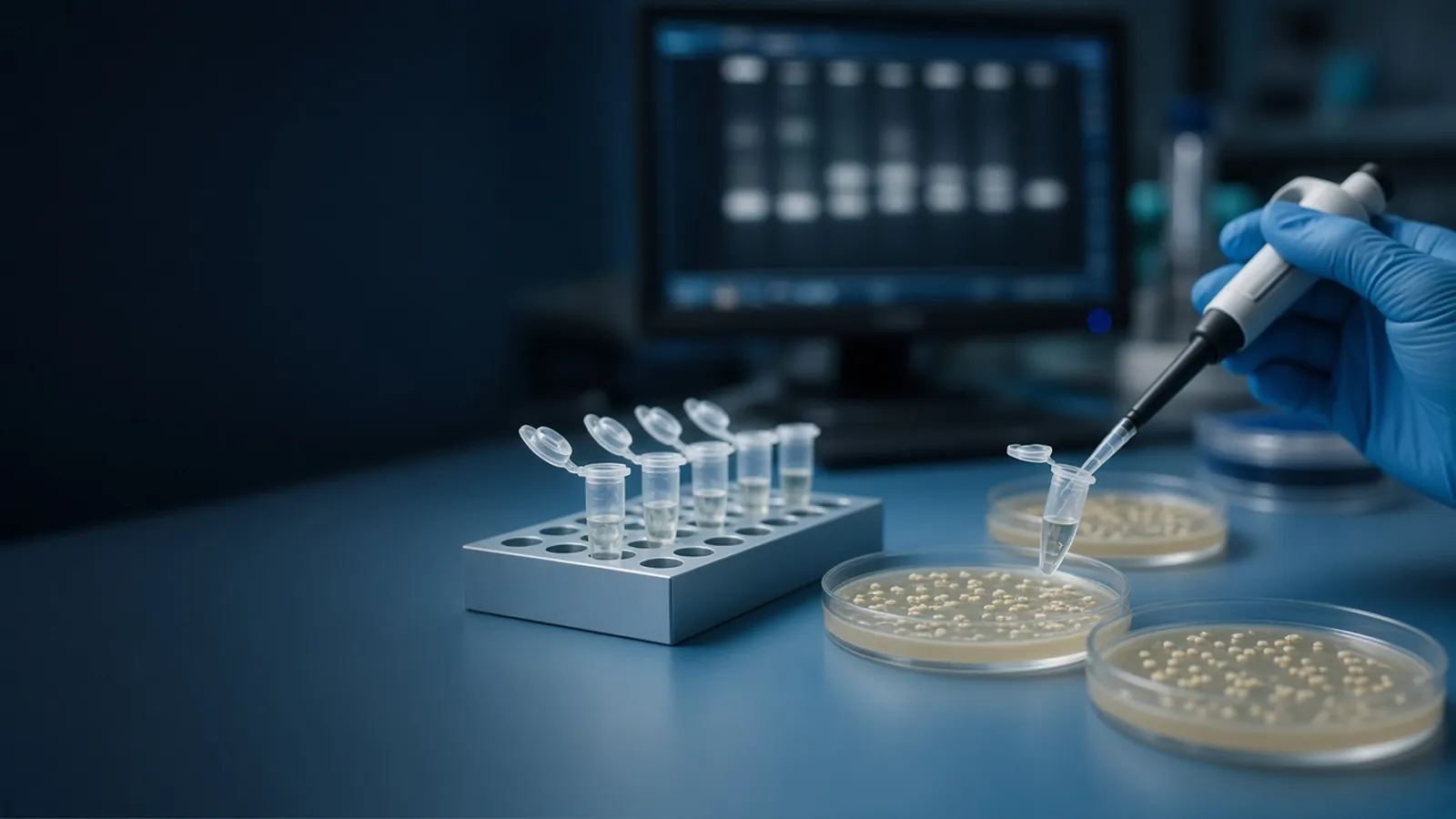
A glycerol stock and a plasmid DNA tube are not two labels for the same backup. One is a frozen population of cells. The other is the circular molecule those cells were carrying, stripped of the need to stay alive. You are deciding which failures you can still recover from after the plate has been discarded. Keep both, made from the same verified culture, under the same name.
The path that produces a colony worth archiving is plasmid cloning from insert to colony. This page starts where that chain stops: the freezer. It is a research comparison, not a viability table and not a permit to store a hazardous insert.
What each tube actually preserves
Glycerol lowers the freezing point of the mixture and reduces the ice damage that kills cells when a culture is frozen neat. A common laboratory practice is to add sterile glycerol until the final concentration is on the order of 15 to 25 percent, then freeze. Follow your SOP. The cells that wake up are a sample of the population you froze, not every genotype that was in the colony. If a minority mutant was present, freezing does not erase it. If the cells warm for long enough to grow, selection inside the tube can shift which genotype you recover. Looking at a still-frozen tube tells you none of this.
A plasmid DNA tube holds double-stranded plasmid, usually from an alkaline-lysis prep, eluted into a simple buffer or water. It does not respire, and it does not need the host to remain viable. It can be nicked, contaminated with RNA or salt, or made from the wrong colony. Those are chemical and clerical failures. They are different from a culture that died or drifted. Retransformation into a clean competent strain is how that tube becomes colonies again. Follow the competent-cell instructions you actually have.
Neither tube remembers insert orientation by itself. Orientation lives in the map and in the sequencing read. Write both onto the label, or the backup will outlast the only person who knew which way the fragment sat.
What you use to make the pair
You need a single colony that has already passed the checks you trust, sterile glycerol of a grade your SOP accepts, a cryovial rated for the freezer you will use, and a plasmid prep of that same culture. The prep class can be a silica miniprep or a larger column. The point is a named tube of DNA, not a particular kit brand. Cryovials, glycerol, and prep columns are ordinary sourcing lines in the molecular biology catalogue.
Match the antibiotic to the marker on the backbone while the culture is still growing. Once the stock is frozen, residual antibiotic in the glycerol mix is not something to count on. The plasmid tube needs a buffer the next transformation can tolerate. A prep swimming in ethanol is a poor backup even if the cells were perfect.
Label both containers before they go into a shared box. The minimum that has saved other people's work is the construct name, the host strain, the antibiotic, the date, and a pointer to the sequence file. A gene nickname alone is how two inserts trade places.
Make both from the culture you sequenced
Start from the colony, or the immediate outgrowth of the colony, whose junctions you have read. If the read is still in progress, hold the culture and do not declare the archive final.
Branch when the sequence disagrees with the map. Stop. Do not freeze a stock "so the work is not lost" under the name of the intended construct. Freeze it only under a name that states the disagreement, or discard it and repeat the cloning. A carefully frozen wrong plasmid is still the wrong plasmid.
When the sequence matches, prepare plasmid DNA from that culture and set the tube aside with the chromatogram identifier written on it. From the same culture, mix cells with sterile glycerol to the final range your SOP uses, commonly on the order of 15 to 25 percent, and freeze. The storage cabinet itself is a separate decision. Storing biological samples from fridge to freezer is the note on temperature class, aliquots, and what to do when a box has warmed. This page does not replace it.
Branch when you have cells but no time for a prep. Freeze the glycerol stock so the genotype is not sitting on a bench, and make the DNA tube from a revival of that stock before anyone else uses it. Until the DNA tube exists, you have one backup, and it is the fragile one.
Branch when you have a prep and the culture has already been thrown away. Keep the DNA, and record that no glycerol stock was made. You can transform later and freeze cells then. Do not invent a stock you do not have.
What each backup still covers
| What happened | Glycerol stock | Plasmid DNA tube |
|---|---|---|
| Power cut, tube thawed | Cells may have died, or a subset may have grown. Appearance does not tell you which. Restreak and resequence before you trust it. | The DNA does not need to be alive. Transform a fresh competent strain and confirm the junctions if the outage was long or the tube was wet. |
| Culture was contaminated | The contaminant is frozen in the population. Selection may hide it until you plate without the drug or switch strains. | You can move the plasmid into a clean, authenticated host and pick again. A prep made after the contamination can still be dirty, so restreak the new transformant. |
| The archived colony was already a mutant | The stock carries that mutation. It is a faithful copy of the wrong cell. | A prep from that same colony carries it too. An earlier prep, tied to a matching sequence file, is the copy that saves you. |
| A mutation arises months later during revival | The original vial still holds the earlier population if you did not scrape it repeatedly. | DNA frozen on sequencing day does not contain a mutation that appeared in a later culture. |
When the archive disagrees with the map
If a revival gives colonies on the antibiotic and a digest that matches, you still only know the marker and the gross structure. A point mutation picked up during a warm thaw will look the same on that gel. Sequence the junctions again when the tube has a doubtful temperature history, and when the construct will be used as a reference. A Sanger sequencing enquiry reference is a way to frame that read. It is an independent method reference. Ask whether a quotation is possible.
If the glycerol stock is contaminated and the DNA tube was prepped from the same bad culture, transform, restreak to single colonies, and only then make a new pair. Do not pour the old glycerol into a large culture and call the prep clean because the column removed the colour.
If insert orientation was never written down, neither tube can answer it. Run a directional check or a junction read before the next person subclones from your archive. Restriction ligation can leave a blunt insert either way round. The backup should say which way you proved.
Repeated freeze-thaw of the glycerol vial is how a box slowly becomes a mixture of scrapes. Aliquot the stock when you first freeze it, and take cells from one working vial. The DNA tube has its own thaw problem: nucleases in a dirty prep, and cap condensation that changes a small volume. Spin, and do not assume the concentration on the old label.
Safety is an institutional decision
A cloning strain is a living organism, and an antibiotic-resistance gene does not belong in a drain. Autoclave or otherwise treat waste as your committee requires. The WHO Laboratory biosafety manual, 4th edition is background reading, not permission to archive a hazardous insert. If the plasmid encodes something your institution restricts, the freezer location and the access rule are part of the record. This article does not approve the construct.
A power cut is why the DNA tube exists
In a building where the ultra-low freezer can warm because the supply failed, the glycerol stock is the tube you should doubt first. Do not invent a story about how long cells remain viable. You were not watching the internal temperature, and a frost line on the door is not a growth curve. Quarantine the box as the storage note describes, revive only if you must, and prefer the plasmid DNA tube plus a fresh transformation. Write on the vial that it thawed, even if colonies appear later. The next person deserves the doubt in ink.
What to put in a sourcing enquiry
State the host species, the resistance marker, whether you need cryovials and glycerol or a plasmid-prep column class, and that both a cell stock and a DNA tube will be kept. If the construct began as a specified sequence, point at that file rather than a gene name. The custom gene synthesis enquiry reference is only a prompt for how a sequence specification is framed. It does not mean a synthesis is running, and it does not mean this archive was synthesised by anyone in particular. Send the practical need with the quote request. Ask whether a quotation is possible. Include the sequence-file habit you want the tubes to match, so the items you receive are the ones the labels can describe.
Questions from the bench
Is a glycerol stock enough if the plasmid was sequenced?
The sequence file proves what that colony was on the day you read it. The glycerol tube is a living copy of that colony, and a later thaw or outgrowth can drift. Keep a plasmid DNA tube from the same verified culture so you can return to the molecule without trusting the cells.
What final glycerol is a typical freezer stock?
Laboratories commonly mix sterile glycerol with culture so the final glycerol is on the order of 15 to 25 percent, then freeze. That range is a planning figure, not a viability guarantee. Follow the laboratory SOP and the note on the glycerol you actually open.
Can I recover a construct from a glycerol stock that thawed in a power cut?
You can try a restreak if the tube only softened, and you should not treat growth as proof that the sequence is unchanged. The plasmid DNA tube is the cleaner route back: transform it into a fresh competent strain and confirm the junctions again. A thawed culture does not announce whether cells died or whether a mutant took over.
Does the plasmid tube protect me if the colony I archived was already wrong?
Only if the DNA was prepared from an earlier, sequenced culture. DNA made from the mutant colony carries the same mutation. Write the sequence filename on both tubes so a later worker can see which molecule the archive claims to be.
References
Manufacturer names identify published method classes. Trademarks remain with their owners. Catalogue records on this site are independent references for enquiry. They are not a statement of inventory, distribution rights or a supply commitment. This page is educational. It is not medical advice, a diagnostic protocol or a biosafety approval.
Catalogue
Related products and categories
These links follow the subject of the article into published manufacturer references. A listing is a reference for an enquiry, not a statement of stock or distribution rights.
Continue in this cluster
Related reading
Plasmid cloning from insert to colonyHow an insert becomes a plasmid, a colony and a verified clone, and which checkpoint fails when the plate is empty or the insert is wrong.A glossary of cloning termsRead a cloning plan and mark vector, insert, MCS, ends, ligase, phosphatase, transformation, and clone against the map before you mix a tube.Antibiotic selection is not proof of an insertWhat selection, marker, satellite and clone mean on an antibiotic plate, and why a colony can grow with no insert, the wrong insert or only a parent vector.