
Pillar guide
Storing biological samples from fridge to freezer
Fridge, minus-20, minus-80 and nitrogen storage slow different kinds of damage. A warm box is a quarantine decision, not a hope.
- Author
- EVRINTH Editorial Team
- Published
- 8 October 2026
- Updated
- 8 October 2026
- Reading time
- 11 min
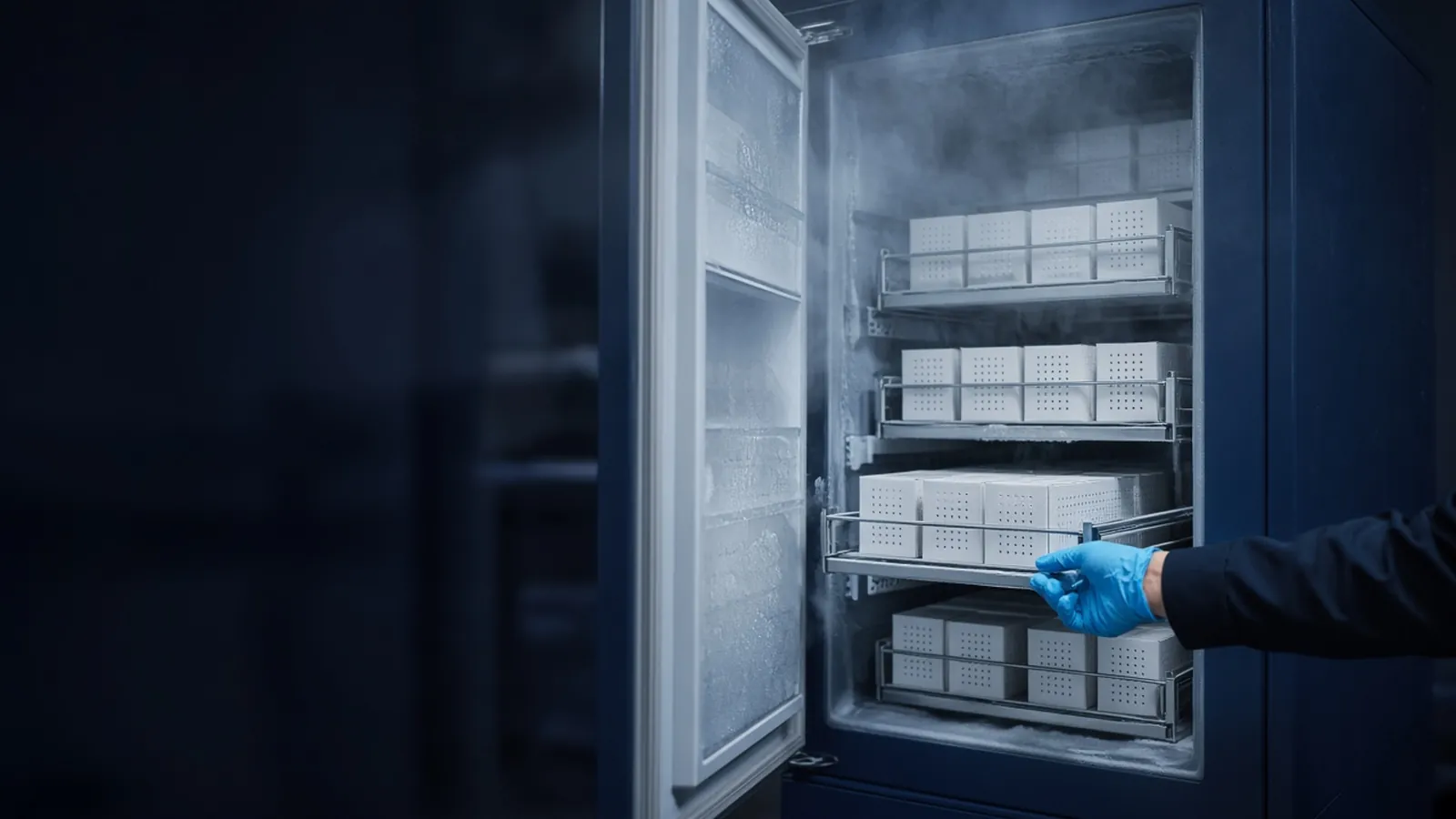
Storing biological samples from fridge to freezer is a choice among temperatures that slow different kinds of damage, plus a record that lets someone else believe the choice later. Cold does not grant immortality. Enzymes still age, ice still rearranges, labels still fall off, and a freezer that warmed during a power cut still contains whatever chemistry happened while it was warm. This page is the cluster reference for that choice. How a shipment uses dry ice, and the hazards that come with solid carbon dioxide, is the companion guide on dry ice packing for sample shipments.
Tubes, cryovials and racks are plasticware decisions in the laboratory plasticware catalogue. A freezer specification, an alarm and a backup plan are procurement questions for laboratory procurement. Send them as a quotation request. Nothing on this page says a cabinet is waiting in a storeroom.
The decision you are actually making
You are deciding where this aliquot may sit so that the property you care about is still there on the day you use it. The property might be a viable culture, a folded protein, an intact RNA, a restriction enzyme's activity, or simply a solution that has not grown a biofilm. Those properties fail at different temperatures and on different clocks. "Put it in the coldest freezer with space" is how a tube rated only to minus 20 ends up in liquid nitrogen, and how a cell stock ends up in a frost-free cabinet.
You are also deciding what will be thrown away if the temperature record breaks. A sample with no owner, no date and no map is already a disposal problem. Cold storage is expensive of electricity, of search time, and of other people's samples if you stand with the door open.
What cold does, and what it leaves undone
Lower temperature slows molecular motion and most chemical reactions. It does not stop them all at minus 20. Proteases can remain active in imperfectly frozen lysates. Ribonucleases are notoriously hard to wish away. Ice formation concentrates salts and proteins in the unfrozen fraction, which is itself a stress, and ice crystals puncture cells. That is why freezing is both a preservation method and a damage method, and why cryoprotectants such as glycerol or dimethyl sulfoxide appear in freezing protocols for viable cells.
The glass-transition region is the idea behind ultra-cold and nitrogen storage of cells: below a low enough temperature the remaining liquid becomes a glass instead of a stew of growing ice. Minus 80 is cold enough for a great deal of research material and is still not the same claim as liquid nitrogen. Viable stocks that the method places in nitrogen should stay there. Warming them to minus 80 for "convenience" can start the damage the nitrogen was preventing. Culture collections publish storage expectations for the lines they distribute. The ATCC culture guides are a public place to see that a strain arrives with a storage class, which you then follow or deliberately replace with your own evidence.
Repeated thawing is a separate insult. Each cycle grows ice, concentrates solutes, and, for a tube that is opened, invites contamination and condensate. Aliquots sized to one experiment remove the temptation.
Temperature classes
A laboratory fridge, typically near 2 to 8 °C, holds material that the label allows to stay liquid and that will be used before microbial growth or chemical decay wins. Many antibody dilutions, some media, and short-term plates live here. Enzymes generally do not. A fridge is also where condensate drips onto labels and where a crowded door shelf runs warmer than the set point. Map the warm spots with a thermometer before you trust the door.
A minus-20 laboratory freezer holds many reagents, oligonucleotides, and enzymes that are formulated in glycerol so they do not freeze solid. Those stocks are damaged by warmth more than by the cold. A frost-free cycle, common in domestic appliances, periodically warms the cabinet to clear ice. The enzyme experiences a thaw you never see. Specify a manual-defrost or a laboratory cabinet that holds temperature. Minus 20 is also a poor long-term address for many RNA preparations and for lysates you hoped to analyse months later.
An ultra-low freezer, commonly set near minus 80, is the default long-term cabinet for nucleic acids, for many proteins, and for lysates. It is not uniform. Racks near the door and racks at the top see more warm air. Frost buildup insulates and then avalanches into neighbouring boxes. An inventory map, a habit of opening one shelf, and an alarm are part of the instrument, not optional manners.
Liquid nitrogen, near minus 196 °C in the liquid and somewhat warmer in the vapour phase above it, is for viable cells and for other material your method explicitly sends there. Vapour-phase storage reduces the chance that liquid nitrogen enters a poorly sealed vial. Liquid that has entered a vial expands violently when the vial is warmed at the bench. That is an explosion hazard with plastic shrapnel, not a quirk. Use vials rated for the duty, and follow the institutional cryogenic procedure. A microcentrifuge tube with a snap cap is not a cryovial.
Dry ice, near minus 78 °C while it lasts, is a shipping and emergency coolant. It is not a shelf. A cardboard shipper in a corner is not a minus-80 freezer, and it will be gone, along with the temperature, on a timescale that depends on insulation and the room. The packing page treats that as its own decision.
| Class | A research use it can support | What it does not do |
|---|---|---|
| Fridge, about 2–8 °C | Short holds of reagents the label keeps liquid | Enzyme storage, long-term lysates, anything that grows at that temperature |
| Minus 20, non-cycling | Glycerol stocks of many enzymes, short and medium reagent storage | A frost-free domestic cycle, or a claim of ultra-cold stability |
| Minus 80 | Long-term nucleic acids, many proteins and lysates | Viable-cell storage that the method placed in nitrogen |
| Liquid nitrogen | Viable cells and other method-specified stocks | Forgiveness for the wrong tube, or for liquid trapped inside a vial |
| Dry ice | A vented shipment or a short emergency hold | A permanent address, or an airtight box |
A workflow with branch points
Read the stability statement you have: the reagent label, the paper method, or a local check. If there is no statement, you are running an experiment in storage, and the first aliquot is the test, not the archive.
Choose the container. Cryovials for ultra-low and nitrogen duty, with caps and O-rings meant for that temperature. Ordinary microcentrifuge tubes for a night in the fridge or a short minus-20 hold if the method allows. Leave expansion room when a liquid will freeze. A tube filled to the brim bursts, and a burst tube in a shared freezer is everyone else's contamination event.
Label before you freeze. Frost eats adhesive. A label that survives the temperature, plus a line in an inventory, beats a pencil that smeared. Include the hazard if the material is infectious or chemically dangerous. The WHO laboratory biosafety manual and the CDC BMBL treat storage as part of containment, not as a housekeeping detail. Your institution decides the cabinet's access and the label's wording. This article does not assign a biosafety level.
Freeze promptly, in a rack that allows air or the freezer's own conditions to reach the tubes, rather than as a solid brick of warm boxes dropped in at once. A large warm load is how you briefly compromise the neighbours.
If a control later fails in a way that looks like degradation, compare a never-thawed aliquot with the working tube before you redesign the assay. If they match, storage is less likely to be the cause. If only the working tube fails, the freeze-thaw history is the prime suspect.
If the freezer alarm sounds, do not open the door to "have a look" at every shelf. Opening dumps the cold. Follow the call-out list. When the cabinet is back at temperature, use the log to decide which boxes crossed the action limit. Quarantine those. A test aliquot, a functional control, or a written rule can release them. Silence cannot.
Failure modes
Unlabelled boxes accumulate because discarding feels riskier than keeping. They then force long searches, which warm the real samples. A review date is a scientific control.
Condensate on cold racks wets labels and introduces water into caps that were opened while frosted. Open tubes in a cabinet only for the moment the method requires, and do not return a wet, unlabelled cap "for now".
Mixed storage of sequencing libraries, competent cells and radioisotopes in one unmapped drawer is an integrity problem and sometimes a regulatory one. Separate by hazard as the institution requires, and by temperature as the chemistry requires.
Topping up a box of enzymes by refreezing the half-used parent tube every afternoon is a slow activity loss. Aliquot on arrival. The parent tube's convenience is the experiment's bias.
Power cuts, heat, and frost in a humid season
Ultra-low freezers live in rooms that are often hot, and they reject a great deal of heat. Ventilation around the cabinet is part of performance. A freezer jammed against a wall in a poorly cooled equipment room runs harder and fails sooner. Humidity grows frost. Frost props the door open a crack, and a crack is a temperature excursion that may never trip an alarm if the probe sits in a still-cold corner. Defrost on a planned day, with a temporary home for the samples that the laboratory has already agreed, not during the crisis.
Power cuts are an operational fact. The useful preparation is an alarm that calls a person, a written limit, and a decision about backup power or a spare chest. Dry ice can be an emergency hold if the institutional plan says so, in a ventilated space, with the hazards on the packing page understood. Inventing a hold time in hours for "a typical freezer" would be fiction. The manufacturer, the load and the room set that number, and your log records what this cabinet did.
Safety and the limit of the claim
Cold burns from racks, from nitrogen, and from dry ice are immediate injuries. Insulated gloves meant for the task, not a wet exam glove, are the control. Nitrogen and large amounts of dry ice displace oxygen in small rooms and in cold rooms. Ventilation and an oxygen alarm, where the institutional risk assessment requires one, outrank bravery.
This page is not clinical sample guidance, not a biobank standard, and not permission to store an infectious agent in a food fridge or an unlabelled domestic freezer. Patient material and pathogens follow the biosafety rules and the legal framework that apply to your institution. Research storage of ordinary reagents is a different claim.
What to put in an enquiry
For plasticware, specify the temperature rating, the volume, sterile or not, and whether the vial is intended for vapour-phase nitrogen. For a freezer, specify the set temperature, the alarm, the inventory habit you need to protect, the room's heat, and the power situation including outages. Ask what documentation describes temperature performance. Compare quotations on those lines.
Use the quote form and keep the specification with the procurement note. A colder adjective on a brochure is not a map of your racks, and it is not a substitute for the aliquot you still have to make on the day the reagent arrives.
Choose a storage temperature and a record that matches the sample
- 01Match the temperature class to the stability you can defendUse the label, the paper, or your own check to decide fridge, minus 20, minus 80, or nitrogen. Colder is not automatically the right cabinet if the sample must stay liquid or if the tube is not rated for that cold.
- 02Aliquot to the volume of one use before the first freezeFreeze-thaw damage accumulates in proteins, cells and some nucleic-acid preparations. A single box of one-use tubes is a more honest store than one precious tube opened every week.
- 03Label and map the boxWrite contents, concentration, date, owner and any hazard on a label that survives frost. Record the freezer, the shelf and the rack so a later user does not warm the whole cabinet to search.
- 04Quarantine a box that warmed past the action limitIf the alarm or the temperature log shows a warm excursion, leave the box quarantined until a test aliquot or a written rule clears it. Do not return it silently to the in-use rack.
Questions from the bench
Is a household frost-free freezer acceptable for enzymes?
It is a poor default. Frost-free cabinets warm-cycle to clear ice, and that cycle thaws and refreezes glycerol stocks and other enzymes even when the door never opens. A laboratory freezer that holds a set temperature, without a defrost cycle, is the class to specify for reagents you need to trust.
Do nucleic acids need liquid nitrogen?
Usually they do not. DNA and many RNA preparations are stored for long periods at minus 80, with RNA handled to limit RNase and warm time. Liquid nitrogen is for material that must stay vitrified, especially viable cells. A tube that is safe at minus 80 may crack or admit liquid nitrogen if it is dunked.
What should happen when a power cut warms an ultra-low freezer?
Keep the door shut, read the alarm, and follow the laboratory's call-out plan. Hold time depends on the cabinet, the load and the room, so this page will not invent one. After power returns, quarantine boxes that passed the action limit and decide from a record, not from the fact that the compressor is running again.
Where does dry ice fit?
Dry ice is a transport and emergency coolant, not a storage address. It holds material near its own sublimation temperature for a limited time in a vented, insulated container. Packing rules, cold burns and carrier duties are covered in the dry-ice shipment page.
References
Manufacturer names identify published method classes. Trademarks remain with their owners. Catalogue records on this site are independent references for enquiry. They are not a statement of inventory, distribution rights or a supply commitment. This page is educational. It is not medical advice, a diagnostic protocol or a biosafety approval.
Catalogue
Related products and categories
These links follow the subject of the article into published manufacturer references. A listing is a reference for an enquiry, not a statement of stock or distribution rights.
Continue in this cluster
Related reading
 Dry ice packing for sample shipmentsDry ice keeps non-infectious research samples cold and can burn skin or displace air. Carrier rules and infectious-substance law still govern shipping.A glossary of cold-chain termsSetpoint is not air temperature, and a phase-change pack is not every coolant. Compare the cold-chain pairs labs treat as one word.Avoiding frost on a rack you opened too longChoose the rack from the map before you open the door. Warm moist air ices the front boxes, and the decision is to close.