
selection guide
Avoiding frost on a rack you opened too long
Choose the rack from the map before you open the door. Warm moist air ices the front boxes, and the decision is to close.
- Author
- EVRINTH Editorial Team
- Published
- 8 October 2026
- Updated
- 8 October 2026
- Reading time
- 9 min
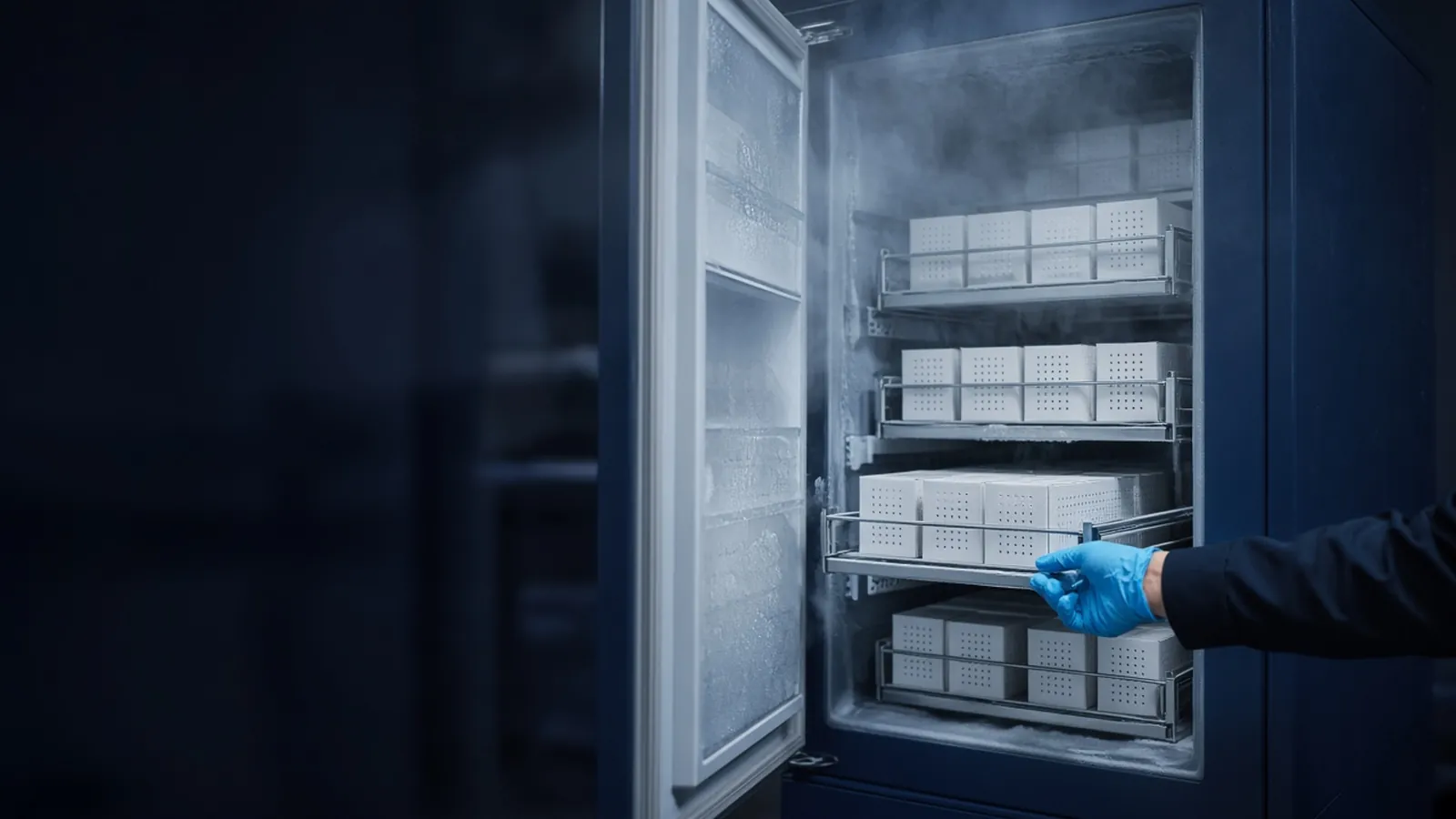
You opened the ultra-low door to fetch one box and stayed long enough to read the map by the light inside the cabinet. The rack you did not need is now furred with new frost, and the boxes on the front edge have been sitting in room air. The selection you should have made was which rack to pull, and you should have made it before the gasket broke its seal. How those boxes are supposed to live once they are back in the cold is in storing biological samples from fridge to freezer.
Racks, cryoboxes, and insulated carriers you might stage into are in the laboratory plasticware catalogue. A cabinet with a layout you can search quickly is a laboratory procurement question, sent as a quotation request.
The selection: one rack, named in advance
You are choosing which physical rack or basket leaves the cabinet, and which ones stay. The criterion is a coordinate you already trust: freezer, shelf, rack, box. If you do not have that coordinate, you are not ready to open the door. The map is read in the warm room. The door is opened for the retrieval, then closed.
A second criterion is how many racks the task truly needs. One box means one rack, pulled far enough to take the box, then returned. A list of eight boxes on three racks means three pulls, each with the door closed in between while you set the previous rack into the stage you prepared. It does not mean three racks on the floor and a conversation.
A third criterion is your own stop rule. The laboratory sets a maximum open time by watching this cabinet in this room: how fast the front edge frosts, how the air-temperature probe moves, how quickly people can take a known box. NIST's metrology resources are a reminder to measure that, not to inherit a slogan. Write the rule in the SOP. When the rule expires and you still have not got the box, close the door. Let the cabinet recover. Open again only if you now know the coordinate.
What the open door does
Room air is warmer than the cabinet and, in most laboratories, loaded with water vapour. That air falls into an upright freezer or sinks into a chest when the lid is up. Water vapour meets surfaces far below freezing and deposits as frost. The deposit is thickest where the moist air hits first: the inner door, the front of the racks, the lids of the outer boxes. Labels disappear under the fur. The next search takes longer. The longer search admits more moist air. That loop is the failure mode.
The same air warms the outer boxes. A box is not the air. A short opening may frost the lid and leave the tubes still far below freezing. A long search can bring the outer boxes up enough that their own product limit is in question, especially small boxes with little mass, while a dense box at the back has barely moved. You will not know which happened from the frost pattern alone. You know that the front row had the worst of it. If the opening violated the SOP's time, note the shelf and treat the question as a quarantine problem for the boxes most exposed, using the storage page's rule: not automatically destroyed, not automatically fine.
Frost also steals cooling capacity. The cabinet must pump heat to hold the setpoint while the door is open, and later it must deal with a load of new ice. Ice on gaskets and on fans is how the next night's alarm starts. Preventing the frost is part of keeping the setpoint meaningful.
How to stage so the door can shut
Staging is the equipment and the sequence that let you work with the door closed.
Before you walk to the freezer, write the coordinates on a slip or have them on the tablet in a type size you can read with gloves off, in the corridor. Prepare a place for the rack or the box: a bench space, or an insulated carrier if the SOP says the box must not sit in room air while you pick tubes. Do not invent a carrier that traps dry ice in a sealed can. If you use dry ice in that carrier, follow the packing page's hazards and use a vessel that can vent. Many retrievals do not need dry ice at all. They need a short, planned pull and a closed door.
Put on the gloves you need for the cold before you open, not after. A search for gloves with the door ajar is a staging failure.
Open, pull the named rack only, take the named box, seat the rack, close. Then, outside, confirm the label. If the label is wrong, the map is wrong. Do not reopen "just to look at the neighbours" until you have decided, from the inventory, what the next coordinate is.
If you need several boxes, close between racks. The few seconds of closing cost less than a minute of browsing.
Which racks you pull, and which you leave
| Situation | Rack you select | Rack you leave | Stop rule |
|---|---|---|---|
| One coordinate on the map | That rack only | Every neighbour | Close if the coordinate is not where the map said |
| Several boxes, one rack | That rack, once | Other shelves | Work the boxes outside, door closed |
| Several racks | The next named rack, after a close | The ones not on this pull | Close between pulls |
| Map disagrees with the labels | None, until you reconcile outside | All of them | Close immediately |
| Frost already hides the fronts | None, if you cannot read | All of them | Close, defrost plan later, do not scrape labels |
Scraping frost with a tool while the door is open is how labels tear and tubes crack. If frost has already made the cabinet unreadable, the selection is to close, plan a defrost or a transfer under the SOP, and not to improvise archaeology in a plume of room air.
A retrieval in a humid laboratory
The map says freezer B, shelf 3, rack 2, box 5. The building is humid. The inner door already has a film of frost from yesterday's longer opening. You write "B3 / R2 / box 5" on a card. You set an empty cryobox carrier on the bench. You open, pull rack 2, take box 5, seat the rack, close. The whole opening is short because you did not read the box grid inside the cabinet.
The branch: box 5's label does not match the card. You do not reopen. You take the box back only if the SOP says an immediate return is safer than holding it out, and you do that as its own short opening. Then you fix the inventory. If you cannot tell whether box 5 warmed past the product limit, it is quarantined, not silently restored and not silently used. The frost on shelf 3's front edge is a maintenance note. It is not proof that every tube thawed, and it is a reason to shorten the next opening, not to schedule a casual browse "while we are defrosting".
If two people need boxes, they share one opening with one list, not two conversations in the doorway. The second person reads the list outside.
When the selection itself is the problem
A freezer organised as "everyone's boxes in the front" cannot be searched quickly. The selection guide for the next cabinet is: racks that match the map, a shelf order that does not require moving three racks to reach one, and labels that remain readable so you are not scraping ice to see a code. Specify that layout. A larger cabinet that encourages browsing is a worse tool than a smaller one with a map.
Chest versus upright is a real choice. Uprights spill cold air when the door is open. Chests keep a cold pool until you lean in and stay. Either one fails if the map is unread. Choose the geometry your room and your racks support, and write the open-time rule for that geometry.
Warm humid laboratories, including many that work through a monsoon season without dried air, grow frost faster. The selection does not change: fewer openings, named racks, close the door. The stop rule may need to be stricter in those rooms because the same duration admits more water. Measure it locally. Do not cite a city average.
Safety
Cold metal and cold racks burn skin. Cryogloves that still let you grip a rack are the control. Bare hands and a long search are how frostbite and dropped boxes happen together. Do not chip ice toward your face or toward a tube of infectious material. A dropped tube is a spill under the institution's rule. The WHO laboratory biosafety manual frames that programme. This page does not.
An alarm that starts because a door was left ajar is a backup problem as well as a frost problem. Closing the door is the first response if you are still standing there.
What to ask for
Ask for racks and boxes that match a coordinate system you can read outside the cabinet, and for labels rated for frost. Describe the room as warm and humid if it is, and ask the cabinet's clearance and heat rejection so the room is not made worse. Put the layout in the quotation request. Do not ask a seller for a door-open time that will be true in every climate. That number is your measurement.
Questions from the bench
How long may the ultra-low door stay open?
As long as your SOP allows after someone has watched how fast frost forms and how fast the front boxes warm in your room. This page will not invent a universal number of seconds. Humid rooms make the same opening worse. If you cannot see the coordinate you came for, close the door and fix the map outside.
Which rack should I pull if two boxes might be the right one?
Pull neither until the map names one coordinate. Standing with the door open to compare labels is how the rack you do not need gains a fur of frost and the outer boxes warm. If the map is ambiguous, close the door, resolve the identity, and open once for the rack the resolution names.
Does new frost mean the samples thawed?
New frost means moist air met a cold surface. The outer boxes have also been in warmer air, so their temperature has risen even if they are still frozen. Frost alone is not a thaw history. A long search with the door open is still a reason to note the event and to look at the alarm delay and any logger on that shelf.
Is a chest freezer easier to stage than an upright?
The geometry differs, and warm air still enters a lid you leave open. Select the rack or basket from the map, lift that one, and close the lid before you read labels in the room. A chest is not a permission to browse. Specify the format that matches the map you already use.
References
Manufacturer names identify published method classes. Trademarks remain with their owners. Catalogue records on this site are independent references for enquiry. They are not a statement of inventory, distribution rights or a supply commitment. This page is educational. It is not medical advice, a diagnostic protocol or a biosafety approval.
Catalogue
Related products and categories
These links follow the subject of the article into published manufacturer references. A listing is a reference for an enquiry, not a statement of stock or distribution rights.
Continue in this cluster
Related reading
Storing biological samples from fridge to freezerFridge, minus-20, minus-80 and nitrogen storage slow different kinds of damage. A warm box is a quarantine decision, not a hope.A glossary of cold-chain termsSetpoint is not air temperature, and a phase-change pack is not every coolant. Compare the cold-chain pairs labs treat as one word.Backup freezers and who holds the keyA backup is a named person, a route for the boxes, and a temperature check on arrival. A locked spare freezer is only a second appliance.