
comparison
A glossary of cold-chain terms
Setpoint is not air temperature, and a phase-change pack is not every coolant. Compare the cold-chain pairs labs treat as one word.
- Author
- EVRINTH Editorial Team
- Published
- 8 October 2026
- Updated
- 8 October 2026
- Reading time
- 11 min
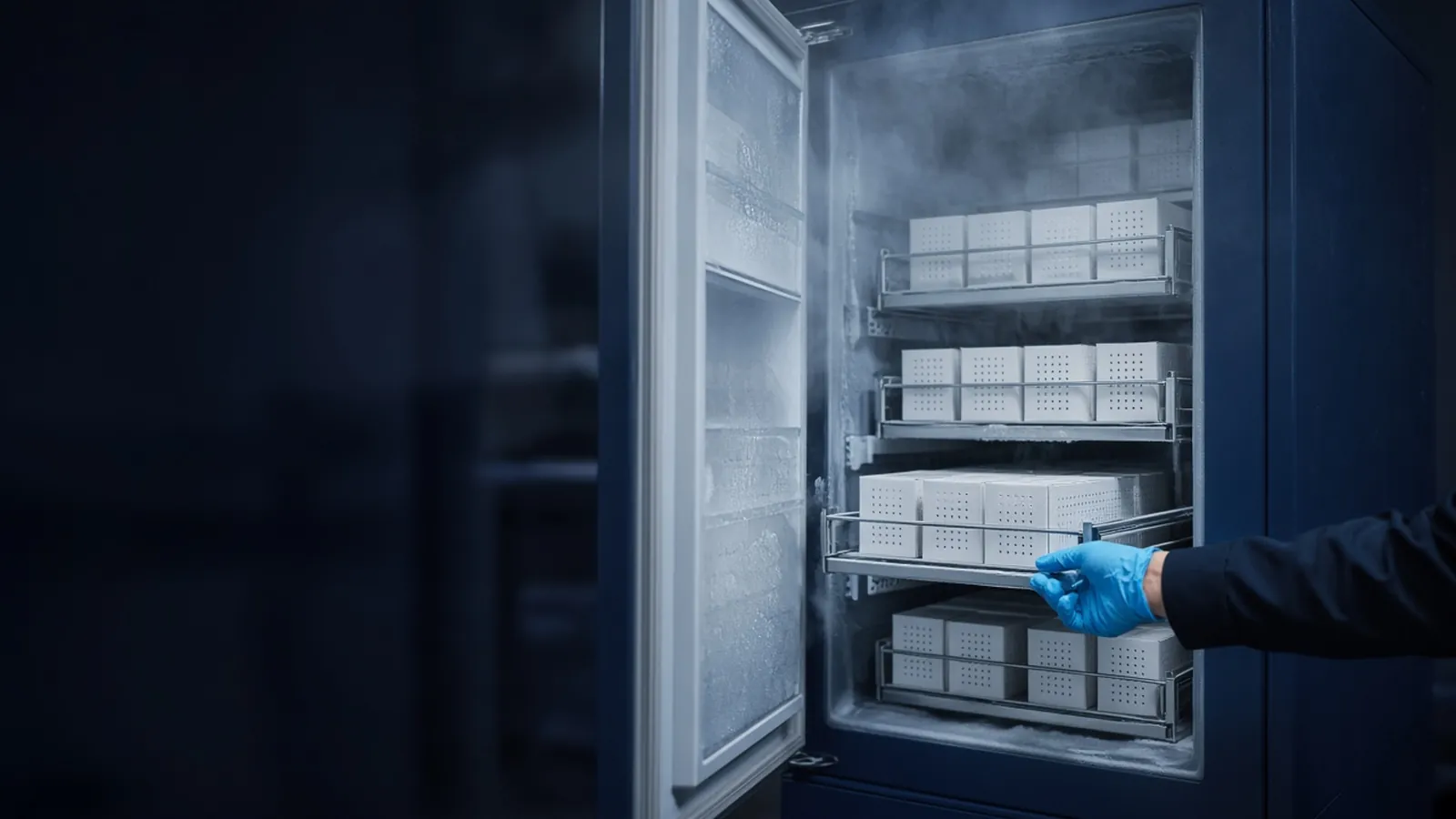
Two people can both say the freezer is at minus 80 and be pointing at different numbers. One means the setpoint painted on the controller. The other means the air a probe measured at 03:10, on a shelf near the door. This page compares the cold-chain pairs that get collapsed into a single word, because the collapse is how a warm sample gets filed as if nothing happened. The temperature classes themselves, from the fridge to nitrogen, are set out in storing biological samples from fridge to freezer. Dry ice as a transport coolant, with its burn and asphyxiation hazards, is in dry ice packing for sample shipments.
Tubes and cryoboxes are chosen from the laboratory plasticware catalogue. A cabinet, an alarm contact, or a logger is a specification you can send through laboratory procurement and a quotation request. The words below are the ones to get straight before that request is written.
The decision the vocabulary is for
You are deciding whether a sentence in a lab notebook, a shipper brochure, or a freezer display is evidence. Evidence supports a release decision or a quarantine. A synonym that is not a synonym supports a story. The five pairs below are the ones that most often turn a story into a false release: setpoint against air temperature, coolant against phase-change pack, holding time against qualification, alarm against logger, and vapour phase against liquid phase.
None of these comparisons replaces the product document for a named enzyme, cell, or nucleic acid. They stop you using the wrong noun when you write the condition you actually have.
Setpoint against the air the probe sees
The setpoint is the target you, or the installer, asked the controller to pursue. It is a number in the controller's memory. It does not move when someone props the door, when a compressor struggles, or when the probe drifts. If the display is set to show the setpoint rather than the probe, the screen can look calm during a failure.
Air temperature is a measurement at a place. In a loaded ultra-low cabinet the air at the top, the air at the bottom, and the air in the pocket behind the inner door are not obliged to match. A probe in a bottle of liquid answers more slowly than a bare probe in air, which is often what you want if you care about tubes, and the wrong answer if you wanted to catch a short door opening. NIST's laboratory metrology pages are a public reminder that a displayed number belongs to a measurement process, not to a wish.
Sample temperature is a third thing again. A full cryobox has thermal mass. Air can spike when the door opens and the liquid in the tubes can still be frozen. The reverse matters after a long power cut: the display may already read the setpoint while the core of a dense box is still warmer than the limit in the product document. Saying "it is back at setpoint" does not clear that box.
When you specify a cabinet, ask where the controlling probe sits, whether the display shows setpoint or measured temperature, and whether a second probe can be placed in a box simulant. Those are different lines on an enquiry.
A coolant is a class. A phase-change pack is one design.
Coolant means any material you pack so that it absorbs heat that would otherwise reach the samples. Wet ice, a frozen gel, solid carbon dioxide, and liquid nitrogen are all coolants. They do not hold the same temperature, and they do not fail the same way. Wet ice holds near the melting point of water while ice remains, then climbs once the ice is gone. Dry ice sublimates far colder and disappears as gas, which is why the shipper must vent. Nitrogen is colder still and is a storage and a hazard regime of its own.
A phase-change pack is a coolant engineered to change phase at a chosen temperature and to spend its capacity on that plateau. The useful part of the pack is the melt, or the freeze, at the temperature printed on the specification, after the pack has been conditioned into the right starting state. A gel pack that was thrown in a minus 20 cabinet overnight and then called a "2 to 8 pack" may begin much colder than 2 degrees and may pass through the desired window without dwelling there. Conditioning is part of the definition. An unconditioned pack is a cold object, not yet the pack-out you think you copied.
The confusion shows up at receipt. "Coolant was present" can mean a bag of meltwater, a still-solid gel, or a lump of dry ice. Those are three different histories. Write the state you saw: solid, slush, liquid, or absent. The packing page covers how dry ice is handled. This page only insists that you do not file all three states under one word.
Holding time is a claim. Qualification is your evidence.
Holding time is a duration attached to a stated pack-out and a stated ambient condition. A shipper maker, or a freezer maker talking about door-closed warm-up, may publish one. It answers a narrow question: under the test they ran, how long did the monitored load stay inside a band. Change the load, the coolant mass, the starting temperature, or the room, and you are outside that sentence.
Qualification is the documented showing that a process meets acceptance criteria you defined in advance. For a cabinet that can mean installation checks, an operational challenge, and a performance mapping under a realistic load. For a shipping lane it means a study, or a justified adoption of someone else's study, that covers the lane you actually use. A brochure holding time can be an input to that study. It is not the study.
The practical split: if the note says "qualified for 48 hours" and the only source is a catalogue line tested at a mild ambient, you have a holding-time claim, not a qualification of your afternoon. If your receiving room is warmer than that test, say so in the record and do not promote the claim.
An alarm calls someone. A logger remembers.
An alarm watches a reading and, when the reading crosses a limit for long enough, makes a noise or sends a message. It is a summons. It may store nothing except the fact that it tripped. A delay is often built in so that a thirty-second door opening does not page the whole building. That delay is a blind spot you should know the length of, from the cabinet manual, not from guesswork.
A logger writes temperature against time. It may have no voice at all. A logger that was not started, that was buried outside the shipper, or that filled its memory and stopped, did not guard the sample. An alarm that was switched off during defrost and never switched back did not either.
Use them as a pair when the material deserves it. The alarm is how a person arrives while the cabinet is still recoverable. The logger is how, the next morning, you decide whether the boxes that warmed are still inside the product document. Neither device measures the centre of every tube. Placement is part of the method: air, a buffer bottle, or a dummy vial, written down.
Vapour phase is not a softer name for liquid nitrogen
Liquid nitrogen at ordinary atmospheric pressure sits near minus 196 degrees Celsius. In the liquid phase, vials are immersed in that liquid, or sit in a rack that floods. The temperature is very low and very uniform while the vials stay under the surface. The hazard specific to immersion is liquid entering a vial whose seal is tired or whose o-ring is wrong, then expanding violently when the vial is warmed. That is a reason to use vials rated for liquid phase, not a reason to invent a home-made seal.
Vapour-phase storage keeps the vials in the cold gas above the liquid. The gas is still cryogenic, and it is not one temperature. Near the liquid surface it is colder; higher in a dewar that has been allowed to run low, it can be warmer than a new user expects, though still far colder than a mechanical minus 80 in a well-run tank. The liquid level is therefore a storage parameter, not a housekeeping detail. A box on the top shelf of a low tank is not in the same condition as a box just above a full charge of liquid.
Cells that a culture collection places in nitrogen should stay on the phase the collection names. The ATCC culture guides show the pattern: a strain arrives with a storage class. Moving vials between liquid and vapour is a new method. Write it as a new method, or do not do it. A tube rated only to minus 80 can crack in nitrogen. Specify the phase, the vial class, and who checks the liquid level.
The five pairs on one page
| Pair | What people swap | What actually differs | What to write down |
|---|---|---|---|
| Setpoint and air temperature | The display number | Target versus a probe at one place, versus the sample | Probe location and whether the screen shows the target or the reading |
| Coolant and phase-change pack | Any cold object in the box | A class of heat absorbers versus a pack with a designed plateau | Solid, slush, liquid, or absent, and the pack's stated temperature |
| Holding time and qualification | A brochure duration | A test under stated conditions versus evidence for your lane or cabinet | The ambient and load the number assumed |
| Alarm and logger | Something that watches temperature | A summons when a limit is crossed versus a stored curve | Limits, delay, placement, and whether the file exists |
| Vapour phase and liquid phase | Nitrogen storage | Gas above the liquid, with a gradient, versus immersion near minus 196 | Phase, liquid level, and vial rating |
A worked afternoon: the word that cleared a box too early
A plasmid box arrives on a Thursday. The brochure holding time assumes a mild room and a full charge of packs. The receiving room is warmer than that test, which you can tell by standing in it. The gel packs are soft. The logger shows a flat line because it was never started. The cabinet display reads the setpoint.
That record is: packs soft, logger not started, room warmer than the brochure ambient, display at the setpoint. It is not a qualification and not a sample temperature. The plasmids go to a marked quarantine shelf until the product document says whether this DNA preparation tolerates an unknown warm interval. Tolerance is a sentence in a document or in your own check.
The same afternoon, vapour phase is used to mean a dewar that still has some liquid at the bottom. The top rack sits above a low liquid level, which is not the phase the freezing SOP named. Those vials are quarantined too, and only someone trained on that dewar restores the level or moves them. Asphyxiation risk sits with the institution. The WHO laboratory biosafety manual frames biosafety as a local programme.
If the only temperature you can quote is the setpoint, you do not yet have a measurement. If the coolant is only "cold packs", you cannot tell a phase-change pack from a lump of gel. If a holding time was copied in as a qualification, replace it with the test conditions or delete it. If the alarm is empty and the logger file is missing, the excursion status is unknown. If a nitrogen inventory says LN2 and does not say liquid or vapour, split the record.
Research use, and what this glossary does not approve
This comparison is for research samples and research reagents. It is not a clinical storage protocol, a diagnostic release rule, or a biosafety approval. Infectious material, patient specimens, and anything a carrier would treat as a dangerous good stay with the institutional biosafety office and with people trained to ship them. Air rules for dry ice live in the IATA Dangerous Goods Regulations and in carrier variations. This page names that class of rule. It does not replace it.
What to put in a cold-chain enquiry
Ask for the temperature class, where the probe sits, and whether a logger or an alarm contact is part of the cabinet you are discussing. Ask which coolant class a shipper is built around, and whether any holding-time figure is tied to a named ambient and load. Ask whether cryovials are rated for vapour only or for liquid immersion. Name the tubes from the plasticware catalogue rather than "something that fits". Send that list with the quotation request. Leave out price talk and leave out any request that a seller promise the contents of your freezer will survive a power cut. Survival is your product document plus your record, not a line in a brochure.
Questions from the bench
If the display reads the setpoint, has the sample stayed at that temperature?
No. The display reports the controller target or a single probe, depending on how the cabinet is built. Air away from that probe, and the liquid inside a tube, can sit at a different temperature, especially after a door opening or a power cut. Use a logger in a realistic position when the question is about the sample.
Is a gel pack a phase-change pack?
Only if it is formulated and conditioned to hold a plateau at a stated temperature while it changes phase. A generic frozen gel can start far colder than that plateau and then warm straight through it. Read the pack specification and the pack-out that was tested, and do not rename every coolant as a phase-change pack.
Does a quiet alarm prove there was no excursion?
It proves that the alarm, as configured, did not see a reading outside its limits for long enough to trip. A probe in the wrong place, a long delay, a silenced buzzer, or a logger that was never started can all leave you without a record. Treat a missing record as a missing record, and quarantine when the product document requires a temperature history you do not have.
Should plasmids and cells share a liquid-nitrogen box?
Not as a default. Plasmids are often happy in a mechanical freezer, as the storage page explains, while viable cells may be specified for nitrogen. Liquid phase and vapour phase are different cryogenic conditions, with different risks of liquid entering a badly sealed tube. Follow the product document and the tube rating rather than filling whatever dewar has space.
References
Manufacturer names identify published method classes. Trademarks remain with their owners. Catalogue records on this site are independent references for enquiry. They are not a statement of inventory, distribution rights or a supply commitment. This page is educational. It is not medical advice, a diagnostic protocol or a biosafety approval.
Continue in this cluster
Related reading
Storing biological samples from fridge to freezerFridge, minus-20, minus-80 and nitrogen storage slow different kinds of damage. A warm box is a quarantine decision, not a hope.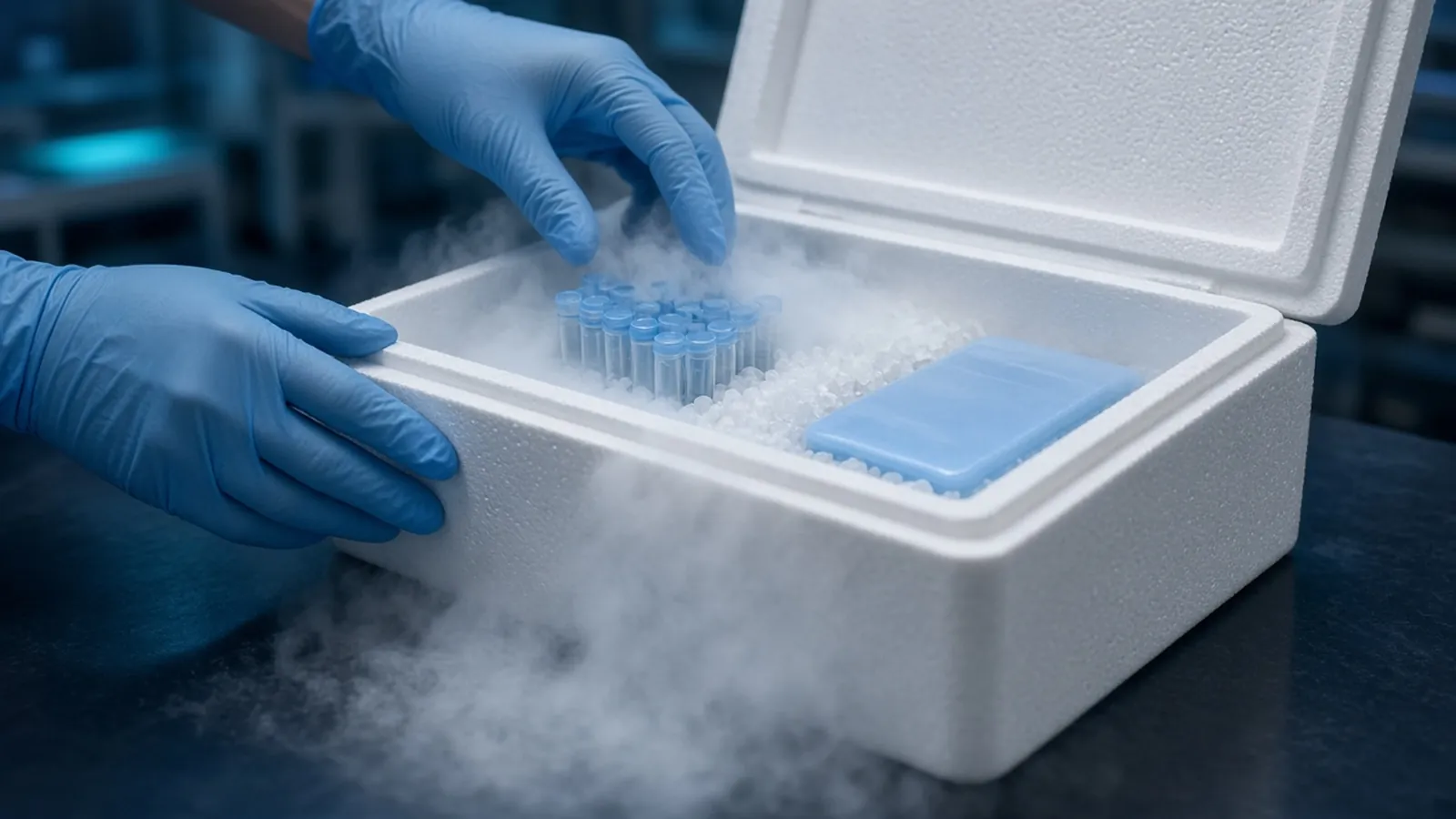 Dry ice packing for sample shipmentsDry ice keeps non-infectious research samples cold and can burn skin or displace air. Carrier rules and infectious-substance law still govern shipping.Avoiding frost on a rack you opened too longChoose the rack from the map before you open the door. Warm moist air ices the front boxes, and the decision is to close.