
guide
Dry ice packing for sample shipments
Dry ice keeps non-infectious research samples cold and can burn skin or displace air. Carrier rules and infectious-substance law still govern shipping.
- Author
- EVRINTH Editorial Team
- Published
- 8 October 2026
- Updated
- 8 October 2026
- Reading time
- 11 min
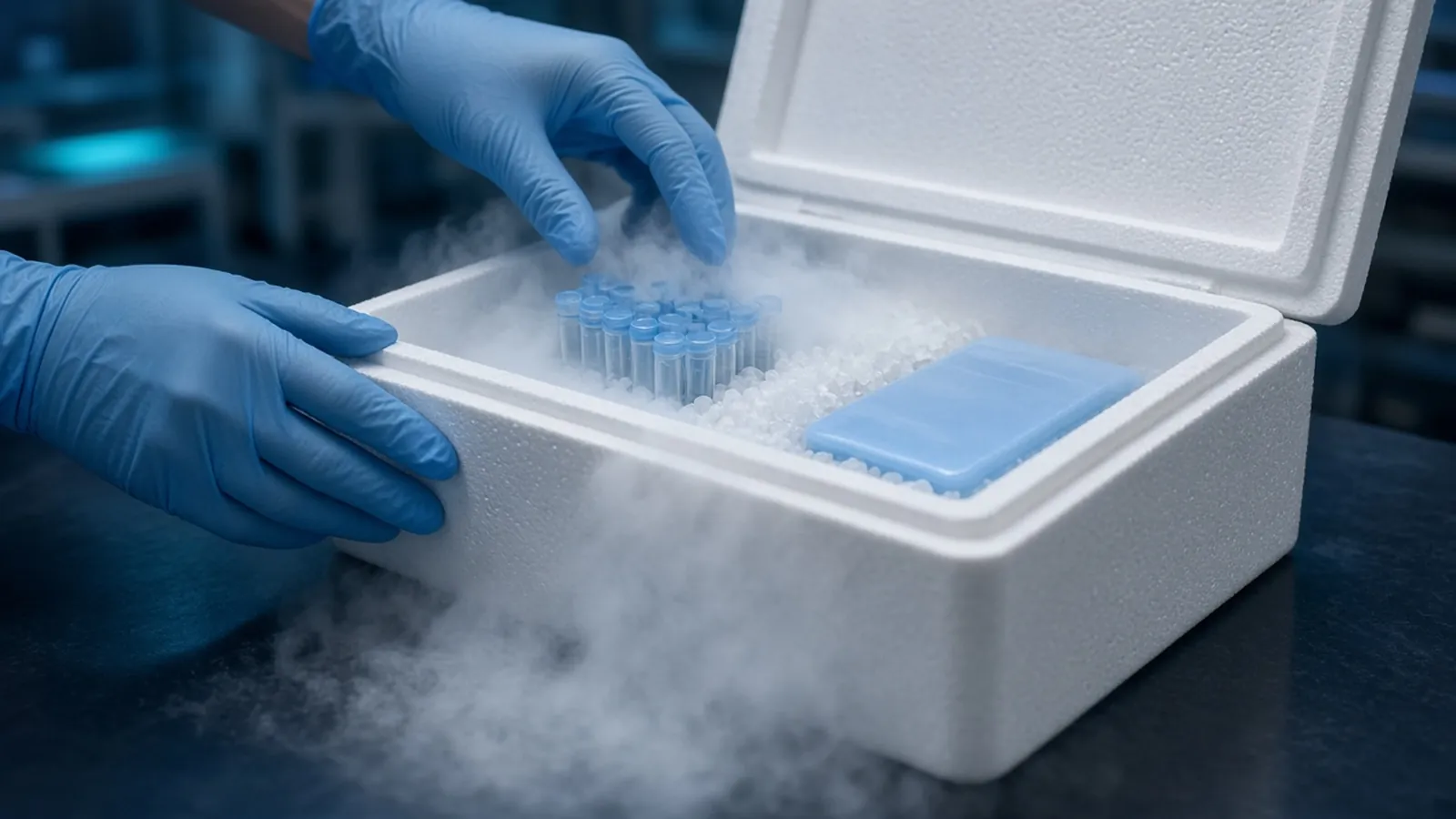
Dry ice packing for sample shipments is a cold-chain decision with two kinds of failure: the sample warms, or a person is hurt by the coolant. Solid carbon dioxide is an effective, temporary refrigerant. It is also a contact freeze injury and a source of gas that can displace oxygen. This page explains those facts and the decisions a laboratory makes for ordinary non-infectious research goods. It does not tell you how to ship a pathogen, a diagnostic specimen, or any material your institution classifies as regulated. That work belongs to people the institution has trained, using the carrier's current rules.
Where the sample should live before and after the journey is storing biological samples from fridge to freezer. Tubes and shippers are discussed as plasticware in the laboratory plasticware catalogue. A handover specification is a laboratory procurement question and a quotation request.
Who this decision is for
Use the decision when a research reagent, a plasmid preparation, an enzyme, or another material your biosafety office has already called non-infectious must stay frozen on a journey, and the receiving laboratory can put it into a real freezer on the day it arrives. Do not use this page to invent a classification. If you are unsure whether the material is an infectious substance, stop and ask. The WHO laboratory biosafety manual and the CDC BMBL treat transport as part of biological risk management. They are educational references here, not a permit, and they are not a packing list you can tick in place of the regulations.
Culture collections ship living material under their own conditions. The ATCC culture guides show that a strain has a recovery method and a biosafety context. Follow the sender's conditions and your institution's approval. Do not translate a research explainer into a customs document.
What dry ice is doing
At ordinary pressure, carbon dioxide does not melt into a puddle. The solid sublimates, and the temperature of that solid sitting in open air is about minus 78 °C. Gas leaves the solid continuously. In an insulated box the rate depends on how well the box resists heat, how warm the surroundings are, how full the box is, and how often it is opened. The gas is colder and denser than room air, so it sinks. That is useful inside a shipper and dangerous in a closed room.
The cold is deep enough to keep many frozen research samples below thawing for a limited time, and deep enough to damage some tubes, some labels, and human tissue on contact. It is not the same as an ultra-low freezer. A freezer holds a set point while power and a sealed cabinet allow it. A dry-ice shipper is a melting clock, except that nothing melts: the coolant simply disappears. When it is gone, the box warms toward the baggage hold, the van, or the loading dock. Sample integrity after that moment is no longer a dry-ice claim.
Hazards you plan for before the scientific details
Cold burns are immediate. Bare hands, thin nitrile gloves, and wet gloves are the wrong tools. Water on a glove freezes to the skin. Use insulated gloves made for dry ice or tongs, and keep the contact short. Do not chip a block with a bare wrist steadying it. Treat a cold burn as an injury under the laboratory's first-aid rule, not as a badge of effort. This page is not medical advice and does not describe treatment.
Oxygen displacement is the hazard people postpone because the gas is invisible. A large charge of dry ice in a small cold room, a walk-in freezer, a sealed cupboard, or a passenger car can lower the oxygen available to breathe. Pack and store shippers in a ventilated place. Do not ride in a closed cabin with the box on the seat. Do not store the week's dry ice in a small office overnight. If a room has an oxygen alarm because the risk assessment required one, believe the alarm and leave.
Pressure is the third hazard. A tightly sealed jar, a welded tin, or a shipper taped all the way around with no vent can burst as gas forms. Purpose-built shippers vent. Leave that path open. "Making it more secure" with extra tape is how a safe box becomes a pressure vessel.
Dry ice can also make some plastics brittle. A tube that is safe at minus 20 can crack at dry-ice temperature. Use primary containers rated for the journey, with expansion room if any liquid can expand, and a secondary container so one crack does not soak the coolant.
What this page will not walk you through
It will not choose a UN packing instruction for an infectious substance, name a pathogen's category, or describe how to pack a patient specimen. Those choices are legal classifications. They change with the organism, the form of the material, the carrier, and the countries on the route. A trained shipper, the carrier's current dangerous-goods manual, and the institution's biosafety office are the procedure. If the material might be regulated, the correct next step is to stop and hand the question to those people.
Even for non-infectious goods, carriers treat dry ice itself as a declared dangerous good. You should expect a proper shipping name, a weight of dry ice, and marks on the package. Confirm the current wording and the accepted label with the carrier you will actually use. Do not copy a form from memory or from this article. Airline and courier cutoffs are part of the method, because a box that misses the flight sits in heat, sublimating.
Decisions for a non-infectious research shipment
Confirm the classification in writing. "We always send it this way" is not a classification.
Choose the temperature need. Some enzymes and glycerol stocks are shipped by their makers on dry ice. Some reagents are stable with cold packs. Using dry ice on a material that must not freeze can destroy it. Read the stability statement. If the receiving laboratory can only refrigerate, a dry-ice shipment that arrives on a Friday night is a freezer problem, not a logistics success. Agree the day and the receiver first. The storage page explains why a shipper is not a cabinet.
Use a primary tube that is sealed, a secondary container, and enough absorbent for a leak if the institution asks for it even on non-infectious liquids. Surround the secondary container with dry ice so the cold reaches it, without crushing tubes under a single block if the method or the tube maker warns against that. A temperature indicator, if you use one, should be where it sees the sample's environment, and someone must be willing to believe a failed indicator.
Weigh the dry ice. The declaration depends on the weight. Hot ambient air, a thin-walled box, a long road leg, and a delay on a warm tarmac all increase the mass you need. Take that mass from the shipper maker's guidance and the carrier's acceptance rules for your route. A figure copied from a cold city and a thick box is how a parcel arrives as cold water and a note that says the ice was "enough last time".
Label the outside as the carrier requires, including the dry-ice weight, and put the scientific identity where the receiver can read it without destroying the vent. Include a packing list inside the secondary container. Do not place a document where condensate will erase it and do not seal the vent to "keep the list dry".
When the box arrives
The receiver opens the shipper in a ventilated place, with insulated gloves, and records whether dry ice remains and what any indicator shows. If the coolant is gone, the samples are quarantined. A plasmid that the stability statement says survives a day at room temperature is a different case from an enzyme that does not. The statement decides, and the record shows you used it. Returning a warm enzyme to the freezer and hoping is how a dead reagent enters the in-use rack.
Do not store the spent shipper, still containing dry ice, in a cold room to "use the last of the cold". The gas still evolves, and cold rooms are famously small and poorly supplied with fresh air.
| What you notice | What it may mean | The decision |
|---|---|---|
| Dry ice remains, indicator acceptable | The hold likely covered the journey | Move the material into the agreed freezer and file the note |
| Dry ice gone, indicator failed | The sample saw an unknown warm time | Quarantine and compare with the stability statement |
| Box bulging or taped shut | The vent was blocked | Do not call that a success. Review the pack before anyone repeats it |
| Receiver absent on a hot day | The clock ran out on the dock | The handover failed even if the pack was good |
Heat, delays, and a long road leg
In a hot season the same shipper and the same mass of dry ice last a shorter time. A route with a van, a hub, and a second van is three heat exposures, not one. Build the plan around the carrier's cutoff and a named person at the destination. A Friday dispatch that arrives on Monday is a storage decision you should make on Thursday, not a surprise.
Power cuts at the receiving laboratory are the storage page's problem, and they belong in the handover note. There is little value in a perfect pack if the only freezer is already dark. Humidity fogs labels and wets cardboard. A soggy outer carton is a handling failure waiting to happen. Use the shipper the carrier accepts, and keep the marks readable.
Methods filed on protocols.io often say "ship on dry ice" in one line. That line assumes a classification, a vented box, and a receiver. Import the assumption into your note, or do not import the method's shipping sentence at all.
Safety, research use, and the boundary
The scientific claim of this page stops at non-infectious research material that your institution has classified. It does not authorise a shipment. It does not replace a dangerous-goods declaration for the dry ice itself. It does not describe how to pack blood, cultures of risk-group organisms, or diagnostic specimens. Those remain with the trained shipper and the carrier.
Personal injury from the cold or from the gas is a laboratory safety incident. Report it through the local system. Do not treat a burn or a headache in a closed car as an acceptable cost of getting the samples out.
What to put in an enquiry
Ask for a vented insulated shipper, the temperature class it is intended to support, the outer dimensions and mass limits a named carrier will accept, and a temperature indicator if you need one. Specify cryovials by temperature rating and volume. State that infectious classification will be performed by your institution. Ask the quotation to confirm that the shipper is meant to vent, not to be hermetic.
Send that specification through the quote form. Compare answers on venting, on what the seller will document, and on whether the box matches the route. A thicker adjective is not a mass of dry ice, and a mass of dry ice is not a classification of the sample.
Decide whether a non-infectious research shipment may use dry ice
- 01Classify the material before you touch the coolantAsk the institutional biosafety office whether the sample is an infectious substance, a patient specimen, or ordinary non-infectious research material. If it is regulated, stop and use the trained shipper and the carrier's dangerous-goods process. This page is not that process.
- 02Choose a vented shipper and a secondary containerPut the sealed primary tubes inside a secondary container that can survive a leak. Place that container in an insulated shipper designed to vent carbon dioxide. Do not tape the lid airtight and do not use a sealed screw-cap jar as the outer box.
- 03Plan the coolant for the heat and the transit timeAsk the shipper manufacturer and the carrier how they expect dry ice to be weighed and declared for the route you have. Hot weather and a thin box shorten the cold hold. Do not copy a kilogram figure from a different climate and a different box.
- 04Write the receipt rule before the parcel leavesName the person who will open the shipper on arrival, the freezer the material should enter, and the quarantine rule if the dry ice is gone. Sample integrity is a recorded condition, not a hopeful shrug.
Questions from the bench
Can this page be used to ship a pathogen or a diagnostic specimen?
No. Infectious substances and many patient specimens are regulated dangerous goods. They require trained people, carrier approval, and the packaging the regulations name. This article explains dry-ice hazards and the decisions for ordinary non-infectious research material. It is not a shipping manual for regulated biologicals.
Why must the shipper be allowed to vent?
Dry ice turns directly to carbon dioxide gas. In a sealed vessel that gas has nowhere to go, and the pressure can burst the container. Purpose-built dry-ice shippers leak that gas on purpose. Venting is a safety feature, which is also why the same gas can fill a closed car or a small room.
What are the immediate hazards to the person packing the box?
Cold burns and oxygen displacement. Solid carbon dioxide injures skin on contact, and wet gloves freeze to the hand. The gas is heavier than air and can pool in a cold room, a walk-in, or a closed vehicle. Pack in a ventilated space, use insulated gloves or tongs, and do not travel in a closed cabin with a large load.
What should a cold-chain enquiry ask for?
Ask for an insulated shipper rated for dry ice, the vent design, the outer size the carrier will accept, and any temperature-indicator class you intend to read on arrival. State that classification of infectious material will be done by your institution, not by the seller. Send the specification as a quotation request.
References
Manufacturer names identify published method classes. Trademarks remain with their owners. Catalogue records on this site are independent references for enquiry. They are not a statement of inventory, distribution rights or a supply commitment. This page is educational. It is not medical advice, a diagnostic protocol or a biosafety approval.
Catalogue
Related products and categories
These links follow the subject of the article into published manufacturer references. A listing is a reference for an enquiry, not a statement of stock or distribution rights.
Continue in this cluster
Related reading
 Storing biological samples from fridge to freezerFridge, minus-20, minus-80 and nitrogen storage slow different kinds of damage. A warm box is a quarantine decision, not a hope.A glossary of cold-chain termsSetpoint is not air temperature, and a phase-change pack is not every coolant. Compare the cold-chain pairs labs treat as one word.Avoiding frost on a rack you opened too longChoose the rack from the map before you open the door. Warm moist air ices the front boxes, and the decision is to close.