
troubleshooting
Backup freezers and who holds the key
A backup is a named person, a route for the boxes, and a temperature check on arrival. A locked spare freezer is only a second appliance.
- Author
- EVRINTH Editorial Team
- Published
- 8 October 2026
- Updated
- 8 October 2026
- Reading time
- 8 min
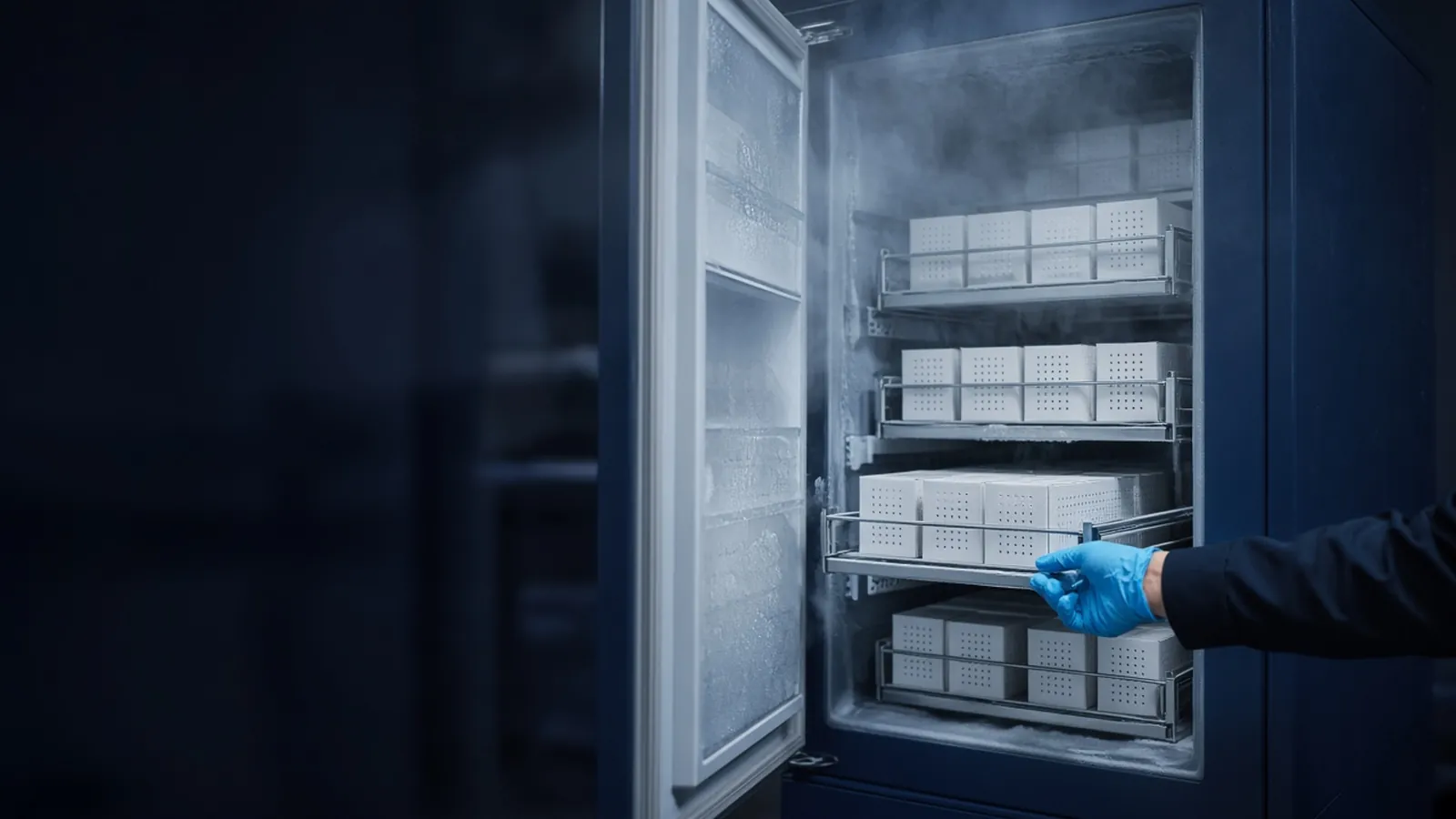
The alarm sounds after the building is locked. The spare ultra-low freezer is in a room nobody on the call-out list can enter. That cabinet may be cold, empty, and well maintained. It is still not a backup. The scientific control is a named person who can act at that hour, a route that says which boxes move and where, and a temperature check when they arrive. Without those three, you have a second appliance and a story about redundancy. Temperature classes and the reason a warm box is quarantined are in storing biological samples from fridge to freezer. Dry ice as a short bridge, including the gas hazard, is in dry ice packing for sample shipments.
Boxes and racks that make a move possible are in the laboratory plasticware catalogue. Specifying an alarm contact or a destination cabinet is a laboratory procurement subject and a quotation request.
The symptom you are actually looking at
Start from the symptom, not from the purchase.
The alarm rang and nobody came, because the number in the controller is a person who left the institution. The alarm rang and someone came, but the source freezer key is in a drawer they cannot open. Someone came and moved boxes onto a bench because the destination was locked. Someone moved boxes into a destination that was itself at minus 40 and warming. Someone moved boxes into a domestic frost-free cabinet because it was the only thing with a plug. The logger on the destination was not started, so the morning record says the move happened and not whether the samples were cold on arrival.
Each of these is a failed backup. The compressor inventory can still say you own two freezers.
What has to be true before the night
A named person and a deputy are written on the call-out, with telephone numbers that work, and with the legal right and the physical means to enter the building, the source room, and the destination room. Access means a key, a code, or a security desk that will open for that name at night. A key safe that nobody has opened in a year is a puzzle, not access. Test the access on a boring afternoon. The test is part of the control.
The route is a short document: which alarm thresholds trigger a move rather than a watch, which boxes or racks move first, what the destination is, and where the empty space is. Priority is a scientific choice made in advance. Irreplaceable study material moves before a box of aliquots you can remake, if the SOP says so. "Move everything" in a cabinet that takes an hour to empty is a route that will prop the door and warm the samples you are saving. A partial, ordered move beats a heroic one.
The destination is at the same temperature class, or at a class the product document allows as a temporary step. It has space that is actually empty. Someone checks that space on a schedule, because empty space fills. The destination's own alarm is on. If the destination is off site, the route includes how boxes travel and who may carry them. A taxi with a foam box is not automatically that plan.
The arrival check
When the boxes reach the destination, read the destination temperature before you declare the incident over. A display at the setpoint, a probe you trust, or a logger you started at the beginning of the move: pick the measurement your SOP names and write the number down with the time and the person's name. NIST's laboratory metrology pages are a public anchor for the idea that the number has to be a measurement.
If the destination is warmer than the limit, the boxes are not saved. They are in a second excursion. Leave them quarantined, keep the door shut if the cabinet is trying to recover, and call the deputy. Do not shuttle boxes back and forth.
If you used dry ice as a bridge, the arrival check includes the coolant state and the time the ice was packed. The packing page covers gloves, ventilation, and the fact that dry ice is not a freezer. In the morning the boxes still need a real cabinet and a quarantine decision if the bridge was longer or warmer than the product document allows.
Symptoms, likely causes, next check
| Symptom | Likely cause | Next check |
|---|---|---|
| Alarm, no person on site | Call-out list stale, or no access at night | Who can open the door tonight, by name |
| Person on site, boxes on the bench | Destination locked or full | Key test and empty space, in daylight |
| Boxes moved, destination warm | Spare was unplugged, in defrost, or alarmed already | Temperature on arrival, then quarantine |
| Frost-free domestic cabinet used as spare | No laboratory-class destination | Product document. Do not call the cycle a hold |
| Morning record has no temperatures | Logger not started, display not written down | The route's arrival line was skipped |
| Dry ice box left in a closed office | Bridge treated as storage | Ventilation and a same-morning move |
A night that failed, and the repair in daylight
Power drops in a warm building. The ultra-low alarm calls a number. The postdoctoral researcher who set the number is abroad, and the key to the spare room is in their desk. A security guard can let someone into the corridor and not into the spare room. The boxes stay in the failing cabinet with the door shut, which is correct given the access you actually have. In the morning the trace shows a long excursion. Quarantine follows the storage page. The spare freezer, still cold and still locked, did not change that outcome.
The repair is not a speech about responsibility. The repair is a deputy with a key, a destination shelf that is emptied and labelled "reserve", a route of ten boxes that are the irreplaceable set, and a line on the form for the destination temperature. You walk the route on a Tuesday. You write how long the door was open. You fix the route if the reserve shelf was already full of someone else's samples.
If the only destination you can open is a frost-free fridge-freezer in a kitchen, do not use it for enzymes or for cells and call the move a save. The warm cycle is a second insult. Prefer a watched, closed source cabinet, or a dry-ice bridge built by someone who has read the packing page, over a domestic cycle. Then get the boxes to a laboratory cabinet the same morning.
Other ways the control fails
The named person can enter and does not know which rack is the study. They empty the front of the freezer, which is the most recently used and often the most replaceable, and leave the archive. The route has to be findable without a memory: a shelf map on the door, readable before the door stays open.
Two groups share the spare and both count the same empty shelf. The first incident consumes it. Shared space needs one owner who can refuse a silent filling of the reserve.
The arrival temperature is written as "OK" rather than a number. The next incident has no baseline. Write the number and the time.
A backup plan that ignores biosafety moves an infectious-material box into a general freezer. The route has to respect the containment the institution already set. The WHO laboratory biosafety manual and the CDC BMBL are the programme context. Your safety office decides whether a night move of that material is even permitted.
What to specify in the enquiry
Ask whether the cabinet provides an alarm contact a building system can watch, and what happens when power returns. State, as your requirement, that a person you name must be able to reach a destination of the same class. Ask for racks that can be lifted as a unit so the route is fast. Put those lines in the quotation request. Do not ask a seller to hold your key, to staff your alarm, or to promise the contents will survive an outage. The key is yours. The check on arrival is yours.
Questions from the bench
The spare freezer is cold. Why is that not enough to call it a backup?
Cold and inaccessible is a second appliance. A backup includes a named person who can open the source and the destination when the alarm rings, a route that says which boxes move, and a temperature check when they arrive. If the only key is in another city, the spare does not participate in the incident.
Can dry ice replace a backup freezer overnight?
Dry ice can be a temporary bridge for material that tolerates that temperature, in a vented insulated container, handled as the packing page describes. It is not a storage address and it is not a backup by itself. Someone still has to be allowed into the building, pack the boxes, and move them to a real cabinet in the morning. An unattended foam box in a closed office is an asphyxiation hazard.
The destination freezer was full. What should the route have said?
The route should have named empty space that is checked on a schedule, not space you hope will exist. A full destination means the move stops or a lower-priority box is removed under a rule you wrote in advance. Discovering the lack of space at 02:00 means the route was a sentence, not a plan.
Who may be the named person?
A person the laboratory designates, plus a deputy, both able to enter at the hour the alarm can ring. The scientific control is that the name is written, the access is real, and the person knows the route. A job title with no key, and a key with no training, are the two ways the name fails.
References
Manufacturer names identify published method classes. Trademarks remain with their owners. Catalogue records on this site are independent references for enquiry. They are not a statement of inventory, distribution rights or a supply commitment. This page is educational. It is not medical advice, a diagnostic protocol or a biosafety approval.
Catalogue
Related products and categories
These links follow the subject of the article into published manufacturer references. A listing is a reference for an enquiry, not a statement of stock or distribution rights.
Continue in this cluster
Related reading
Storing biological samples from fridge to freezerFridge, minus-20, minus-80 and nitrogen storage slow different kinds of damage. A warm box is a quarantine decision, not a hope. Dry ice packing for sample shipmentsDry ice keeps non-infectious research samples cold and can burn skin or displace air. Carrier rules and infectious-substance law still govern shipping.A glossary of cold-chain termsSetpoint is not air temperature, and a phase-change pack is not every coolant. Compare the cold-chain pairs labs treat as one word.