
comparison
Incubator temperature and shaking speed
Routine E. coli cloning cultures are shaken near 37 Celsius so the broth stays aerated. This comparison separates that shaker from a plate incubator and from a
- Author
- EVRINTH Editorial Team
- Published
- 8 October 2026
- Updated
- 8 October 2026
- Reading time
- 9 min

A cloning strain does not care what the incubator door says. It cares whether the broth is near the temperature on the protocol and whether the liquid is actually moving air into the culture. The decision this comparison supports is which machine matches non-pathogenic E. coli plate work, which machine matches a shake flask, and which familiar box is simply the wrong class. Growth, transformation and the fill of a flask are set out in bacterial culture and transformation. Plates that then have to stay selective are the subject of antibiotic selection and blue-white screening.
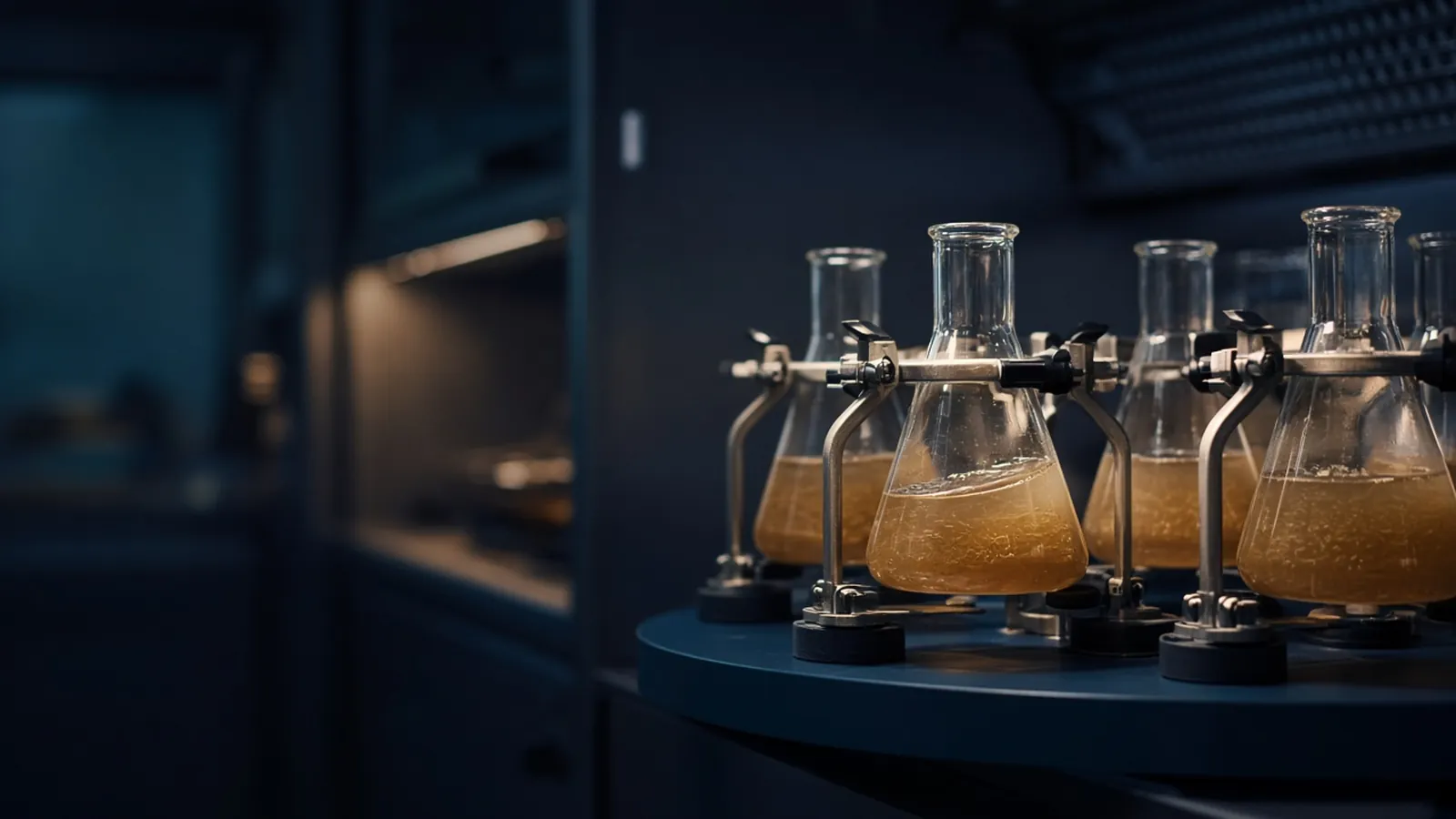
Look at the hero photograph before you trust the title. It shows a gloved hand reaching into a CO2 incubator stacked with cell culture flasks of red medium. That is a mammalian incubator. It is printed here as a reminder that incubator class must match the organism. A routine E. coli shake flask does not belong in that box. Medium and antibiotic classes for the bacterial work are in the reagents and chemicals catalogue. The path around the culture is the molecular biology pathway. Sequence questions can be framed from custom gene synthesis as a reference only. A shaker specification goes through the quote request.
Temperature the strain can use
Many K-12 cloning and ordinary expression cultures are incubated near 37 Celsius. That is the set point you will see in a large share of plasmid preps and in the inoculation notes collected by the Addgene protocol for inoculating a bacterial culture. It is not a law for every construct. A toxic plasmid, a temperature-sensitive origin, or an induction that the vector sheet moves to the mid-20s, all need a machine that can hold the lower number. Follow the sheet. Write the number you intend on the flask, because a shared shaker's panel is everybody's number and therefore nobody's record.
Plates want the same temperature and no orbit. They are incubated inverted so condensate forms on the lid and does not rain colonies into one another. A plate incubator is a static cabinet or a static shelf in a larger room. It does not become a shaker by being warm. Crowding plates against the wall of a cabinet that runs hot at the edges changes colony size from shelf to shelf. When colony size is the assay, that gradient is a problem. When you only need isolated colonies, it is still worth knowing which shelf runs high.
Measure something other than the panel once in a while. A bottle of water with a thermometer, left where the flasks stand, tells you whether the platform matches the display. Uniformity across a wide platform is part of a commercial specification because the flask over the motor and the flask at the corner are not automatically the same culture.
What shaking is for
Shaking exists to move oxygen into the broth and carbon dioxide out. An orbital platform does that by swirling a flask that is not filled to the neck. A planning habit used widely is to keep the culture volume in the lower fifth to quarter of the flask so the swirl can form. The habit is not a brand rule. A flask filled to the shoulder, shaken slowly, becomes hypoxic, acidifies, reaches a meagre stationary phase, and can lose a burdensome plasmid. People then blame the antibiotic.
Speed has a floor and a ceiling, and both depend on the throw of the orbit. A larger orbit moves the liquid more at the same revolutions per minute. Many cloning laboratories use a few hundred revolutions per minute on a common orbital throw for E. coli in Erlenmeyer flasks. The manual for the machine in front of you is the document that matches speed to throw. Too low, and the surface of the broth barely ripples. Too high for that flask and that closure, and a foam bung, a foil cap or a cotton plug lifts, the culture wets the closure, and the flask can unscrew itself from a tired clamp. A loose clamp is a contamination path and a broken-glass path.
Closures have to pass air and stop dust. A tightened solid cap is a sealed bottle, not a shake flask. Filter caps and loose foams are method classes. Match them to the flask you specified, and do not borrow a mammalian flask cap from the CO2 incubator because it was dry.
Static broth in a warm cupboard is not a mild form of shaking. It is a different, poorly aerated culture. If the protocol says shaken, a still flask is a deviation, not a quiet success.
The CO2 box is a different organism's machine
A mammalian CO2 incubator holds a carbon dioxide fraction so bicarbonate-buffered medium stays at the pH the animal cells expect, and it is usually humidified so small volumes do not evaporate. The photograph at the top is that machine. E. coli cloning medium is not that buffer system. Parking shake flasks inside it because the bacterial shaker is full gives you the wrong gas, the wrong humidity, and no orbit. Parking agar plates in it because the plate incubator is full dries or soaks them on a schedule the cloning method did not set, and it mixes bacterial plates with a cell-culture room that may have its own contamination rules.
The comparison is therefore three ways, not two. Plate incubator: static, near 37 Celsius unless the plasmid says otherwise, dishes inverted. Shaking incubator: orbital aeration, clamps, a temperature the flask actually reaches, closures that breathe. Mammalian CO2 incubator: the wrong class for a routine E. coli shake flask, even when the number on the door is also 37.
Collection laboratories describe how they expect recipients to revive strains, including temperature, in guides such as the ATCC culture guides. Reagent context around the culture appears in Promega protocols. A place laboratories deposit their own written methods is protocols.io. None of those pages converts a CO2 incubator into an orbital shaker.
Three machines
| Machine | What it is for | What goes wrong if you use it for the other job |
|---|---|---|
| Static plate incubator | Inverted agar plates at the strain temperature | It will not aerate a broth. A flask left here is a still culture with a warm label. |
| Orbital shaking incubator | Aerated broth in clamped flasks, temperature uniform enough for the protocol | Speed too low starves the culture of oxygen. Speed too high throws the closure. A heat-only unit cannot run a cold induction in a hot room. |
| Mammalian CO2 incubator | Animal-cell flasks in humidified CO2, as in the photograph | Wrong atmosphere and no proper bacterial shake. It is not a spare 37 degree room for E. coli flasks. |
A commercial specification can be written from the middle row without a favourite brand. Ask for orbit class, temperature range, whether cooling exists below ambient, uniformity across the platform, and clamp or sticky-mat style sized to the flasks you use. Ask the maximum flask mass the platform is happy to balance. An unbalanced load walks, and walking flasks are how closures open.
When the culture disagrees with the panel
A broth that smells sharply sour, is dense early, and yields little plasmid often had too little air or sat too warm. Reduce the fill or raise the agitation within the manual before you change the strain. A culture that never clouds may be at a temperature the strain is not using, on the wrong antibiotic, or dead from the inoculum. A closure found off in the morning is a speed or clamp finding, and the flask is contaminated until proved otherwise. Do not decant it into a fresh bottle "to save the prep".
A platform that runs hotter at the back will make induction flasks incomparable. That is a uniformity failure, and it belongs in the specification you write next time. A heat-only shaker in a room that is already above the set point cannot cool a culture for a mid-20s induction. The panel will tell a comforting story. The broth will not.
Safety around a moving platform
Balance the load. Stop the orbit before you open a flask. A broken flask in a shaker is an aerosol and a cut, and it is cleaned the way the safety office cleans a culture spill, not with a paper towel and optimism. Cloning strains stay inside the assessment you have. Do not park a different organism in the bacterial shaker because the clamp fits. This page is not medical advice and not a manual for a particular brand.
Power cuts and rooms that are hotter than 37
When the power fails, shaking stops and heating or cooling stops. A flask that sat still and warm for hours is not the aerated log-phase culture you planned to induce or to prep. Cool it if the rule allows, record the interval, and start again from a fresh colony rather than pretending the growth curve continued. In a hot season, a machine that only heats can overshoot if the room itself is hot and the cabinet cannot reject heat. Specify cooling if any protocol you run sits at or below ambient. Specify that a CO2 incubator is not an acceptable substitute in the quotation, so a mammalian box is not delivered against a bacterial shake-flask need.
What to put in the enquiry
State bacterial shaking incubator, temperature class near 37 Celsius for routine work and any cooler class you actually use, orbit class, platform uniformity, and clamp style for the flask volume class you use. State that plates are a separate static incubator. State that a humidified CO2 machine is a different organism's tool. The method can be discussed against that specification. Send it with the strain and the antibiotic through the quote request. If the culture exists only because a new construct is being designed, keep custom gene synthesis as a design reference beside the shaker note, not as a status on a run.
Questions from the bench
Is the photograph a bacterial shaker?
No. The hero image is a gloved hand and a CO2 incubator stacked with mammalian culture flasks of red medium. It is a reminder that the machine has to match the organism. A humidified CO2 incubator is the wrong class for a routine E. coli shake flask, which needs an orbital shaker, clamps, and air exchange rather than a bicarbonate atmosphere.
What temperature do cloning strains usually see?
Many non-pathogenic E. coli cloning cultures are grown near 37 Celsius, on plates and in shaken broth. Some plasmids and some induction protocols call for a lower set point. Follow the strain and the vector sheet. A panel value is only real if a flask or a dummy bottle at the platform actually sits near that temperature.
Why is revolutions per minute not a universal speed?
Aeration depends on the orbit diameter, the flask size, the fill, and the speed together. A few hundred revolutions per minute is a common class on a standard orbital throw for E. coli, and the shaker manual is the authority. Too slow, and the broth is a hypoxic stationary culture. Too fast for the closure and the clamp, and the bung comes off or the flask walks.
What belongs in a shaker specification?
Temperature class, whether the machine can cool below room temperature, orbit class, the uniformity you need across the platform, and the clamp or mat style that holds your flasks. Leave brand loyalty out. State the antibiotic work and the strain class so a plate incubator is not offered as a substitute for a shaken broth.
References
Manufacturer names identify published method classes. Trademarks remain with their owners. Catalogue records on this site are independent references for enquiry. They are not a statement of inventory, distribution rights or a supply commitment. This page is educational. It is not medical advice, a diagnostic protocol or a biosafety approval.
Catalogue
Related products and categories
These links follow the subject of the article into published manufacturer references. A listing is a reference for an enquiry, not a statement of stock or distribution rights.
Continue in this cluster
Related reading
 Bacterial culture and transformationHow non-pathogenic E. coli cloning strains are grown and how plasmid DNA is introduced, with the controls that make a colony meaningful.
 Antibiotic selection and blue-white screeningHow antibiotic plates keep a plasmid in a cloning strain, and why a white colony on X-gal is a candidate rather than proof of the insert.A glossary of bench microbiology termsPlain definitions of colony, lawn, streak, pellet, transformant and the other bench words a cloning afternoon depends on.