
guide
PCR controls and contamination control
How no-template, positive and inhibition controls decide whether a PCR band can be trusted, and how a shared bench keeps old amplicons out of the next setup.
- Author
- EVRINTH Editorial Team
- Published
- 8 October 2026
- Updated
- 8 October 2026
- Reading time
- 8 min
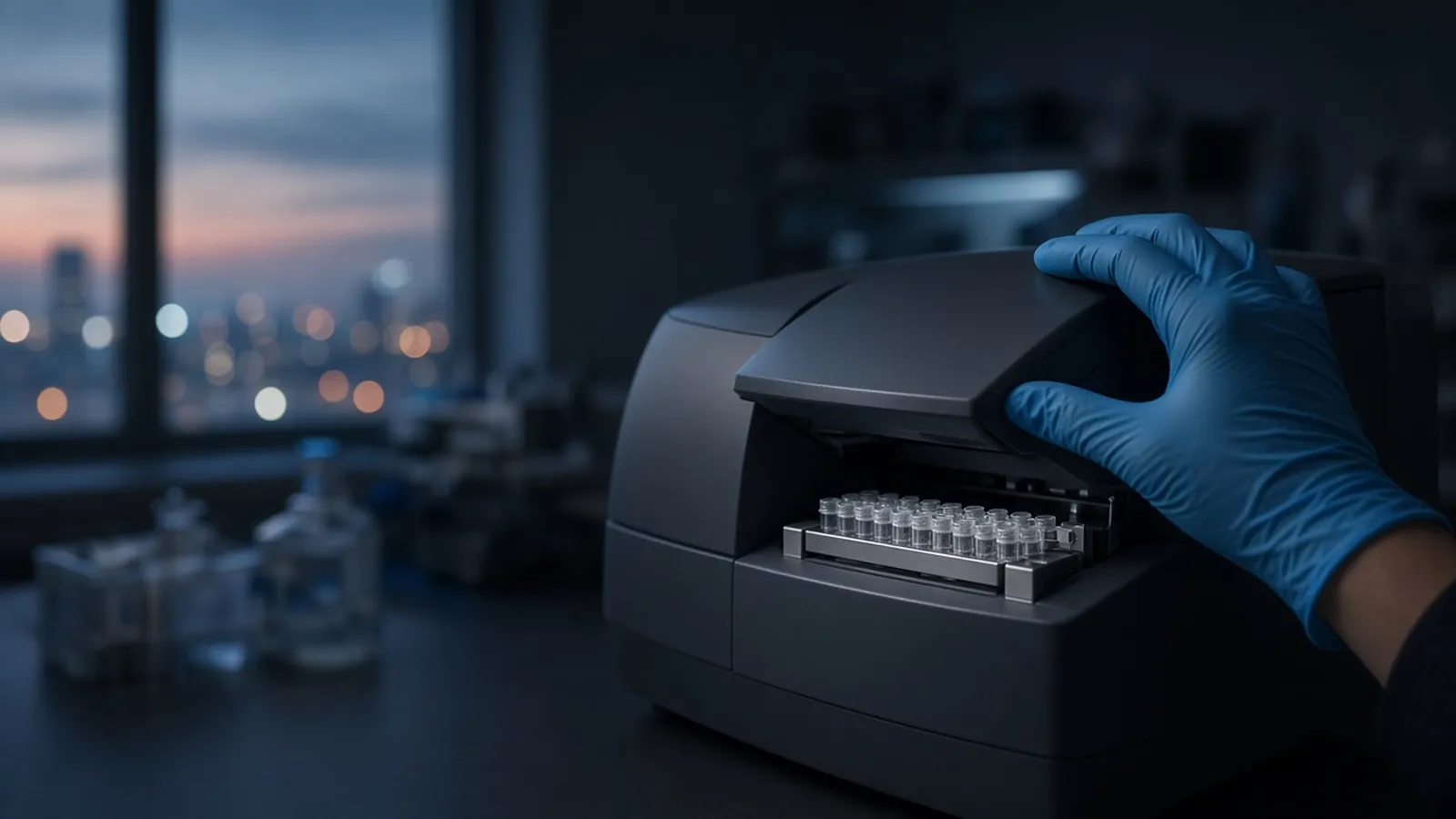
A PCR band is only as meaningful as the controls that sat beside it. The reaction copies whatever the primers can amplify, including yesterday's product, a primer artefact, or nothing at all if the tube was inhibited. This note is about the decision those controls support: whether you may interpret the sample lanes. The cycle itself is explained in how polymerase chain reaction works. What follows is the discipline around that cycle. It is a research explainer, not a clinical protocol and not a kit insert.
If you are choosing enzymes, nucleotides or vessels, start from the molecular biology catalogue and send the scientific requirement with the quote request. A family name on a catalogue page is not evidence about a particular lot.
What contamination actually is
The dangerous contaminant in an endpoint laboratory is usually an amplicon, not genomic DNA from the organism you study. A finished reaction can hold an enormous number of copies of a short fragment that already has primer sites at both ends. Opening that tube, pipetting it, or loading it on a gel sheds a few of those copies into the air, onto gloves, and into the barrel of a pipette. The next master mix needs only a handful of them to grow a band that looks exactly like a real positive.
Thermal cycling does not create specificity by itself. It only repeats denaturation, annealing and extension. Specificity lives in the primer design, the annealing window, and the cleanliness of everything that touches the mix before the block heats. NCBI Primer-BLAST is a public place to ask what else a pair might bind. A pair that is specific on a database can still amplify a contaminant that is already the perfect template.
The three controls that change the call
A no-template control contains every reagent except the DNA you claim to be testing. Water or buffer replaces the sample. If that tube produces the assay product, the reagents or the handling created the band. Sample lanes from that run cannot be called positive. If the no-template control is clean, you have evidence about this mix and this session, not a lifetime certificate for the freezer box.
A positive control contains a trusted template at a level the assay should see. Plasmid, a previous sequenced amplicon used sparingly, or genomic DNA from a known source can serve, provided it is stored away from the master-mix area. If the positive control fails, the mix, the programme, the enzyme or the primers are the first suspects. Calling every sample "negative" in that run is a mistake. If the positive control succeeds and a sample shows a band of the same size, you still have not proved the sequences match. Size is a filter. Sequence, a diagnostic restriction cut, or an orthogonal assay is the identity check.
An inhibition control asks whether this sample matrix allows amplification. The practical versions are a dilution series of the sample, or a spike of a known target into an aliquot of the sample. Dirty matrices — blood, soil, plant homogenate, a column elution that still smells of ethanol — can hide a real target. A spike that amplifies inside the sample supports a negative call on the unspiked tube. A spike that fails says the tube could not have answered the question.
| Control | Clean or expected result | What you do when it fails |
|---|---|---|
| No-template | No assay product | Stop. Discard suspect aliquots. Do not call sample lanes |
| Positive | Product of the expected size | Fix the reaction before you trust any negative sample |
| Inhibition spike | Product appears in the spiked aliquot | Treat the sample as uninterpretable until the matrix is cleaned or diluted |
| Size check on a gel | Band sits with the design, separated from primer-dimer | Do not claim sequence identity from size alone |
A workflow with branch points
Prepare the master mix in a space that does not see PCR products. Add template in a second place. Open finished reactions in a third. Gloves, lab coats and tip boxes do not travel backward from the gel bench to the mix bench. A pipette used to load a bright band does not build the next mix.
When the no-template lane is dirty, discard the master-mix aliquots, the water, and the primer dilutions that were open. Wipe benches with a freshly prepared hypochlorite solution, which damages nucleic acids, and then remove the residue as your local chemical practice requires. Ethanol is a poor DNA destroyer. Ultraviolet light inside a box only helps where the light actually reaches; shadowed ridges and the inside of a pipette stay dirty. Do not "confirm" the samples by repeating them with the same aliquots.
When the positive control fails and the no-template control is clean, change one thing you can name: a new enzyme aliquot, a new primer working dilution, or a programme you have written down and compared with the enzyme class. Running the samples again on hope wastes the template.
When samples are negative, the positive control worked, and a spike into the sample also worked, you may report a research negative within the limit of detection you actually tested. You may not report a clinical negative. When the spike fails, clean the nucleic acid or dilute it and repeat. Extraction choices that leave inhibitors behind are discussed with how DNA extraction methods differ.
Failure modes that look like biology
A band in every lane, including the no-template control, is contamination or a primer artefact until proved otherwise. A blank carried through extraction catches contamination that arrived with the sample tubes. Late contamination often hides in water, in a primer dilution that lives on the product bench, or in an open tip box. When a control fails, retire the whole aliquot.
Some workflows add a second chemical layer, incorporating uracil into products and treating the next reaction so earlier amplicons are degraded before copying begins. That layer still has to be inactivated by the heat cycle you actually run, and it leaves genomic contamination untouched. The MIQE guidelines, written for quantitative PCR, are a useful list of what a methods note should disclose. They do not turn an endpoint gel into a measured copy count.
Rooms, climate and shared cyclers
Physical separation fails in small rooms when the gel documentation bench is an arm's length from the setup rack. Even then, the direction of work can stay one-way during a session: mix first, samples second, gels last, and no return trip with the same gloves.
In a hot building, a waiting master mix is warmer than a protocol from a cooler city assumed. Hot-start enzymes exist for this reason, and they still have a storage temperature on their own label. A cycler that rebooted after a power cut should earn back trust with a known positive control before a precious plate is committed. Two blocks that display the same annealing temperature can still heat a plate differently if the plastic, the lid pressure and the service history differ. Write the programme down, and spin a finished tube before you open it so condensation stays off your gloves.
Safety and the limit of the claim
The everyday hazards are hot blocks, ultraviolet light at a gel imager, and DNA stains. Follow the safety note for the stain you use. Template from an infectious specimen is not made harmless by amplification. Your institutional biosafety rules, informed by references such as the WHO laboratory biosafety manual and the CDC BMBL, decide containment. This article does not.
A controlled research PCR supports a research sentence: under these primers, this programme and these controls, the product was present or not detected. It does not support a medical diagnosis.
What to send with an enquiry
EVRINTH can take a sourcing question. The useful note names the enzyme class, endpoint or real-time readout, amplicon length, template matrix, and the control set you intend to run. If the assay must detect several targets in one tube, the multiplex PCR service reference is a prompt for questions, not a statement that an assay is already running. The nucleic acid analysis pathway is the wider context when PCR sits downstream of extraction and upstream of a gel or a sequencer. Ask whether a quotation is possible. Do not read a catalogue family name as a single recipe.
Decide whether a PCR run can be interpreted
- 01Place the controls before the samplesPut a no-template control in every run. Add a positive control when a trusted template exists, and an inhibition check when the sample matrix is dirty or concentrated.
- 02Read the no-template lane firstIf the no-template control shows the product, stop. Do not interpret sample lanes, do not repeat on the same bench with the same aliquots, and treat the reagents as suspect until you find the source.
- 03Separate a dead reaction from a negative sampleA failed positive control points at the mix, the programme or the enzyme. A sample that stays negative while a spiked aliquot of the same sample amplifies is a better candidate for a true negative.
- 04Record the layout with the gel or the tracesSave the well map, primer identities, cycler programme and the image that includes the controls. A band without its control lanes is an incomplete result.
Questions from the bench
Does a clean no-template control prove the samples are uncontaminated?
It proves that this mix, handled this way, did not create the product by itself. A contaminant that entered only one sample tube, or a different amplicon from another assay, can still be present. Identity still needs a size check and, when it matters, a sequence or a diagnostic digest.
Why did the no-template control become positive after months of clean runs?
Endpoint products accumulate in a room. Aerosols from opened tubes, a pipette barrel, a shared lab coat or a contaminated water aliquot are enough, because PCR copies a few molecules into a visible band. The failure often appears suddenly once a reservoir crosses the detection threshold of that primer pair.
Should every sample be spiked to test inhibition?
Not always. Spike a known target into the matrix when the sample is new, inhibitor-rich, or unexpectedly negative. Once a preparation method is known to be clean for that assay, a smaller set of inhibition checks can represent the batch. A spike that fails means you cannot call the unspiked tube negative.
Can a research PCR with clean controls be reported as a diagnosis?
No. Clean controls make a research result interpretable inside the claim you designed. Diagnostic use needs a validated assay, a quality system and the legal framework that applies where you work. This page is not that validation.
References
Manufacturer names identify published method classes. Trademarks remain with their owners. Catalogue records on this site are independent references for enquiry. They are not a statement of inventory, distribution rights or a supply commitment. This page is educational. It is not medical advice, a diagnostic protocol or a biosafety approval.
Catalogue
Related products and categories
These links follow the subject of the article into published manufacturer references. A listing is a reference for an enquiry, not a statement of stock or distribution rights.
Continue in this cluster
Related reading
How polymerase chain reaction worksHow PCR copies a chosen DNA segment: the temperature cycle, reagents, controls and what a band on a gel does and does not prove.A glossary of PCR termsPlan a PCR by defining amplicon, Tm, Ta, hot-start, plateau, master mix, NTC, inhibition, fidelity and multiplex before you mix.Choosing an annealing temperatureWhy annealing temperature is not the Tm printed on a tube, and how salt, magnesium, additives, and a short gradient locate the real window.