
guide
PCR in a teaching laboratory
Plan a teaching PCR on a short amplicon from a safe plasmid, with shared cyclers, one-way gloves and a record the demonstrator keeps.
- Author
- EVRINTH Editorial Team
- Published
- 8 October 2026
- Updated
- 8 October 2026
- Reading time
- 8 min

A teaching PCR has to survive shared cyclers, many pairs of gloves, and a room that is often warmer and more humid than the protocol assumed. The decision this guide supports is how to design that practical so students see the method, the controls stay interpretable, and the work stays inside the institution's biosafety rules. The cycle itself is explained in how polymerase chain reaction works. How amplicons travel on a shared bench is the note on PCR controls and contamination control.
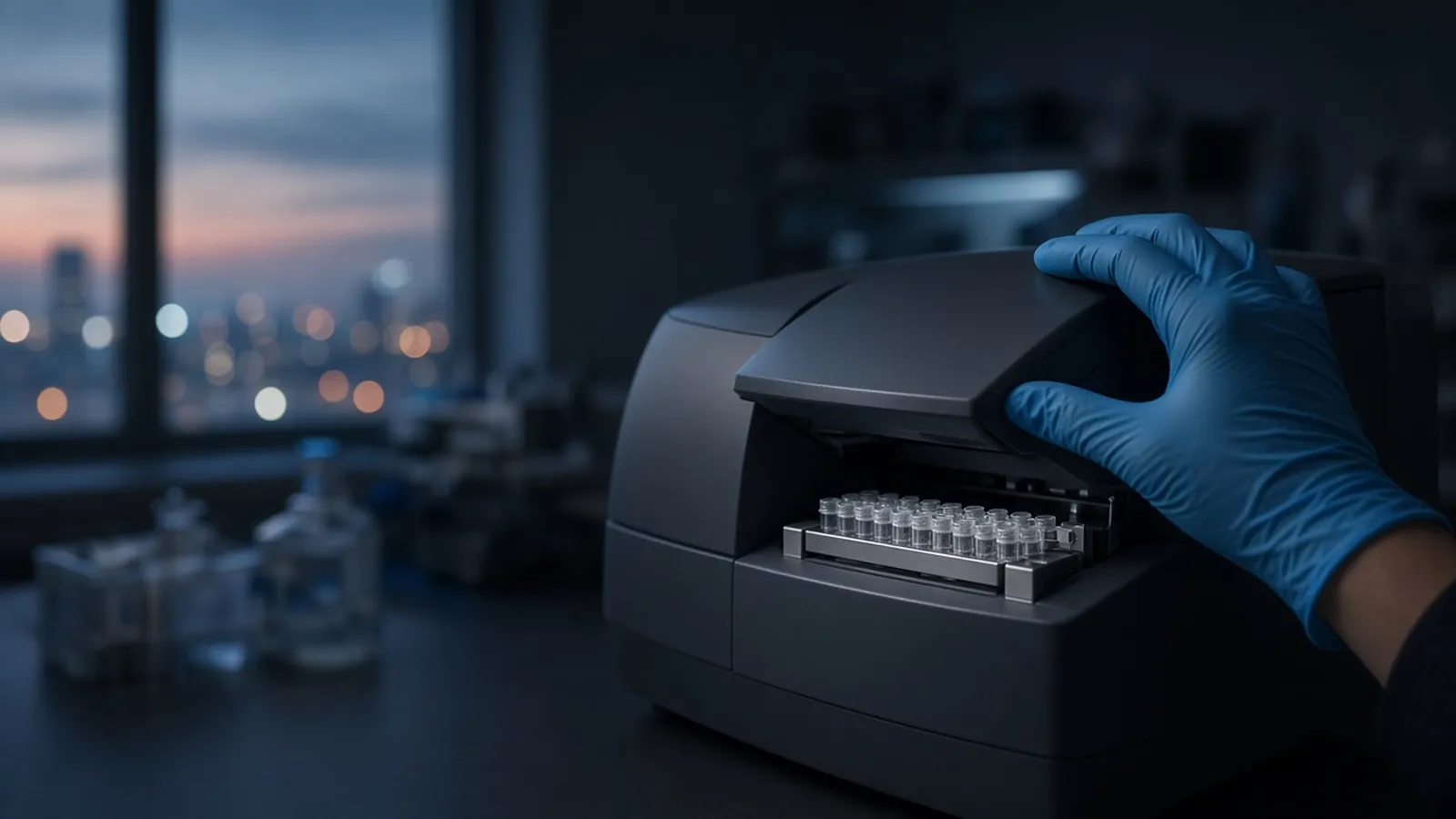
The photograph shows a modern research laboratory at dusk, with researchers at benches and a city skyline beyond the glass. A teaching session is usually more crowded than that frame, and the crowding is the hazard. Order enzymes and vessels from the molecular biology catalogue against a written class specification, and use the quote request for the quantities the timetable actually needs.
Start from what students may legally handle
Institutional biosafety decides the material. This article does not. For a first practical, design a short amplicon from a safe research plasmid: a non-pathogenic cloning plasmid with a known sequence, not an unknown clinical specimen, not a swab from a student, and not an environmental sample whose hazard you have not assessed. The plasmid gives every group the same template. The short product, often a few hundred base pairs, finishes inside a class period and separates from primer-dimer on a gel. Extension time follows the enzyme. A classical Taq-like plan is often on the order of a minute per kilobase near 72 Celsius. A short amplicon makes that hold brief. Engineered enzymes publish different speeds. Follow the bottle the class will open.
Record the plasmid the way a sequence record deserves: a name, a map, and a public accession if one exists in a place such as NCBI GenBank. Students should see that the expected size comes from the map, not from a wish.
Shared cyclers and many students
One block will often serve several groups in a day. Book it, name the programme in the instrument library with the class and the date, and write the cycler identity in the demonstrator's book. Two machines that display the same annealing temperature can still heat a plate differently if the plastic, the lid and the service history differ. Do not move a plate to "the other cycler" without naming that change in the record.
Prepare the master mix in a space that has not seen today's products. Aliquot it before student template tubes are open. Each group adds template to its own tubes, or the demonstrator adds it if the lesson is only the gel. The no-template control is closed first, while the plasmid is still shut. The positive, a modest amount of the same plasmid, is added last. Thirty students opening a concentrated plasmid over one rack is how the blank becomes a positive before the block starts.
Gloves and coats move the contamination. The gel bench is downstream. Coats that loaded a bright band do not return to the setup bench. Tip boxes do not travel backward. A pipette used to load the gel does not build the next mix. Say this out loud at the start, because the failure is social as much as chemical. The companion controls note describes why a few copies of yesterday's amplicon are enough.
Humidity in a hot teaching lab changes the setup even when the biosafety plan is sound. A master mix that waits on the bench through a long briefing is warmer than a protocol written for 22 Celsius assumed. Hot-start enzymes, blocked by antibody, chemistry or an aptamer and released by the initial heat, reduce extension during that wait. They do not fix a primer pair that dimerises once cycling starts, and they still follow the storage temperature on the label. Labels smear, films stick badly to fogged plates, and condensation on cold racks looks like a leak. Bring plastic to room condition before you seal, and look at liquid height after the run.
What to do when the power drops
Teaching buildings lose power. If the cycler stops, the demonstrator owns the interpretation, not the first student who sees a band. Read the instrument log. Note whether the programme finished, aborted, or restarted at cycle one, and whether the heated lid came back to the set-point in the programme. Extra cycles push a teaching reaction deeper into plateau and can grow non-specific products. A lid that stayed cold lets small student volumes evaporate. Verify the block with a known positive and a no-template control before any precious or assessed set is trusted. Do not invent a calibration offset. The calibration is the institution's service record.
The demonstrator's record
Write, before the class is dismissed: date, plasmid identity and why it was an allowed teaching template, primer names, expected amplicon length, master-mix lot references you actually used, cycler identity, programme including the heated-lid set-point, which groups shared a mix, the no-template result, the positive result, any power interruption, and the gel image with the marker visible. A student notebook that says "it worked" is not this record. The demonstrator's copy is what you will need when the next class inherits the same cycler and the same room.
If the no-template lane shows the assay band, the practical stops being a success story. Show the students that stop. Retire the aliquots. Do not send them home believing a contaminated blank is a positive sample. If the positive fails and the blank is clean, the lesson is that the reaction failed and the samples cannot be called negative. Both outcomes teach the method more honestly than a perfect gel.
| Class hazard | What you design in | What the demonstrator records |
|---|---|---|
| Unknown clinical material | A safe plasmid and a short amplicon | Plasmid name, map, expected size |
| Many students, one mix | NTC closed before template is open | Which groups shared the mix, and the NTC result |
| Gloves returning from the gel | One-way coats, gloves and tip boxes | That product handling stayed downstream |
| Humidity and a long briefing | Hot-start class, dry plastic, volumes checked | Enzyme class and any volume loss |
| Power cut on a shared cycler | Log check, then a positive and an NTC | Time, cycler, resume or restart, lid set-point |
Failure modes that look like a bad class
A blank that is positive after a morning practical is carryover until proved otherwise. A whole edge of a student plate that failed is often film, lid contact or a plate that does not match the block, not thirty biological negatives. A mix that sat through speeches in a hot room can throw primer-dimer even with a hot-start enzyme if the oligos were a poor pair. Change the pair, or show the dimer as the lesson, and do not call it the amplicon.
If groups disagree and they shared a mix, compare their caps and their volumes before you compare their skill. Evaporation changes salt. A loose cap is a chemistry problem.
Safety
Hot blocks, ultraviolet gel imagers and nucleic-acid stains are the everyday hazards. Students do not look into a bare ultraviolet box. Follow the stain's safety data. The plasmid may be harmless by the institution's assessment and the product is still DNA that will contaminate next week's mix. Containment, waste and who may supervise are institutional decisions. The WHO laboratory biosafety manual is background for that committee, not a permission slip from this page.
What to put in an enquiry
State that the material is for a teaching practical, the enzyme class, the approximate amplicon length, the number of reactions in a session, endpoint readout, and the control set (no-template and a plasmid positive). Ask for a hot-start class if the briefing is long and the room runs warm. The nucleic acid analysis pathway places the practical in a wider sample-to-result path if you later add extraction. The multiplex PCR enquiry reference is only a prompt if a later class truly needs more than one product. It is not a statement that a multiplex assay is running. Ask whether a quotation is possible. Leave clinical language out of the note.
Plan a teaching PCR a demonstrator can defend
- 01Fix the biosafety boundary and the plasmidConfirm with the institution which material students may handle. Choose a safe research plasmid and a short amplicon. Leave unknown clinical specimens out of the practical.
- 02Write the control map before the class startsPlace a no-template control and a known plasmid positive on the sheet first. Decide which groups share a master mix, and close the blank before student template tubes are open.
- 03Separate gloves and coats by direction of workSetup benches do not receive gloves that have loaded a gel. Coats and tip boxes stay with the bench they started on. The cycler is a shared machine, not a shared pair of gloves.
- 04Record the run before students leaveWrite the plasmid identity, expected size, cycler identity, programme, heated-lid set-point, control results, and any power cut. Keep the gel image with the marker. A remembered band is not the record.
Questions from the bench
Why is the teaching template a plasmid?
A known plasmid gives every group the same template and a size you can predict, so the lesson is the cycle and the controls. An unknown clinical specimen adds infection risk, consent and diagnostic meaning that a teaching practical does not have. Institutional biosafety rules decide what may enter the room, and a safe plasmid is the usual fit.
What should the demonstrator write down if the power fails mid-class?
Record the time, which cycler stopped, what the display showed when power returned, and whether the programme resumed, aborted, or started again at cycle one. Do not let groups interpret bands until a known positive and a no-template control have been read on that block. The class record includes the interruption.
How do many students contaminate a shared cycler room?
Finished amplicons leave on gloves, cuffs and tip boxes and return to the next group's master mix. One opened positive from the morning class is enough to seed the afternoon blank, because the product already carries primer sites. One-way movement and a fresh no-template control for each setup are the practical defences.
Can a class gel be reported as a diagnostic result?
No. A teaching gel shows whether this practical, with these controls, produced a band of the expected size from a safe plasmid. It is not a validated assay and not a clinical report. Keep that limit in the briefing so students do not leave with the wrong claim.
References
Manufacturer names identify published method classes. Trademarks remain with their owners. Catalogue records on this site are independent references for enquiry. They are not a statement of inventory, distribution rights or a supply commitment. This page is educational. It is not medical advice, a diagnostic protocol or a biosafety approval.
Catalogue
Related products and categories
These links follow the subject of the article into published manufacturer references. A listing is a reference for an enquiry, not a statement of stock or distribution rights.
Continue in this cluster
Related reading
 How polymerase chain reaction worksHow PCR copies a chosen DNA segment: the temperature cycle, reagents, controls and what a band on a gel does and does not prove.A glossary of PCR termsPlan a PCR by defining amplicon, Tm, Ta, hot-start, plateau, master mix, NTC, inhibition, fidelity and multiplex before you mix.Choosing an annealing temperatureWhy annealing temperature is not the Tm printed on a tube, and how salt, magnesium, additives, and a short gradient locate the real window.