
glossary
PCR tube sealing and evaporation
Define the seal, heated lid, plate film, volume loss and edge effects so a loose PCR cap is treated as a change in the reaction chemistry.
- Author
- EVRINTH Editorial Team
- Published
- 8 October 2026
- Updated
- 8 October 2026
- Reading time
- 8 min
A PCR that loses water is no longer the mixture you pipetted. This glossary defines five words that decide whether the late cycles still match the early ones: seal, lid, plate film, volume loss and edge effects. The decision they support is practical. A loose cap is a chemistry problem, and it should be written up as one. The temperature programme those words protect is described in how polymerase chain reaction works. Which polymer belongs in which vessel is the companion note on plastic tubes, tips and plates.
Order vessels against the block you actually own. The molecular biology catalogue is the place to start that specification, and the quote request is where the dimensions belong.
The five words, in the order a dried well happens
A seal is any closure that keeps vapour inside the vessel for the whole programme. On a strip, the seal is the cap, or a cap strip pressed until it clicks home. On a plate, the seal is an adhesive film, a heat-bonded film, or a reusable mat. The seal has failed when there is a path for water vapour to leave, even if the cap still looks "mostly on". A cap that sits proud of the tube, a film that missed one rim, and a mat that the lid cannot flatten are all open seals.
The lid, in this article, is the heated cover of the cycler, not the plastic cap. The instrument holds that cover warmer than the liquid so the roof of each tube stays too hot for a large water droplet to park there. Many heated lids are set somewhere around 100 to 105 Celsius. That range is a common planning figure, not a measurement of your machine. Follow the set-point in the programme and the service note for the block. If people in your laboratory also call the cap a lid, write "heated lid" and "cap" in the method so the two objects stay distinct.
Plate film is the sheet that seals a multiwell plate. Adhesive optical film is the class used when a camera must look through the seal. Heat seals are bonded with a plate sealer. A storage film from a cold-room shelf is a different object. The film has to survive the heated-lid temperature, stick to that plate, and stay flat if the instrument reads through it. Wrinkles and a tunnel along one edge are seal failures you can see before the run.
Volume loss is the water that left. Primers, dNTPs, magnesium and buffer salts do not leave with it. Their concentration rises as the volume falls. Lose about half the water and you have roughly doubled those concentrations, including the magnesium that both activates the polymerase and changes how tightly primers bind. dNTPs chelate magnesium, so the free magnesium and the nucleotide concentration move together. A common classical planning range is about 1.5 to 2.5 millimolar magnesium and about 200 micromolar of each dNTP. Those numbers were for the volume you mixed. They are not still true in a well that has shrunk. Follow the mix you opened, and treat any visible volume drop as a reason to discard the well.
Edge effects are the extra bias at the rim of a plate. Outer wells often meet the block and the heated lid differently from interior wells, so they can sit at a different liquid temperature or lose more volume. The symptom is a pattern that follows the plate map. A plate geometry the block was cut for, a film the lid can press, and a skirt that sits flat are the physical fixes.
Why the late cycles die first
Early cycles may still succeed in a slowly leaking tube, because most of the water is still there and the primers have already found the template. The reaction then enters a different mixture. Annealing temperature that was specific at the original salt becomes permissive, or the polymerase slows as magnesium and solutes climb. By the time an endpoint reaction should be showing a band, the well has either plateaued in the wrong chemistry or dried to a film of dye and salt.
A dried well is not a low-template negative. There is nothing left for the enzyme to work in. On a real-time plate the trace may stall, drift, or never cross the threshold, and the optical film over that well may look sunken. Score it as a failed vessel. Do not average it into a biological conclusion.
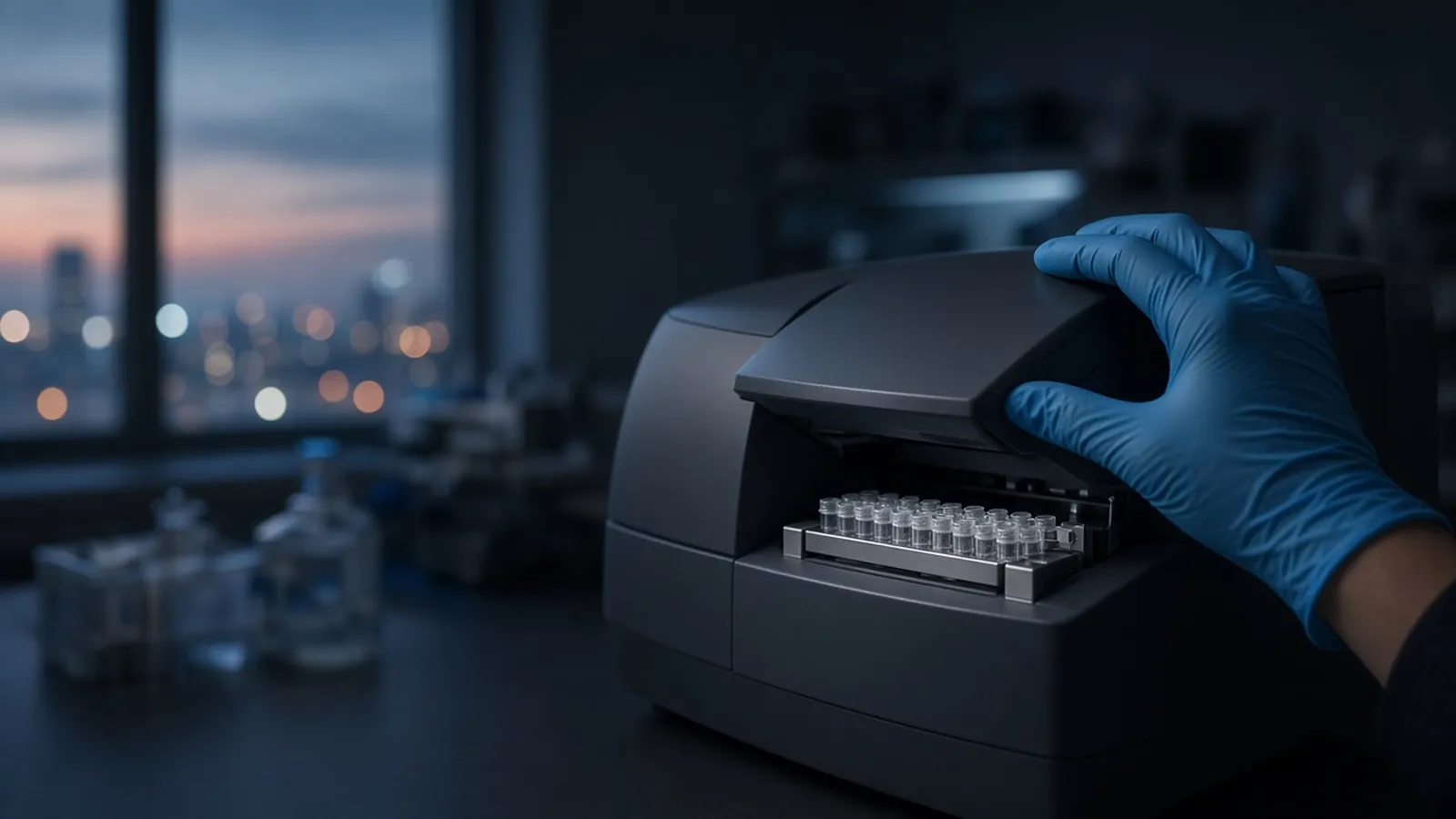
The photograph shows a gloved hand closing the cycler lid on a strip of tubes. That lid has to land on caps that are fully seated. A strip that rocks is a row of edge effects.
Match the plastic to the block
Tube blocks and plate blocks are cut to different shapes. High-profile and low-profile plates need the lid travel the instrument specifies. A plate that is too tall can keep the lid from locking. A plate that is too short lets film peel at the corners. Caps from one family on tubes from another often fail to seat. Thin-walled vessels exist so the block can change the liquid temperature, and the seal must survive that change without a vapour path. The wider vessel choice is in the plastic note linked above.
Before a run, press every cap, smooth the film from the centre outward, and reject a plate that rocks. After the run, look at the volume. A short spin returns condensate to the bottom. It does not restore water that left.
| Term | What it is | What a failure does to the chemistry |
|---|---|---|
| Seal | Cap, cap strip, film or mat that keeps vapour in | A gap lets water leave and concentrates every solute |
| Lid | The cycler's heated cover, held above the block temperature | A cold lid collects condensate and can unbalance small volumes |
| Plate film | The sheet sealing a plate, optical when the run is read through it | Wrinkles leak at the rim and scatter a real-time reading |
| Volume loss | Water gone, solutes left behind | Magnesium, primers and dNTPs rise together and the late cycles change |
| Edge effects | Rim wells with different contact or greater loss | A positional pattern masquerades as a biological one |
How to reason when a well looks empty
Compare the failed well with its neighbours before you blame the template. If one cap was soft and the others are full, the chemistry of that tube changed and the biology is unknown. If a whole edge row shrank and the interior did not, you have an edge effect: film, lid pressure, or a plate that does not fit. If every tube dropped, the heated lid may have been off, the temperature set-point may be wrong for that plastic, or the block and the vessels are mismatched.
A no-template control that dried is a failed control. It cannot declare the reagents clean, and a dried sample cannot declare the target absent. Repeat the set in vessels you have seated. Extra bands in a shrunken well are the annealing window moving with the salt, which is volume loss showing up as apparent biology.
Safety and the laboratory limit
The heated lid and the block are burn hazards. Opening a hot cap can spray a small aerosol. Let the lid release as the instrument asks, and spin before you open. A tight seal does not change the research limit of the result, or your institution's biosafety decision about the template.
In a humid building, film applied to a cold, fogged plate sticks to water and then lifts in the cycler. Seal dry plastic that has come to the room. A warm room raises the vapour pressure the seal must hold. Check volumes after the first run in that season.
What to put in an enquiry
Name the block you have, the vessel profile (tube strip, low-profile plate, high-profile plate), whether the run is endpoint or read through optical film, and the heated-lid set-point the instrument uses. Ask for vessels and film that match that geometry. The nucleic acid analysis pathway is the surrounding context. Ask whether a quotation is possible. A catalogue family is not evidence a plate will sit flat on your block.
Questions from the bench
Why does a loose cap change the PCR result?
Water leaves as vapour and the solutes stay behind, so magnesium, primers, dNTPs and buffer salts become more concentrated as the volume falls. Annealing and enzyme activity were set for the concentration you mixed. Late cycles then run in a different chemistry, and a well that dries out stops synthesising altogether.
Is condensation on the cap proof that the seal failed?
A little condensate under the cap is common before the heated lid is fully up to temperature, and a short spin brings it back into the reaction. Condensate that comes with a visibly smaller volume, a crusted pellet, or a cap that was never seated is volume loss. Look at the liquid height, not only at the fog.
What is an edge effect on a PCR plate?
Wells on the rim of a plate often see a different block contact and a different lid pressure from wells in the middle. They can lose more water or sit at a slightly different temperature. A plate that matches the block, and a film or cap mat the lid can press evenly, reduces that gradient. It does not vanish because you randomised the samples in your head.
Can any clear film seal a qPCR plate?
Optical film is a particular seal: clear, flat, and stuck so the instrument can read through it. A wrinkled film, a film applied over a wet rim, or a storage film that is not rated for the heated lid will both leak and scatter light. Match the film to the plate and to the cycler, and follow the instrument note for how the lid should press.
References
Manufacturer names identify published method classes. Trademarks remain with their owners. Catalogue records on this site are independent references for enquiry. They are not a statement of inventory, distribution rights or a supply commitment. This page is educational. It is not medical advice, a diagnostic protocol or a biosafety approval.
Catalogue
Related products and categories
These links follow the subject of the article into published manufacturer references. A listing is a reference for an enquiry, not a statement of stock or distribution rights.
Continue in this cluster
Related reading
How polymerase chain reaction worksHow PCR copies a chosen DNA segment: the temperature cycle, reagents, controls and what a band on a gel does and does not prove.A glossary of PCR termsPlan a PCR by defining amplicon, Tm, Ta, hot-start, plateau, master mix, NTC, inhibition, fidelity and multiplex before you mix.Choosing an annealing temperatureWhy annealing temperature is not the Tm printed on a tube, and how salt, magnesium, additives, and a short gradient locate the real window.