
protocol overview
Phosphatase treatment and self-ligation
When to strip 5-prime phosphates from a cut vector so it cannot recircularise, why the insert must keep its phosphates, and how leftover background looks.
- Author
- EVRINTH Editorial Team
- Published
- 8 October 2026
- Updated
- 8 October 2026
- Reading time
- 8 min
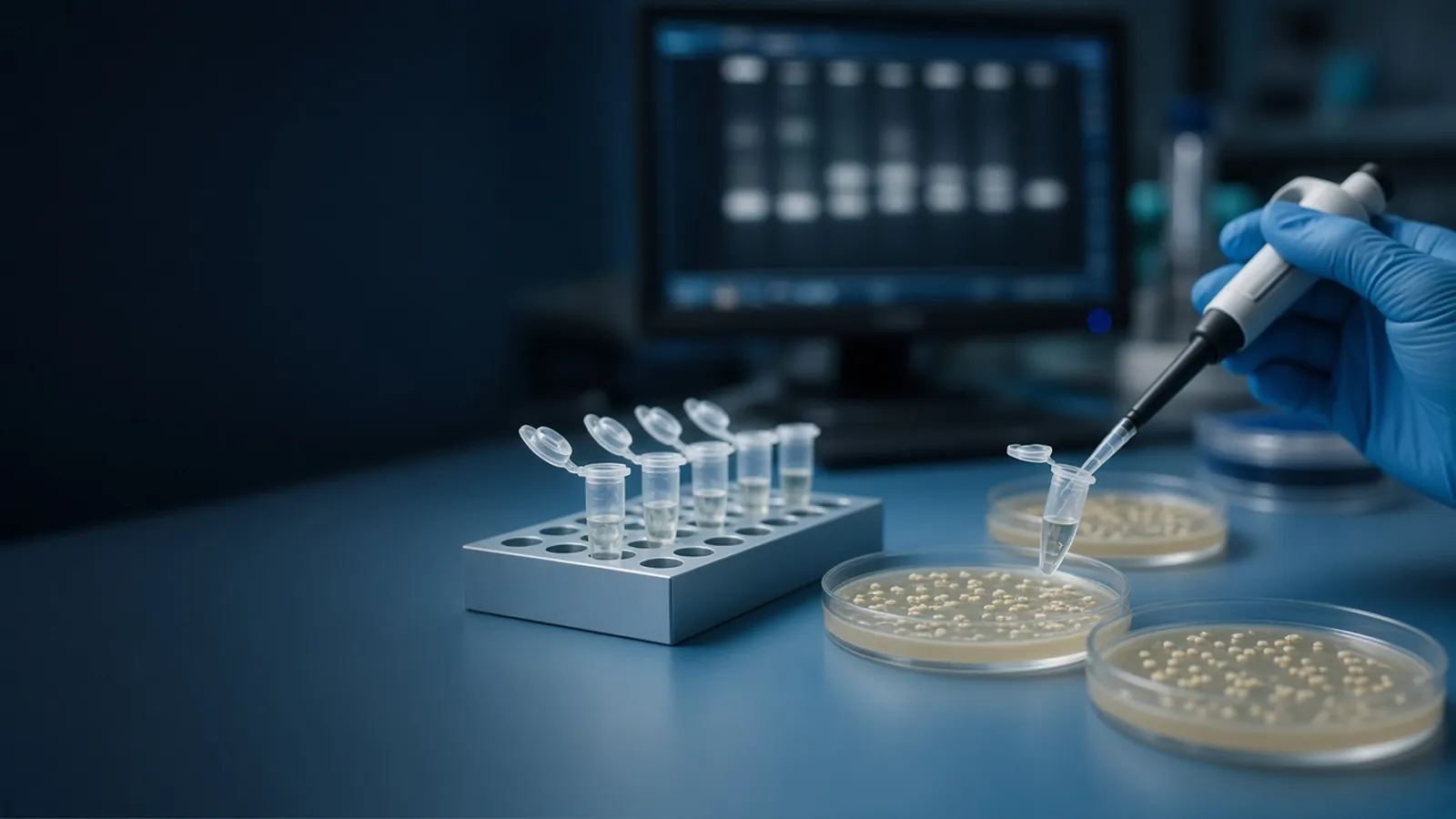
Phosphatase treatment is a way to stop a cut vector from ligating back to itself. DNA ligase seals a 5-prime phosphate to a 3-prime hydroxyl. Take the phosphates off the vector ends and the vector cannot recircularise. Leave the phosphates on the insert and the insert can still be joined to those ends. That split is the whole method. The chemistry of the join around it is in restriction ligation and Gibson assembly. The path to a colony you can archive is in plasmid cloning from insert to colony.
This is a staged overview for a research ligation. Volumes and minutes belong to the phosphatase card in your hand. Enzyme classes can be compared from the molecular biology catalogue.
Who should reach for phosphatase
Use it when self-ligation is a realistic path to a colony. A vector cut with one enzyme, a blunt-ended vector, or a double digest you suspect is only partial will recircularise if the ends still carry phosphates. Intramolecular closure is efficient. Those empty circles transform well, and they all carry the resistance marker, so the plate looks successful while the insert is rare.
Skip phosphatase when you have already shown, on a gel, that two incompatible overhangs are both cut and the uncut plasmid is gone. The ends cannot base-pair. Phosphatase would only make each junction harder to seal. If you are unsure the second enzyme cut, treat the vector. An honest double digest is cheaper to prove on a gel than to rescue with a screen of empty colonies.
What the phosphatase actually removes
Calf intestinal phosphatase, shrimp alkaline phosphatase and Antarctic phosphatase are three classes that hydrolyse 5-prime phosphates from DNA ends. They do not choose the vector out of loyalty. Any end in the tube is a substrate. That is why the insert stays in a different tube until the phosphatase has been stopped.
The insert must bring phosphates. A restriction fragment has them, because the restriction enzyme left a 5-prime phosphate. A PCR product does not, unless the oligonucleotide was ordered with a phosphate or you added one with polynucleotide kinase. People dephosphorylate a vector, then ligate an ordinary PCR product, and conclude the ligase is dead. Both partners lacked a phosphate. Kinase the insert or reorder phosphorylated primers. Do not dephosphorylate the insert to make the tubes match.
After a successful vector-insert join, one strand at each junction may still be nicked, because the vector side had no phosphate. The cell repairs that nick after transformation. Ligase does not need both phosphates. It needs at least the insert's.
Dephosphorylating both partners leaves nothing for ligase to join. The reaction is quiet, the plate is empty, and the control plasmid you should have transformed beside it is the only clue that the cells were fine.
Classes differ in how you stop them
The three classes are not interchangeable at the inactivation step. Antarctic phosphatase and shrimp alkaline phosphatase are commonly heat-inactivated, at a temperature and time printed on that enzyme's card, often well above the digest temperature. Calf intestinal phosphatase is more persistent. Laboratories usually remove it with a cleanup rather than trusting a heat step the card does not stand behind. If you carry live phosphatase into the ligation, it will strip the insert phosphates you just protected.
Cleanup also removes small oligonucleotide pieces and the restriction enzyme if that enzyme cannot be heat-killed. A gel of the linear vector, and excision of that band, removes uncut supercoiled plasmid that phosphatase cannot touch. Uncut circles are a second source of empty colonies. Phosphatase does not solve them.
Public notes such as the Addgene restriction digest protocol show where a phosphatase step sits relative to cleanup. Use them as a map of decisions. Copy the card you opened, not a table from a different enzyme generation. protocols.io is a further place to see how groups record the control, not a volume to pipette.
A workflow with branches
Cut the vector and look at it on a gel next to uncut plasmid. If the linear species is missing, fix the digest before any phosphatase. If the linear species is clean and the ends are incompatible, go to ligation without phosphatase. If the ends can rejoin, phosphatase-treat the vector alone, stop the enzyme by the method on its card, and only then add the phosphorylated insert and ligase.
Run three ligations when the result matters. Vector plus insert. Vector without insert. And, separately, a known plasmid into the same cells so an empty plate can be blamed on cells or drug rather than on the join. Transform equal fractions. The no-insert plate is the self-ligation measurement. It should be sparse compared with the plus-insert plate. The known plasmid should produce colonies you can count.
If the no-insert plate is dense, do not screen your way out. Incomplete phosphatase or leftover uncut plasmid is still in the DNA. Repeat the treatment or gel-purify the linear band. If both ligation plates are empty and the known plasmid grew, the insert likely lacked phosphates, the ligase or ATP failed, or the phosphatase was still active. If nothing grew, including the known plasmid, the cells, the heat shock or the antibiotic plate failed, and the phosphatase result is unreadable.
| Tube | Phosphatase on vector | Insert phosphates | What a colony means |
|---|---|---|---|
| Vector plus insert | Yes, then stopped | Present | A candidate join, still needs a screen |
| Vector, no insert | Yes, then stopped | None added | Self-ligation background; should be rare |
| Vector plus insert | Yes, still active | Stripped in the same tube | Often no colonies; the control is confounded |
| Both partners treated | Yes | Removed on purpose | Ligase has no phosphate; empty plate |
| Known circular plasmid | Not in this tube | Not relevant | Cells and antibiotic can produce colonies |
Failure modes, read from the two plates
A high empty-vector background after phosphatase means the treatment was partial or uncut plasmid remained. More colonies on the no-insert plate than on the plus-insert plate can also mean the insert DNA inhibited the ligation, or that you added insert ends that were not phosphorylated and the only molecules able to close were the few vectors you failed to treat. Check the arithmetic of the gel before you invent a worse story.
Insert orientation is a separate question. Phosphatase does not make a single-enzyme clone directional. Both orientations can still enter, and both will grow. Screen for direction after the background is low enough that a positive colony is meaningful. If every colony is still parent plasmid, screening more of them from the same plate wastes primers.
ATP that has died in a repeatedly thawed ligation buffer mimics a phosphatase disaster: no colonies anywhere except the uncut control plasmid, which does not need ligase. Keep the buffer's freeze-thaw history in the note. The enzyme did not forget the chemistry.
Safety
These phosphatases are ordinary research enzymes in aqueous buffers. The hazard that matters on this page is calling an empty vector a finished clone, then expressing from it. The host strain and the insert still fall under your institution's biosafety rules. This overview is not a clinical protocol and not permission to scale a ligation into a production culture.
Cold handoff of the enzyme
Phosphatase stocks are shipped and stored cold for a reason printed on their label. A vial that spends an afternoon in a warm courier bag, or sits on a bench while plates are poured, is a different reagent from the one the card describes. Before you trust a low background from a new lot, run the no-insert ligation. If that control is suddenly full, suspect the enzyme's journey as well as your incubation. Do not compensate by doubling the volume from a lot you no longer trust. Record the lot and ask for the storage specification when you enquire.
What the enquiry should carry
Name the phosphatase class, the vector ends (single enzyme, blunt, or doubtful double digest), and whether the insert is a restriction fragment or a PCR product that still needs phosphates. Attach the map. A synthetic insert ordered with phosphorylated ends, or with ends that remove the self-ligation problem, can be discussed via the custom gene synthesis enquiry reference. A later read of the junctions can be framed with the Sanger sequencing enquiry reference. Neither URL means EVRINTH performs that work. Send the requirement through the quote request and ask whether a quotation is possible.
Decide whether phosphatase belongs on this vector
- 01Ask whether the vector ends can rejoinUse phosphatase when the cut vector can recircularise: one enzyme, blunt ends, or a double digest you do not fully trust. Skip it when two incompatible overhangs are complete and you would rather keep ligation efficiency.
- 02Treat the vector and leave the insert phosphorylatedRemove 5-prime phosphates from the vector only. A restriction fragment already carries phosphates. A PCR insert has them only if the primers were phosphorylated or you added them with kinase.
- 03Stop the phosphatase before the insert arrivesHeat-inactivate only the phosphatase classes whose card says heat kills them, and clean up the others. Active phosphatase carried into the ligation will strip the insert as well.
- 04Read the no-insert ligation before you trust the plateLigate vector alone beside vector plus insert, and transform both. A no-insert plate nearly as full as the test plate means self-ligation survived. Repeat the phosphatase or purify the linear vector before you screen colonies.
Questions from the bench
What happens if both vector and insert are dephosphorylated?
Ligase needs a 5-prime phosphate on at least one side of each nick. If you remove phosphates from both partners, neither strand can be sealed and the junction does not form. Colonies collapse even when the ends were compatible. Phosphatase is a vector treatment when the goal is to reduce self-ligation.
Why do empty-vector colonies remain after I used phosphatase?
Incomplete phosphatase leaves some vector ends phosphorylated, and those molecules recircularise. Uncut supercoiled plasmid, which never needed a phosphate removed, transforms even better. Either contaminant fills the plate with parent backbone. The no-insert ligation plus a gel of the cut vector tells you which one you still have.
Do CIP, SAP and Antarctic phosphatase get used the same way?
They are all phosphatase classes that take 5-prime phosphates off DNA ends, and they differ in whether heat inactivation is reliable. Calf intestinal phosphatase is often removed by cleanup because heat is a weak way to stop it. Shrimp alkaline phosphatase and Antarctic phosphatase are often heat-killed at a temperature their own card states. Follow that card. Do not copy one class's minutes onto another.
Should a directional sticky-end clone still be dephosphorylated?
Often no, if the double digest is complete and the overhangs cannot base-pair with each other. Phosphatase then lowers efficiency, because each junction can be sealed on only one strand until the cell repairs the nick. Use it when a partial digest could leave single-cut vector, and always keep the insert phosphorylated so the mixed junctions can still form.
References
Manufacturer names identify published method classes. Trademarks remain with their owners. Catalogue records on this site are independent references for enquiry. They are not a statement of inventory, distribution rights or a supply commitment. This page is educational. It is not medical advice, a diagnostic protocol or a biosafety approval.
Catalogue
Related products and categories
These links follow the subject of the article into published manufacturer references. A listing is a reference for an enquiry, not a statement of stock or distribution rights.
Continue in this cluster
Related reading
Plasmid cloning from insert to colonyHow an insert becomes a plasmid, a colony and a verified clone, and which checkpoint fails when the plate is empty or the insert is wrong.A glossary of cloning termsRead a cloning plan and mark vector, insert, MCS, ends, ligase, phosphatase, transformation, and clone against the map before you mix a tube.Antibiotic selection is not proof of an insertWhat selection, marker, satellite and clone mean on an antibiotic plate, and why a colony can grow with no insert, the wrong insert or only a parent vector.