
glossary
Questions to ask before a PCR reagent enquiry
Define template matrix, amplicon length, readout, hot-start, fidelity, inhibitors and the control plan before a PCR reagent enquiry.
- Author
- EVRINTH Editorial Team
- Published
- 8 October 2026
- Updated
- 8 October 2026
- Reading time
- 7 min
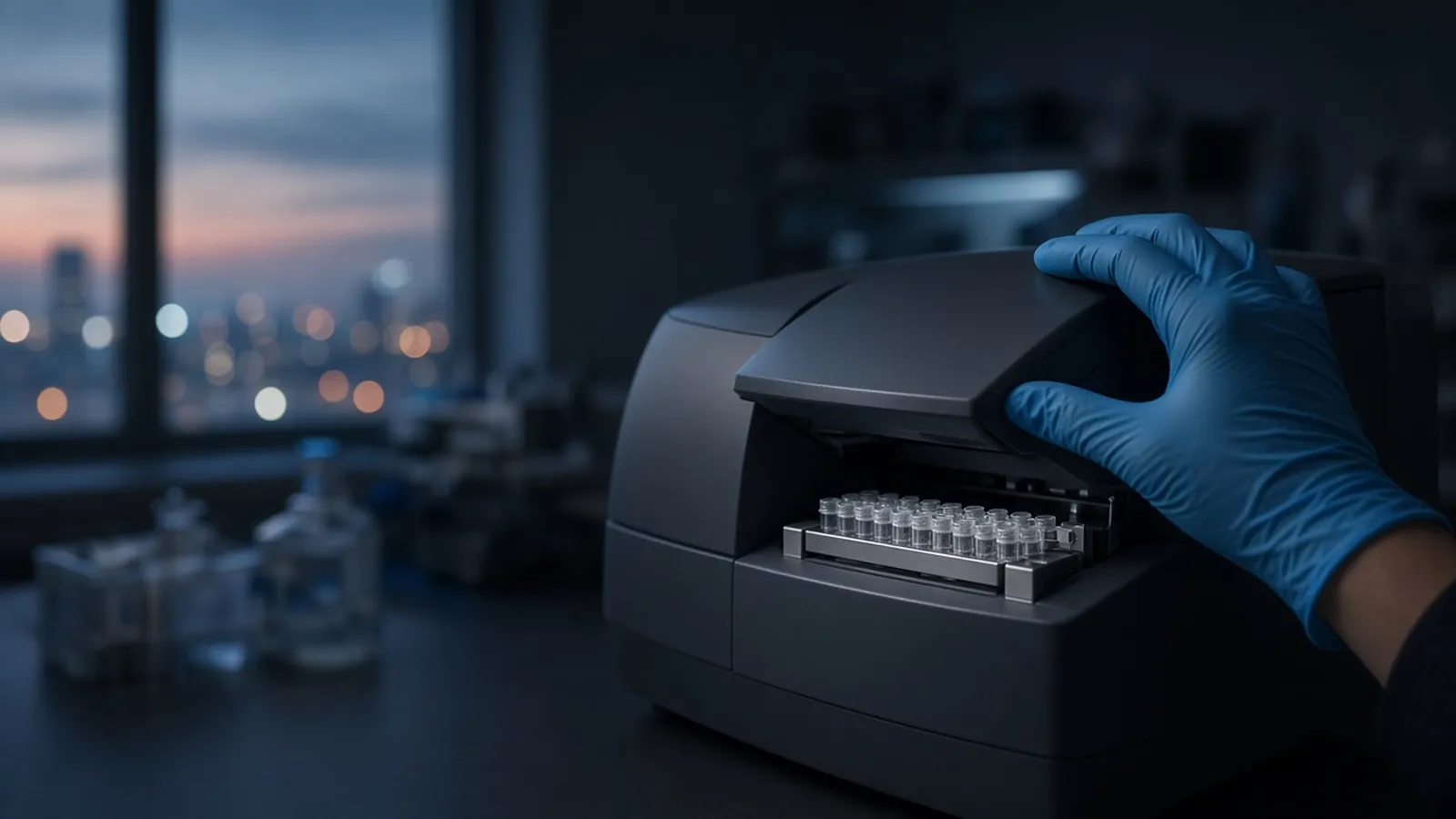
A PCR reagent enquiry fails when the scientific words are missing. Template matrix, amplicon length, endpoint versus real-time, hot-start, fidelity, an inhibitor-rich sample and the control plan are the terms a quotation has to carry if two replies are to be comparable. This glossary defines those words so you can write them down before you ask. How a laboratory enquiry is structured in general is the pillar on how to write a laboratory sourcing enquiry. The reaction the reagents must support is how polymerase chain reaction works.
Send the finished note with the quote request. Browse enzyme and nucleotide classes in the molecular biology catalogue only far enough to name the class. A family name is not a formulation.
Template matrix
Template matrix is the material around the nucleic acid, not a slogan for "sample". Plasmid DNA in a simple buffer, genomic DNA from a column elution, blood, soil, plant tissue, faeces and a swab transport medium are different matrices. They imply different inhibitors, different extraction histories, and different biosafety questions. Write the matrix in ordinary words. If an extraction method has already been chosen, name the class, because a silica elution and a crude lysate do not ask the polymerase for the same tolerance.
An enquiry that omits the matrix invites a generic mix. The generic mix may be right for a plasmid and hopeless for blood. You will not see that from a catalogue heading.
Amplicon length
Amplicon length is the product size in base pairs, taken from a stated reference. It sets extension time and it sets whether a cleanup will still bind the fragment. Give the length, or a short range if you are still choosing primers. "A gene" is not a length. If you have primers, you may say they exist and that specificity has been checked, for example with a tool such as NCBI Primer-BLAST. You do not have to paste a full oligo table into a first enquiry. You do have to give the length the enzyme must cross.
Endpoint versus real-time
Endpoint versus real-time is the readout. Endpoint means you will judge presence and size after the run, usually on a gel. Real-time means fluorescence each cycle, a Cq, and often optical plastic and a dye or a probe in the mix. The mixes are not interchangeable by wishing. A gel-loading dye in an endpoint mix can interfere with a fluorescence read. An optical plate is wasted on a strip that will only be opened for a gel. Write one of the two. If you need both a size and a quantity, say so, because that is two assays or a deliberate combination, not a single default tube.
The photograph shows a gloved hand closing a benchtop cycler on a strip of tubes. That picture is an endpoint-shaped setup. If your enquiry is real-time, say that the plastic must be optical and that the cycler must read fluorescence. Do not let the picture choose the assay for you.
Hot-start
Hot-start is a block on the polymerase that a heat step removes. The block is an antibody, a chemical modification, or an aptamer, depending on the product class. Ask for hot-start when setup is slow, the plate is large, or the room is warm enough that a waiting mix is not cold. Say so in those words. Hot-start reduces extension during pipetting. It does not repair primers that dimerise strongly once cycling begins. If dimer is already your problem, the enquiry should say you need better primers, not only a hotter-start enzyme.
Also ask, when you name hot-start, whether you are prepared to include the activation hold that class requires. An enquiry that demands hot-start and a programme with no activation step is a contradiction. Follow the enzyme you eventually receive.
Fidelity
Fidelity is the error behaviour you need, named as a class. Proofreading enzymes, with a 3-prime to 5-prime exonuclease, are the class to request when the amplicon will be cloned or used as a sequence reference. A Taq-like enzyme is an honest request when you only need a band to show presence. Write which of those sentences is yours. Avoid adjectives that do not pick a class. The manufacturer's fidelity claim stays on their card. Your enquiry says whether you need that class of claim, and it does not invent an error rate.
Fidelity and hot-start are separate lines. Request both only when both are true.
Inhibitor-rich sample
Inhibitor-rich sample means the matrix is known to interfere with polymerase. Blood and heme, soil and humic acids, faeces and bile salts, heparin tubes, and elutions that may still carry ethanol or guanidine are the usual reasons to tick this box. Say which one applies. A mix advertised for difficult samples is a class you can ask about. It is not a promise that every dirty extract will amplify, and it does not replace a spike-in or a dilution in the control plan. If the sample is a clean plasmid, say that too. Silence reads as if you forgot, not as if the template were easy.
Control plan
Control plan is the list of tubes that decide whether the result can be called. At minimum, name a no-template control. Name the positive template if a negative result would matter. Name an inhibition check, spike or dilution, when the inhibitor line is yes. A quotation can then include the extra reactions those controls consume. Without the plan, the reaction count is a guess, and the scientific need is incomplete. The sourcing pillar explains how to attach an acceptance check to a specification. Use that shape. The control plan is the acceptance check for a PCR enquiry.
| Word | The question it forces | A vague substitute that does not |
|---|---|---|
| Template matrix | What is around the DNA? | Sample, or just DNA |
| Amplicon length | How long is the product? | The name of a gene |
| Endpoint versus real-time | Gel size, or a fluorescence cycle? | PCR kit |
| Hot-start | Must the enzyme wait through setup? | Sensitive enzyme |
| Fidelity | Proofreading, or a presence-assay polymerase? | Best polymerase |
| Inhibitor-rich sample | Which known inhibitor is in this matrix? | Works on everything |
| Control plan | NTC, positive, spike or dilution? | A bottle count with no blanks |
Multiplex, when that is truly the question
If more than one product must share the tube, add the product count, the lengths, and how you will tell them apart. Pointing a reader at the multiplex PCR enquiry reference is a way to collect those questions. It is an enquiry reference for those design questions. Keep the note on primer constraints and product lengths so a link is not mistaken for a finished method.
What not to add, and what to send
Do not add a demand for a commercial relationship, a delivery promise, or a diagnostic stamp. Do not paste a vendor's volume table and ask someone to match it blind. Do write the seven words, the enzyme class they imply, the approximate reaction count including controls, and the acceptance check: a clean no-template control and a band or a curve that matches the plan on a known positive.
The nucleic acid analysis pathway is the surrounding path if extraction and a gel or a sequencer sit on either side of the PCR. Specification writing is the skill that makes a reply usable: measurable class, documents you need, and a check that can fail. In a shared purchasing office, those words travel better than a brand nickname remembered from a paper. Ask whether a quotation is possible. Compare replies on enzyme class, hot-start, fidelity and the documents, using the sourcing pillar as the method.
Questions from the bench
What is a template matrix, and why does the enquiry need it?
The template matrix is what the DNA is sitting in: a plasmid in water, blood, soil, a plant extract, a swab, or an elution from a column. It tells the reader which inhibitors to expect and which biosafety context applies. A request that says only DNA leaves those facts blank, so two replies cannot be compared.
Why name hot-start and fidelity as separate words?
Hot-start is a block, antibody, chemical or aptamer, released by heat so the enzyme does little during setup. Fidelity is whether the enzyme proofreads. You can need either, both, or neither. A single phrase such as high-quality polymerase does not say which one you meant, and the programme changes with the answer.
Should I ask for a multiplex assay to be run for me?
Say if more than one amplicon must share a tube, and point at the multiplex PCR enquiry reference as a list of questions. That page is an enquiry reference for the design. The enquiry still has to carry primer constraints, product lengths and how you will tell the products apart.
What belongs in the control plan line?
State the no-template control, what the positive template will be, and whether an inhibitor-rich matrix needs a spike or a dilution. A control plan makes the reagent request an assay request. A list of bottle sizes without controls is only a shopping list, and it is harder to quote against a scientific need.
References
Manufacturer names identify published method classes. Trademarks remain with their owners. Catalogue records on this site are independent references for enquiry. They are not a statement of inventory, distribution rights or a supply commitment. This page is educational. It is not medical advice, a diagnostic protocol or a biosafety approval.
Catalogue
Related products and categories
These links follow the subject of the article into published manufacturer references. A listing is a reference for an enquiry, not a statement of stock or distribution rights.
Continue in this cluster
Related reading
How polymerase chain reaction worksHow PCR copies a chosen DNA segment: the temperature cycle, reagents, controls and what a band on a gel does and does not prove.A glossary of PCR termsPlan a PCR by defining amplicon, Tm, Ta, hot-start, plateau, master mix, NTC, inhibition, fidelity and multiplex before you mix.Choosing an annealing temperatureWhy annealing temperature is not the Tm printed on a tube, and how salt, magnesium, additives, and a short gradient locate the real window.