
guide
Sanger confirmation of a clone
How to confirm a clone by Sanger sequencing: place the primer upstream, send clean DNA, plan a few hundred reliable bases, and read mixed peaks as mixed
- Author
- EVRINTH Editorial Team
- Published
- 8 October 2026
- Updated
- 8 October 2026
- Reading time
- 8 min

Sanger confirmation is how you find out whether the plasmid inside a colony matches the map base by base, starting from a primer you chose. One reaction reads one strand from that primer for as far as the peaks stay clean. Planning the primer, the DNA quality and the number of reads is the decision this guide supports. The checks shared with any sequencing run, including knowing which tube you are holding, are in what to check before a sequencing run. The cloning path that produced the colony is in plasmid cloning from insert to colony.
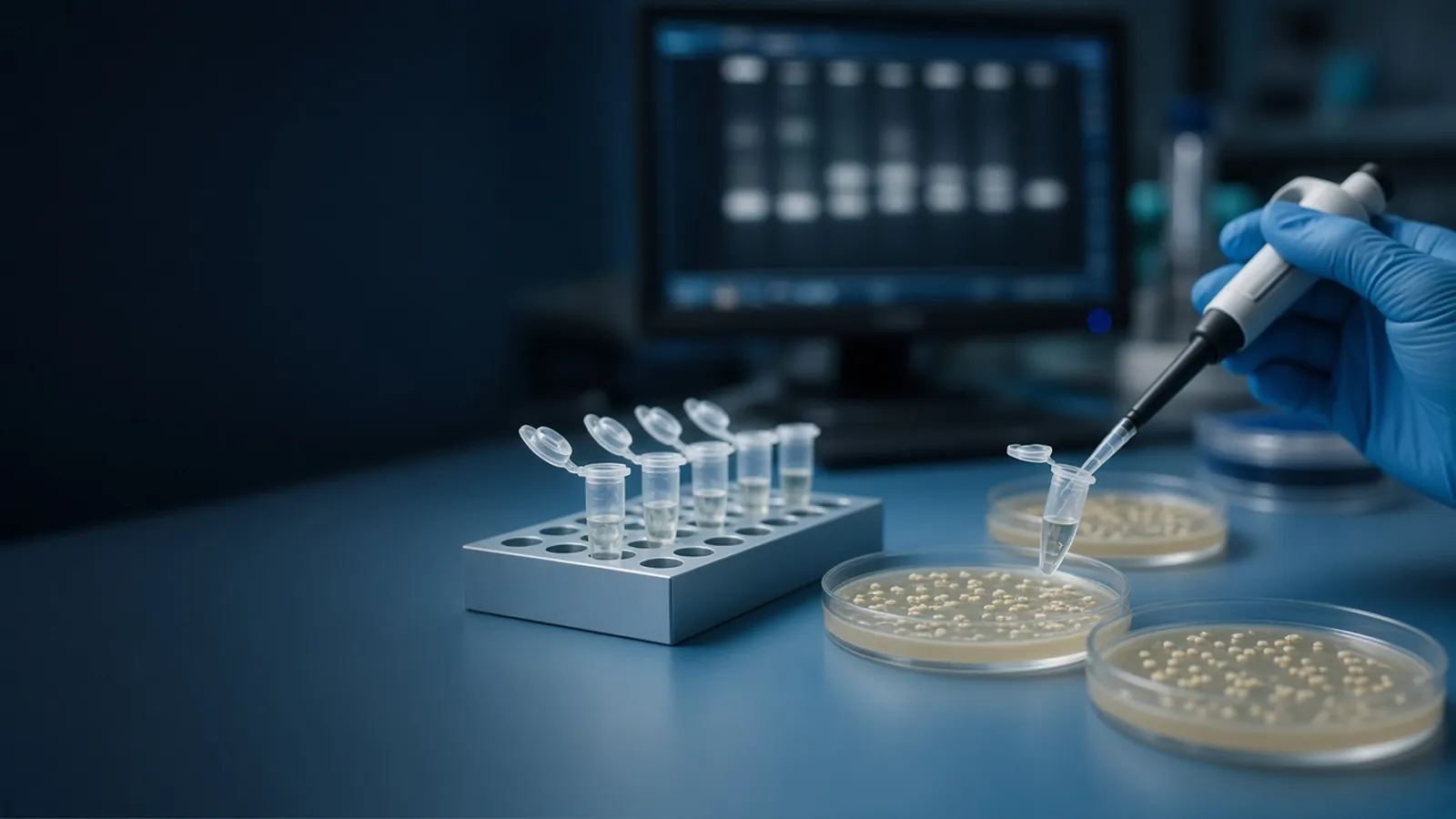
The photograph on this page is a benchtop sequencer with a teal status light and a flow cell cartridge. It is not a capillary printout and it does not show a person. Sanger data for a clone is a trace of peaks from a primer-initiated reaction. Keep that distinction when you look at the picture. Instrument classes and related reagents can be discussed from the molecular biology catalogue. The Sanger sequencing enquiry reference is a way to frame a read. It is not a claim that EVRINTH runs sequencing.
What a confirming read is allowed to say
A Sanger read reports the bases downstream of one primer on the templates that were in the tube. Where the peaks are single, evenly spaced and strong enough to call, you may compare those bases to the map. Where the peaks pile up, fade or split, you do not have a base. Alignment with NCBI BLAST against your map, or against a GenBank accession if that is the reference, is the comparison. A colony PCR band and a friendly filename are not.
Plan on a few hundred reliable bases from a good primer as the coverage you actually count. Chemistry often calls further, sometimes well past that, and those extra bases are usable only while you can still see clean peaks. Do not draw a one-kilobase arrow on the map and call it covered because a service returned a long text file. Open the trace. The text file will contain letters after the trace has given up.
The first bases after the primer are frequently messy. Place the primer upstream of the insert, on vector sequence, far enough that this messy start is over before the junction. If the primer sits inside the first codon you care about, you will lose exactly the junction a cloning error prefers. Several dozen bases of lead-in is a sound planning habit. The precise gap depends on the chemistry. Leave a margin rather than starting the read on the base you must know.
Clean DNA, in practical terms
The reaction wants one plasmid species at a mass the submission note states, in a buffer that does not carry ethanol or a heavy load of salt. A miniprep eluted in water or a low-salt buffer is the usual template. Ethanol left from a wash kills the signal or shortens it. Too much template also shortens the read. Too little gives noise. Follow the mass and volume window the sequencing instructions give. Do not invent a universal nanogram from this article.
Absorbance ratios are a cleanliness hint. A 260 to 280 ratio near the familiar DNA value does not prove integrity, identity or the absence of inhibitors. RNA inflates absorbance and is not a Sanger template. The Addgene DNA quantification protocol is a public note of how laboratories separate those measurements. Use it as a reminder to look at both a dye reading and a gel if the numbers disagree. Addgene's molecular biology reference is vocabulary, not a sample sheet.
Label the tube with the plasmid name, the primer name and a date. A confirmation that cannot be tied back to a colony is a trace of an unknown.
Extra primers when the insert is long
Sketch the insert as a line. Mark a vector primer upstream of the left junction and shade a few hundred bases into the insert. If the shade does not reach the far junction with an overlap to spare, add another primer. For a long insert, walk primers along the sequence so each reliable window overlaps the next. Sequence the opposite strand when a region is hard to call, GC-rich, or a run of the same base that slips. One strand can be enough for a short, clean insert if the trace is unambiguous and you accept that a compression artefact would hide. Two strands are the calmer record when the clone will be a reference.
Gibson junctions and restriction junctions fail in a handful of bases. Make sure a read crosses each junction, not merely the middle of the insert. A perfect middle with an unread scar at the edge is how a frameshift escapes.
| Trace | What it supports | What you do |
|---|---|---|
| Clean peaks across the junction and a few hundred bases | Those bases match or do not match the map | Record the alignment; add a primer if the insert continues |
| Strong signal that dies early | Template amount, salt, ethanol, or a structure stop | Clean the DNA or move the primer; do not re-call noise |
| Mixed peaks from the start | Two templates or two priming sites | Restreak, prep a single colony, repeat |
| Mixed peaks beginning at one position | A deletion or insertion in part of the population | Restreak; do not average the two sequences |
| Clean read of the wrong plasmid | The colony or the tube was mislabelled | Go back to the plate; do not edit the map to fit |
Mixed peaks are a sample problem
Double signal at many positions means the capillary saw two sequences. Restreak the colony to isolate a single line and sequence a fresh prep. If every colony from the plate gives mixed peaks at the same position, the mixture may be in the plasmid population itself, such as a recombination repeat. More of the same prep will look the same. Redesign or reisolate from an earlier step. Editing the letters to match the map you wanted hides the clone you have.
A primer that binds twice, once upstream of the insert and once inside it, produces a mixed trace even from a pure plasmid. Blast the primer against the whole molecule before you blame the miniprep.
Where this guide stops
Sanger confirmation does not measure how much protein you will get, and it does not certify a clinical genotype. It does not cover a genome. It covers the bases a primer reached on one clone. When the trace and the map agree across the insert and the junctions, you may name the glycerol stock. Keep a DNA backup of that prep. When they disagree, the trace wins and the map is what you update, or the colony is what you throw away.
A hot journey and a written primer name
Plasmid DNA for a read is often sent as a small liquid tube. A delay in heat can drop the quality of a dilute sample even when the same tube was fine on the day you measured it. Follow the submission conditions, and do not assume a wet tube in an ordinary envelope still has the concentration you calculated if the journey was hot. Write the primer name, the primer sequence and the junction you expect on the enquiry itself. A repeat after a delayed parcel should not depend on someone remembering which vector primer was "the usual one."
What the enquiry contains
Include the map, the primer names and sequences, the template type (plasmid, not a PCR mixture unless you mean a PCR product), the length you need covered, and the mass you measured. State that you want clone confirmation, which means junction and insert, not a single short read if the insert is long. Frame that request with the Sanger sequencing enquiry reference. If the clone is wrong often enough that you would rather order the designed sequence, the custom gene synthesis enquiry reference is a separate enquiry. Neither page means EVRINTH runs the work. Ask through the quote request whether a quotation is possible, and keep the trace as the record.
Plan Sanger coverage before you send the clone
- 01Place a primer upstream of the insertChoose a primer on the vector, upstream of the junction, so the messy first bases of the trace finish before the insert starts. Name that primer in the same note as the map.
- 02Send DNA that a capillary reaction can readUse a miniprep free of ethanol carryover and excess salt, at the mass the submission note asks for. Absorbance near the usual DNA ratio is only a cleanliness hint. It does not prove the plasmid is the one on your map.
- 03Count a few hundred reliable bases per primerPlan each read as a few hundred bases you are willing to trust where the peaks stay clean. Treat a longer call as a bonus you still inspect, not as coverage you already spent.
- 04Add primers until junctions and insert are coveredA long insert needs extra primers spaced so the reliable windows overlap. Mixed peaks mean mixed template. Restreak and repeat rather than editing the trace to match the map.
Questions from the bench
The photograph shows a sequencer with a flow cell. Is that the Sanger trace?
No. The photograph is a benchtop sequencing instrument with a teal status light and a flow cell cartridge. It is not a capillary printout, and it does not show a person. Sanger confirmation of a clone is a separate chemistry: one primer, one template, chain terminators, and a trace of peaks. Do not read this picture as the data file you will align to the map.
One clean read from a vector primer covered my junctions. Is the insert confirmed?
Only the bases you can actually trust in that trace are confirmed. A few hundred reliable bases will not cross a long insert. The far junction and the middle remain unread until another primer covers them. Archive the clone when every base you care about has been read from clean peaks and matches the map, not when the first file looks tidy.
What do double peaks at many positions mean?
Mixed peaks mean the reaction saw more than one template, or a primer bound in more than one place. A colony that picked up two plasmids, a miniprep of a mixed streak, or a deletion mixed with the full-length molecule all look like this. Software will still assign letters. Those letters are not a consensus you should save. Restreak to single colonies and sequence again.
Does the Sanger service page mean EVRINTH will sequence the clone?
The Sanger sequencing page on this site is an enquiry reference. Use it to frame primer names, template type and the coverage you need. It is not a statement that EVRINTH runs sequencing, holds a particular chemistry, or has accepted your sample. Ask whether a quotation is possible, and keep the trace plus the map as your own record of identity.
References
Manufacturer names identify published method classes. Trademarks remain with their owners. Catalogue records on this site are independent references for enquiry. They are not a statement of inventory, distribution rights or a supply commitment. This page is educational. It is not medical advice, a diagnostic protocol or a biosafety approval.
Catalogue
Related products and categories
These links follow the subject of the article into published manufacturer references. A listing is a reference for an enquiry, not a statement of stock or distribution rights.
Continue in this cluster
Related reading
 Plasmid cloning from insert to colonyHow an insert becomes a plasmid, a colony and a verified clone, and which checkpoint fails when the plate is empty or the insert is wrong.A glossary of cloning termsRead a cloning plan and mark vector, insert, MCS, ends, ligase, phosphatase, transformation, and clone against the map before you mix a tube.Antibiotic selection is not proof of an insertWhat selection, marker, satellite and clone mean on an antibiotic plate, and why a colony can grow with no insert, the wrong insert or only a parent vector.