
comparison
Satellite colonies around a large colony
Why tiny colonies ring a large one on ampicillin, and how that halo differs from kanamycin plates poured for cloning strains.
- Author
- EVRINTH Editorial Team
- Published
- 8 October 2026
- Updated
- 8 October 2026
- Reading time
- 9 min
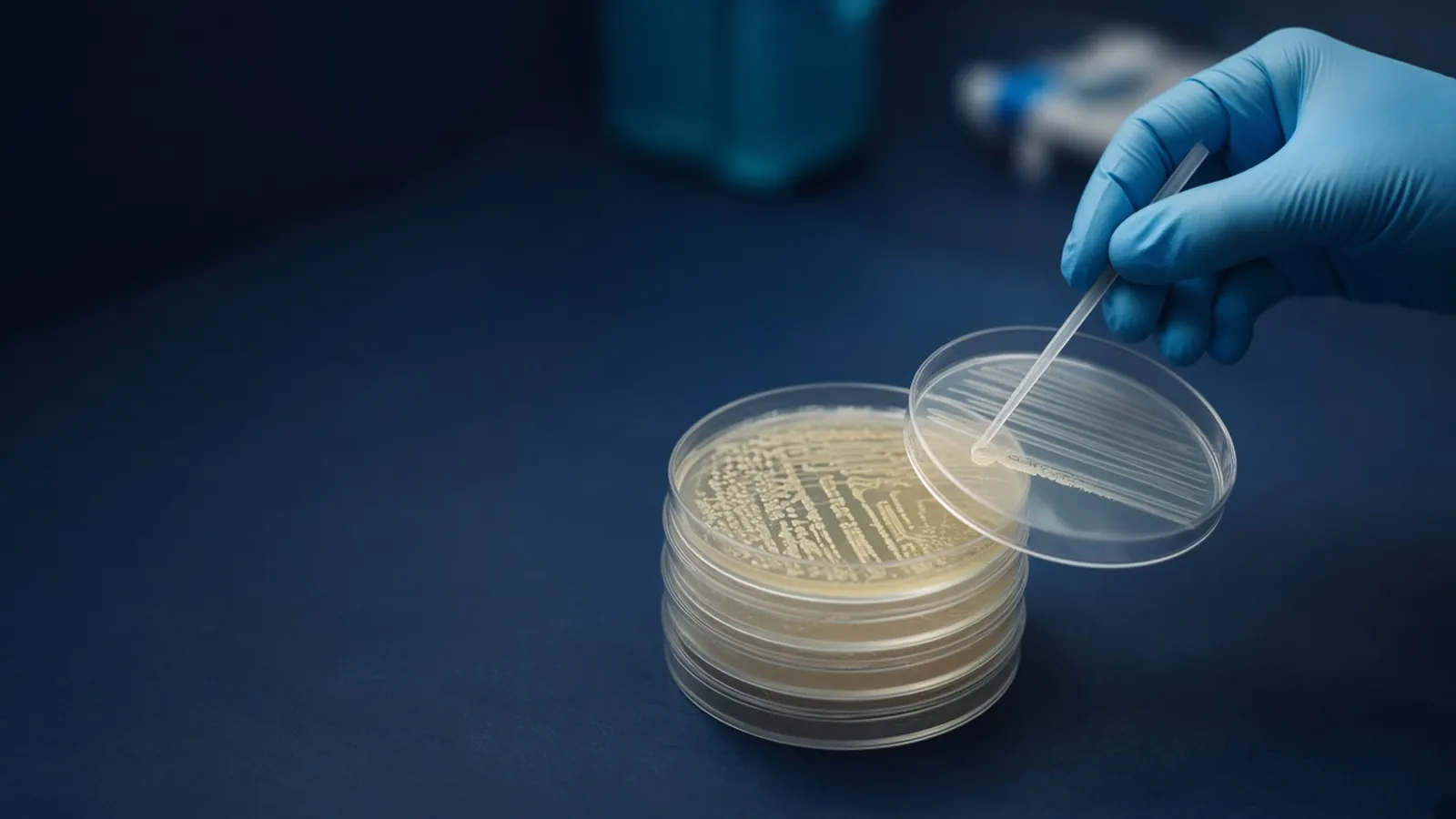
A ring of tiny colonies around one large colony is a chemistry result, not a bonus yield of clones. The decision this comparison supports is which antibiotic class you specify, and whether the plates are fresh enough that the drug still means what the label says. The culture that produced the large colony is described in bacterial culture and transformation. How markers and colour screens are read, including why satellites are the wrong thing to pick, is antibiotic selection and blue-white screening. The plasmid those colonies are supposed to carry is plasmid cloning from insert to colony.
Antibiotic identity belongs in a specification drawn from the reagents and chemicals catalogue, with the method context on the molecular biology pathway. If the marker gene is being designed with the construct, say so via the custom gene synthesis reference. The buying question goes to the quote request. A method can be discussed. This page does not set a dose chart.
What the halo is
On ampicillin agar the large colony is the cell that matters. It holds a plasmid with a beta-lactamase gene, often still called bla, and it secretes enzyme into the agar around itself. Beta-lactamase hydrolyses the beta-lactam ring. Ampicillin near the colony falls below the concentration that stops a sensitive cell. Cells that never took up the plasmid, and that would have stayed invisible on a fresh plate, then form pinprick colonies in that zone. They are satellites. They do not contain your construct unless a transformant happens to be sitting there by chance, which you cannot see.
The pattern is spatial. Satellites hug the large colony. They are scarce or absent farther away, where the drug is still intact. A plate that is tiny colonies everywhere, including far from any large colony, is a different fault: the antibiotic was omitted, cooked, or exhausted across the whole dish. Do not use the word satellite for a general lawn.
Protein records for beta-lactamases live in public databases such as UniProt. Use them to confirm what a named enzyme is. They are not a plating recipe. Everyday cloning language for the same observation is collected in the Addgene molecular biology reference.
Why ampicillin invites the pattern
Ampicillin is effective and familiar, and it is chemically fragile. It is heat-labile, it does not love a low pH as a culture acidifies, and a single resistant colony is a local factory for the enzyme that destroys it. The longer a plate incubates, the wider the halo can become, because the enzyme keeps working and the drug does not regenerate. Plates stored warm before they are ever inoculated have often lost potency everywhere, so the "halo" becomes the whole dish and you see a lawn or a carpet of small colonies with no honest selection.
A fresh ampicillin plate, read when colonies are discrete and not after a long extra day on the bench, still shows satellites if a strong secretor is present. Freshness reduces the background. It does not repeal the enzyme. If your experiment must distinguish true transformants from neighbours, ampicillin is the class that demands the most discipline about which colony you touch.
Carbenicillin as the same idea, stabler in the dish
Carbenicillin is a penicillin-class antibiotic, still destroyed by beta-lactamase, still selecting for the same bla marker. The practical difference laboratories care about is stability in agar. Carbenicillin holds up better during storage and during a long incubation, so the local halo is slower to become a neighbourhood of satellites. People specify it when plates cannot be poured the hour they are used, or when an incubation has to run long enough that ampicillin would be exhausted.
It is not a free pass to pick every small colony. A large resistant colony can still clear a zone. The comparison is "fewer and later satellites", not "satellites abolished". Concentration stays on the antibiotic sheet and the plasmid map. This article will not print a milligram table, because copy number and strain change the working level, and a comparison of classes does not need invented doses.
Other beta-lactams exist in research catalogues. Specify the molecule, not the phrase "ampicillin-like". A purchasing note that says only "beta-lactam" will be answered with the wrong bottle as often as the right one.
Kanamycin does not feed the neighbours
Kanamycin is an aminoglycoside. The resistance proteins used on cloning plasmids modify the drug inside the cell that carries the gene. They do not flood the agar with an activity that rescues sensitive neighbours. A kanamycin plate can still be overgrown if you plated too many cells or if the drug was inactive, but you do not get the classic picture of one large colony wearing a crown of tiny ones. Chloramphenicol and tetracycline are different chemistries again. Each has its own stability and its own failure look. None of them should be substituted because the freezer was closer. The marker gene decides.
If a kanamycin plate does show a halo of tiny colonies, do not import the ampicillin explanation by habit. Check whether the antibiotic was added after the agar had cooled, whether the stock was ancient, and whether the host was already resistant. A chromosomal kanamycin cassette in the strain will grow with or without your plasmid, and it will not bother to form satellites. It will form a lawn or a full streak.
What to write into a specification
| Antibiotic class | Marker it pairs with | Satellite behaviour on a cloning plate | What the specification should state |
|---|---|---|---|
| Ampicillin | Beta-lactamase (bla) | Prone: a large colony clears a halo and sensitive cells grow in it | Molecule, that plates are fresh, storage cold, added after autoclaving |
| Carbenicillin | The same beta-lactamase | Same mechanism, slower halo because the drug is more stable in agar | Molecule by name, not "ampicillin equivalent", and the same post-autoclave rule |
| Kanamycin | Aminoglycoside-modifying enzyme | The resistant cell does not rescue neighbours; a halo means something else is wrong | Molecule, host genotype free of a chromosomal copy, plate age |
| Inactive or omitted drug | None | Carpet or lawn everywhere, including the no-DNA plate | Do not buy "more of the same plates" until a blank plate stays blank |
Picking the ring by mistake
The operational failure is a tip that touches a satellite because it was nearby and small and therefore "looked like a fresh transformant". That colony often has no plasmid. The miniprep is empty, or it is contaminated with a true transformant you also grazed, and the gel becomes a mixture. Pick the centre of the large colony, change the tip, and restreak onto a plate poured recently enough that you trust the drug. If the colonies are so crowded that you cannot tell large from satellite, streak for single colonies before any precious downstream step.
A no-DNA control that is sprouting small colonies across the whole plate means you do not have a halo problem. You have no selection. Discard the interpretation and the plates together. A no-DNA plate that is clear, plus one large colony with a private ring, is the classic satellite picture. The large colony is a candidate. The ring is not a library.
Incubation time is part of the comparison. Reading plates as soon as colonies are large enough to touch, and not after they have sat warm all weekend, keeps the halo small. Refrigerating plates to "stop" them only helps if the drug is still there. A weekend at 37 Celsius is how an ampicillin plate becomes a non-selective plate with a memory of having been selective.
Resistance genes are still a biosafety question
The strains here are non-pathogenic cloning hosts. The resistance gene is a laboratory marker, not an invitation to move that plasmid into an organism outside the institutional list. Waste plates that carry bla or a kanamycin cassette are inactivated by the route your laboratory already uses. Do not send them out as ordinary rubbish because the colonies were "only E. coli". This page is not medical advice and not guidance on clinical resistance. Containment stays with the institution. The WHO Laboratory Biosafety Manual is a reference for that decision. It does not authorise a change of organism.
Warm storage is how ampicillin becomes a halo the size of the plate
Where the cold room is unreliable, ampicillin plates age in days that a cool laboratory would not count the same way. A stack left on a bench overnight in hot weather is a different reagent in the morning. Carbenicillin is specified in that setting because its stability buys time, not because the enzyme disappeared. Humidity does not create beta-lactamase. Heat and time do. Pour closer to the day of use, store what you must store cold, and write the pour date on the base. A plate of unknown age is not a plate you can use to declare a satellite.
What the enquiry should name
State the molecule, the marker gene, the host, whether plates will be stored or poured for immediate use, and whether satellites have already confused a previous lot. Ask for the stability note and for confirmation that the drug is added after the medium has cooled. Put that on the quote request. A method can be discussed. Do not ask for "whatever is usually used for cloning" and expect the halo to go away. The custom gene synthesis reference is relevant only when the marker is being chosen with the construct. It is an enquiry prompt, not a statement that a gene is already being made. Public plating notes in the Addgene protocols collection show how laboratories record the drug next to the strain. Copy the habit of writing both down, not a concentration from a different vector.
Questions from the bench
Are the small colonies around a large one extra transformants?
On an ampicillin plate they usually are not. The large colony carries a beta-lactamase plasmid and destroys ampicillin in a local halo, so nearby cells that never took up DNA can divide. Pick the large colony if you must pick from that plate, and restreak it on fresh selective agar before you trust it.
Does carbenicillin stop satellites completely?
Carbenicillin is still a beta-lactam, so a beta-lactamase plasmid can still inactivate it. It is widely regarded as more stable in agar than ampicillin, and laboratories use it when they want fewer halos on plates that must sit for a while. It is not a different resistance mechanism, and it is not a dose you should invent. Follow the antibiotic note and the plasmid map.
Why do kanamycin plates rarely show the same ring of tiny colonies?
Kanamycin resistance enzymes act inside the cell and do not clear a public halo of drug the way secreted beta-lactamase clears ampicillin. A sensitive neighbour stays sensitive. A crowd of tiny colonies on kanamycin is a reason to suspect the drug was never active, or that you plated a lawn, rather than to call them satellites of the ampicillin type.
What should a buyer specify when satellites have been a problem?
The antibiotic class, whether the plates must be fresh or will be stored, the host, and the marker gene on the plasmid. Ask whether the beta-lactam is ampicillin or a more plate-stable penicillin-class option such as carbenicillin, and ask for the written specification. A method can be discussed from that note.
References
Manufacturer names identify published method classes. Trademarks remain with their owners. Catalogue records on this site are independent references for enquiry. They are not a statement of inventory, distribution rights or a supply commitment. This page is educational. It is not medical advice, a diagnostic protocol or a biosafety approval.
Catalogue
Related products and categories
These links follow the subject of the article into published manufacturer references. A listing is a reference for an enquiry, not a statement of stock or distribution rights.
Continue in this cluster
Related reading
 Bacterial culture and transformationHow non-pathogenic E. coli cloning strains are grown and how plasmid DNA is introduced, with the controls that make a colony meaningful.
 Antibiotic selection and blue-white screeningHow antibiotic plates keep a plasmid in a cloning strain, and why a white colony on X-gal is a candidate rather than proof of the insert.
 Plasmid cloning from insert to colonyHow an insert becomes a plasmid, a colony and a verified clone, and which checkpoint fails when the plate is empty or the insert is wrong.