
glossary
Streaking for single colonies
A streak dilutes cells across agar until a sector holds colonies that each grew from one cell. This glossary names the pattern, the loop, and a smear.
- Author
- EVRINTH Editorial Team
- Published
- 8 October 2026
- Updated
- 8 October 2026
- Reading time
- 9 min
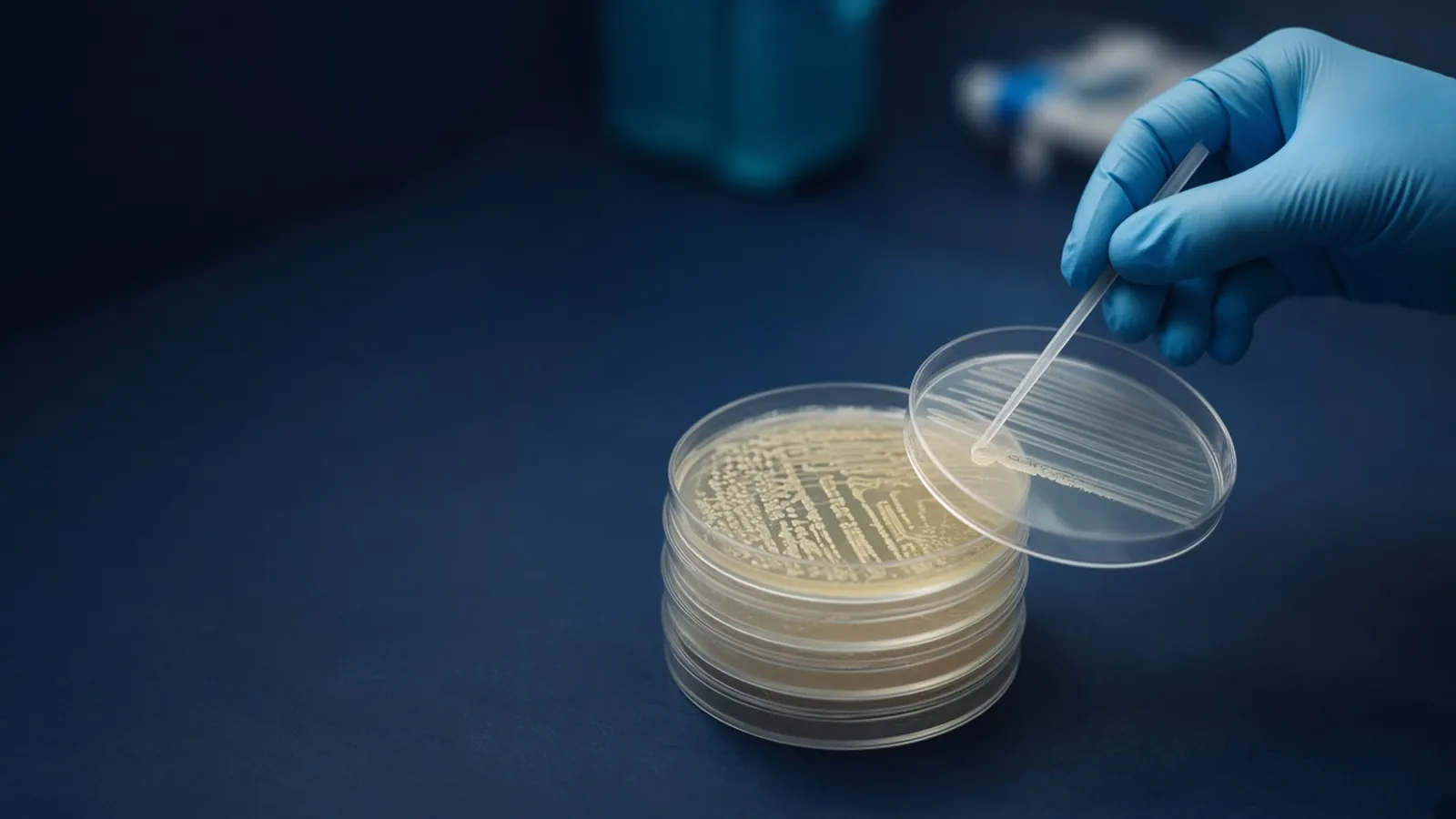
A liquid culture is only as clonal as the colony that started it. Streaking is the dilution, done on agar with a loop, that makes an isolated colony possible. This glossary names the pattern and the failures for non-pathogenic E. coli cloning strains, so a confluent smear is not quietly called a pure culture. The hero photograph shows a gloved hand streaking an agar plate with an inoculating loop, beside a stack of plates that have already grown. That is the action this page defines. How the strain is grown once a colony exists, and how a transformation is judged, is bacterial culture and transformation. How that colony becomes evidence of a construct is plasmid cloning from insert to colony.
A public, practical account of the same motion is the Addgene streak plate protocol. Medium and loop classes sit in the reagents and chemicals catalogue. The surrounding work is the molecular biology pathway. If the colony you hope to streak does not exist yet because the DNA is still a design, custom gene synthesis is an enquiry reference only. Consumable questions go through the quote request.
The words
A streak is the path of a loop or a sterile stick across the agar. The inoculum is whatever you start with: one colony, a scrape of a glycerol stock, or a droplet of broth. A quadrant streak divides the plate into three or four sectors. A T-streak is a different drawing with the same ambition. In both, the first sector is seeded heavily and each later sector is seeded only from the edge of the one before.
An isolated colony is a mound separated from its neighbours by bare agar, in the sector where the dilution finally succeeded. The first sector is often a confluent streak, a solid smear where cells were too dense to form separate mounds. That smear is supposed to happen. It is not a failed plate. The failure is a last sector that looks like the first.
A colony-forming unit is the thing you actually spread. Two cells stuck together found one colony. For a cloning strain handled gently, an isolated mound of the right morphology is the working definition of a single clone. It is the inoculum you want for broth. A mixed streak shows two morphologies, or a loop path that wandered back into the heavy sector and dragged a crowd into the "isolated" zone.
Flaming a metal loop, or changing a disposable one, between sectors is the dilution step. The flame kills what is on the wire. The fresh stick simply does not carry it. Either way, the next sector starts from a light touch on the previous path, not from the original blob.
Why the geometry works
Each sector is a physical dilution. The first pass spreads thousands of cells. The cooled, sterile loop touches that path a few times and carries a much smaller number into empty agar. Do it again and the number falls until individual units sit millimetres apart and grow into mounds you can pick without touching a neighbour. If you skip the sterilising step, the geometry is theatre. The cell number never falls.
The agar has to be set, not wet, and not so dry that the loop tears it into flakes. A wet surface lets cells swim sideways in a film, so the careful gaps close up and the plate looks smeared even though your wrist was steady. Condensation on the lid is the usual water source in a humid incubator. Invert plates during incubation so that water stays off the agar. Before streaking a fresh plate that just came out of a cold room, let the surface lose its sweat by the method your laboratory uses. A short inverted wait is a common habit. Baking the plate until it cracks is not.
The loop must be cool. Touching cells with glowing metal kills them and spatters agar. Cool the loop on a bare edge of the agar, where you can see it stop sizzling, then go to the previous sector. Disposable loops skip the flame and skip that hazard. They still need changing between sectors, and they still need to be discarded as the waste rule says, not wiped and reused.
Once you have an isolated colony of the right look, that colony, not a swipe of the whole sector, is what goes into broth. The Addgene protocol for inoculating a bacterial culture starts from that discipline. A loopful of confluent streak starts a mixture.
A short workflow with a branch
Label the base with the strain, the antibiotic and the date before you streak, so a lid swap cannot rename the source. Take the inoculum from one colony or from one place in a glycerol vial that you did not thaw into soup. Draw sector one. Sterilise or change the tool. Draw sector two across the tail of sector one a few times, then onward into empty agar. Repeat for the remaining sectors. Do not let sector four cross back into sector one. Incubate inverted at the temperature the strain expects, often near 37 Celsius for routine K-12 work.
Branch when you read it. Last sector still confluent: the tool was not changed, the inoculum was a puddle, or the plate was wet. Restreak a tiny touch from the least crowded area onto a fresh, drier plate. Two morphologies in the last sector: the source was mixed, or the loop dug into a contaminant at the edge. Do not inoculate a flask. Restreak one mound of each morphology only if both are within the strain you are allowed to handle, and keep them separate. No growth anywhere: the loop was hot, the antibiotic is one this strain cannot resist, or the stock was dead. Streak the same inoculum on a non-selective plate only if your assessment allows that plate, and only to separate "dead cells" from "wrong drug". A hot loop is confirmed when a cooler second streak from the same source grows.
Strains that arrived from a collection should be revived in the spirit of the ATCC culture guides, then streaked to isolation before you trust a broth. Reagent classes around later steps appear in Promega protocols.
What the last sector is telling you
| What you see | Reading | Next action |
|---|---|---|
| Isolated mounds of one morphology, bare agar around them | A usable colony-forming unit of that look. Confirm it matches the strain and the marker on the base. | Pick one mound into one tube. Do not sweep the sector. |
| A continuous smear, or a last sector as heavy as the first | The dilution did not happen. Wet agar, an unchanged loop, or a crossed path. | Restreak onto a fresh plate with a cooled or new tool. |
| Two colours or two edges in the "isolated" area | A mixed streak. The flask you start from it will be mixed too. | Restreak each morphology separately, or discard if one is not your strain. |
| No growth in any sector | Hot loop, wrong antibiotic, dead inoculum, or cells that were never there. | Cool the tool and repeat. Check the drug on the base before you blame the stock. |
Failures that look like a curse on the strain
Digging the loop tears the agar and piles cells into the groove, so "colonies" are a scar. Light contact is enough. Crossing back into sector one refills the loop with the original density and paints it across the plate. Leaving the plate upright in a humid incubator lets the lid rain on the streaks and join them. Incubating at a temperature the strain is not using gives you no growth and a false story about the glycerol stock. The base label is how you notice you streaked onto kanamycin with an ampicillin-only plasmid.
A transformation plate that is already a set of isolated colonies does not need a heroic restreak before you pick, if the no-DNA control was clean and the mound is separate. Restreaking is how you purify a colony you do not yet trust, and how you revive a stock. It is not a decoration on every plate.
Flame, waste, and the strain boundary
A flame and a bottle of ethanol in the same hand is a burn the cloning strain does not cause. Follow the laboratory rule for flaming. If the rule is disposable loops, use them and discard them in the biological stream the office named. Plates are that same waste system. This glossary is for non-pathogenic cloning strains already assigned to the bench. It is not a method for isolating an unknown organism from the environment. This page is not medical advice.
Humidity on the lid
In a humid season the stack in the photograph's background will sweat the moment it enters a cool room or leaves a fridge. Streak those plates only after the surface is no longer a mirror, or the sectors will swim. Do not wipe the agar with a non-sterile tissue. You can remove lid condensate with the sterile technique your method already allows, or you can incubate the empty plate inverted briefly so the surface dries. A power cut that leaves fresh streaks at an undefined temperature belongs in the notebook. Read those plates against a plate that stayed at the set point before you call the stock dead. Write the antibiotic on the base so a smeared lid does not become the only record.
What to specify if you are asking for loops or plates
Name sterile disposable loops or a reusable loop class, the plate recipe class, the antibiotic and the storage of the plates. Say you need a surface dry enough to streak, if you are receiving pre-poured dishes that have been sitting cold. The streaking method can be discussed against the Addgene protocol linked above and against your strain. Send the practical fields through the quote request. A construct that still has to be designed stays on the custom gene synthesis reference as a design question, and the colony you will eventually streak is not evidence that the design already succeeded.
Questions from the bench
What is the point of flaming or changing the loop between sectors?
Each new sector should be seeded only by the few cells the loop picks up from the previous streak, not by the original droplet still sitting on the wire. A loop that is not flamed, or a disposable stick that is not changed, reprints the heavy inoculum into every quadrant. The last sector then stays confluent and you have not diluted anything.
Why does a wet plate turn a careful streak into a smear?
Condensation and a wet agar surface let cells move in a film instead of staying where the loop put them. Sectors blur together and isolated colonies never appear. Dry the surface the way your method allows, often a short inverted rest that does not desiccate the agar, and keep the lid's condensate off the surface while you streak.
Is an isolated colony always one cell?
It is a colony-forming unit that landed far enough from its neighbours to grow as its own mound. Cells that were stuck together can found one colony, so the mound is usually pure and is not a mathematical guarantee of a single ancestor. For cloning strains it is still the right inoculum for a liquid culture, and a mixed morphology means you restreak.
What if the loop was still glowing when it touched the agar?
A hot loop kills the inoculum and can spit molten agar. Cool the metal in the agar at the edge, away from the cells, or in the air for the time your technique requires, before you enter the previous streak. No growth in any sector is sometimes a loop that was too hot, not a dead glycerol stock.
References
Manufacturer names identify published method classes. Trademarks remain with their owners. Catalogue records on this site are independent references for enquiry. They are not a statement of inventory, distribution rights or a supply commitment. This page is educational. It is not medical advice, a diagnostic protocol or a biosafety approval.
Catalogue
Related products and categories
These links follow the subject of the article into published manufacturer references. A listing is a reference for an enquiry, not a statement of stock or distribution rights.
Continue in this cluster
Related reading
 Bacterial culture and transformationHow non-pathogenic E. coli cloning strains are grown and how plasmid DNA is introduced, with the controls that make a colony meaningful.
 Plasmid cloning from insert to colonyHow an insert becomes a plasmid, a colony and a verified clone, and which checkpoint fails when the plate is empty or the insert is wrong.A glossary of bench microbiology termsPlain definitions of colony, lawn, streak, pellet, transformant and the other bench words a cloning afternoon depends on.