
Pillar guide
Accurate micropipetting technique
How an air-displacement micropipette delivers a volume, how forward pipetting uses the two stops, and why temperature belongs in the result.
- Author
- EVRINTH Editorial Team
- Published
- 8 October 2026
- Updated
- 8 October 2026
- Reading time
- 9 min
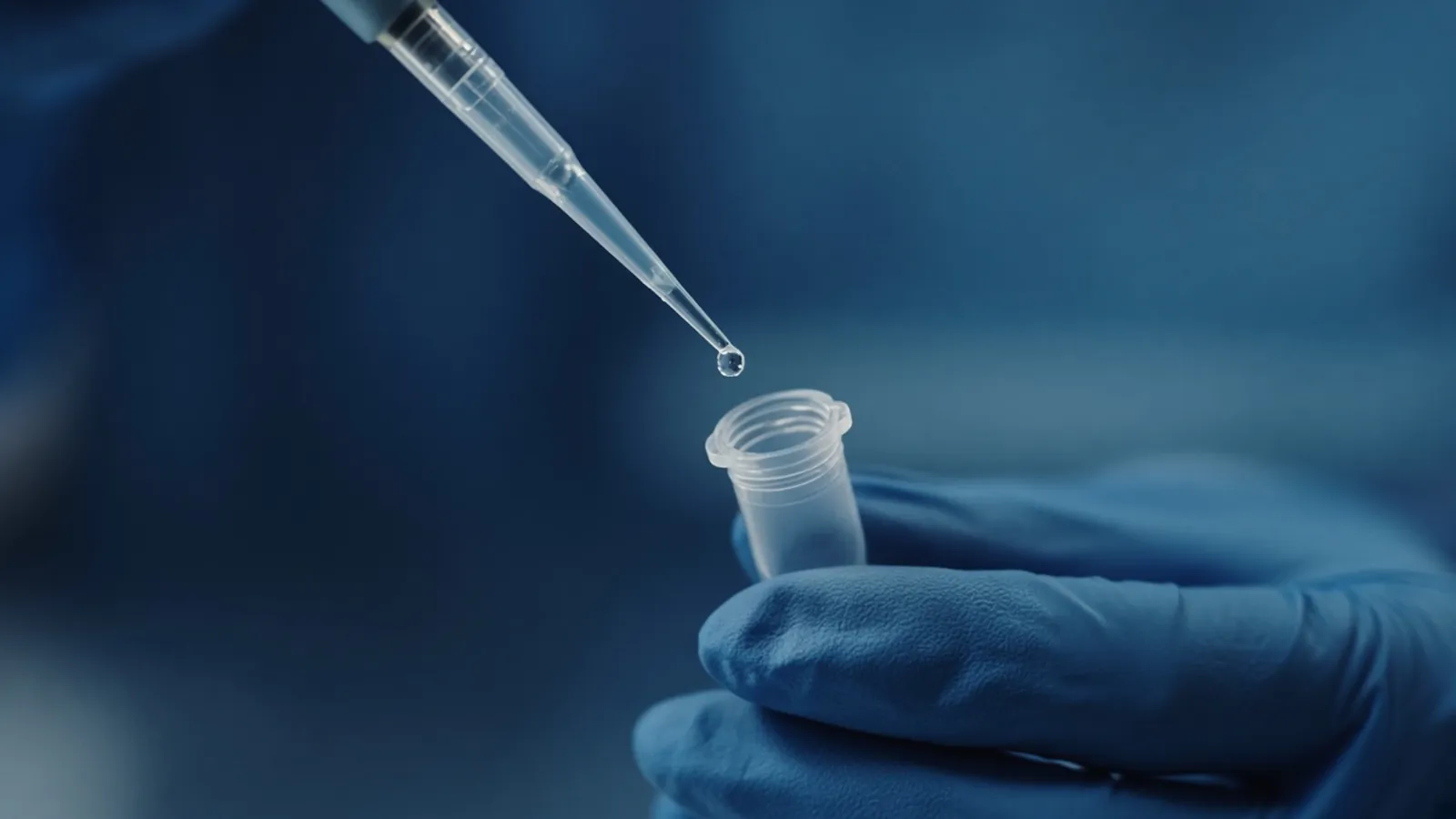
Accurate micropipetting technique is the habit that makes a stated microlitre volume the volume the tube actually received. The decision this page supports is how to handle an air-displacement pipette so that forward pipetting of aqueous reagents is repeatable, and when that technique is the wrong tool. Checking the same pipette on a balance between formal calibrations is the companion note, checking a pipette between calibrations.
Pipettes as instruments are in the scientific instruments catalogue. Tips and tubes are in the laboratory consumables catalogue. A specification, including any calibration document you need named, goes to the quote request. A family name is not a statement that a particular pipette has been adjusted.
The volume the experiment thinks it received
Most molecular measurements assume the pipette did what the dial said. Enzyme units, standard curves and PCR master mixes are all ratios. A pipette that delivers short on a small setting will not announce itself with a drip if the error is a thin air cushion rather than a leak. The experiment simply moves. Quantitative PCR is one place the community has written this down: the MIQE guidelines treat pipette performance as part of what makes a quantification publishable. The principle is older than that paper and wider than PCR. If the volume is the data, the pipette is a measuring instrument. If the volume is "about a millilitre of wash", a serological pipette or a cylinder may be the honest tool, and a micropipette is theatre.
Air displacement
In an air-displacement pipette a piston moves, a cushion of air transmits that movement, and the liquid stays in the tip. The pipette never intends to pull liquid into the barrel. That cushion is why the instrument is sensitive to temperature, to atmospheric pressure, to a wet barrel, and to a tip that does not seal. It is also why volatile solvents vaporise into the cushion and drip, and why viscous liquids lag behind the piston.
A positive-displacement pipette puts a piston in contact with the liquid, usually via a capillary tip. It is the better class for viscous, dense or volatile liquids, and it is a different calibration. Do not "correct" an air-displacement pipette for glycerol by a private factor scribbled on the handle and then use that factor for water.
The tip is part of the metrology. It must match the cone. Filter tips protect the barrel from aerosols and change the air path slightly; if you calibrated with one tip family, routine work that must match the calibration uses that family. Pre-wetting the tip, for aqueous forward pipetting, fills the air with vapour so the first dispense is not the odd one that evaporates into a dry cushion. Skip pre-wetting only when the method says the first stroke is discarded anyway.
Forward pipetting
Set the volume. Seat the tip with a firm press, not a pounding that bends the shaft. Hold the pipette vertical to aspirate. Press the plunger to the first stop, dip the tip a few millimetres under the surface, and release the plunger smoothly. A deep plunge carries liquid on the outside of the tip, which then wipes off into the destination and was never in the calibrated stroke. A shallow dip that breaks the surface sucks air. Pause briefly at the end of aspiration so viscous drag can catch up. If you see a bubble, expel and try again. A bubble is an air volume wearing a liquid costume.
Withdraw the tip along the wall or straight up, according to a single habit. Move to the receiving vessel. Touch the tip to the inner wall above the liquid, or just at the surface, as your method standardises. Press to the first stop. Pause. Press to the second stop to blow out. Still holding the plunger down, remove the tip, then let the plunger rise. Releasing the plunger inside the liquid pulls the delivery back up.
That sequence is forward pipetting. Reverse pipetting aspirates by pressing past the first stop, toward the second, and then delivers only to the first stop, leaving the blow-out volume in the tip. It improves repeatability for foaming, volatile and some viscous liquids, and it is a poor way to dispense the last of a precious standard you thought you had measured by the dial. Do not mix the two techniques in one calibration check. The Addgene protocol collection shows how often molecular methods simply say "pipette" and leave this choice unwritten. Your method should not.
Multichannel pipettes add a new failure: one loose tip, one bent piston, a plate that rocks, and twelve volumes that are not the volume you think you replicated. Seat all tips. Watch the tips enter the wells together. If one channel lags, stop using that channel for a quantitative plate.
When the balance disagrees
A gravimetric check weighs water delivered into a vessel and converts mass to volume with the density of water at that temperature. That is the skeleton of a calibration. The full procedure, the balances, and the documentary standards live in metrology practice. NIST's calibration-procedure collection is a public index into that world. Your quality system names the limits and the interval. This article will not invent an acceptable percentage.
Between those intervals, a quick check can tell you that a pipette has been dropped, that a piston is corroded, or that a new tip brand does not seal. How to do that check without pretending it is a full calibration is the companion article. If the check fails, the branch is simple. Stop using the pipette for quantitative work. Do not hand it to a student with a warning to "be careful". Careful technique cannot repair a leaking seal.
| What you see | Likely class of cause | Branch |
|---|---|---|
| Tip drips before you dispense | Poor seal, cracked tip, volatile solvent, or liquid in the barrel | Reseat or change tip; if the barrel is wet, the pipette is out of service |
| Bubbles in the tip | Releasing too fast, tip above the liquid, or detergent | Repeat the stroke; slow down |
| Delivery changes with the hour of the day | Temperature of liquid, pipette or room | Equilibrate; do not mix morning calibration with afternoon heat |
| Last well of a multichannel is short | One loose tip or one weak piston | Stop the plate; mark the channel |
| Viscous liquid left in the tip | Forward aqueous technique on the wrong liquid | Reverse pipetting or positive displacement |
Record the pipette identity in the method when the volume is critical. "P200" is a range, not a serial number.
Failure modes that feel like biology
A master mix that is short because the water pipette drifts will look like an enzyme failure. A standard curve that flattens because small volumes were aspirated at an angle will look like saturation. Droplets on the outside of the tip, wiped on the rim, add an uncalibrated extra that matters most at the smallest settings. Laying a pipette down with liquid in the tip runs fluid into the barrel. That fluid corrodes the piston and then every later volume is wrong. Keep pipettes upright, tips off when you are not using them, and out of solvent pools.
Never rotate the volume dial past the range. The stop you feel is a mechanical limit. Forcing it is a repair bill and a silent bias until then. Do not set a 10-microlitre pipette to 1 microlitre and expect the percentage error of the middle of the range. Use a pipette whose middle includes the volume you care about.
Safety
The liquid is the hazard, not the piston. Acids, solvents, cultures and radioactive tracers do not become mild because the volume is small. Aerosols from blowing out a culture belong in the containment your assessment named, with a filter tip if that assessment asks for one. Do not mouth-pipette. Do not point a tip at a person while you seat it. A pipette is not a syringe for clinical dosing, and this page is not medical advice. Tips that touched hazardous material are waste, not a rinsed item returned to the box.
Temperature, humidity and the room you have
Calibration temperatures are often near 20 Celsius. Many working benches are warmer, and a room that is 30 Celsius with a fan on the balance will not reproduce a temperate calibration mass. Equilibrate water, tips and the pipette. Keep the balance out of the draught and out of direct sun. Humidity changes evaporation of small droplets during a slow check; work steadily and cap the vessel. In a humid week, condensation on a cold tip rack dilutes the first samples unless you dry the rack. A power cut does not decalibrate a piston, but it stops the balance and the air-conditioning that made yesterday's check comparable. Repeat the check when the room returns, if the volume is the result. Altitude changes air density and matters for laboratories far above the place where the pipette was adjusted. If you moved a pipette between cities of very different elevation, treat it as needing a check before you trust the old certificate.
What to send with an enquiry
State the volume range, the liquid class, single or multichannel, filter tips, and whether the specification must include a calibration document or only the instrument. Use the scientific instruments catalogue, the laboratory consumables catalogue for tips, and the quote request. Ask for the written range and tip cone. Do not ask a page to promise that a named unit has already been adjusted for your bench.
Deliver an aqueous volume with a forward-pipetting technique you can repeat
- 01Match the pipette and the tip to the volumeChoose a pipette whose range covers the volume without sitting on the extreme bottom of the range, and seat a tip that actually seals. A dripping tip is a failed measurement already.
- 02Pre-wet, then aspirate to the first stopFor aqueous work, draw and expel the liquid once to humidify the air cushion. Aspirate vertically, tip only a few millimetres into the liquid, releasing the plunger smoothly from the first stop.
- 03Dispense to the first stop, then to the secondTouch the tip to the wall of the receiving vessel if the method expects it, push to the first stop to deliver, pause, then push to the second stop to clear the blow-out. Do not release the plunger while the tip is still in the liquid.
- 04Stop and check if the balance disagreesIf a gravimetric check at a controlled temperature falls outside the limit your laboratory set, take that pipette out of service for adjustment. Do not average a bad technique into a good-looking mean by discarding droplets you dislike.
Questions from the bench
What is the difference between the first stop and the second stop?
The first stop is the calibrated stroke. Forward pipetting aspirates by releasing from that stop and delivers by pressing to it. The second stop is an extra blow-out used at the end of dispensing to empty the tip. Aspirating from the second stop on purpose is a different technique, reverse pipetting, and it is not how a routine aqueous calibration was usually defined.
Why does a pipette that was fine in a cool room read differently on a hot afternoon?
An air-displacement pipette measures with a cushion of air. Warm liquid, a warm barrel and a warm room change the density of water and the volume of that cushion. Calibration is stated at a temperature. Working far from that temperature, or moving from an air-conditioned balance room to a hot bench without a check, changes the delivered volume even when your hands repeat the same gesture.
Do viscous liquids use the same forward technique?
Often they should not. Glycerol, detergent and concentrated protein aspirate slowly, cling to the tip and drain late. Reverse pipetting, a positive-displacement pipette, or a wider tip with a slower rhythm is the class of fix. Forcing the aqueous forward technique and then spinning the tube to 'get it all down' hides an unmeasured film on the tip.
What should an enquiry about pipettes and tips include?
The volume range, aqueous versus viscous or volatile liquids, single channel or multichannel, sterile or filter-tip needs, and whether you need a calibration document. Ask for the specification. A catalogue family name is not a calibrated instrument and not evidence about any particular unit.
References
Manufacturer names identify published method classes. Trademarks remain with their owners. Catalogue records on this site are independent references for enquiry. They are not a statement of inventory, distribution rights or a supply commitment. This page is educational. It is not medical advice, a diagnostic protocol or a biosafety approval.
Catalogue
Related products and categories
These links follow the subject of the article into published manufacturer references. A listing is a reference for an enquiry, not a statement of stock or distribution rights.
Continue in this cluster
Related reading
 Checking a pipette between calibrationsA gravimetric water check shows whether a piston pipette is still fit for quantitative work between scheduled calibrations, and when to stop using it.A glossary of liquid-handling termsSeparate the liquid-handling terms people mix up, from blow-out and pre-wetting to systematic error, tip fit, and the Z-factor.Air displacement versus positive displacementTrace under-delivery and dripping to the air cushion or the piston, and choose the pipette class that matches the liquid.