
troubleshooting
Air displacement versus positive displacement
Trace under-delivery and dripping to the air cushion or the piston, and choose the pipette class that matches the liquid.
- Author
- EVRINTH Editorial Team
- Published
- 8 October 2026
- Updated
- 8 October 2026
- Reading time
- 7 min
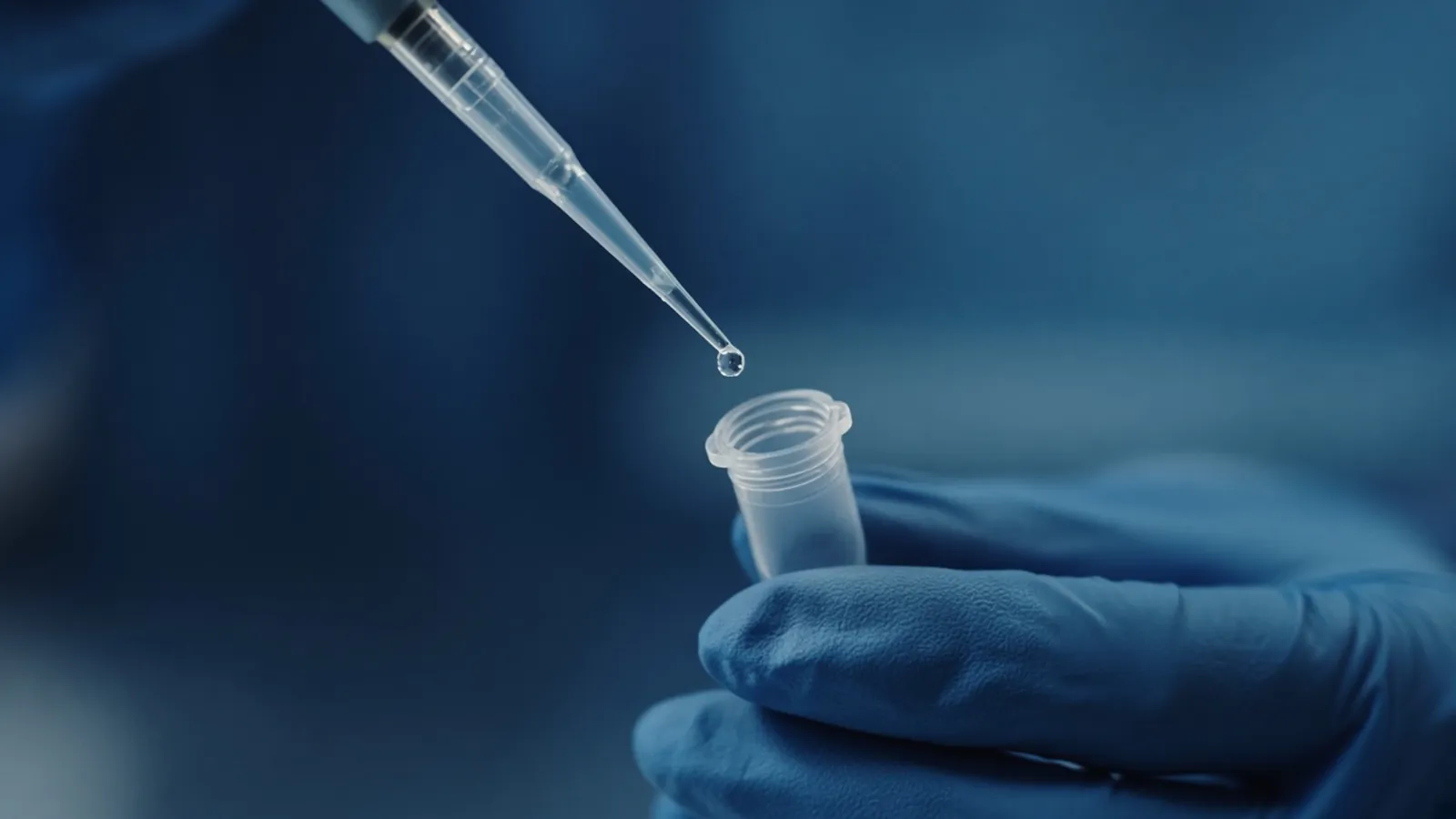
The symptom is usually small. A solvent tip grows a drop while you reach for the tube. A glycerol aliquot leaves a bead behind. A water check last month looked fine. Air displacement versus positive displacement is the choice that explains those symptoms, and the next check is to decide which mechanism you are actually using. The forward aqueous stroke on an air pipette is described in accurate micropipetting technique. This page is what to do when that stroke is the wrong mechanism for the liquid.
Two ways to move a liquid
An air-displacement pipette, often called type A in the pipette part of the ISO 8655 series, moves a piston in the body of the instrument. A cushion of air transmits the movement to liquid held in a separate tip. The liquid is not supposed to enter the shaft. That architecture is fast, familiar, and well matched to aqueous reagents. It is also why vapour pressure, density, viscosity, temperature, and altitude all have a path into the result. Anything that changes the cushion changes the volume that arrives.
A positive-displacement pipette, type D in the same part, puts the piston in the tip. The usual consumable is a capillary-piston pair. The piston face meets the liquid directly, or meets it across a negligible gas gap. Vapour has nowhere to accumulate, and a thick liquid is pushed rather than persuaded through an air spring. The tips are dedicated. You do not substitute an ordinary filter tip and keep the type D calibration.
ISO 8655-2:2022 specifies metrological requirements, maximum permissible errors, marking, and user information for both types, single-channel and multichannel, complete with the selected tip. This article does not copy those error tables. The numbers live in the standard and in the manufacturer specification. ISO 8655-1:2022 is the terminology and user-recommendation part. It is not a claim that a named pipette on your bench is inside tolerance today. You compare your own gravimetric check with the specification you claim.
How the errors grow on an air pipette
Vapour pressure is the ethanol problem. Molecules leave the liquid, join the cushion, and raise the pressure until a drip forms or the aspirated mass falls. Pre-wetting delays the worst of the first stroke. It does not repeal vapour pressure. Density matters because the balance of forces at the orifice changes, and because any mass check must use the right density. Viscosity makes the liquid late relative to the thumb. Temperature expands or contracts the cushion, so a cold enzyme mix on a warm pipette drifts during a series. Altitude changes the outside air that the cushion is compared with. A laboratory that moves a pipette from a coastal bench to a high hill station should check it before trusting the old certificate. None of these is a reason to scribble a private correction factor on the handle and use it for every liquid.
Humidity is the easy mis-diagnosis. Moist air changes how fast a droplet evaporates on a balance, and it changes static. It is a smaller direct effect on the delivered volume than temperature or vapour from the liquid itself. If the weighing room and the pipetting bench disagree, record both. Do not "correct" the pipette for monsoon air with a factor you invented during one wet week.
Symptom, likely cause, next check
Start with water, forward mode, a tip that seals, and the interim gravimetric approach in checking a pipette between calibrations. If water fails, the next check is mechanical: reseat, try a tip family you know, inspect the shaft for damage, and take the pipette out of service if the drip remains. Positive displacement will not repair a corroded air-pipette piston. Sending the failing air pipette back to the bench with a warning to be careful just spreads the bad volume.
Altitude belongs beside temperature in that note. A pipette carried from a coastal laboratory to a high hill station changes the air the cushion is compared with. Check it where it will be used before you treat an older water series as current. The check is still water, still the specification you claim, and still not a private factor written on the handle.
If water passes and the problem liquid fails, the cause class is the liquid interacting with the cushion. Confirm by weighing a few dispenses of that liquid and converting with its density at the measured temperature, not with 1.000 grams per millilitre and not with the water factor. Then choose. For a mildly viscous aqueous mix, slow reverse pipetting on the air pipette may be enough, and you document that mode. For volatile solvents, oils, and liquids that still bead or drip, move to positive displacement and a tip system made for it. Recheck on the new class. A robot or a second person does not change this branch. They repeat whichever mechanism you handed them.
| Symptom | Air-displacement reading | Positive-displacement reading |
|---|---|---|
| Drip with ethanol, stable with water | Cushion vapour pressure | Often steadier, because there is no cushion |
| Bead of glycerol left in the tip | Liquid lagged the air spring | Piston can push the remainder out |
| Water check fails on every tip | Seal, shaft, or piston | A different instrument, not a repair of this one |
| Volume shifts from a cool morning to a hot bench | Cushion and liquid density both moved | Much less air to expand; still equilibrate the liquid |
| Good at the coast, shifted at a hill laboratory | Air density changed around the cushion | Still check it; the certificate did not travel |
Safety and research-use limits
Positive-displacement tips that held solvent, culture, or radionuclide are contaminated consumables, not a rinsed item. The piston that touched the liquid is part of that waste stream. Follow the institutional assessment. CDC BMBL is advisory material for laboratory risk assessment, not a licence for a particular pipette. This page does not authorise diagnostic measurements or clinical dosing.
Do not autoclave either class unless the manufacturer says that model can be autoclaved. Solvent inside an air shaft is a service event, not a wipe.
What to ask for
Tell the enquiry whether the liquid is aqueous, volatile, viscous, or dense, the volume range, and whether you need type A, type D, or both. Name single or multichannel, the tip system, and the calibration document you need at the volumes you use. Instruments are listed from the scientific instruments catalogue, capillaries and air tips from the laboratory consumables catalogue, and the specification travels with the quotation request.
Questions from the bench
Why does an air-displacement pipette drip with ethanol but pass a water check?
The water check fills the cushion with a modest vapour and uses a liquid the calibration was built around. Ethanol, acetone, and acetonitrile classes put far more vapour into the same cushion, pressure rises, and liquid is forced out of the tip. Positive displacement avoids that path by using a piston in the tip. Pre-wetting and a faster pace can make an air pipette usable for some solvent work, and a drip that remains is a reason to change class rather than to edit the water certificate.
What does altitude or a warm room do to the air cushion?
The cushion is a volume of gas. Lower air pressure at higher altitude, and a higher temperature in the barrel, both change how that gas links the piston to the liquid. A pipette adjusted near sea level and then used in a high hill laboratory can shift even when the thumb repeats the same forward stroke. Equilibrate the instrument and check it where it works. Humidity changes evaporation during weighing more than it changes the piston itself.
Can one calibration cover both pipette classes?
No. Air-displacement and positive-displacement pipettes are different mechanisms, and ISO 8655-2 treats them as different types, each complete with the tip that belongs to it. A certificate states what was measured, on what date, at which volumes. It does not migrate from a water test of an air pipette to a glycerol test of a capillary piston. Keep the documents, the tips, and the error limits with the instrument they describe.
Which symptoms should make you stop and switch class?
Switch class when the liquid is volatile, dense, or viscous and a careful air technique still drips, retains a bead, or fails a mass check that used the right density. Also switch, or send the air pipette for repair, when every tip drips on water. That second pattern is a seal, shaft, or piston problem, and a positive-displacement tip will not diagnose it. Remove a dripping air pipette from service until someone checks it.
References
Manufacturer names identify published method classes. Trademarks remain with their owners. Catalogue records on this site are independent references for enquiry. They are not a statement of inventory, distribution rights or a supply commitment. This page is educational. It is not medical advice, a diagnostic protocol or a biosafety approval.
Catalogue
Related products and categories
These links follow the subject of the article into published manufacturer references. A listing is a reference for an enquiry, not a statement of stock or distribution rights.
Continue in this cluster
Related reading
Accurate micropipetting techniqueHow an air-displacement micropipette delivers a volume, how forward pipetting uses the two stops, and why temperature belongs in the result.A glossary of liquid-handling termsSeparate the liquid-handling terms people mix up, from blow-out and pre-wetting to systematic error, tip fit, and the Z-factor. Checking a pipette between calibrationsA gravimetric water check shows whether a piston pipette is still fit for quantitative work between scheduled calibrations, and when to stop using it.