
guide
Authentication and misidentified lines
How to quarantine a new research line, check it against misidentification records, and authenticate it before it shares an incubator.
- Author
- EVRINTH Editorial Team
- Published
- 8 October 2026
- Updated
- 8 October 2026
- Reading time
- 8 min
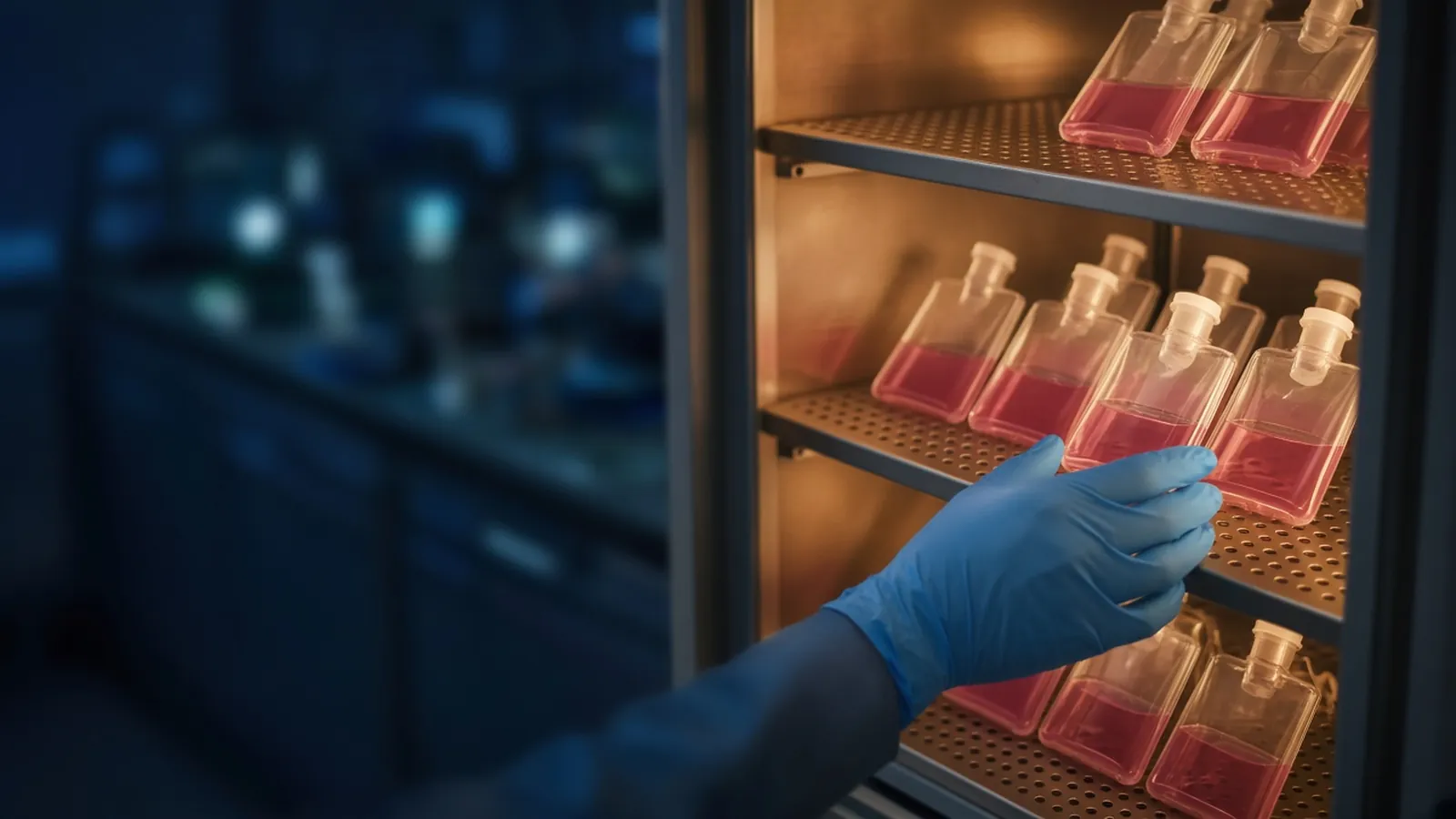
A misidentified line is a culture whose name is a fiction and whose behaviour is someone else's. Cross-contamination, a swapped cap, and a vial from a colleague's unnamed box all produce that fiction. The decision this guide supports is simple and often skipped: a new line does not enter the shared incubator until you know what it is, and you do not discover that in the microscope. The day-to-day culture around that rule is in mammalian cell culture for research labs. Opening the vial is allowed only under the institutional assignment in biosafety basics for research benches.
What misidentification is, and what it is not
Misidentification means the cells are not the entity the label claims. HeLa, a robust human line, became the historical lesson because it outgrew slower cultures and left their names on the flask. That history is a warning, not a joke and not a complete list. The International Cell Line Authentication Committee maintains a register of contaminated or misidentified lines and publishes resources laboratories use when they check a name. Consult the register. Do not rely on a remembered headline, and do not invent a personal estimate of how often this happens. The register is the document. Your result is the document for your vial.
Identity is not the same as cleanliness. A correctly named line can carry mycoplasma. A mycoplasma-negative line can still be the wrong species. Aseptic technique stops some of the swaps that happen through shared media and pipettes. It does not repair a vial that was already wrong when it arrived. Confluence, growth rate and a familiar photograph are not identifiers. Two lines can look alike at the density you always split them.
Two method classes that answer different questions
Short tandem repeat profiling is a common class for human lines. It reads a panel of microsatellite markers and compares the pattern with a reference profile for the claimed line. Extra alleles can suggest a mixture. A match supports the claim against that reference. It does not prove the cells still have the tissue phenotype of the original donor, and it does not see mycoplasma. A failed or empty human profile is not a species name. If you only run human STR, a mislabelled non-human line can look like a technical failure rather than like a mouse, a rat or a hamster. Species PCR, or another species assay your laboratory has validated for this purpose, is the different check. Use it when the species is in doubt, and use it alongside STR when a human line might contain a second species that the human panel will not describe.
Non-human lines need the method that fits them. Some have STR or SNP panels. Some are checked by species-specific assays and by a careful reading of the collection's own profile. Karyotype and targeted sequencing are further classes for questions STR was not asked. Pick the method for the question. A bargain assay that cannot see your species is not thrift.
Reference profiles come from the collection that established the line, from a paper that published the profile, or from the first authenticated vial you banked. ATCC culture guides and ECACC are examples of collections that describe lines they hold. A profile with no stated reference is a number, not a match.
A path that keeps the shared incubator honest
Write the origin before anyone thaws. Supplier or donor laboratory, catalogue description if there is one, stated species, claimed passage, date received, and the biosafety assignment. Then search the misidentification register for that name and for any name the donor used interchangeably. If the register says the name is known to be misidentified, do not talk yourself into "ours might be the real one" without a profile. Quarantine means a separate incubator or a separation your rules define, with its own medium bottles. It does not mean the bottom shelf of the general chamber, reached with the same pipette.
Authenticate with the species-appropriate method. If the result matches, and the mycoplasma test your schedule requires is acceptable, freeze a reference stock from that culture, at a passage you record. Later working flasks descend from that stock, not from a culture that has been in continuous use so long that a swap could have happened unnoticed. If the result does not match, stop. Tell the people who might already have the line. Do not relabel the flask with the name you prefer.
Branch if the assay fails technically. A missing positive control, a degraded sample, or a human STR attempt on a non-human line is a repeat or a change of method, not a quiet pass. Branch if the culture grows much faster in quarantine than the sheet suggests. Speed is a hint of a swap such as HeLa. It is not proof. Get the profile before you rewrite the name. Branch if a collaborator insists the line is authenticated because their slides look right. Ask for the report. Slides are not a report.
| Method | What a pass can support | What it cannot see |
|---|---|---|
| Human STR against a reference | The human line matches that profile, or a mixture adds alleles | A non-human line, mycoplasma, or the tissue phenotype |
| Species assay | Which species' DNA you amplified | Which human line, if several human lines are in play |
| Morphology and confluence | That cells are present and spreading | Identity. Similar lines look similar |
| Growth rate | A hint that this is not the slow line you ordered | Which contaminant it is |
| Register check | That the name has a known misidentification history | That your particular vial is clean or dirty |
| Mycoplasma PCR | A contamination question | Whether the name on the cap is true |
Failure modes that produce a confident wrong name
The common path is social. A line arrives as a favour, is thawed the same day because a pilot cannot wait, and is authenticated "when there is time". Time arrives after the pilot is a figure. Another path is a mixed profile that someone calls contamination of the assay rather than contamination of the cells. Repeat from a new DNA preparation of the culture. If the extra alleles remain, you have a mixture, and the mixture does not stay in the shared room. A third path is testing once in 2016 and calling every later passage the same cells. Swaps happen at the bench in later years. The schedule has to include a repeat, especially after a line has travelled.
Do not adjust the reference until the sample matches. Choosing a different claimed identity after you see the profile, without telling the record, is how misidentification continues under a new cap.
Safety and the limits of a profile
Quarantine is a biosafety practice as well as a quality practice. An unidentified human line is handled under the stricter local assumption until identity and risk are written down. Waste, cabinet and who may enter that incubator are institutional. The WHO Laboratory Biosafety Manual is a reference for writing those rules. A matching STR report does not lower a biosafety assignment by itself. This guide is not a clinical identification of a patient's cells and not a permit to culture a pathogen.
A warm shipment is still unidentified
Heat and a delayed courier damage viability. They do not confirm identity. A vial that arrives warm is a handling excursion and an identity question at the same time. Do not rush it into the general incubator because only a few cells survived and you want them "with the other lines for company". Surviving cells are the ones you are about to bank. Profile them. In a building where packages sit on a dock, write a receiving path that gets vials to cold storage and to the quarantine record the same day. Power cuts that force many lines into one rescue incubator are a classic mixing event. Label every vessel before the move, and do not pool "unknowns" into one dish to save plastic.
What an enquiry should carry
State the species, the claimed line name, whether you need consumables for quarantine culture or a discussion of which assay class fits, and that a register check is part of your intake. Ask for the reference logic in writing if a service or a kit claims to authenticate: which markers, which species, what a failed amplification means. The laboratory consumables catalogue is the everyday plasticware list. The academic research reference frames a broader university conversation. Use the quote request to ask whether a quotation is possible. An authentication approach can be discussed from the species and the register. A catalogue page does not identify your vial, and this laboratory's name on an enquiry is not itself a profiling service.
Hold a new line out of the shared incubator until it is identified
- 01Record origin before the vial warmsWrite the supplier or the colleague, the stated species, the passage they claim, and the biosafety assignment. A cap code without that page is not an origin.
- 02Check the name against a misidentification registerLook the claimed identity up on a register of contaminated or misidentified lines, and read what the entry actually says. A famous name is not a clean name.
- 03Quarantine, then authenticate for the speciesKeep the culture out of the shared incubator. Use a method that fits the species: human short tandem repeat profiling is a common class for human lines, and a species assay is a different check.
- 04Freeze a reference stock only after the result matchesWhen identity is acceptable and your mycoplasma schedule is satisfied, freeze vials you can return to. Do not fill the archive with the working flask that has already been passed for months.
Questions from the bench
Does morphology confirm a cell line?
No. Shape is a hint and a weak one. Many epithelial lines look alike, and a contaminant can adopt the density you expect. Confluence does not carry identity. A profiling method, compared with a reference, is the evidence.
Will a human STR test identify a mouse line?
Not as a mouse line. A human short tandem repeat assay is built for human alleles. A non-human culture may fail to produce a profile rather than announce its species. You need a species-level assay when the species itself is the question.
Is HeLa the only cross-contaminant that matters?
HeLa is the historical lesson because it has turned up inside cultures that carried other names. It is not the only misidentified line on the public registers. Treat the register as a list to consult, not as a single cautionary story.
Can I authenticate after the paper is written?
You can learn that the work used the wrong cells, which is an expensive order. Authenticate when the line enters, and again on the schedule your quality system names, before the line becomes the parent of a figure. A late test does not repair a shared incubator.
References
Manufacturer names identify published method classes. Trademarks remain with their owners. Catalogue records on this site are independent references for enquiry. They are not a statement of inventory, distribution rights or a supply commitment. This page is educational. It is not medical advice, a diagnostic protocol or a biosafety approval.
Catalogue
Related products and categories
These links follow the subject of the article into published manufacturer references. A listing is a reference for an enquiry, not a statement of stock or distribution rights.
Continue in this cluster
Related reading
Mammalian cell culture for research labsHow research labs keep mammalian cell culture workable: medium, aseptic technique, confluence, passage records and contamination checks. Biosafety basics for research benchesResearch-bench biosafety is a stack of barriers chosen by a risk assessment. This page explains the stack. It does not approve the work.A glossary of culture termsPairs of culture words that laboratories mix up, and the wrong next action each pair causes, from confluence versus density through to confluent versus