
Pillar guide
Mammalian cell culture for research labs
How research labs keep mammalian cell culture workable: medium, aseptic technique, confluence, passage records and contamination checks.
- Author
- EVRINTH Editorial Team
- Published
- 8 October 2026
- Updated
- 8 October 2026
- Reading time
- 8 min
Mammalian cell culture for research labs is a way to keep a living model stable enough that an experiment can be repeated. The cells need a medium that matches the line, a clean technique, a controlled atmosphere, and a record of how many times they have been divided. When any of those slips, the assay still produces a number. The number describes the accident as well as the biology. This pillar is a research orientation. Working at the cabinet is developed in working inside a biosafety cabinet. Nothing here authorises clinical use or assigns a biosafety level.
What you are maintaining
A cell line is a population with a history. It has a species, a tissue of origin, a growth mode, and a recommended medium. Adherent lines sit on a treated surface. Suspension lines grow in the liquid. Some lines need a feeder layer or a coated plastic. Those facts decide the vessel, the split, and the experiment. A public collection of culture guides, such as the ATCC culture guides, is a useful starting sheet for lines they describe. Your institutional record and the vial in your freezer override a generic page when they disagree. Confirm the identity you rely on. Morphology alone will not catch a swapped flask.
The medium is a formulation, not a colour. Bicarbonate-buffered media such as the DMEM and RPMI families are designed to equilibrate with elevated carbon dioxide, commonly about five percent, inside a humidified incubator near 37 Celsius. Phenol red is a pH indicator sitting in that design. It is not a nutrient. Yellow medium can mean overgrowth or bacterial contamination, both of which acidify the medium. Purple medium can mean a flask left out of the incubator, where carbon dioxide has escaped and the buffer has become alkaline, or a very sparse culture that has not yet produced much acid. Read the colour together with the microscope, not instead of it.
Serum, when the medium uses it, is a biologically active mixture. Lots differ. Record the lot when a phenotype matters. Serum-free and chemically defined media are a different class, often required by a specific line, and they are not interchangeable with a serum bottle because the flask looks hungry. Supplements such as glutamine or its more stable analogues, pyruvate, and growth factors belong on the recipe card for that line.
Aseptic technique is a sequence
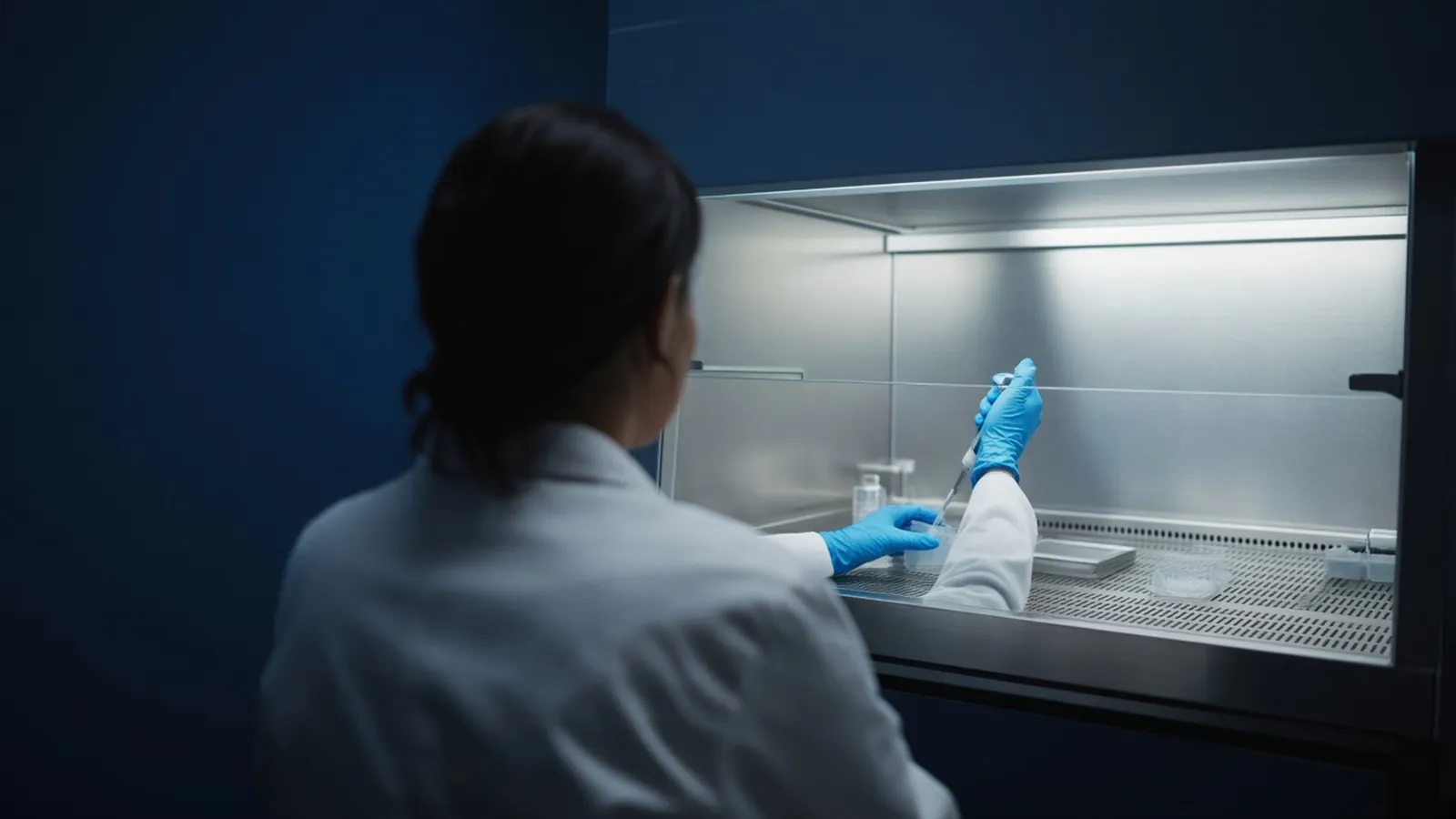
Aseptic technique is the set of habits that keeps environmental microbes out of the culture and keeps the culture's own aerosols under control. The cabinet is the tool. The habit is the method: hands and surfaces prepared as your local rules require, reagents wiped and arranged so you do not reach over open flasks, pipettes used once, and caps parked on sterile surfaces rather than face down on the grille. The companion article on the cabinet goes into that choreography. Antibiotics are not a substitute for it.
Water baths used to warm medium are a classic source of contamination. Warm only what you need, dry the bottle before it enters the cabinet, and do not let a bath become a culture of its own. Incubators need cleaning on a schedule your laboratory writes down. A shared incubator is a shared risk. A cloudy flask does not stay "to see what happens".
Confluence, passage and the freezer
Confluence, for adherent cells, is that surface estimate. Many lines are subcultured before they are fully covered, because crowding changes the biology you meant to study. The split ratio is part of the method. One-to-five and one-to-twenty produce different experiments a week later. Write the ratio, the passage number, and the date. A suspension culture is followed by a count or a density measurement rather than by confluence. Use the same counting rule each time.
Dissociation of adherent cells, often with a trypsin-class enzyme or a non-enzymatic alternative, is line-specific. Over-trypsinising kills cells and selects survivors. Under-dissociating leaves clumps that make counts and seedings uneven. Follow the record for the line, and look at the cells, rather than copying a minute value from a different laboratory's poster.
Cryopreservation is how a line survives a contamination event and a change of staff. A freezing medium contains a cryoprotectant. The vial is cooled in a controlled way and stored so cold that the biological clock nearly stops, often in nitrogen vapour or a liquid-nitrogen vessel, following your safety rules for those vessels. Thawing should be prompt, and the cryoprotectant diluted, because it is harsh once the cells are warm and awake. A new thaw is a return to a known passage, not a continuation of a flask that has been in culture for months. Quarantine new arrivals until you have looked at them and, on the schedule you set, tested them.
Mycoplasma is the contamination that does not cloud the medium. It changes growth and metabolism quietly. Testing by a PCR-class assay, a culture method, or a DNA stain is a laboratory decision made on a schedule, not a test you run only when a figure looks odd. Bacteria and fungi that do cloud the medium are an emergency for the incubator. Discard the culture under your biohazard rules and check the neighbours.
Branch points
If the viability after thaw is poor, the freeze or the thaw failed. Do not build a long experiment on the few cells that clung on, unless the line is irreplaceable and you have documented the bottleneck. If growth is suddenly faster and the medium is acid, suspect contamination or a swap with a faster line. If growth stops, check the carbon dioxide, the medium recipe, the serum lot, and whether the cells are simply too sparse or too crowded. If a mycoplasma test is positive, that lineage is finished for ordinary shared use. Tell the people who share the room.
| Observation | A reasonable reading | A poor response |
|---|---|---|
| Even monolayer at the planned confluence | Ready to passage or treat as the protocol states | Leaving it for the weekend because the calendar slipped |
| Cloudy medium, debris, or a sharp pH crash | Contamination until proven otherwise | Adding more antibiotic and hoping |
| Slow growth after a new serum lot | The lot may have changed the phenotype | Mixing lots in one flask without a note |
| Cells only in the centre of the well | Uneven seeding or evaporation at the edge | Treating the well as a uniform dose |
| No mycoplasma test in the record | The quiet contaminant has not been looked for | Assuming clarity of the medium is a test |
Workflow collections such as protocols.io show how other groups write a passage record. The useful part is the structure: line, passage, medium, split, observations. The volumes still come from your line's own sheet.
Safety is an institutional assignment
Mammalian lines can carry viruses. Human blood and some primary cells raise the risk further. The cabinet class, the disinfection, and the waste path come from a local risk assessment. Two public references that laboratories use when they write that assessment are the CDC Biosafety in Microbiological and Biomedical Laboratories and the WHO Laboratory Biosafety Manual. Citing them does not approve your room. Liquid nitrogen and cryovial explosions are physical hazards with their own training. This article is not medical advice and not a permit to culture a pathogen.
Heat, humidity and power
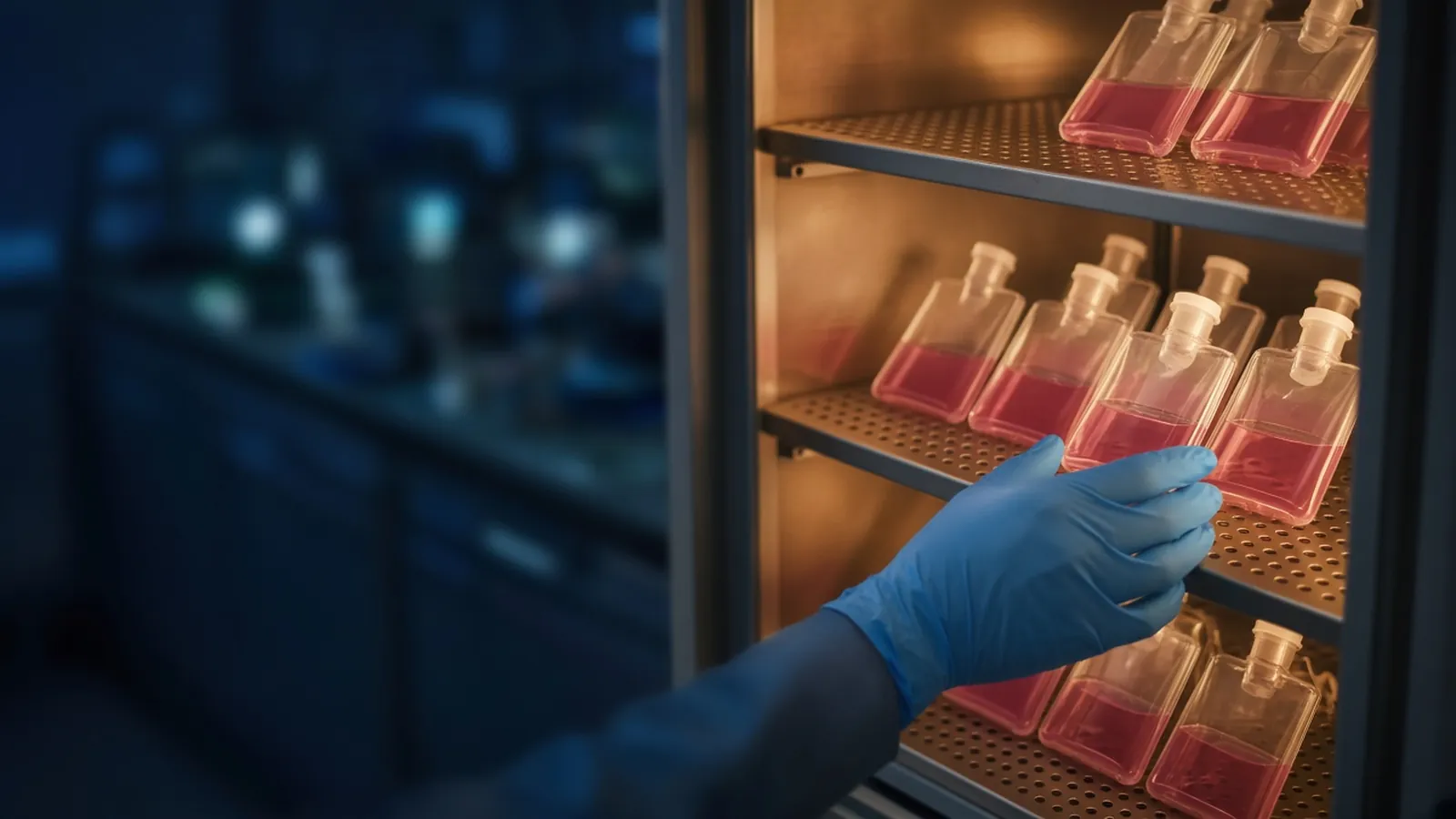
The incubator in the photograph is doing three jobs: temperature, carbon dioxide, and humidity that limits evaporation. In a hot building, a flask left on the bench acidifies or alkalinises as gas exchange and temperature drift. Work in small batches and return flasks promptly. Humidity that is too low concentrates medium at the edges of plates and changes drug concentrations in outer wells. A power cut is a recorded excursion. Note how long temperature and gas were lost before you treat those cells as equivalent to an uninterrupted culture. Alarm logs matter more than a recollection.
Medium and serum arrive through a cold chain. A warm shipment is a reason to quarantine the lot and ask the supplier's stability statement, not a reason to top up a precious line with it the same afternoon. Write the specification in the purchasing note: basal medium, serum requirement, vessel surface, and any sterility or endotoxin expectation your work actually needs.
What to put in an enquiry
Name the line if you may, the growth mode, the medium family, the vessel format, and whether you are sourcing routine consumables or asking a methods question. The laboratory consumables catalogue covers the plasticware and related everyday classes. The academic research reference is an independent page for university laboratories framing a broader sourcing conversation. Use the quote request to ask whether a quotation is possible. Do not read either page as a statement that EVRINTH stocks a named medium or operates a culture facility. A catalogue family is not a formulation. Ask for the specification in writing before you compare offers.
Decide whether a mammalian culture is fit to use
- 01Confirm the line and the medium before you thawMatch the vial label to a written record of species, biosafety assignment, adherent or suspension growth, and the medium formulation. A nickname on a freezer box is not that record.
- 02Handle the culture so the cabinet and the incubator agreeUse aseptic technique inside the cabinet your risk assessment names, then return the flask to temperature, humidity and carbon dioxide that match the buffer in the medium.
- 03Passage on confluence and on the biology, not on the calendar aloneLook at the monolayer or the suspension density. Passage before the cells are exhausted, and write the split ratio and the passage number.
- 04Quarantine a culture you no longer trustCloudiness, a sudden pH change, or a failed mycoplasma check removes the flask from the experiment path. Do not 'see if it recovers' in the shared incubator.
Questions from the bench
What is confluence actually measuring?
For adherent cells it is an estimate of how much of the growth surface is covered. It is not a cell count unless you have calibrated your eye or an imager against a count. Over-confluent cultures change shape, signalling and transfection behaviour even when they still look alive.
Should antibiotics be in every medium?
They are a choice, not a default that replaces technique. Penicillin and streptomycin do not control mycoplasma, and routine antibiotics can hide a low-level contaminant until an experiment without them collapses. Many laboratories omit them once technique is stable, and still test for mycoplasma.
How do I know the cells are still the line I ordered?
Morphology is a hint and a weak one. Passage records, a short tandem-repeat authentication for human lines when your quality system asks for it, and a mycoplasma test are the practical evidence. A public culture guide for the line is a starting sheet, checked against your own record.
Can these cultures be used to produce a therapy or a diagnosis?
Not on the basis of this article. Research culture supports research experiments. Therapeutic manufacturing and clinical testing follow separate quality and legal rules. Containment is an institutional decision.
References
Manufacturer names identify published method classes. Trademarks remain with their owners. Catalogue records on this site are independent references for enquiry. They are not a statement of inventory, distribution rights or a supply commitment. This page is educational. It is not medical advice, a diagnostic protocol or a biosafety approval.
Catalogue
Related products and categories
These links follow the subject of the article into published manufacturer references. A listing is a reference for an enquiry, not a statement of stock or distribution rights.
Continue in this cluster
Related reading
 Working inside a biosafety cabinetHow a Class II biosafety cabinet moves air, how that differs from a chemical fume hood, and which habits keep cultures and workers protected.A glossary of culture termsPairs of culture words that laboratories mix up, and the wrong next action each pair causes, from confluence versus density through to confluent versusAntibiotics in medium hide poor techniqueWhen penicillin-streptomycin in routine medium hides a contaminant, and how to choose whether a research culture should grow with or without it.