
selection guide
Antibiotics in medium hide poor technique
When penicillin-streptomycin in routine medium hides a contaminant, and how to choose whether a research culture should grow with or without it.
- Author
- EVRINTH Editorial Team
- Published
- 8 October 2026
- Updated
- 8 October 2026
- Reading time
- 8 min
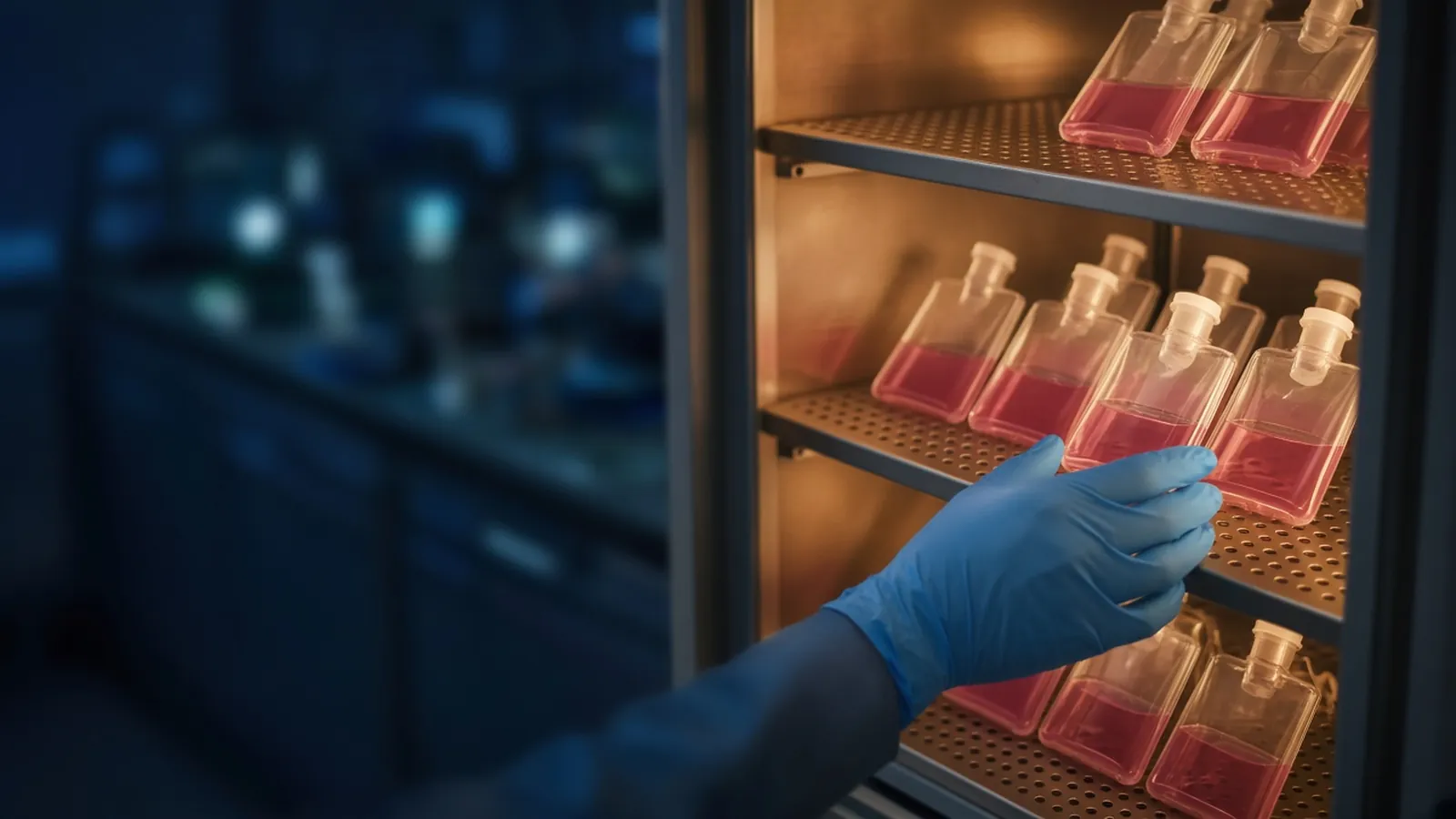
Penicillin plus streptomycin in a mammalian medium is a selection pressure disguised as hygiene. It kills or stalls some bacteria, spares others, and teaches a laboratory that sloppy caps still produce a clear flask. The decision this guide supports is whether your line should see that pair at all, for how long, and whether the assay you care about is one of the assays the drugs disturb. The culture frame is mammalian cell culture for research labs. The habits they are not allowed to replace are in working inside a biosafety cabinet.
What the common pair actually selects
Penicillin interferes with bacterial cell-wall synthesis. Streptomycin is an aminoglycoside that interferes with bacterial protein synthesis. Together, at the levels printed on research supplement sheets, they are often called pen-strep and are often used near 100 units per millilitre of penicillin and 100 micrograms per millilitre of streptomycin. Those figures are a class reminder. Follow the sheet you bought, and do not invent a stronger mix because a flask looked worrying. Walls and ribosomes are not universal. Organisms without the target, organisms that already resist the drug, yeast, mould and mycoplasma are not handled by this pair in any way you should trust. What remains in the flask is a filtered sample of whatever your technique allowed in, biased toward the survivors.
That bias is the hiding. A low-level contaminant that would have clouded an antibiotic-free medium by Friday stays invisible. The operator repeats the same reach across an open bottle. Passage number climbs. Months later someone prepares medium without antibiotic for a defined experiment and the culture crashes, or a resistant bacterium finally outruns the drug. The crash looks sudden. The technique was visible all along, if the medium had been allowed to tell the truth.
Gentamicin is a different aminoglycoside some laboratories substitute. It is not a moral improvement. It is another spectrum and another set of side effects. Name it if you use it. Do not write "antibiotic" as if the class were inert.
When a protocol can still ask for them
A primary isolation from tissue sometimes includes antibiotics for a short, written window because the tissue arrival is dirty and the alternative is to grow nothing. That window has an end. The cells move into antibiotic-free medium before you trust their metabolism, and they do not re-enter the general incubator until you are willing to see a contaminant. A documented rescue of an irreplaceable line is a second, rarer case, done off the clean shelf, with a test afterwards. An undergraduate practical that adds antibiotic so that twenty first attempts do not fill the incubator with blooms is a teaching choice. It should be labelled as teaching material, not quietly become the laboratory's standard medium.
Routine continuous lines that have a frozen stock do not meet that bar. They should grow without routine antibiotics so a mistake is visible at the next passage. If the line cannot be kept clean without the drug, the technique or the room is the finding. Adding a second drug is not the finding.
Toxicity and the experiment you think is about biology
Aminoglycosides are not silent in mammalian cells. They can affect mitochondria and protein synthesis at exposures that overlap careless overdosing, and even intended doses are a variable in assays of metabolism, respiration or translation. Penicillin is quieter for many readouts and is still a molecule in the well. Antifungals such as amphotericin B sit closer to mammalian toxicity. Laboratories that add them "just in case" often discover the case was the additive: slowed growth, odd morphology, a dose-response that will not repeat in a collaborator's antibiotic-free medium. Match the decision to the endpoint. An assay of mitochondrial function run in streptomycin is an assay of two things. A confluence call is less sensitive, and is still cleaner without an extra selective pressure.
Duration matters. A maintenance flask that saw antibiotic last month is a different object from a three-day treatment plate that still contains it. Wash and feed into the experimental medium the protocol names, and record the last day the drug was present. "We always have it in" is not a wash.
A selection you can defend
Choose on four questions. Is there a written reason tied to this line, or only habit? Is the duration finite? Does the endpoint include metabolism, mitochondria, protein synthesis or a membrane the drug might touch? Will someone notice contamination if the drug stays in? If the reason is habit, the duration is "always", the endpoint is metabolic, or the answer to visibility is no, leave the antibiotic out. If a primary protocol truly requires a window, write the class, the catalogue description, the concentration from the sheet, and the passage at which it stops.
| Practice | What you learn | What you miss |
|---|---|---|
| No routine antibiotic, stable technique | A contaminant becomes turbidity or debris while it is still small | Nothing about mycoplasma, which needs its own test |
| Pen-strep in every bottle | The flask stays clearer than the technique deserves | Resistant bacteria, yeast, mycoplasma, and any assay the drug perturbs |
| Antibiotic only for a primary window, then stopped | The arrival is protected briefly, later passages tell the truth | A window that silently becomes permanent |
| Antifungal added without a named mould event | Morphology changes you may call biology | The fact that no mould was ever shown |
Failures that follow the "always" choice
A collaborator cannot repeat your doses because their medium has no streptomycin and yours always did. A mycoplasma test was skipped because the flask never went cloudy, and the phenotype was the mycoplasma. A new student is told the antibiotic makes the cabinet forgiving, and their later antibiotic-free transfection week destroys a month of work. An antifungal started during one mould scare in a humid month is still in the recipe a year later. Each of these is a selection failure, not bad luck. The branch is to stop the drug on a designated passage, watch daily, and be ready to discard. Do not taper it in secret so the notebook stays pretty.
If a flask clouds the first time you omit the drug, that flask is contaminated now. It was probably contaminated before. Do not put the drug back to save the figure. Discard under local rules, thaw a stock prepared from a tested passage, and repair the handling. Biosafety basics for research benches is the containment companion. The WHO Laboratory Biosafety Manual is a reference for writing waste rules. It does not prescribe an antibiotic.
Research limits
This is not a clinical regimen. Do not scale a medium recipe into advice about an infected person, and do not use cell-culture streptomycin as if it were a pharmacy product. Antibiotic powders and stocks are chemical and biological materials under your institutional rules. Weighing them out requires the balance practice and the waste path those rules name. A research supplement sheet is the formulation document. A hospital guideline is a different document for a different decision.
Writing the specification so the next order tells the truth
The operational habit that matters in a purchasing office is the line item. "Medium with antibiotic" and "medium without antibiotic" are different formulations. If the method has dropped routine pen-strep, the standing order has to drop it too, or the next receiving day puts the drug back without a conversation. Write the class, the decision to omit, and the exception for primary isolation if one exists. In a hot receiving bay, do not let a warmed supplement vial get added "so the bottle is complete" before anyone checks whether this line is supposed to see it. Heat does not create a scientific reason. A power cut is not a reason to protect flasks with a double dose.
State, in the same note, that mycoplasma testing remains required. Omitting penicillin does not create that test, and including penicillin does not cancel it. If confluence is the only record you keep, add the antibiotic decision beside the passage number. A later reader cannot reconstruct a metabolic result from a flask that looks full and a notebook that never mentions the drug.
What the enquiry should contain
Name the line, whether you are in a primary window or a routine passage, the endpoint of the assay, and whether you want medium or supplements specified without routine antibiotics. Ask for the concentration basis on the supplier sheet if a supplement is truly required. The laboratory consumables catalogue covers everyday plastic and related classes. The academic research reference is a page for a university laboratory setting the context. Use the quote request to ask whether a quotation is possible. A formulation choice can be discussed. A quotation is not a prescription, and a catalogue class is not a statement that antibiotics are included unless the specification says so.
Questions from the bench
Should every research medium contain penicillin and streptomycin?
No. That pair is a common class, not a default that replaces aseptic technique. Routine use suppresses some bacteria, selects resistant ones, and keeps the flask looking acceptable while handling slides. Many laboratories omit them once technique is stable so contamination can be seen.
Do these antibiotics control mycoplasma?
Do not count on them. Penicillin acts on bacterial cell walls mycoplasma do not have, and streptomycin is not a reliable mycoplasma clearance. A clear flask on penicillin-streptomycin can still carry mycoplasma. Keep a real test on the schedule.
When is it reasonable to include an antibiotic?
When a written primary-isolation protocol requires a defined window, or when a documented exception is being handled away from the clean incubator. The reason, the class and the end date belong in the record. An open-ended habit of always adding it is not a reason.
Can this page be used as a prescribing guide?
No. Nothing here is a clinical regimen, a dose for a person, or advice about an infection. The concentrations laboratories put in medium are a research-formulation choice and still follow the supplier sheet, not a hospital formulary.
References
Manufacturer names identify published method classes. Trademarks remain with their owners. Catalogue records on this site are independent references for enquiry. They are not a statement of inventory, distribution rights or a supply commitment. This page is educational. It is not medical advice, a diagnostic protocol or a biosafety approval.
Catalogue
Related products and categories
These links follow the subject of the article into published manufacturer references. A listing is a reference for an enquiry, not a statement of stock or distribution rights.
Continue in this cluster
Related reading
Mammalian cell culture for research labsHow research labs keep mammalian cell culture workable: medium, aseptic technique, confluence, passage records and contamination checks. Biosafety basics for research benchesResearch-bench biosafety is a stack of barriers chosen by a risk assessment. This page explains the stack. It does not approve the work.A glossary of culture termsPairs of culture words that laboratories mix up, and the wrong next action each pair causes, from confluence versus density through to confluent versus