
explainer
Beakers are for handling not for accuracy
Why a beaker graduation is only a handling guide, and when a concentration other people will reuse belongs in a volumetric flask.
- Author
- EVRINTH Editorial Team
- Published
- 8 October 2026
- Updated
- 8 October 2026
- Reading time
- 7 min
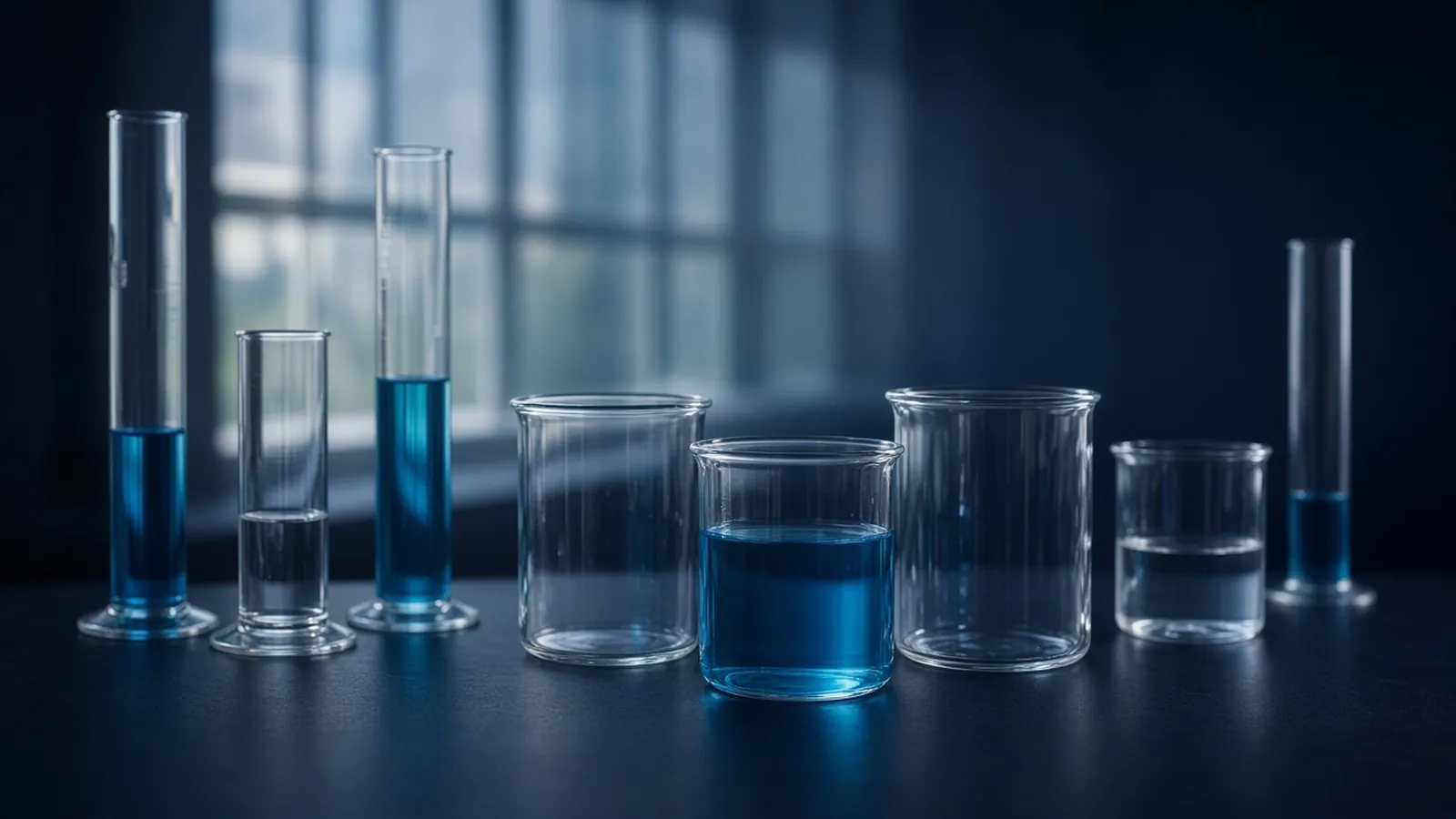
The number moulded into a beaker is a capacity guide written in the same place people look for a measurement. This explainer is for anyone who prepares reagents and needs to keep handling glass separate from volumetric glass. A beaker is a wide cylinder with a spout, made so you can dissolve, stir, heat and pour. It is a poor place to declare the volume that later arithmetic will trust. The vessel map that puts beakers next to flasks and cylinders is choosing laboratory glassware.
What a graduation on a beaker is doing
A beaker wall is thick enough to stir against and wide enough for a probe. Marks at round intervals help you see that a 250 millilitre beaker is about half full, or that the liquid will overflow if you add the next portion. Manufacturing those marks to a tight tolerance would fight the shape. The diameter is large, so a small error in height is a large error in volume. The spout and the rim interrupt a clean circle. None of that is a defect. It is the reason the beaker exists.
Volumetric glass inverts the geometry. A one-mark flask puts the reading in a narrow neck, where a small height change is a small volume change, and it states a reference temperature, commonly 20 °C. Class A and Class B name tolerance bands in the standard that applies to that flask. A beaker has no such job. If your notebook needs a volume another person must repeat, the sentence in the method is "made up to the mark in a volumetric flask", after dissolution in the beaker.
How people accidentally promote a beaker
The usual path is haste. A protocol says "add 50 millilitres". The beaker nearest the balance shows a 50 mark. The liquid's meniscus is somewhere near it, read from above, and the notebook gains a trailing zero. Downstream, a calibration curve treats that zero as real. The error is often a few percent, sometimes more if the beaker is tilted or the mark is worn. For a rough buffer that will be pH-adjusted and used the same day, that error can be acceptable if the method says so. For a stock that defines a molarity, it is the wrong vessel.
A second path is heating. People dissolve on a hot plate in the vessel they intend to call the volume. Warm liquid occupies a different volume from the same mass at the flask's reference temperature, and evaporation removes solvent the graduation never knew about. Cool and transfer, then make up.
A third path is the "close enough" cylinder. A graduated cylinder is tighter than a beaker and still wider than a volumetric flask. It is the right tool for an approximate transfer. It is the wrong tool for the flask's job. NIST weights and measures practice is the public background for why a declared volume has a calibration story. This article does not invent a tolerance for either vessel.
Equipment classes around the beaker
Low-form beakers are the everyday mixing shape. Tall forms suit a probe that must stay immersed in a small volume. Both remain handling ware. Griffin-style beakers with a spout pour; vessels without a controlled spout dribble down the outside and change the mass you thought you transferred. Borosilicate 3.3 is the glass to specify when the beaker will be heated. ASTM E438 separates that low-expansion type from soda-lime. Plastic beakers exist for some aqueous work and for places where broken glass is the greater hazard. They scratch, they can leach, and their marks are still approximate. Solvent work stays in glass unless the resin chart says otherwise.
Watch glasses, stirring rods and magnetic bars are part of the handling set. None of them repair a volume. A volumetric flask downstream is the repair.
| Step | Vessel that fits | What you may record |
|---|---|---|
| Dissolve a solid | Beaker or Erlenmeyer flask | Mass of solid, identity of solvent |
| Rough aqueous portion | Graduated cylinder | An approximate volume, if the method allows |
| Declare a concentration | Volumetric flask at its reference temperature | The nominal volume and the flask class |
| Heat or stir while reacting | Borosilicate beaker or flask | Temperature and time, not a new exact volume |
| Store the reagent | A bottle the chemical tolerates | Contents, date, and hazards |
When the rough volume is the wrong kind of wrong
If a control buffer prepared in a beaker gives the expected pH and the assay only needs that pH, keep the beaker and say so. If the same beaker feeds a standard curve, stop and remake the standard in volumetric glass. If two batches of a stain differ in strength, check whether someone has been reading the beaker. The branch is the use of the number, not the pride of the person who poured.
Rinsing belongs in the quantitative transfer. A solid that stays on the beaker wall, or a concentrate you do not rinse forward, makes the flask's mark honest and the concentration low. The flask cannot correct a solute you left behind.
Etched beakers are a different problem. Alkali clouds the marks until "about 50" becomes "about something". Retire a beaker whose spout is chipped. A chipped spout cuts gloves and dumps liquid down the outside, which is both a volume loss and a chemical exposure.
Probes and stir bars displace a volume the mark ignores
A pH probe, a thermometer, or a stir bar sitting in the liquid pushes the level up by a volume the graduation never included. In a beaker that is harmless, because the mark was only a guide to fullness. It becomes a real error if that level is then called the prepared volume. Lift the probe, rinse it into the volumetric flask that will hold the standard, and bring the flask meniscus to the line. Leaving the probe in place keeps the pH reading and spoils the concentration.
A tall-form beaker covers a probe with less liquid and loses less surface while you heat. A low-form beaker is easier to stir and easier to pour. Both remain handling ware. Choose the form for the probe and the splash, then write the volume that matters on the flask that follows, at that flask's reference temperature.
Safety on an ordinary bench
Hot borosilicate looks like cold borosilicate. A beaker from a drying oven needs a heat-proof surface. Do not sit it in a puddle. Stirring a corrosive liquid in an oversized beaker still splashes; a face shield and the institutional chemical rules apply. If the beaker held a culture, it is a biosafety object. Cleaning follows your laboratory, with the WHO biosafety manual and the CDC BMBL as background, not as a clinical method. This page does not authorise diagnostic preparation.
What to ask for
Name low-form or tall-form, capacity, borosilicate 3.3 if the beaker will be heated, and whether volumetric flasks are a separate line on the same request. Beakers and flasks are grouped in the beakers and flasks catalogue, with the broader laboratory glassware catalogue and volumetric glassware beside them. Send the specification through the quote request. State how many pieces. A picture of a beaker with a painted scale is not evidence of a tolerance.
Questions from the bench
Why do beakers carry graduation marks at all?
The marks tell you roughly how full the vessel is so you can choose a size, leave room to swirl, and avoid boiling over. They are moulded or printed as a capacity guide. They are not a statement that the manufacturer held the vessel to a volumetric tolerance at a reference temperature. Recording those marks to a decimal place invents precision the glass never had.
Is an Erlenmeyer flask any more accurate than a beaker?
For volume, no. An Erlenmeyer flask is also a handling and mixing vessel. Its cone limits splashes and suits swirling, and a culture method may care about that shape. The graduation, when one exists, remains approximate. A concentration you will calculate from is made up in volumetric glass, then poured into the flask if the next step needs the cone.
Can I dissolve a standard in a beaker and then transfer it?
Yes. Dissolving is what the beaker is for. Transfer the solution quantitatively into a volumetric flask, rinse the beaker into the flask with the same solvent, and bring the meniscus to the line at the flask's reference temperature. The beaker's own marks never become the declared volume, including the rinses you forgot to count.
Which beaker glass belongs on a hot plate?
Use borosilicate marked for heating, on a hot plate rather than a direct flame under a thick base, and retire any piece with a chip or a star crack. Soda-lime and unmarked glass are poor matches for thermal shock. The wider glass-type choice is part of choosing laboratory glassware, and the beaker form does not upgrade a weak glass.
References
Manufacturer names identify published method classes. Trademarks remain with their owners. Catalogue records on this site are independent references for enquiry. They are not a statement of inventory, distribution rights or a supply commitment. This page is educational. It is not medical advice, a diagnostic protocol or a biosafety approval.
Catalogue
Related products and categories
These links follow the subject of the article into published manufacturer references. A listing is a reference for an enquiry, not a statement of stock or distribution rights.
Continue in this cluster
Related reading
Choosing laboratory glasswareHow to match borosilicate beakers, flasks and volumetric glass to the measurement you need, and when a printed line is only a guide.A glossary of labware termsDefinitions of the labware words that change a result: class marks, to contain and to deliver, joint size, resin, sterile and clean.Borosilicate versus soda-lime in practiceHow to choose borosilicate 3.3 or soda-lime from the temperature step, the chemical, and the volume you intend to trust.