
Pillar guide
Choosing laboratory glassware
How to match borosilicate beakers, flasks and volumetric glass to the measurement you need, and when a printed line is only a guide.
- Author
- EVRINTH Editorial Team
- Published
- 8 October 2026
- Updated
- 8 October 2026
- Reading time
- 8 min
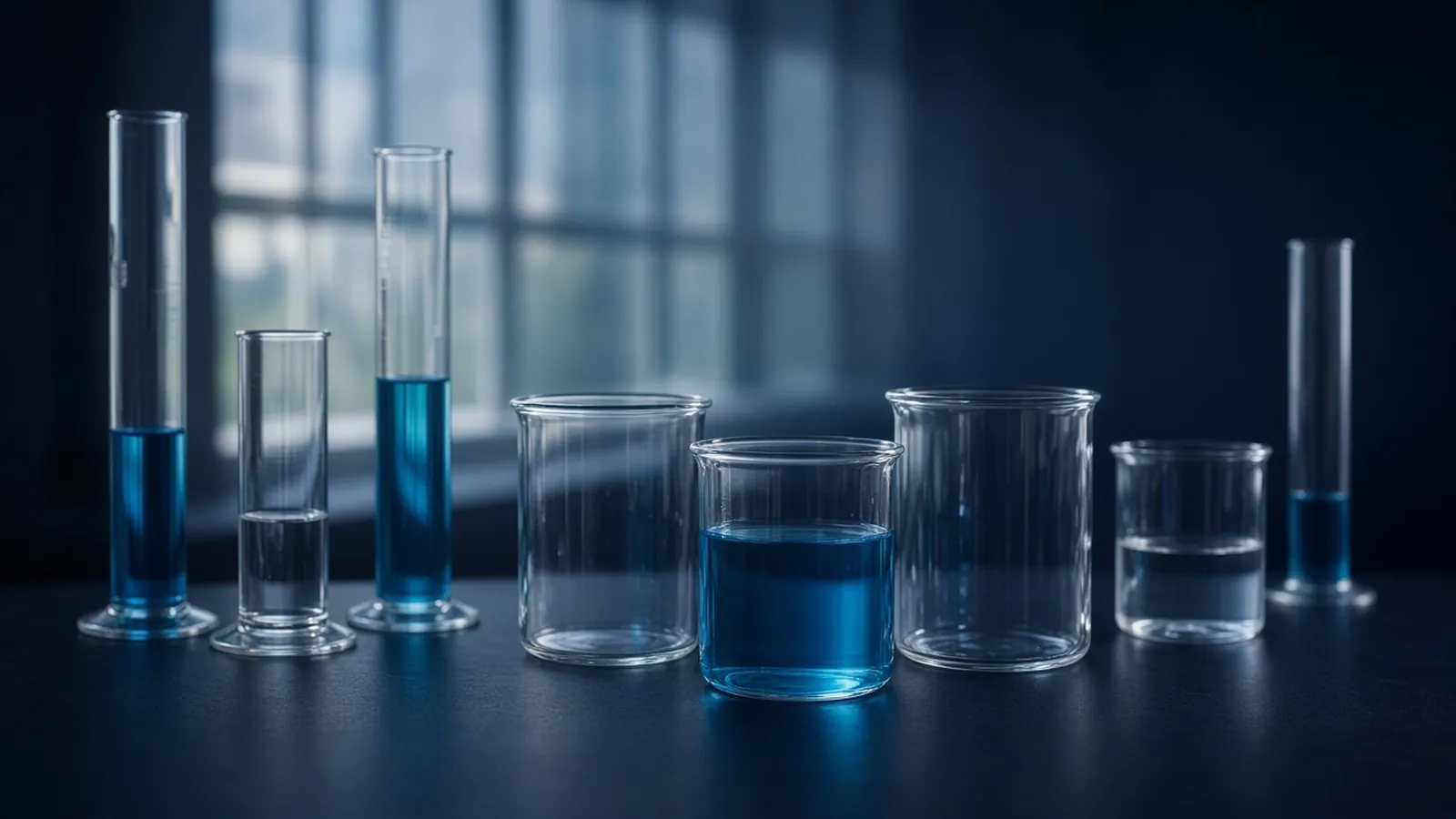
Choosing laboratory glassware is the decision that a volume, a heating step or a titration is only as honest as the vessel that held it. This page is for people equipping a research bench who need to tell a beaker from a volumetric flask, borosilicate from a vague "lab glass" label, and a convenient plastic tube from the wrong substitute. Polymer formats are the companion topic in when to use plastic tubes tips and plates.
Compare heat-resistant vessels in the laboratory glassware catalogue, calibrated pieces in the volumetric glassware catalogue, and the polymer alternative in the laboratory plasticware catalogue. A specification goes to the quote request. A family name on a page is not evidence that a stated class has been certified for your method.
The measurement you are actually making
Ask what would be wrong if the volume were off by a few percent, and what would be wrong if the vessel cracked when heated. If you are holding a buffer, mixing a slurry or boiling a stain, a beaker or an Erlenmeyer flask is the right class. If you are preparing a standard whose concentration other calculations will trust, you need volumetric glass used as it was calibrated. If you are delivering a titrant, you need a burette or a volumetric pipette marked to deliver, and you need to know whether the last drop is part of the calibration. If you are only estimating how much solvent to pour into a waste bottle, any intact vessel will do, and spending a volumetric flask on that job is how calibrated glass gets etched.
Write the answer into the method. "Add 100 millilitres" performed in a beaker is not the same operation as "make up to 100 millilitres" in a volumetric flask. Both sentences look alike in a hurried protocol.
What the glass is
Most reusable laboratory heat-resistant ware is borosilicate. Its low thermal expansion is why it tolerates the temperature changes of a hot plate, a water bath and an autoclave better than soda-lime bottle glass. Soda-lime still appears as cheap cylinders, jars and some disposable pasteur-style items. It is more sensitive to shock. If the piece does not say what it is, do not assume it will survive a burner.
Glass fails in ways that look sudden and were usually visible earlier. A star crack in the bottom, a chip on a rim, or a flask that rings wrong is a piece that should leave the bench. Etching by strong alkali over repeated use thins the wall and can shift a carefully ground neck mark. Hydrofluoric acid attacks silica glass itself. It is an institutional chemical hazard with its own rules, and it does not go into ordinary volumetric ware under a hope that the exposure will be brief. This page is not a procedure for that acid. It is a compatibility stop.
Hot glass looks like cold glass. A flask from a drying oven belongs on a heat-proof surface with a sign the next person will notice, or it belongs in a place where no one will pick it up. Thermal shock is the complement: cold liquid into a hot thick base, or a hot flask onto a wet cold bench, cracks borosilicate too.
What the marking means
Volumetric flasks are generally calibrated to contain a stated volume at a stated temperature, often 20 Celsius, when the meniscus sits on the line. A volumetric pipette or a burette may be calibrated to deliver. The letters or words for "to contain" and "to deliver" are the whole method. If you blow out a pipette that was not calibrated to be blown out, you have added a drop the line did not include. If you use a to-contain pipette as if it delivered its entire contents, you have left a film behind and called it the volume.
Class marks, where a standard defines them, point at a tolerance published in that standard and on a certificate. This article will not invent the tolerance. If the work needs the tolerance, read the certificate and the NIST compilation of laboratory calibration procedures. A catalogue adjective is not that certificate. Graduated cylinders sit between beakers and volumetric flasks: useful for approximate delivery, not the vessel in which you declare a primary standard. Read the meniscus at eye level, the bottom of the curve for aqueous solutions, on a vessel standing straight. A cylinder tilted in the hand is a different volume.
Joints and stoppers are a mechanical standard. A glass stopper ground for one flask does not automatically seal another. Interchangeable joint sizes exist so that condensers and adapters meet. Forcing a wrong joint is how necks snap.
A short map of vessels
| Vessel | Honest job | Do not ask it to |
|---|---|---|
| Beaker | Dissolve, heat, hold a probe | Define a standard concentration |
| Erlenmeyer flask | Swirl, culture a non-pathogenic strain, limit splashes | Replace a volumetric flask |
| Graduated cylinder | Approximate transfer of a liquid | Calibrate a pipette |
| Volumetric flask | Contain one stated volume at the marked temperature | Store strong alkali for weeks, or heat on a burner |
| Volumetric pipette or burette | Deliver a calibrated quantity | Survive a dropped rinse onto a hard floor and stay trusted |
| Bottle or media vessel | Store a reagent the glass tolerates | Be assumed sterile because it is glass |
An Erlenmeyer flask of culture medium is a biological vessel as well as a glass one. The culture decision for cloning strains is separate. The flask still has to be clean, intact and not filled so high that shaking throws liquid into the closure.
Failure modes
The repeated failure is false precision. A worker reads 48 millilitres on a beaker, records 48.0, and builds a standard curve on that fiction. The repeated mechanical failure is thermal shock and chipped rims that cut gloves and seed cracks. The repeated chemical failure is alkali left standing in volumetric ware, and salt solutions dried onto a fritted filter or a ground joint until the piece seizes. A seized stopper is not a challenge to be forced. It is a piece that needs a laboratory-approved release, or retirement.
Dirty glass changes biology and chemistry. Detergent films alter surface tension and therefore the meniscus and the drain time of a pipette. Protein films seed the next culture. Rinse as the method requires, with the water grade the method requires, and do not dry volumetric ware by baking it so hot that you change the volume the glass was ground to. If a certificate matters, the drying and the calibration temperature are part of the certificate's assumptions.
A methods note that names the flask class prevents the next person from "improving" a make-up step into a beaker. Contaminated glass is also a biosafety object. Decontamination follows your institution, with the WHO laboratory biosafety manual and the CDC BMBL as background references, not as a procedure this article issues.
Heat, water and calibration in a real building
An autoclave unloads glass that is still above the temperature any volumetric mark assumed. Let it cool before you trust a line, and do not set a hot thick base on a cold wet bench. Hard water leaves scale that looks like a permanent frost and hides etch. If the building's purified water is the rinse the calibration needs, use it for the volumetric pieces even when tap water is closer. A power cut does not change a flask's volume, but it does stop a drying oven and a distilled-water unit. Do not swap in an unknown bottle because the still is down and call the rinse equivalent.
Calibration is a metrology activity. A working laboratory checks critical volumetric pieces on a schedule and after any repair. NIST's calibration-procedure collection is a public doorway into that practice. It is not a sticker you draw on a cylinder.
What to send with an enquiry
Name the class, the capacity, borosilicate or a stated alternative, volumetric or ordinary, joint size, and the chemicals and temperatures the piece must survive. Say if you need a calibration document as part of the specification. Use the laboratory glassware and volumetric glassware catalogues and the quote request. Ask whether a quotation is possible. Do not treat a product-family title as a measured tolerance.
Choose a glass vessel from the measurement, not from the nearest shelf
- 01Name the quantity the vessel must get rightDecide whether you need a rough hold, a stirred mixture, a delivered titration volume, or a concentration prepared in a stated volume. The vessel class follows that quantity.
- 02Read the marking before you trust the lineCheck the glass type, whether the vessel is made to contain or to deliver, the calibration temperature, and any class mark. A line without those words is not a volumetric promise.
- 03Reject damaged or chemically tired glassChips, star cracks and a cloudy etch from alkali change both strength and the volume a neck calibration assumed. Retire that piece rather than 'using it carefully' for a standard.
- 04Write the vessel into the methodRecord flask size, class and whether the meniscus was read at the calibration temperature. A sentence that says 'made up in a beaker' is a different method from a volumetric flask.
Questions from the bench
Can the graduations on a beaker be used to prepare a standard solution?
No. Beaker lines are a guide to capacity so you do not overfill a mixing vessel. A concentration that other people must be able to repeat is prepared in volumetric glassware, used at the temperature and meniscus the calibration assumes. The beaker is where you dissolve, not where you declare the volume.
What does borosilicate change, practically?
Borosilicate laboratory glass expands less when heated than ordinary soda-lime glass, so it survives typical bench heating and autoclave cycles more gracefully. It still cracks from thermal shock, from a chip, and from a direct flame on a thick bottom. The name is a reason to choose it for heat. It is not an indestructible label.
When is a plastic tube the better vessel?
When the step needs a single-use sterile format, a centrifuge rotor, or a plate an instrument accepts, polymer labware is often the correct class. The companion article on plastic tubes, tips and plates covers that choice. Glass remains the default when the solvent attacks the polymer, when you are calibrating a volume, or when the piece must be heated as glass.
What should a glassware enquiry include?
The vessel class, the capacity, whether you need volumetric performance or ordinary heat-resistant ware, any joint or stopper standard, and the chemicals the glass must meet. Ask for glass type and, for volumetric pieces, the calibration basis. A catalogue family name is not a certificate and not a promise about any particular lot.
References
Manufacturer names identify published method classes. Trademarks remain with their owners. Catalogue records on this site are independent references for enquiry. They are not a statement of inventory, distribution rights or a supply commitment. This page is educational. It is not medical advice, a diagnostic protocol or a biosafety approval.
Catalogue
Related products and categories
These links follow the subject of the article into published manufacturer references. A listing is a reference for an enquiry, not a statement of stock or distribution rights.
Continue in this cluster
Related reading
 When to use plastic tubes tips and platesWhen polypropylene tubes, pipette tips and polystyrene plates are the right vessel, and when solvent or volume still belongs in glass.A glossary of labware termsDefinitions of the labware words that change a result: class marks, to contain and to deliver, joint size, resin, sterile and clean.Beakers are for handling not for accuracyWhy a beaker graduation is only a handling guide, and when a concentration other people will reuse belongs in a volumetric flask.