
guide
Borosilicate versus soda-lime in practice
How to choose borosilicate 3.3 or soda-lime from the temperature step, the chemical, and the volume you intend to trust.
- Author
- EVRINTH Editorial Team
- Published
- 8 October 2026
- Updated
- 8 October 2026
- Reading time
- 8 min
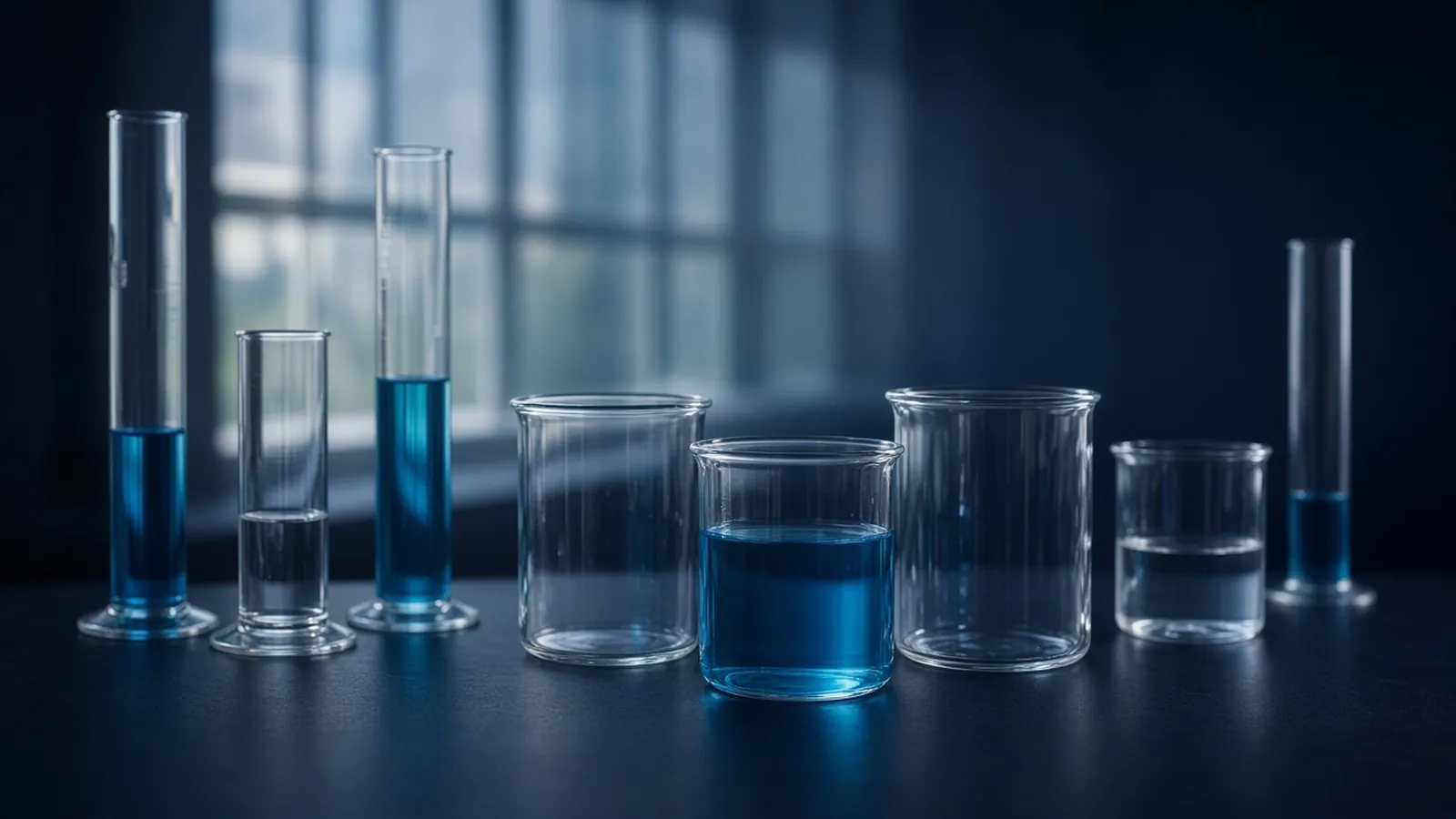
A hot plate, an autoclave and a cold rinse are three different promises, and only the glass type makes any of them reasonable. This guide is for people equipping a research bench who need to decide between borosilicate 3.3 and soda-lime before a vessel is heated, steamed or trusted with a volume. The wider map of beakers, flasks and volumetric pieces sits in choosing laboratory glassware. Polymer substitutes sit in when to use plastic tubes, tips and plates.
The decision the glass type actually changes
Ask what fails if the wall cracks, and what fails if the volume is only approximate. If the piece will see a steep temperature change, low-expansion borosilicate is the class to specify. If it will sit on a shelf with an aqueous buffer and never see steam or a burner, soda-lime can be an honest, cheaper hold, provided it stays intact and you do not later promote it to the autoclave. If the number you write down will be reused as a concentration, the vessel class matters as much as the glass recipe: a volumetric flask, not a generous beaker, carries that number.
Write the choice into the method in words a stranger can follow. "Heat-resistant glass" is a mood. "Borosilicate 3.3 beaker, 250 millilitre, hot plate only, no direct flame" is a specification.
Why expansion decides thermal shock
Glass fails in tension. When one part of a wall heats or cools faster than another, the hotter part wants to be longer. If the glass expands a lot, that mismatch becomes stress. Borosilicate 3.3 is named for a linear expansion near 3.3 × 10⁻⁶ per kelvin. Soda-lime laboratory glass expands several times more, so the same plunge from steam temperature onto a cold wet bench is harsher.
ASTM E438 is a public specification for glasses used in laboratory apparatus. It distinguishes a low-expansion borosilicate, an alumino-borosilicate, and a soda-lime type. Those classes are the language to use in a purchase note. A trade name such as Pyrex or Duran identifies a manufacturer line, not a universal composition. Some consumer ware sold under a familiar kitchen name in some markets is tempered soda-lime. That is the wrong assumption for a laboratory heating step. Specify the glass type.
Chemical durability does not copy the thermal ranking. Borosilicate resists water and many acids better than soda-lime, which is why volumetric ware is usually this glass. Strong alkali etches both. Hydrofluoric acid attacks silica glass and belongs in an institutional chemical-hygiene procedure, not in ordinary volumetric ware.
What you can specify, in classes
Reusable heat-resistant beakers, Erlenmeyer flasks and media bottles for steam are the usual borosilicate 3.3 domain. One-mark volumetric flasks are also commonly this glass, because the neck mark assumes a stable shape and a surface that drains cleanly. Soda-lime shows up as some jars, some cheaper cylinders, some disposable Pasteur-style items, and a great deal of non-laboratory bottle glass. If a cylinder does not say what it is, do not assume a burner or an autoclave is acceptable. Polymer tubes and plates remain a separate decision, governed by the resin chart.
| Duty | Borosilicate 3.3 | Soda-lime | Polymer labware |
|---|---|---|---|
| Hot plate or steam, intact ware | The usual specification | Poor thermal-shock match | Only resins marked for that cycle |
| Room-temperature aqueous hold | Works, often more than you need | Acceptable if intact and marked for the chemical | Often simpler for single-use work |
| Declared concentration | Volumetric piece, used at its reference temperature | Do not assume a cheap cylinder is calibrated tightly | Not a substitute for volumetric glass |
| Aggressive organic solvent | Usually the default | Glass still, if the piece is intact | Read the resin chart before you pour |
A short decision path, with a branch when the mark is missing
Start from the harshest step, not from the vessel you already own. If that step is steam or a hot plate, specify borosilicate 3.3 or a named low-expansion class, and specify the vessel form separately: beaker for handling, volumetric flask for a made-up volume, bottle for storage. If that step is only bench storage of an aqueous reagent the glass tolerates, soda-lime is discussable. If the chemical is a strong alkali, limit contact time for either glass and do not store it for weeks in a volumetric flask whose neck mark you still need.
The branch that matters is an unmarked piece. Do not heat it to discover the glass. Move the heating step to a marked borosilicate vessel. Keep the unmarked piece for a room-temperature hold, or retire it if the rim is chipped. A second branch is a trade name without a glass line. Ask for the composition in the enquiry.
If a volumetric flask is the right tool, the glass type does not relax the metrology. Use it at the reference temperature printed on it, commonly 20 °C, with the meniscus on the line. NIST's Office of Weights and Measures is the public doorway into laboratory calibration practice. A catalogue adjective is not a calibration certificate.
How the failures look
Thermal shock looks sudden and usually had a visible prelude: a star in the base, a chip, a flask taken from an oven onto a wet bench, or cold liquid poured into a hot thick bottom. Borosilicate reduces the stress. It does not cancel a chip. Soda-lime fails the same way sooner.
The quiet failure is etch. Alkali frosts the surface, graduations soften, and a volumetric neck no longer drains as the calibration assumed. The operational failure is false identity: a soda-lime bottle put into an autoclave because it was stored next to borosilicate media bottles. Colour of the glass is not the test. The printed glass type is the test.
Safety, and what this page does not approve
Hot glass looks like cold glass. Treat every vessel that might have been heated as hot until you know it is not. Broken glass is a sharps problem and, if it held a culture or a toxic reagent, a contamination problem. Decontamination and chemical waste follow your institution. The WHO laboratory biosafety manual and the CDC BMBL are background references for biological work, not a permit to culture an organism and not a clinical instruction.
This page is research-use education. It does not replace the manufacturer limit for pressure, vacuum or autoclave cycles.
Heat in a warm building
In a hot laboratory, "let it cool" is not a few minutes on a metal tray that is itself warm. Give borosilicate unloaded from an autoclave time to approach the room before anyone trusts a volumetric line or sets a thick base on a cold wet surface. A power cut mid-cycle can leave a load half-heated. Do not open a pressurised autoclave to find out. Follow the machine's own instruction, then inspect glass for new cracks before the next run. Hard water spots mimic etch. Rinse volumetric pieces with the water grade the method names.
What to put on an enquiry
State borosilicate 3.3 or the alternative you accept, the vessel form, the capacity, whether any piece must be volumetric and to which class, and the hottest step it must survive. Say if soda-lime is acceptable for the room-temperature items on the same list, so the two are not substituted for each other. Quantity belongs in the note as a count of pieces. Use the laboratory glassware catalogue, the volumetric glassware catalogue when a line must be trusted, and the quote request. A family name on a page is not a glass analysis.
Match the glass type to the hottest honest step in the method
- 01Write the temperature step firstName the hottest and the fastest temperature change the vessel will see, including autoclave steam, a hot plate, a drying oven, and a cold rinse onto warm glass.
- 02Read the glass line on the pieceLook for borosilicate 3.3 or another stated low-expansion type. If the wall only carries a trade name, treat the composition as unstated until the marking or the data sheet says otherwise.
- 03Separate volume truth from heat resistanceIf the method declares a concentration, put that step in volumetric glass used at its reference temperature. Heat resistance does not turn a beaker line into a standard.
- 04Retire unmarked ware from heatKeep unmarked soda-lime-looking bottles, jars and thin cylinders off burners and out of autoclaves. Use them for room-temperature holding only when they are intact.
Questions from the bench
What does the 3.3 in borosilicate 3.3 refer to?
It refers to a low linear thermal expansion, about 3.3 millionths per kelvin, which is why this glass tolerates ordinary bench heating better than soda-lime. The figure is a materials description, not a promise that a chipped or shocked piece will survive. Read the marking on the vessel you have, because a similar look can hide a different glass.
Can soda-lime laboratory glass go in an autoclave?
Soda-lime expands more than borosilicate 3.3, so repeated steam cycles and fast cooling are a poor match for it. Use glass the manufacturer marks for autoclave duty, leave headspace, and loosen caps unless a vented cap is explicitly allowed. An unmarked jar is a storage vessel, not a sterilisation vessel.
Does a Pyrex or Duran mark settle the glass type?
Those words identify a manufacturer line. Laboratory borosilicate should be specified by glass type, such as borosilicate 3.3 or the relevant low-expansion class. Some consumer bakeware sold under a familiar trade name in some markets is tempered soda-lime. The printed glass description on laboratory ware is the line that belongs in the method.
When is a plastic vessel the clearer choice?
Choose a polymer when the step needs a centrifuge tube, a sterile single-use format, or a plate an instrument accepts, and the chemical compatibility chart allows that resin. Glass remains the usual default for aggressive organic solvents and for a volume you will declare. The plastic decision is covered beside this glass decision, and the two should be written as separate lines in a method.
References
Manufacturer names identify published method classes. Trademarks remain with their owners. Catalogue records on this site are independent references for enquiry. They are not a statement of inventory, distribution rights or a supply commitment. This page is educational. It is not medical advice, a diagnostic protocol or a biosafety approval.
Catalogue
Related products and categories
These links follow the subject of the article into published manufacturer references. A listing is a reference for an enquiry, not a statement of stock or distribution rights.
Continue in this cluster
Related reading
Choosing laboratory glasswareHow to match borosilicate beakers, flasks and volumetric glass to the measurement you need, and when a printed line is only a guide.A glossary of labware termsDefinitions of the labware words that change a result: class marks, to contain and to deliver, joint size, resin, sterile and clean.Beakers are for handling not for accuracyWhy a beaker graduation is only a handling guide, and when a concentration other people will reuse belongs in a volumetric flask.