
troubleshooting
Carryover between injections
Trace carryover to the needle, a weak wash, or a missing blank, and decide whether the next peak belongs to the previous sample.
- Author
- EVRINTH Editorial Team
- Published
- 8 October 2026
- Updated
- 8 October 2026
- Reading time
- 7 min
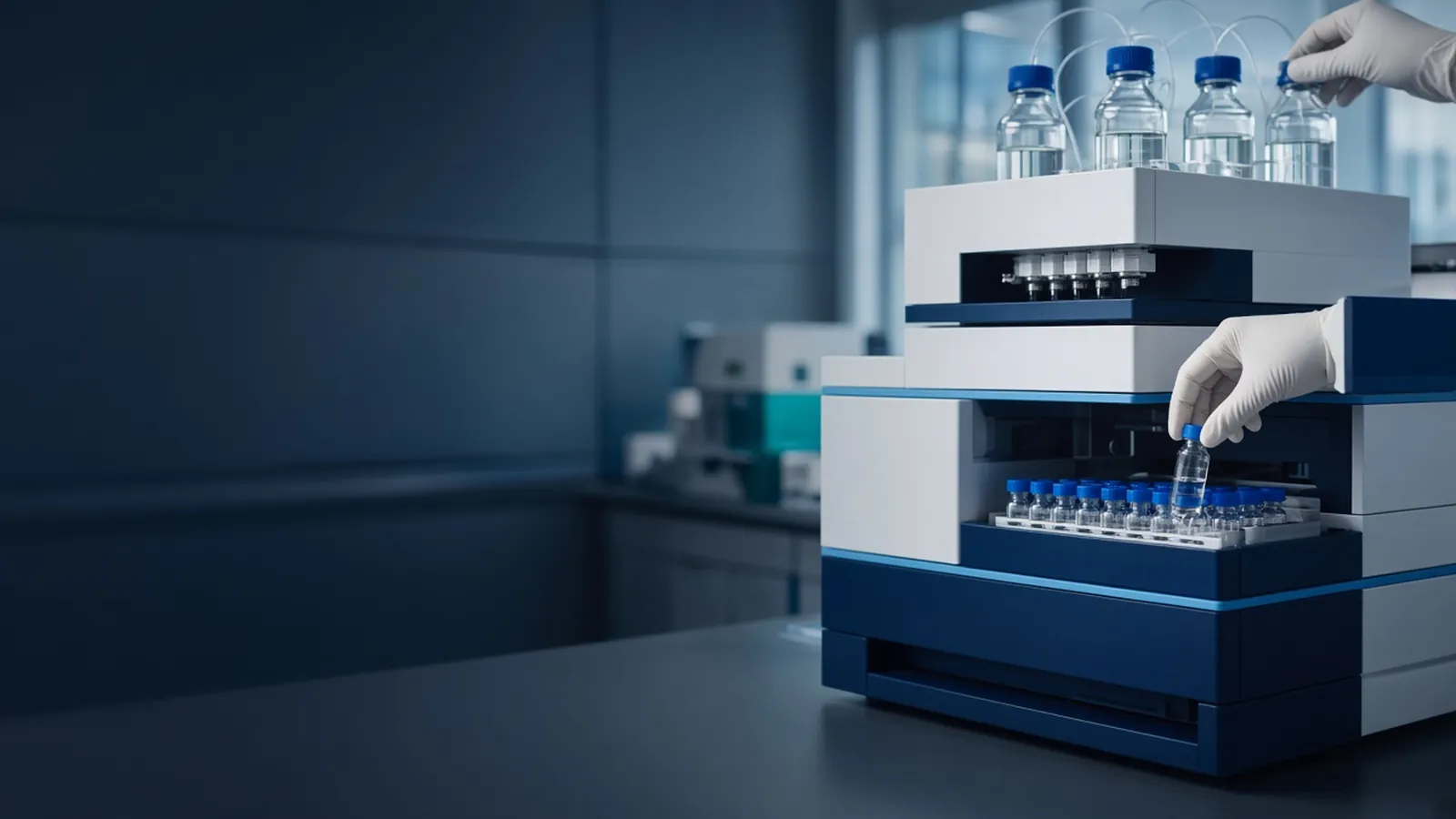
Carryover is sample from the previous injection appearing in this one. It is a plumbing and a washing problem before it is a chemistry problem. The decision is whether the peak you are about to integrate belongs to the vial in the tray. How separations produce true peaks is covered in chromatography methods in life-science labs.
Where the previous sample hides
Chromatography assumes the band you injected is the band you detect. An autosampler needle, a seat, a loop, a rotor seal, and the detector cell all touch that band. Hydrophobic peptides, basic compounds, and proteins at high concentration adsorb to those surfaces. The next injection's mobile phase redissolves a little of them. You see a peak at the old retention, often a few tenths of a percent to a few percent of the previous area, sometimes much more after a dirty sample. The exact fraction is an empirical measurement, not a constant to copy.
A weak needle wash is the usual reason. Water after a sticky peptide does not clean a steel needle. A strong solvent, often the organic solvent the method already uses, with the same acid if the hardware allows, is the class of wash that works. Some samplers have an external wash and an internal flush of the needle lumen. Both matter. A programme that dips the outside of the needle and never flushes the inside will still carry over. Follow the manual for solvent compatibility. A strong wash that attacks a seal becomes a leak, and the leak looks like missing area rather than carryover.
Manual injection has the same disease in a syringe. A syringe rinsed once with mobile phase and then used for a blank will write last sample into the blank. Rinse with a strong solvent and then with starting mobile phase so you do not inject a strong plug. ISO 8655-1 speaks to volumetric apparatus. It does not replace a rinse. The volume you deliver can be accurate and still be the wrong liquid.
The blank injection is the test
Run the stickiest sample you care about, then one or two blanks in identical vials. Integrate the blank at the sample's retention. Carryover falls on the second blank if it was a surface film. A peak that does not fall is coming from the column or the solvent, which is a ghost-peak problem, and more washing of the needle will not fix it. Swap the order: blank, sample, blank. The first blank should be quiet. If it is not, you have not started from a clean system, and any carryover percentage you calculate is a fiction.
Quantify carryover as area in the blank divided by area in the sample, and write the number in the method. There is no universal pass mark in this article. A trace impurity assay cannot tolerate a carryover that a preparative fraction collection might ignore, because the preparative decision is a gel of a new load, not a 0.1 percent area. Match the test to the claim. If you report a small peak after a large one, the blank between them is part of the result.
Affinity chromatography and ion exchange carry over through valves and through resin that was not stripped. A blank load after a concentrated elution, collected as fractions and assayed, is the equivalent of the HPLC blank. Activity in that blank is leftover protein. Clean as the insert allows before the next real load. Do not rely on a short equilibration to erase a high-capacity bead.
Branching the fix
If blanks fall once you strengthen the needle wash, lock that wash into the method and keep a periodic blank after the dirtiest sample. If the wash is already as strong as the seals allow and carryover remains, reduce the mass injected, add a blank injection as a scheduled rinse, or change needle and seat materials. A scheduled blank that you do not look at is not a control. Look at it.
If carryover appears only after samples in a particular solvent, that solvent is leaving a film. Dry-down and redissolve in the starting mobile phase when the chemistry allows, or dedicate a loop to that solvent and flush it. If a single sample poisons the column so that every later injection shows the peak, the analyte is sticking on the bed, not only on the needle. Extend the gradient or the strip the insert allows, then blank again. Replacing the autosampler will not cure a column that is still loaded.
Shared vials and reused pipette tips imitate carryover. A tip that touched a high standard and then a blank has done the autosampler's job. Fresh tips and a blank vial that never held sample are part of the test. So is the order of the tray: do not place a blank or a low calibrator immediately after the highest standard unless a wash and a blank injection sit between them on purpose.
| Observation | Likely home of the leftover | Next check |
|---|---|---|
| Blank peak shrinks on a second blank | Needle, seat, loop, or syringe | Stronger wash the manual allows, then two blanks |
| Blank peak constant all day | Solvent, bottle, or column bleed | Blank gradient without an injection |
| Only the resin blank has activity | Affinity or ion-exchange bed not stripped | Insert-approved strip, assay again |
| Carryover only after one matrix | That solvent films the path | Dedicated rinse and a fresh blank vial |
| Area missing and fittings wet | Leak, not carryover | Stop and fix the seal before any percentage |
What you must not conclude
A blank that is clean does not prove the sample peak is pure. It proves the injector did not donate yesterday's sample at that retention. Co-elution inside the sample is a separate limit. A mass spectrometer makes carryover look more dramatic because it is sensitive, and it can also show that the blank's peak has the same mass as the previous analyte. That match supports carryover. Reporting it as an identification in the blank sample would be a HUPO-relevant mistake if you treat the blank as a specimen. The sequence in UniProt does not belong to an empty vial.
Safety
Needle-wash solvents are often the flammable or acidic ones. The wash bottle is a chemical hazard, not a minor accessory. Waste from blanks is still solvent plus whatever bled off the needle. Biological samples leave biological residue on the needle. Your institutional rules decide how that residue is handled. This troubleshooting path is not a clinical contamination policy.
Enquiry
State the analyte class, measured carryover in a blank after a stated load, current wash solvents, and the seal materials you must live with. Ask for a sampler and a wash programme that can use a strong solvent safely. The scientific instruments catalogue lists instrument classes. Send the measurement with the quote request. If carryover sits in a protein purification workflow, the custom protein expression and purification reference can frame the method discussion. ---
Questions from the bench
How do you prove a peak is carryover rather than a real component?
Inject a blank, the same vial and solvent with no sample, immediately after the suspect injection. A peak at the same retention, smaller than the previous one, that shrinks again on a second blank, is carryover until proved otherwise. A peak that stays constant in every blank is more likely a ghost from the solvent or the column. A peak that appears only when a particular sample is injected, and not in the following blank, belongs to that sample. The blank is the branch point. Skipping it makes the next sample inherit the last one.
Why does a needle wash fail on sticky peptides?
The wash solvent is weaker than the peptide's preference for the needle and the seat. Aqueous wash after a hydrophobic peptide leaves a film. A strong organic wash, sometimes with the acid the method already uses, dissolves that film if the autosampler materials tolerate it. Follow the instrument manual for which solvent may enter the wash port. Then prove the fix with a high standard followed by two blanks. A wash you cannot see in a blank is a wish.
Can affinity or ion-exchange fractions show carryover too?
Yes. A loop, a valve, or a detector cell that held a concentrated elution will seed the next run. On an open column the equivalent is a tip or a fraction tube reused without a real rinse, or resin that was not eluted before the next load. The symptom is a band in a blank load. Strip or wash as the resin insert allows, then run a blank gradient and assay the tubes that would have been the product. Do not start the next lysate on a resin that still has last week's protein.
What should an autosampler enquiry say about carryover?
State the stickiest analyte you inject, the current wash solvents, the carryover you measure as a percent of the previous area in a blank, and the materials the needle may see. Ask for a wash programme and wetted materials that can use a strong solvent. Send it with the quote request. A sampler specified only by vial count does not specify carryover.
References
Manufacturer names identify published method classes. Trademarks remain with their owners. Catalogue records on this site are independent references for enquiry. They are not a statement of inventory, distribution rights or a supply commitment. This page is educational. It is not medical advice, a diagnostic protocol or a biosafety approval.
Catalogue
Related products and categories
These links follow the subject of the article into published manufacturer references. A listing is a reference for an enquiry, not a statement of stock or distribution rights.
Continue in this cluster
Related reading
Chromatography methods in life-science labsHow life-science chromatography separates molecules on a stationary phase, and what an HPLC or column peak does not prove about purity.A glossary of chromatography termsUse chromatography terms with their real limits: retention, resolution, void, and a peak that is only a detector response. Affinity and ion-exchange protein purificationHow affinity capture and ion exchange pull a protein from a lysate, and why each collected fraction still needs an identity check.