
guide
Choosing agarose percentage for a fragment
Choose an agarose percentage from the expected fragment size and a ladder that brackets it, balancing resolution, gel strength and run time.
- Author
- EVRINTH Editorial Team
- Published
- 8 October 2026
- Updated
- 8 October 2026
- Reading time
- 9 min
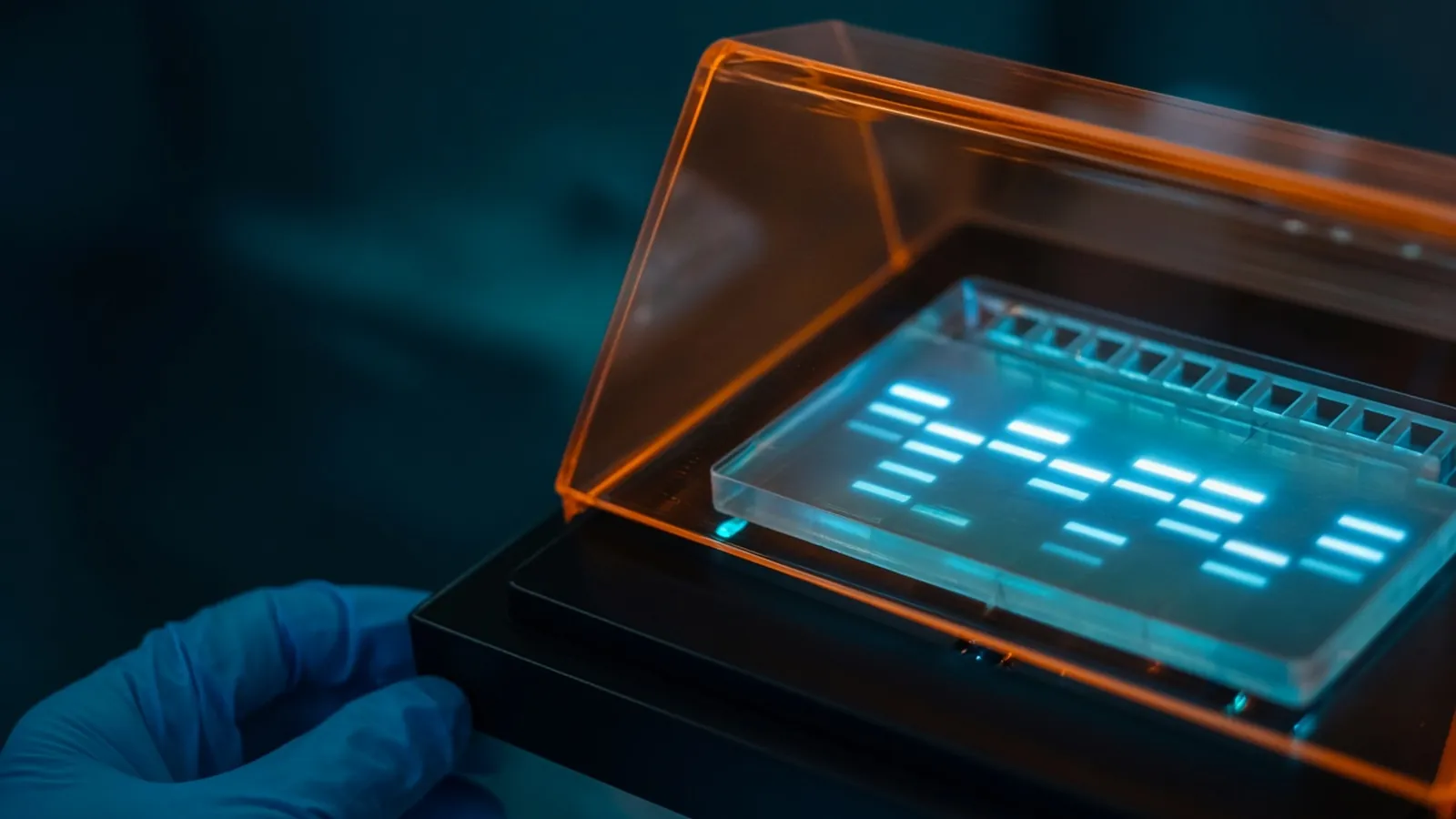
Choosing an agarose percentage is the decision that decides whether two fragments will sit apart or travel as one glow. The percentage is the mass of agarose in the gel, and it sets the mesh those fragments must thread. This page is a planning guide for that choice. The wider method, including buffer family, voltage and what a band can prove, is agarose gel electrophoresis for DNA. It is a research note, not a stain insert and not a clinical test.
If you are ordering agarose, ladders or tanks, start from the molecular biology catalogue and attach the sizes you must resolve to the quote request. A grade name is not evidence that a particular lot is the mesh you need.
Who the percentage is for
Use this decision when the next step depends on separation. A PCR product that must be cut away from primer-dimer, a restriction digest whose fragments differ by a few hundred base pairs, a genomic smear you only need to see high in the lane, and a multi-kilobase plasmid you must linearise and measure, all ask for different meshes. A single compromise gel is honest only when every fragment you care about falls in one window.
Write the lengths before you weigh agarose. "A band" is not a size. A 400 base-pair amplicon, a 3 kilobase miniprep, and an 8 kilobase digest product are three gels until you check that one percentage can space all three. If the experiment only needs one of them, pour for that one.
What percentage does to the mesh
Agarose is a polysaccharide. As it sets, chains meet and leave pores. More agarose in the same volume leaves a tighter mesh. Short DNA still finds paths. Long DNA is held back more severely, which is why a higher percentage spreads small fragments and squeezes large ones into a slow group near the wells.
Over a useful middle of the gel, the distance a linear fragment travels is roughly logarithmic with its length. That relationship is why a ladder with even spacing on the card looks uneven on the gel, and why a percentage that is wrong for the range piles many sizes into a short stretch of lane. Changing the percentage moves which part of the log curve is readable. It does not make the curve a ruler you may extend past the last ladder band.
Planning ranges that many laboratories use as a start:
| Expected linear DNA | Percentage to plan | What you are accepting |
|---|---|---|
| Multi-kilobase fragments | About 0.7 to 0.8 percent | Better spacing of long DNA, a fragile gel, a field that must stay gentle |
| Ordinary plasmid and PCR work | About 1 percent | A general mesh when the fragments are not at either extreme |
| Under roughly 500 bp | About 1.5 to 2 percent | Room between a small amplicon and primer-dimer, a slower run |
| Very small fragments | Higher, or a small-fragment grade | Tighter pores, a gel that can be brittle and slow to dissolve |
Those are windows, not a table copied from one bottle. Follow the agarose grade. A standard molecular-biology agarose, a low-melting agarose used when you will remelt a slice, and a high-resolution grade sold for small fragments do not behave as the same mesh at the same number on the balance. The grade note is the local authority. If the grade says it is meant for a size band, believe that before you invent a percentage from memory.
Reagents and equipment that belong in the choice
You need agarose of a stated grade, the running buffer you have already standardised on, a tray and comb, a flask or bottle that can take a boil, a ladder whose card covers the window, loading dye, and a way to see the DNA afterwards. Tris-acetate-EDTA and tris-borate-EDTA are buffer families, not interchangeable mid-project. Pour the gel in the same family you will put in the tank. The pillar page explains why a tired tank buffer and a swapped family make a familiar percentage look wrong.
Loading dye is density plus tracking colour. The dyes move at sizes that themselves depend on percentage, so a dye position you learned on a 1 percent gel is the wrong stopping cue on a 2 percent gel. The dye is not a ladder. Stop because the fragments you care about have separated, while they are still on the gel.
The ladder is part of the percentage decision. A marker that ends at 1 kilobase cannot rescue a 0.8 percent gel poured for an 8 kilobase fragment. A marker with no bands below 500 base pairs cannot tell you whether 1.5 percent split an amplicon from primer-dimer. A photograph of a different percentage is a different scale. If this gel is only a step before a blot, still choose the percentage for separation. The transfer membrane comes later and cannot unstack a pile-up that already happened in the agarose.
From an expected size to a gel you can run
Place the length in the window above, together with the neighbour it must clear. A 6 kilobase backbone and a 250 base-pair insert on the same digest will not both be favoured. Run two gels, or decide which fragment the decision needs. A percentage gradient in one tray is a learning experiment, not a routine.
Weigh agarose for that tray in the grade you checked. Dissolve it fully in the running buffer. Grains left in the flask cast an uneven mesh. Cool the flask until you can handle it before you pour. Molten agarose burns. A comb that touches the floor tears wells, and a 0.7 percent gel has less strength around a tear.
Load a defined volume with the ladder on the same gel. When the question is a PCR product, keep the no-template control on that gel too. How the control is read sits in PCR controls and contamination control. A high field warms the centre, smiles the lanes, and can soften a low-percentage slab. Give a low percentage more time at a gentler field. Give a high percentage more time because the mesh is slower. Do not raise the voltage to buy back the clock.
Photograph with the ladder in the frame and the orange shield in place. If the spacing is still wrong, the next pour changes one thing: percentage, ladder, or run length.
When the gel disagrees with the plan
Bands stacked near the wells on a high percentage usually mean the DNA was too long for that mesh, or it never became linear. Uncut plasmid is the second case. Supercoiled DNA is not a linear ladder band of the same length. Cut it once if length is the question, then judge the percentage.
Bands stacked at the front on a low percentage usually mean the fragments were short. Primer-dimer lives there. Raising the percentage is the separation fix. Running the same 0.8 percent gel "a bit longer" often runs the small DNA off the end before the large DNA has moved enough to help.
A smeared ladder after a change of agarose brand can be the grade, a poor dissolve, or the buffer. Restore one variable and pour again before you redesign the primers.
Safety and the limits of the claim
Molten agarose, ultraviolet light and nucleic-acid stains are the routine hazards. Ethidium bromide and alternative dyes differ. Follow the bottle you have, and view the gel through the orange shield shown in the photograph. Ultraviolet light damages eyes, skin and DNA you may still want to clone. Tanks stay closed while the field is on. Biosafety follows the sample. The WHO Laboratory biosafety manual, 4th edition is background for institutional practice, not permission for a particular organism or a diagnostic gel.
A matched percentage supports a length comparison inside the ladder. It does not name the sequence, prove that two same-sized species are absent, or report a starting copy number. Endpoint PCR still answers presence and size, and only if this mesh let that size travel alone.
Heat, fragile gels and unfinished runs
In a hot laboratory a 0.7 to 0.8 percent gel slumps, tears at the wells, and smiles at a voltage that was fine in a cooler season. Keep that percentage when the fragments are multi-kilobase, lift the slab on its tray, and drop the field. Budget the extra time. If the supply may cut out, do not start a long gentle run you cannot finish. Bands that sat without a field diffuse, ladder included, and the distances are no longer the plan. A higher percentage survives the heat and hides the large-fragment spacing you poured to see. Let the gel set fully in humid weather. A surface that dried and warped on the bench is a poor photograph.
What to put in an enquiry
State the fragment lengths you must separate, the neighbour each must clear, the buffer family you already run, whether you will extract DNA from a slice, and whether that extraction needs low-melting agarose. Say if the ladder you have stops before the size in question. The nucleic acid analysis pathway is the route when the gel sits between amplification and a clone or a sequencing check. Ask for the grade and the ladder range that match those lengths. Ask whether a quotation is possible. Do not treat a percentage printed in a title as a promise that every size below it will resolve.
Pick an agarose percentage from the fragment you must resolve
- 01Write the size and the neighbour you must separateRecord the expected length and the nearest band you cannot afford to merge with it, such as a second amplicon or primer-dimer. A percentage chosen for a lone band often fails when two close lengths are the real question.
- 02Place that size in a planning windowUse about 0.7 to 0.8 percent for multi-kilobase fragments, about 1 percent as a general gel, about 1.5 to 2 percent under roughly 500 bp, and a higher percentage or a small-fragment grade for very small pieces. Treat those windows as a start, then follow the agarose grade in front of you.
- 03Match the ladder to the same windowThe ladder has to place bands on both sides of the expected size on that percentage. If the only marks are far above or already stacked at the front, change the ladder or the percentage before you pour.
- 04Accept the handling cost or change the questionA lower percentage resolves large DNA, tears more easily, and often needs a slower field, while a higher percentage sharpens small DNA and takes longer. If the gel cannot be handled or the run cannot be finished, narrow the size question rather than forcing one slab to do every job.
Questions from the bench
Will a 1 percent gel separate a 200 bp product from primer-dimer?
Often poorly. Under roughly 500 bp, a general 1 percent gel leaves short DNA stacked near the front, so a small amplicon and primer-dimer can glow as one region. Move toward 1.5 to 2 percent, or a grade sold for small fragments, and keep a ladder that still has bands in that low range.
Why does a 0.7 percent gel tear when the same tray is fine at 1 percent?
The mesh is looser, so the slab is mechanically weaker. Wells rip, the gel slips off the tray, and a hot run softens it further. Pour it only when the fragments are multi-kilobase, let it set fully, and move it with a support. Do not thicken the biology problem by switching to 2 percent, which will compress those long fragments together.
Does a higher percentage make an uncertain band the correct size?
No. Percentage changes spacing. It does not name the sequence. A band that now sits apart from its neighbour is easier to compare with the ladder, and identity still needs a digest, a clone check, or a sequence when identity is the claim.
Should I change the percentage or the ladder first?
Change whichever one fails the bracket. If the expected size sits inside the ladder but the bands are piled on top of each other, the percentage is wrong for that range. If the bands are spaced and the ladder simply stops before your fragment, pour the same percentage again with a ladder that continues.
References
Manufacturer names identify published method classes. Trademarks remain with their owners. Catalogue records on this site are independent references for enquiry. They are not a statement of inventory, distribution rights or a supply commitment. This page is educational. It is not medical advice, a diagnostic protocol or a biosafety approval.
Catalogue
Related products and categories
These links follow the subject of the article into published manufacturer references. A listing is a reference for an enquiry, not a statement of stock or distribution rights.
Continue in this cluster
Related reading
Agarose gel electrophoresis for DNAHow agarose percentage, buffer and a size ladder turn a DNA sample into a band, and what that band does and does not prove about identity.A glossary of electrophoresis termsDefine anode, cathode, sieving, mobility, stacking, resolving, electroendosmosis, Rf, and leading dye for an honest gel reading. Blocking buffers and background signalChoose milk or BSA and a wash that fits the antibody, then decide whether speckles are sample signal or block, secondary, or a dried membrane.