
protocol overview
Colony PCR for screening clones
Screen colonies with flanking or insert primers, a lysis step, an empty-vector colony, and a no-template control. A band is not a sequence.
- Author
- EVRINTH Editorial Team
- Published
- 8 October 2026
- Updated
- 8 October 2026
- Reading time
- 9 min
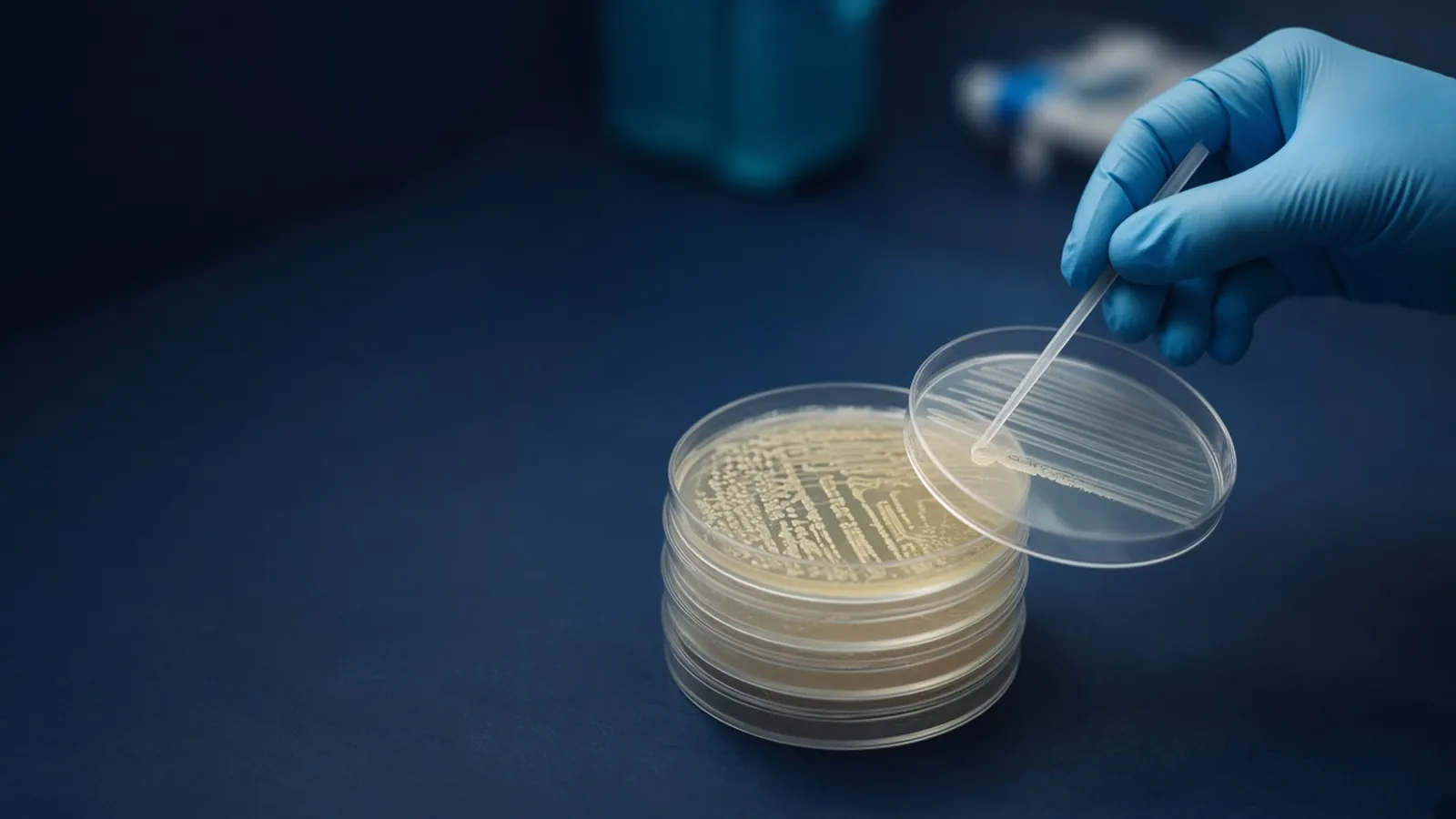
Colony PCR asks whether a colony from a cloning plate carries a plasmid of the size you expect, before you spend a miniprep and a sequencing reaction on every colony on the dish. It uses the same endpoint chemistry as any other PCR, with a colony lysate as the template. A band is a screen. It is not a sequence, not proof of orientation, and not proof that the open reading frame is intact. Where this screen sits in the cloning path is described in plasmid cloning from insert to colony. The cycle itself is in how polymerase chain reaction works.
What the plate has already told you
Colonies on antibiotic agar show that a resistance marker was present. They do not show that an insert is present. Empty vector grows on the same drug. Ampicillin plates add a further trap: beta-lactamase can leak into the agar and let nearby cells that never took up a plasmid form small satellite colonies. Those satellites are not clones. How drug selection and blue-white colour should be read is set out in antibiotic selection and blue-white screening. Pick a well-isolated large colony, not a pinprick in a cleared halo, and not a colony from a lawn.
Blue or white colour, on a system built for it, only chooses which colonies are worth this PCR. A white colony can be a damaged lacZ fragment with no insert. A blue colony can hide a small in-frame insert. Screen the DNA either way if the claim needs the insert.
Flanking primers and insert primers answer different questions
Flanking primers bind the vector on either side of the cloning site. On an empty plasmid they copy only the short stretch between them. On a plasmid that took an insert they copy that stretch plus the insert. You see both outcomes as different sizes, which is what you want when the question is empty versus occupied. You do not learn orientation unless the size somehow depended on direction, which it usually does not. You do not learn whether the junctions are clean.
Insert primers bind inside the fragment you ligated. A true empty vector gives no product. A colony whose plasmid contains that sequence gives the internal amplicon. This is a sharp screen for "is this sequence somewhere in the well," and a weak screen for "is it in my vector." A contaminating fragment in the mix will amplify. An insert of a different gene will not, which is useful, and a truncated insert that lost the primer site will look empty, which is a false negative. Pair insert primers with the empty-vector control so silence means something.
One primer in the vector and one in the insert asks about orientation and presence together. The wrong orientation does not make a product. The size should match the map from the vector primer to the insert primer. Run the opposite orientation as a separate pair if you need to see the other direction rather than infer it from a blank. A blank can also be a failed lysis.
Write the expected sizes down before you load the gel. Include the bases between flanking primers on the empty map, not the insert length alone. A 500-base-pair insert with flanking primers 150 bases apart on the empty vector is a 650-base-pair product beside a 150-base-pair empty product. Those two must be separable on the percentage you pour.
Lysis is a class, not a recipe to invent
The polymerase has to see plasmid DNA, and a whole colony is mostly cells, agar and inhibitors. Use a lysis class the mix tolerates. Common classes are a brief heat step on a small suspension of cells in water or buffer, or a colony-PCR mix sold to accept intact cells. The decision-level rule is a barely visible touch of colony, not a glob. Too much biomass inhibits the reaction and turns real clones into false blanks.
Patch first. Stab or streak the same colony onto a numbered selective plate, then suspend what remains on the tip. If the PCR looks promising you still have the patch to inoculate. If you suspended everything, a positive band has no cells behind it.
Do not pool colonies to save reactions. A band from a pool does not name the colony, and a mixed pick already looks like two plasmids in one chromatogram later. One colony, one tube, one patch.
Controls that make the screen interpretable
Run an empty-vector colony through the same lysis and the same primers. With flanking primers it must produce the short backbone size. If it produces the long size, either it was not empty or the long band is contamination. With insert primers the empty colony must be blank. If it lights up, the insert primers are amplifying something that does not depend on your ligation.
Run a no-template tube with no cells at all. It must be blank at every size you intend to score. Colony PCR is famous for false positives because the ligation fragment and yesterday's amplicon are often on the same bench as the master mix. A no-template band at the insert size ends the session. Remake the mix away from post-PCR work, and do not score the colonies beside it.
A failed empty-vector reaction, with a blank where the backbone band should be, means the lysis or the flanking primers failed. Blank sample lanes then mean nothing. Fix the lysis or the primers before you call twenty colonies negative.
| Tube | Flanking primers | Insert primers | If this pattern breaks |
|---|---|---|---|
| No-template | Blank | Blank | Carry-over. Stop scoring |
| Empty-vector colony | Short backbone size | Blank | Wrong colony, or contamination if a long band appears |
| Candidate, insert present | Backbone plus insert | Internal band | Still not orientation or sequence |
| Candidate, empty plasmid | Short backbone only | Blank | Expected for a religated vector |
| Too much colony | Blank or smear | Blank or smear | Repeat with a smaller pick from the patch |
From the gel to a clone you can keep
Score sizes against the map and a marker that brackets both the empty and the insert products. A colony that shows both sizes may be a mixed pick. Restreak the patch to single colonies and screen again. A colony that shows an unexpected third size may be a deletion or a double insert. Do not average it into the "close enough" pile.
Take one or more size-matched patches to a miniprep. A diagnostic digest can confirm that extra DNA of the right length is in the plasmid. Sanger sequencing across the junctions is what shows the bases. One read does not cover a long insert. Mixed peaks mean the template was mixed. The Sanger sequencing enquiry reference is a way to frame that check. It is an independent method reference, not a statement that a sequencing bench is already running. Keep plasmid DNA as a backup separate from the plate you screened.
If every colony matches empty vector, the ligation or assembly did not deliver insert into the cells you plated. More colony PCR will keep reporting that. Return to the join, the molar ratio class, and the empty-vector control on the original plate. If no colony amplifies, including the empty-vector control, the screen is broken. Check lysis and primers. If the no-template tube is the only tube with a band, you do not have twenty recombinants. You have a contaminated mix.
Safety, warm plates and satellites
These are laboratory cloning strains, still living organisms, and the insert may change the institutional biosafety decision. Inactivate plates and cultures by the method your institution specifies. Do not tip antibiotic waste down a drain because the PCR already finished. This screen is research practice, not identification of a clinical isolate.
Plates that sit on a warm bench grow satellites around true ampicillin colonies and, in humid weather, sweat until neighbouring colonies merge. A pick then becomes a mixture that colony PCR will sometimes show as two bands and sometimes hide inside one. Screen colonies the day you need the answer, from a plate that has not been left out, and keep the patch plate from becoming the next warm incubation you forgot. A power cut to an incubator means you do not actually know how long selection ran. Look at the colonies before you lyse fifty of them from a lawn.
What an enquiry should include
Say you are screening bacterial colonies, the vector and the expected insert length, whether you need flanking-primer interpretation or only an enzyme for colony PCR, and that positives will go on to sequencing. Enzyme families are in the molecular biology catalogue. Send the lengths with the quote request. A polymerase that cannot tolerate colony debris is the wrong convenience. The nucleic acid analysis pathway is the context if the insert itself was amplified from a difficult extract. The multiplex PCR enquiry reference is relevant only if one colony reaction must report several junctions at once. Most screens are clearer as one pair and a size you can tell from the empty backbone.
Screen colonies without mistaking a band for a sequence
- 01Patch the colony before you lyse itTouch a fresh, isolated colony and streak a small patch on selective agar so the cells you test still exist tomorrow. Do not suspend the entire colony and leave yourself nothing to grow.
- 02Choose flanking primers or insert primers on purposeFlanking primers on the vector report empty-backbone size versus insert size. Insert primers report whether that sequence is present and stay silent on a true empty vector. One of each can ask about orientation.
- 03Include an empty-vector colony and a no-template tubeThe empty-vector colony must give the backbone product with flanking primers and no product with insert primers. The no-template tube must stay blank. If it shows the insert band, stop and do not score colonies.
- 04Treat a correct-size band as a shortlistGrow the matching patch, prepare plasmid DNA, and confirm the junctions by digest or Sanger sequencing. A colony PCR band does not prove orientation, an intact reading frame, or an error-free insert.
Questions from the bench
Do antibiotic-resistant colonies already prove the insert is there?
No. They prove a resistance marker was present and expressed well enough to form a colony. Empty vector carries the same marker. Satellite colonies around an ampicillin-resistant colony may carry no plasmid at all. Screen DNA, and read the limits of colour and drug selection in the blue-white and antibiotic note.
Which primers tell empty vector from insert?
Primers that sit in the vector on either side of the cloning site. Empty vector gives the short distance between those primers. A colony with an insert gives that distance plus the insert length. Primers that both lie inside the insert stay blank on empty vector, so they cannot show you the backbone size.
Why did every colony, and the no-template tube, give the insert band?
The insert sequence is contaminating the master mix, often from a purified fragment or an old amplicon used near the setup. Colony PCR is extremely sensitive to that carry-over. Discard the working primer dilution, remake the mix away from the fragment, and rerun the no-template tube before you believe a single colony.
Is a band of the right size enough to archive the clone?
No. Archive after a sequence, or at minimum after a digest that would fail if the insert were absent, reversed, or badly truncated. Polymerase errors and chewed junctions survive colony PCR whenever the primers still bind. The map plus the chromatogram is the identity. The band was only the screen.
References
Manufacturer names identify published method classes. Trademarks remain with their owners. Catalogue records on this site are independent references for enquiry. They are not a statement of inventory, distribution rights or a supply commitment. This page is educational. It is not medical advice, a diagnostic protocol or a biosafety approval.
Catalogue
Related products and categories
These links follow the subject of the article into published manufacturer references. A listing is a reference for an enquiry, not a statement of stock or distribution rights.
Continue in this cluster
Related reading
 How polymerase chain reaction worksHow PCR copies a chosen DNA segment: the temperature cycle, reagents, controls and what a band on a gel does and does not prove.A glossary of PCR termsPlan a PCR by defining amplicon, Tm, Ta, hot-start, plateau, master mix, NTC, inhibition, fidelity and multiplex before you mix.Choosing an annealing temperatureWhy annealing temperature is not the Tm printed on a tube, and how salt, magnesium, additives, and a short gradient locate the real window.