
guide
Colony picking without mixing clones
How to move one isolated colony of a cloning strain into one labelled tube so the miniprep is not a mixture of neighbours.
- Author
- EVRINTH Editorial Team
- Published
- 8 October 2026
- Updated
- 8 October 2026
- Reading time
- 9 min
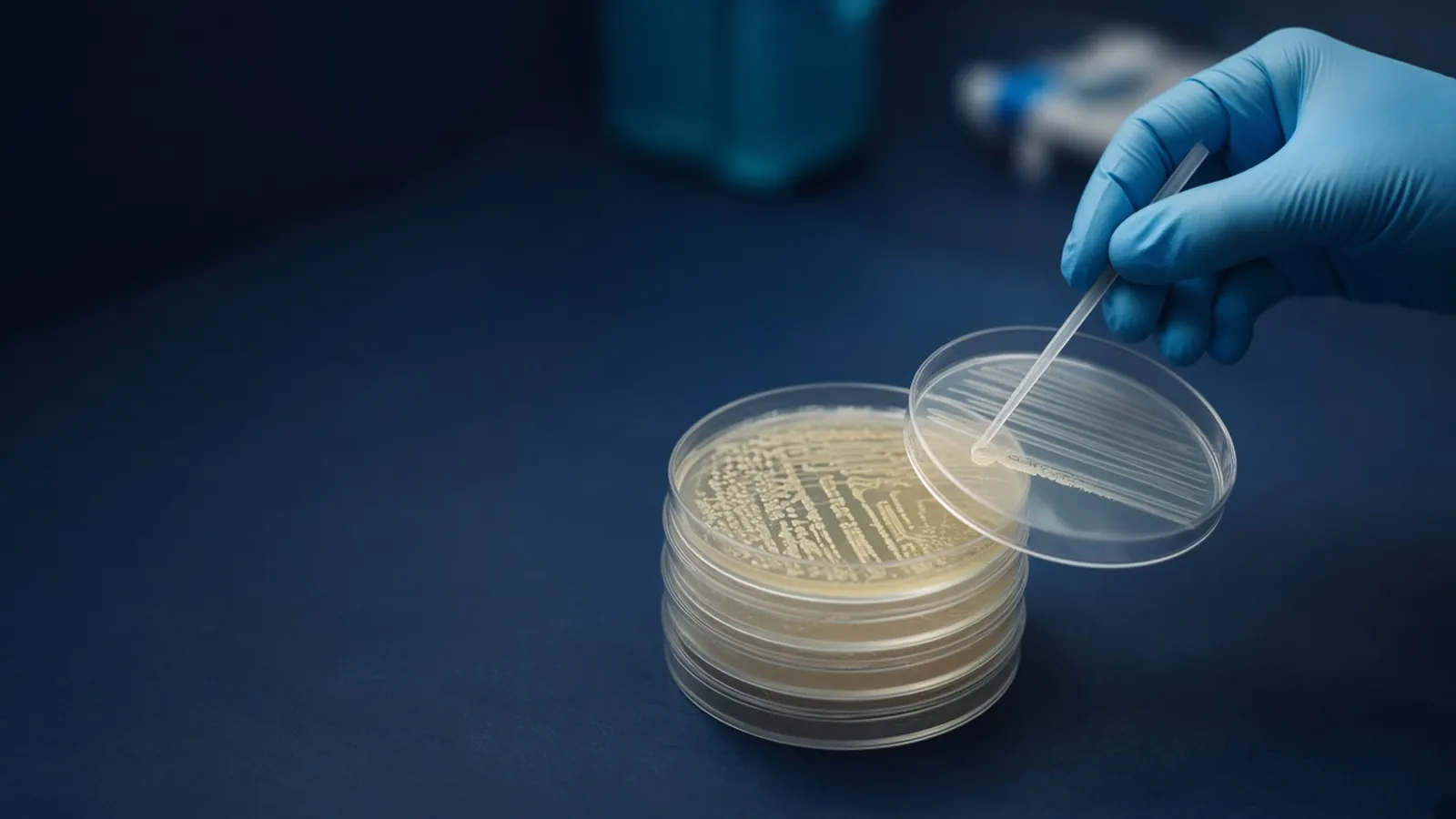
Colony picking is the moment a plate of candidates becomes a set of cultures you will trust one by one. The decision is whether each tube receives one isolated colony or a quiet mixture of neighbours. How those colonies arose is in bacterial culture and transformation. Colour and antibiotic context, which decide which colony is even worth touching, are in antibiotic selection and blue-white screening. What you still have to prove after the pick is the subject of plasmid cloning from insert to colony.
Tips, plates and broth are specified from the reagents and chemicals catalogue. The method sits on the molecular biology pathway. Sequence confirmation questions can be framed with the custom gene synthesis reference. Use the quote request for the consumable specification. A method can be discussed.
One contact, one record
A transformation plate is a map. Each isolated colony is a place on that map. The miniprep, the digest and the sequence trace are useful only if you can walk back from a lane to that place. The habit is mechanical: mark the plate base with numbers, touch colony 3 with a fresh tip, inoculate tube 3, discard the tip, write "3" in the notebook. Anything that breaks the chain, a shared tip, an unlabelled tube, a lid that got swapped, turns the gel into a rumour.
Do this while colonies are discrete. Waiting until they merge "so they are easier to see" removes the isolation you needed. Pick earlier in the day rather than after a long warm incubation that lets halos and neighbours meet.
A colony is a pile, not a certificate
An isolated colony usually grew from one cell, so the pile is mostly sisters. That is the best clonal unit plating can give you. It is not a sequence. The founding cell might have taken up two plasmids. A daughter might have lost the insert and kept the marker. A tip that also scrapes the agar next door adds a second founding cell you did not mean. The pick reduces those risks. It does not retire them. Plan the verification before you grow a litre from tube 3.
Touch the colony, not a streak of agar between colonies. On a dense plate the agar looks empty and is not. Cells you cannot see as a colony yet are still there. A short streak-out is the branch when you cannot see bare agar around the candidate. The Addgene streak-plate protocol is the public sketch of that dilution. Use fresh selective agar so the second plate is still asking the resistance question.
Satellites, touchers and the isolated colony
Three objects sit on a careless plate, and only one of them is a fair pick.
An isolated colony has a margin of agar you can see all the way round. That margin is the evidence you will not scoop a neighbour. Pick it.
Touching colonies have already exchanged cells at the boundary, or they may have been two colonies that grew into one shape. You cannot point to a pixel that is "only the left one". Streak them out. If the downstream step is cheap you might still be tempted. The mixed miniprep is more expensive than the extra night.
Satellite colonies are the small ones in the zone around a large colony on ampicillin. They are the wrong object. They often have no plasmid. Picking them because they look tidy is how a "clone" fails every later test. Pick the large colony if it is itself isolated from other large colonies, then restreak so the next pick is away from the halo. Kanamycin plates do not make that halo as a normal feature. A crowd of tiny colonies there is a reason to suspect the drug, not a menu of clones.
Blue and white colour, where the vector offers it, is a reason to choose which isolated colony to number. It is not a reason to pick a white colony that is buried in a cluster. Colour is a screen. Isolation is a handling rule. They stack. Neither one sequences the insert.
Tools that do not travel between colonies
Use a sterile tip or a sterile loop for each colony. A metal loop must be flamed and cooled between picks, and cooling includes not touching the bench. Disposable tips make the "between" harder to get wrong if you actually discard them. A tip that is set down, then used for colony 4, has inoculated colony 4 with colony 3.
Inoculate a labelled tube of selective broth, or patch a labelled grid on selective agar if you are screening many candidates before broth. Patching is a way to keep dozens of picks spatially honest. The patch must not run into the next square. A sloppy patch is a mixture with a grid drawn on the lid.
Tubes and plates that hold the picks are consumable classes. When to use plastic tubes, tips and plates is the companion if the format itself is the sourcing question. The biology rule does not change with the brand: one colony, one vessel.
What you are allowed to pick
| Object on the plate | What the tip collects | Decision |
|---|---|---|
| Isolated colony, margin of bare agar | Mostly one clonal pile | Pick it, number it, change the tip |
| Two colonies touching | Both piles, in unknown proportion | Do not pick; streak out and return |
| Satellite in an ampicillin halo | Often a cell with no plasmid | Do not pick; take the large colony and restreak |
| Colony in a field of background lawn | The colony plus the lawn | Selection has failed; discard the plate as evidence |
| Isolated colony of unexpected colour or texture | A stranger, or a mutant | Do not fold it into the clone list; stop and check |
Mixtures you only notice on the gel
A mixed pick can look like a clean culture. The broth is cloudy. The prep yields DNA. The digest shows two patterns at once, or a sequence trace goes double at the junction. That is the moment to stop and return to the numbered colony, if you still have it, or to the patch. If you discarded the plate, you repeat the transformation. Numbering is cheaper.
A double trace can also be a mixed plasmid inside one cell, or two colonies. You cannot tell from the chromatogram alone. Re-streaking to single colonies and prepping several sisters separates a mixture of cells from a single cell that took up two plasmids. Keep those sisters numbered too.
Do not pool "a few similar colonies" into one tube to get more DNA. You get more DNA of an unknown blend. Grow one colony longer, or start from one colony in a larger volume, under selection.
The pick does not change containment
You are handling a non-pathogenic cloning strain the institution has already accepted. A colony pick is not casual food-lab technique and not a method for an unapproved organism. Tips and plates go to the waste stream already specified. Do not leave a picked plate open while you label a rack. This page is not medical advice. The WHO Laboratory Biosafety Manual is a reference for the people who set the waste rule. ATCC culture guides are a reminder that revived material is checked, which is the same spirit as verifying the colony you just numbered.
Humidity that glues colonies together
In a humid incubator, lids rain onto the agar. Droplets drag cells from one colony into the next, and by morning the isolated colony you planned to pick has a bridge. Pick sooner, incubate plates inverted, and do not tap a wet lid onto the surface to "clear the fog". If bridges have already formed, streak out. A dry-season fan can do the opposite, crusting the edge of the plate so rim colonies look odd and are easy to misread. Number colonies from the moist, discrete centre of the pattern, not from a smear at the wall.
Write the numbers on the base before the lid fogs again. A lid label that is wiped off by condensation is how tube 3 becomes an orphan.
What to ask for
State the antibiotic, the plate size, whether picks go into broth tubes or onto a patch plate, and the sterile tip style. Ask for the specification rather than a family name. Put it on the quote request. A method can be discussed. The custom gene synthesis reference is in play only when the thing you are confirming is a designed sequence. It does not mean that confirmation has already been run. Promega protocols and the Addgene protocols collection show how public methods tell you to record the colony you prepped. Copy that record-keeping, not a volume from a different kit.
Pick one isolated colony into one labelled tube and keep the record straight
- 01Choose only colonies with bare agar around themIgnore colonies that touch, and ignore the tiny satellites around a large ampicillin colony. If the plate is a crowd, streak a candidate out and pick tomorrow rather than guessing a boundary today.
- 02Touch one colony with one sterile tipTouch the edge or the centre of that colony only. Do not sweep the agar between colonies. Open the labelled tube and inoculate the broth or the patch, then close it.
- 03Change the tip before the next colonyDiscard the tip before it can rest on the bench or enter a second tube. Number the tube so it matches a mark on the plate base. A tip that picks two colonies has already mixed them.
- 04Write which colony becomes which miniprepThe gel lane, the sequence trace and the frozen archive should all cite the same colony number. If a later test disagrees, you can return to that colony or its streak, not to an unlabelled tube.
Questions from the bench
Is a single colony guaranteed to contain one plasmid?
It is a pile of cells that usually descended from one cell, which is as clonal as plating gets. Two cells can land in the same spot, and a cell can still delete an insert while it grows. Picking an isolated colony removes the obvious mixture. A digest or a sequence is what shows the plasmid is the one you designed.
Should I pick a satellite if it is the only small colony nearby?
No. On ampicillin the small colonies in the halo are often cells with no plasmid, feeding on drug the large colony destroyed. Pick the large colony, restreak it on a fresh plate, and choose an isolated daughter. The satellite article in the selection guide explains the halo; the practical rule here is simply not to touch the ring.
What if every colony on the plate touches its neighbour?
Do not invent a boundary with the tip. Streak one region onto fresh selective agar, incubate until colonies are separate, and pick from that second plate. The delay is shorter than repeating a cloning cycle from a mixed miniprep.
What should an enquiry about plates or tips mention?
The antibiotic, the plate format, and whether you need sterile tips or sterile loops for picking into broth. A method can be discussed against that specification. Say the organism is a non-pathogenic cloning strain so the consumable is matched to bench plating rather than to a different duty.
References
Manufacturer names identify published method classes. Trademarks remain with their owners. Catalogue records on this site are independent references for enquiry. They are not a statement of inventory, distribution rights or a supply commitment. This page is educational. It is not medical advice, a diagnostic protocol or a biosafety approval.
Catalogue
Related products and categories
These links follow the subject of the article into published manufacturer references. A listing is a reference for an enquiry, not a statement of stock or distribution rights.
Continue in this cluster
Related reading
 Bacterial culture and transformationHow non-pathogenic E. coli cloning strains are grown and how plasmid DNA is introduced, with the controls that make a colony meaningful.
 Antibiotic selection and blue-white screeningHow antibiotic plates keep a plasmid in a cloning strain, and why a white colony on X-gal is a candidate rather than proof of the insert.
 Plasmid cloning from insert to colonyHow an insert becomes a plasmid, a colony and a verified clone, and which checkpoint fails when the plate is empty or the insert is wrong.