
application
Comparing HPLC and open-column work
Decide when HPLC pressure and resolution are worth it, and when a gravity column and larger fractions are the honest tool.
- Author
- EVRINTH Editorial Team
- Published
- 8 October 2026
- Updated
- 8 October 2026
- Reading time
- 7 min

HPLC and an open column are the same idea in chromatography, distribution between a stationary phase and a moving liquid, run at very different pressure, particle size, and fraction volume. The decision is which limits your sample actually hits. The menu of chemistries is in chromatography methods in life-science labs.
What each format is for
An open column, gravity-fed or nudged by a low-pressure pump, uses large beads in a bed you can often see. Flow is modest. Bands are wider. Fractions are large enough to assay by hand. The format suits affinity capture and a first ion-exchange cut of a clarified lysate, where the binder and the flow-through are far apart and the volume is tens of millilitres to litres. You trade plates for capacity and for a resin that still works if the load is a little dirty.
HPLC forces liquid through fine particles. Pressure is high, peaks are narrow, injections are small, and the detector is quantitative when you calibrate it. The format suits peptide maps, small-molecule assays, and a polish where two species separate by a small selectivity. Preparative HPLC exists and is still not a gravity column with a steel jacket. The load is a designed fraction of capacity, the fraction collector deals in small volumes, and the solvent quality shows up immediately as ghost peaks.
A peak from either format is detector response or a tube, not purity. Co-elution happens in both. It is merely easier to see on HPLC because the neighbours had a chance to become two apices. On an open column they may share one fat fraction. Assay either way.
Pressure, resolution, and fraction volume
Resolution needs selectivity and a band that stays narrower than the gap. Fine particles help the band. They demand pressure proportional to how fast you push and how long the bed is. Soft agarose used for many protein steps compresses under HPLC pressure. If the resin note says a few bar, an HPLC pump is the wrong engine even when the ligand is exactly what you want. Run that chemistry on the open column or on a medium-pressure system the note allows.
Fraction volume follows the peak width. An HPLC peak may be a few hundred microlitres. Pooling it with the neighbouring baseline tubes undoes the resolution. An open-column peak may be several column volumes. Cutting it into HPLC-sized tubes adds work and does not create plates the bed never had. Choose the collector and the assay volume with the format. A 280 nanometre trace on a preparative open column is a guide. A gel of each fraction is the decision. On HPLC, area against a standard can be the decision for a small molecule, and it is still only as good as the resolution under the area.
Column volume remains the scale for washes on both formats. Five column volumes of wash is a large bottle on a process column and a short wait on an analytical HPLC column. Linear velocity, not the pump's millilitres per minute copied between formats, is the number to hold steady when you move a method. The open column's recommended velocity is often much lower than an HPLC method's.
A research example with a branch
Suppose a recombinant protein needs a histidine-tag capture and then a charge separation from a clipped form. The capture belongs on an open or low-pressure affinity column because the lysate volume is large and the selectivity is the tag. The clip may be only a few charge units away. That second step may justify a narrower ion-exchange bed, a controlled salt gradient, and smaller fractions. It still may not justify silica HPLC pressures. Read the bead. If the two forms also differ in a peptide after a digest, that analytical question belongs on reversed-phase HPLC, with a microgram injection, not on the gravity column.
Branch when the open-column fractions show two bands you cannot pool apart. Moving the same pool onto a longer bed of the same resin at the same linear velocity is the conservative upgrade. Moving it onto HPLC of a different chemistry is a new method, not a sharper version of the old one. Recheck solubility. Buffers that were fine in water on the bench can precipitate when the HPLC gradient adds organic solvent.
If the HPLC assay and the open-column gel disagree, believe the one that measures the property you care about, and check that both saw the same sample rather than a fraction that was mislabelled during a manual collection. Manual tubes get swapped. Autosampler vials get mis-set. The format does not protect you from a label.
| Need | Open column is the honest tool | HPLC is the honest tool |
|---|---|---|
| Load volume | Large, preparative, clarified lysate | Small, analytical, filtered sample |
| Selectivity | Large, as with a specific affinity ligand | Small, as with closely related peptides |
| Pressure the resin allows | Low, soft beads | High, fine silica or a rated polymer |
| Fraction you can assay | Millilitres, gel or activity | Microlitres, detector area or mass spectrometry |
| Gradient control | Step or a simple pump | Repeatable programmed ramp |
| Failure you must budget | Broad bands, manual mix-ups | Blocked frits, dwell, solvent ghosts |
Power, heat, and the format you can finish
An HPLC gradient that dies when the power drops is a wasted equilibration and sometimes the entire sample if you injected the stock. An open column paused mid-wash can often be restarted because the selectivity is broad and the bed is not relying on a precise dwell. In a building with uneven supply, put the must-not-fail capture on the format you can finish by gravity if the pump stops, and put the analytical HPLC on a supply that holds or on a batch you can reinject. Heat changes viscosity and therefore HPLC pressure more dramatically than it changes a slow gravity drip. Record temperature with the HPLC pressure baseline. A gravity column in a hot room still needs capped fractions so the last tube does not evaporate.
Safety
HPLC solvents under pressure spray when a fitting fails. Open columns spill by gravity and still expose you to the buffer and the lysate. Neither format is a biosafety cabinet. Chemical ventilation and institutional biological rules both apply. The WHO laboratory biosafety manual is a public reference for the biological judgement. Sequence context from UniProt and identification practice from HUPO belong to what you claim about a fraction, not to which pump you used.
Enquiry
State sample volume, mass, closeness of the impurities, resin pressure limit, detector need, and fraction size you can assay. Ask whether the honest format is open-column, medium-pressure, or HPLC. The scientific instruments catalogue is the hardware list. Send the application with the quote request. A protein purification method can be discussed from the custom protein expression and purification reference. That page is an enquiry prompt. ---
Questions from the bench
When is a gravity column enough?
Gravity or a low-pressure peristaltic setup is enough when the selectivity is large, as in many affinity captures, and you need capacity more than plates. A tagged protein that binds and a lysate that does not can be separated on a short bed with fractions of a column volume or more. Moving that step onto fine HPLC particles adds pressure the soft resin may not survive and spends sample on a format that cannot take the load. Use the open column when the chemistry is doing the work and the bands are already far apart.
What does HPLC add that the open column cannot?
Fine particles and controlled high pressure give narrower bands, so closely related peptides or small molecules can resolve. The pump holds a repeatable gradient, the autosampler holds a repeatable injection, and the detector quantifies against a standard. Fraction volumes become small. That is the right trade for an analytical assay and for a difficult polish. It is a poor trade for a litre of lysate unless the hardware is a preparative system designed for that volume.
Can the same ion-exchange chemistry run on both?
The ligand can be the same class and the bead will not be. Open-column ion exchange uses larger particles that tolerate gravity or a gentle pump. HPLC ion exchange uses finer particles and a pressure rating you must read. Keep the pH and the salt logic. Recalculate linear velocity from the new diameter and the new recommended flow. A millilitres-per-minute value copied from the glass column will be the wrong velocity on a narrow steel column, and the reverse can crush the soft bed.
What should an enquiry say if you might need either format?
State the sample volume, the mass load, how close the impurities are, whether you need a number against a standard or a collected pool, and the pressure the resin can take. Ask which format matches that load. Send it with the quote request. Asking only for HPLC misses a gravity step that would have been the better application.
References
Manufacturer names identify published method classes. Trademarks remain with their owners. Catalogue records on this site are independent references for enquiry. They are not a statement of inventory, distribution rights or a supply commitment. This page is educational. It is not medical advice, a diagnostic protocol or a biosafety approval.
Catalogue
Related products and categories
These links follow the subject of the article into published manufacturer references. A listing is a reference for an enquiry, not a statement of stock or distribution rights.
Continue in this cluster
Related reading
Chromatography methods in life-science labsHow life-science chromatography separates molecules on a stationary phase, and what an HPLC or column peak does not prove about purity.A glossary of chromatography termsUse chromatography terms with their real limits: retention, resolution, void, and a peak that is only a detector response.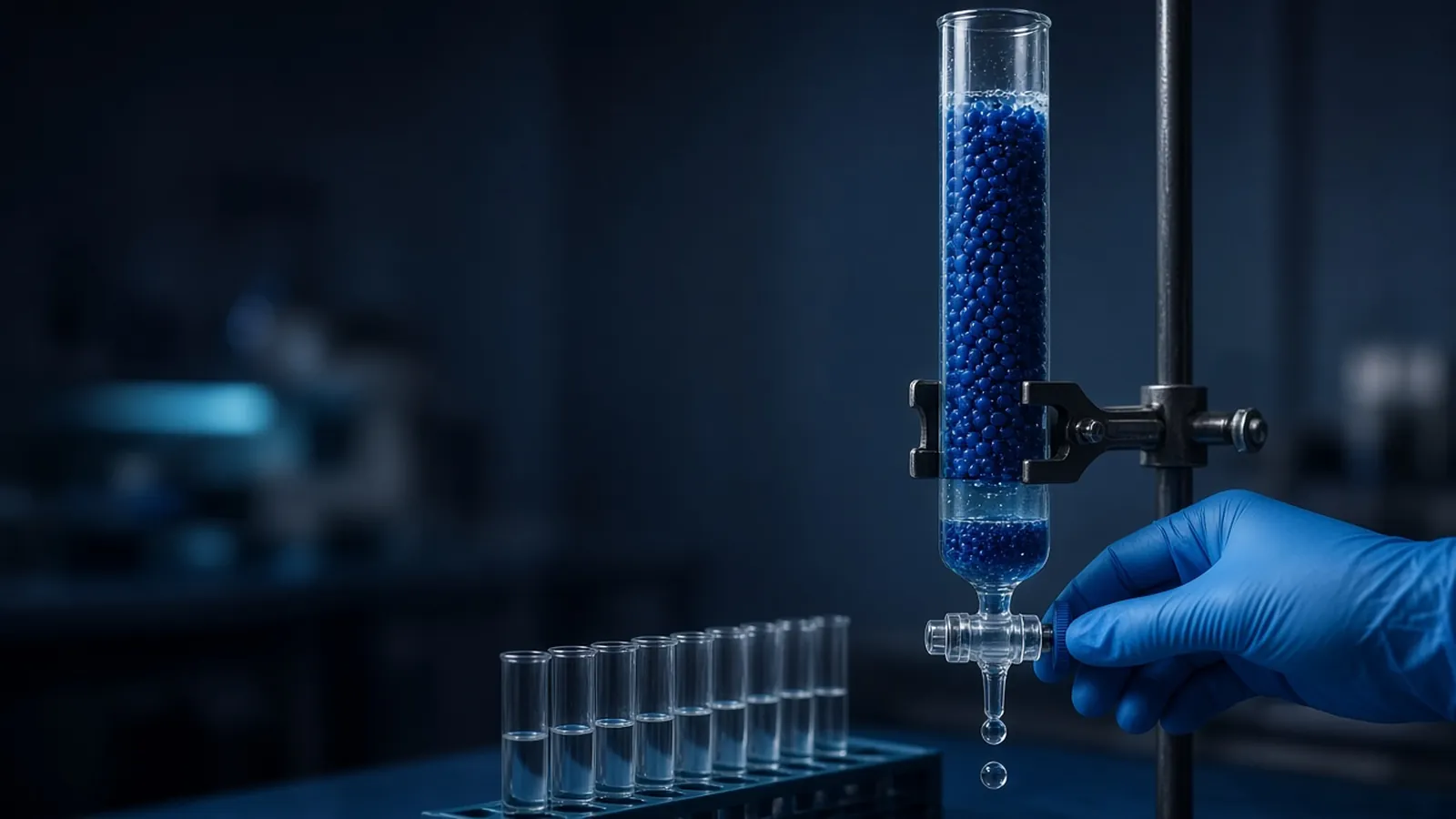 Affinity and ion-exchange protein purificationHow affinity capture and ion exchange pull a protein from a lysate, and why each collected fraction still needs an identity check.