
comparison
Contamination by bacteria yeast and mycoplasma
How bacteria, yeast and mycoplasma look different in a research culture, which signs you must not trust, and what a testing specification should name.
- Author
- EVRINTH Editorial Team
- Published
- 8 October 2026
- Updated
- 8 October 2026
- Reading time
- 8 min
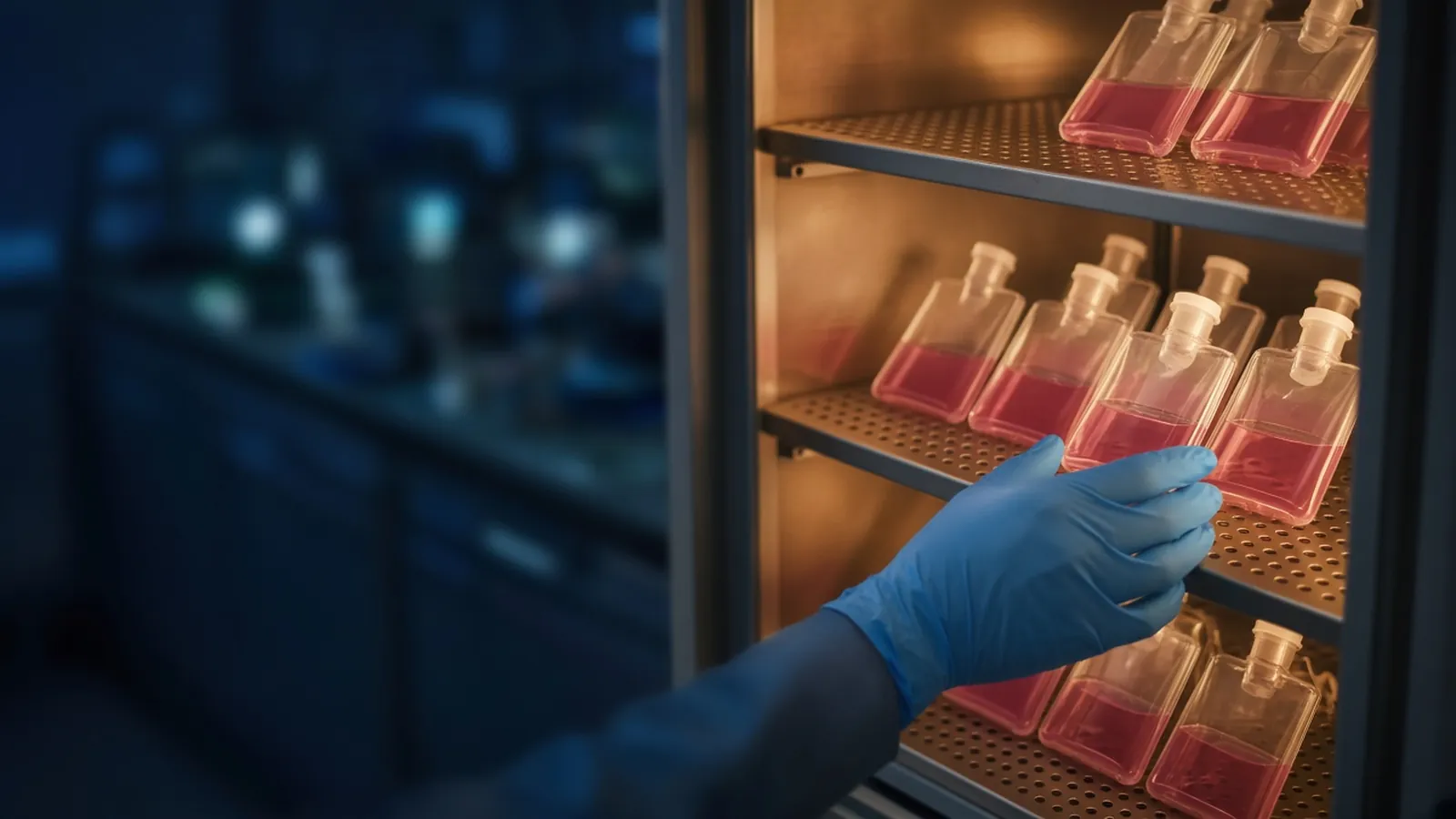
Bacteria, yeast and mycoplasma are three different failures that share a flask and not a signature. One clouds the medium by tomorrow. One may show particles and still be argued about. One leaves the medium clear and edits the biology. The decision this comparison supports is which observation you are allowed to trust, and what a testing practice has to include before a line shares an incubator. Culture basics are in mammalian cell culture for research labs. Containment language is in biosafety basics for research benches. This is research contamination control. It is not a clinical microbiology service and not a treatment plan.
Three organisms, three kinds of evidence
Bacteria that overgrow a mammalian flask are usually free-living contaminants from a bath, a pipette or a bottle, not the cell line's own flora. They often turn medium turbid within a day, push phenol red toward yellow by making acid, and under a high-power microscope appear as tiny rods or cocci, sometimes motile, far smaller than the mammalian cells. The mammalian monolayer may lift or look peppered with debris. That picture is urgent. It is still not a species name. You do not need a species name to remove the flask from the shared chamber.
Yeast is a fungus with a different pace. The medium may stay clearer than a bacterial bloom and still show grit when you swirl it. Under the microscope, budding oval cells, sometimes in short chains, sit among the mammalian cells and are easy to dismiss as debris if you have never been shown one. A filamentous mould is a further class: threads, often a colony you can see without a microscope once it is established. Odour is the cue people remember and the cue you must not use. Sniffing a flask is a bad habit and a poor assay. Do not write "yeast" in the book because the cabinet smelled like bread.
Mycoplasma is the one the eye will not convict. These bacteria lack a cell wall, pass filters that stop many other bacteria, and reach high densities without turbidity. Growth of the mammalian line slows or becomes fussy. Transfection and metabolic readouts drift. Morphology can look a little granular. Any of those signs also has innocent causes, which is why "it looks a bit sad" is not a mycoplasma result. Detection is a method class: PCR aimed at conserved mycoplasma sequences, culture on specialised broth and agar that can take weeks, or a DNA stain that shows extranuclear dots against a mammalian nucleus. Each misses something the others catch. A negative from a method you do not understand is not a clearance.
What you must not trust
Do not trust a clear medium as a mycoplasma test. Do not trust penicillin-streptomycin as a cure. Those antibiotics hit organisms with the pathways they inhibit, select resistant bacteria, and leave mycoplasma and fungi largely unbothered. A line "maintained on antibiotics" can be a line whose contamination is invisible until someone runs an experiment without them. Do not trust a 0.2 micrometre filter as a mycoplasma barrier. Some mycoplasmas pass pores that stop typical rod bacteria. Serum and incoming cell lines are classic sources for that reason. A certificate you have not read is not the same as a quarantine you actually ran.
Do not trust confluence. A contaminated culture can be sparse because it is dying, or dense because you have been scoring yeast as mammalian cells. Passage number does not immunise a line. An old passage and a new thaw can both be dirty. Authentication, the subject of cross-contaminated identities, is a different problem from infection. A line can be the right name and still carry mycoplasma, which is why registers such as ICLAC do not replace a contamination assay.
A comparison you can put in a method
| Class | What you may see | What you must not trust | A research response |
|---|---|---|---|
| Bacteria | Turbidity, fast acid shift, tiny motile or non-motile bodies | Smell, or "it might clear" | Remove from the shared incubator, discard under local rules, check neighbours and open media |
| Yeast | Grit, budding ovals, sometimes a slower pH change | Bread-like smell, debris excuses | Same removal. Do not add antifungal and return the flask to the shared shelf |
| Mould | Threads, a spot you can see late | A single wiped cap | Treat the chamber as exposed until cleaned under the SOP |
| Mycoplasma | Clear medium, subtle growth or assay drift | Your eyes, routine pen-strep | Test by a named method, quarantine newcomers, do not rescue by adding more antibiotic |
Quarantine and a testing cadence
A new line, a new serum lot used on a precious culture, and a flask that shared a cabinet with a bloom do not go straight into the general incubator. Quarantine means a separate chamber or a written physical separation, plus a test, plus a person who is allowed to say no. The cadence belongs in the method: test at receipt, test before a freeze you will trust later, and test on a schedule the laboratory writes rather than when a figure looks odd. Collection guides such as the ATCC culture guides describe testing as part of responsible maintenance. They do not pick your week for you.
Branch if bacteria or yeast are obvious. Do not wait for PCR. Isolate the flask, tell the people who share the room, discard under the biosafety rules, and clean what those rules name. Check the medium bottle that fed it. A contaminated bottle explains five flasks at once. Branch if the culture is merely slow. List medium, carbon dioxide, confluence and passage before you buy a test, then run the test anyway if the schedule is due. A negative PCR with a failed positive control is not a negative. Repeat the assay or send it to someone who runs the controls.
Rescue kits exist in the research market. Using one on a replaceable line, inside a shared facility, trades a short convenience for a longer outbreak. If a line truly cannot be replaced, the rescue is a documented exception, done away from the clean incubator, followed by a test that passes. It is not a quiet addition of antibiotic over a weekend.
Antibiotics and false comfort
Routine antibiotics change the comparison. A laboratory that always includes them will under-call bacteria and will not gain a mycoplasma safety net in exchange. Run at least some maintenance without them so a contaminant can become visible, and keep the mycoplasma method on the calendar regardless. Antifungal additives are toxic to the mammalian cells at doses near their useful range. They are not a seasoning. The selection problem is developed as its own decision elsewhere. Here the point is narrower: antibiotics are not one of the three detection methods.
Disposal is an institutional rule
A contaminated culture is biological waste under the local risk assessment, not a bottle to rinse in the sink. Disinfectant, contact time and whether autoclaving is required are written locally. The WHO Laboratory Biosafety Manual is a reference for writing those rules. Citing it does not authorise a particular room. Do not take a turbid flask into a teaching bench to "show everyone". Show a photograph. This article is not medical advice and does not identify an infection in a person.
Humid rooms, water baths and power cuts
Warm, humid buildings grow the organisms that then enter flasks. A water bath used to warm medium is a frequent source: bottles go in wet and come out dripping into the cabinet. Dry them. Change the bath on a schedule. An incubator pan with a film is a source sitting under every experiment. Power cuts that force flasks out of a dead incubator and onto a crowded bench multiply handling. Note the excursion, and do not restack unlabelled rescue flasks into the clean chamber the moment the power returns. None of this needs a climate percentage. It needs a dry bottle and a pan someone looks at.
What to ask for when you specify a test
Say which method class you need, which organisms it must cover, whether a positive control is supplied, how long culture-based methods take, and that the use is research. Ask whether the assay claims mycoplasma specifically or "bacteria" in a way that will miss them. State that you will quarantine until the result is in. Use the quote request to ask whether a quotation is possible, and point at the laboratory consumables catalogue only for the plastic the assay also consumes. The academic research reference is a separate page for a laboratory framing the wider need. A family name on a bottle is not a method. A method can be discussed from the controls and the organism list. Nothing here says a test is sitting on a shelf waiting.
Questions from the bench
If the medium is clear, can I skip mycoplasma testing?
No. Mycoplasma does not make a flask turbid. A clear monolayer can be heavily colonised and still look like a quiet culture with slightly odd growth. Clarity is a screen for some bacteria, not a mycoplasma assay.
Will penicillin and streptomycin clear a contaminated line?
They suppress some bacteria and leave a resistant remainder, and they do not reliably clear mycoplasma or yeast. Adding more antibiotic to a cloudy flask hides the problem from the notebook and keeps a risk in the shared incubator. The usual research decision is to discard under local rules.
Is a smell enough to name the organism?
No. People describe yeasty or sour odours, and those descriptions are not an identification. Work in the cabinet, do not sniff cultures as a method, and use microscopy plus the assay class your laboratory has chosen.
What belongs in a testing-reagent specification?
Name the method class, such as PCR, specialised culture or a DNA-stain approach, the organism range the assay claims, the positive and negative controls, and whether the work is research use. Ask for that scope in writing. Do not accept a product family name as a test.
References
Manufacturer names identify published method classes. Trademarks remain with their owners. Catalogue records on this site are independent references for enquiry. They are not a statement of inventory, distribution rights or a supply commitment. This page is educational. It is not medical advice, a diagnostic protocol or a biosafety approval.
Catalogue
Related products and categories
These links follow the subject of the article into published manufacturer references. A listing is a reference for an enquiry, not a statement of stock or distribution rights.
Continue in this cluster
Related reading
Mammalian cell culture for research labsHow research labs keep mammalian cell culture workable: medium, aseptic technique, confluence, passage records and contamination checks. Biosafety basics for research benchesResearch-bench biosafety is a stack of barriers chosen by a risk assessment. This page explains the stack. It does not approve the work.A glossary of culture termsPairs of culture words that laboratories mix up, and the wrong next action each pair causes, from confluence versus density through to confluent versus