
comparison
Endotoxin is a separate question from purity
Why a clean SDS-PAGE lane leaves endotoxin unmeasured, when an LAL-class assay is the right extra question, and why removal is its own process.
- Author
- EVRINTH Editorial Team
- Published
- 8 October 2026
- Updated
- 8 October 2026
- Reading time
- 7 min
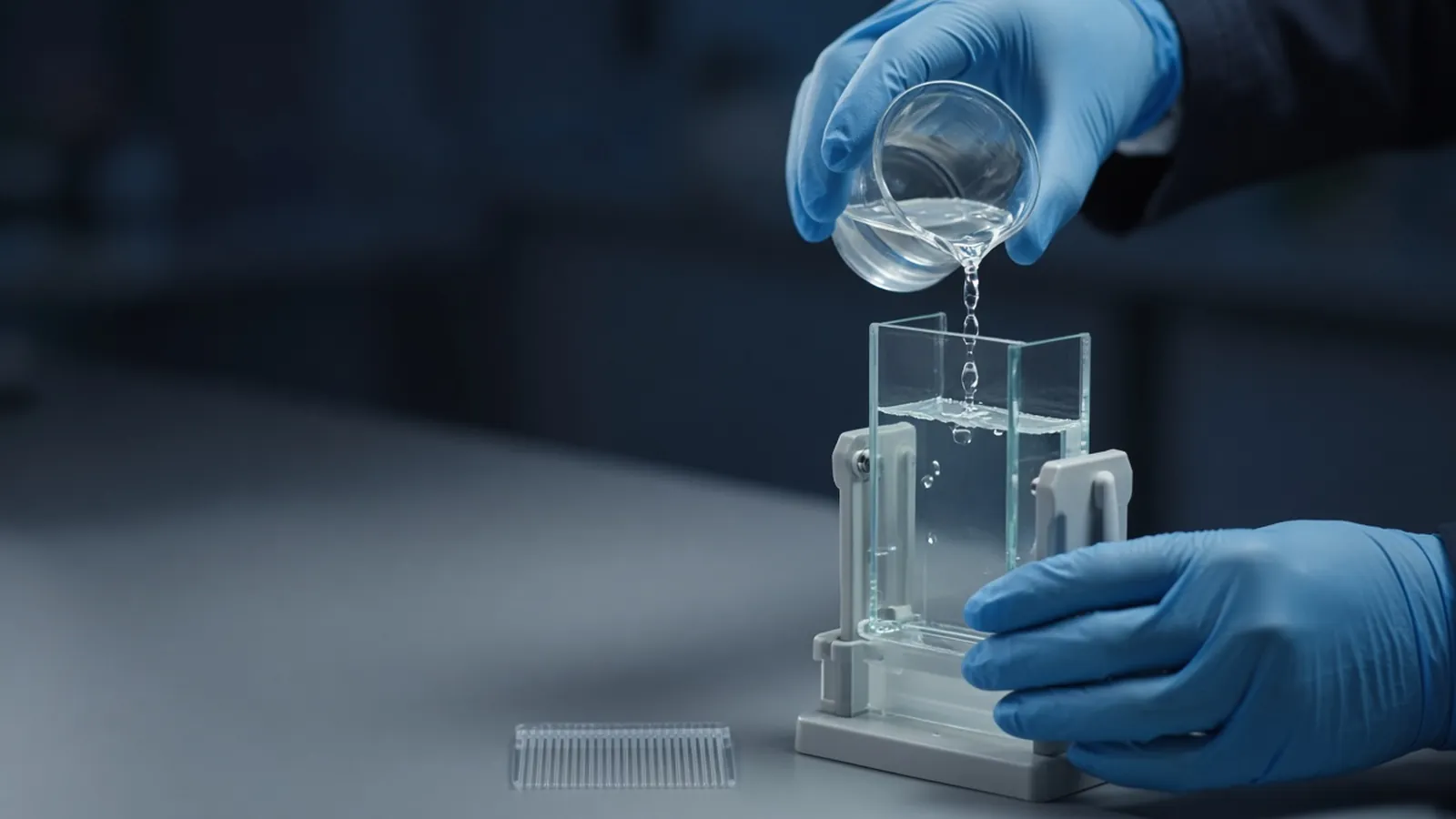
Endotoxin, in bacterial protein work, means lipopolysaccharide from the outer membrane of Gram-negative cells. It is a potent stimulus for some biological assays and an invisible passenger on an SDS-PAGE gel. A lane can be one band wide and still carry enough LPS to dominate a cell experiment. This comparison keeps the gel question and the endotoxin question apart. It is a research explainer, not a release specification and not a clinical method.
How to read the lane you do have is in reading a protein gel. Why the host puts LPS in reach of the protein is in expression hosts in outline. Where the question belongs in a brief is in questions for a protein expression enquiry.
Two measurements that share a tube
Polypeptide purity asks whether the stained protein is mostly the chain you named. You answer it with a gel, sometimes with chromatography and intact mass. Endotoxin asks how much LPS activity is in the same volume. LPS is a glycolipid. Coomassie and typical protein stains do not report it. Silver stains and protein gels are still the wrong instrument. A Bradford or BCA number can be high because protein is high, while saying nothing about LPS. People combine the sentences because both feel like "cleanliness". They are different contaminants.
Host choice sets the prior. E. coli and other Gram-negative bacteria bring LPS with the biomass. Yeast, insect and mammalian hosts do not make bacterial endotoxin. They bring other impurities. Switching host to avoid LPS is rational when the assay is sensitive and the protein can fold in the new host. It is wasteful when the assay is a biochemical interaction that has no LPS-sensitive step. Inclusion bodies washed from E. coli can look pure on a gel and still be associated with LPS. Washing removes some of the bacterial soup. It is not an endotoxin method unless you measured the result.
Assay classes, not a single number from a blog
The Limulus amebocyte lysate family, LAL, has been the classical activity assay for endotoxin. Recombinant factor C assays use a recombinant enzyme from that cascade so the readout does not depend on a lysate prepared from the animal. Both are classes. Inside each class, kits differ in range, in whether they are kinetic or endpoint, and in which buffer components inhibit them. Chelators, detergents, high salt and some chaotropes disturb the reactions. A number from a buffer the kit forbids is not a low endotoxin result. It is an invalid run.
Spike recovery is the control that makes the class honest. You add a known endotoxin spike to the sample and ask whether you get it back. Poor recovery means the matrix hid the signal. A low reading with poor recovery does not clear the sample. It tells you to dilute within the kit's range or to change the sample buffer before you claim anything. Follow the insert. This page will not invent a dilution series.
Units and limits are specification language. A research project may set its own acceptance number for a particular assay. Copying a pharmacopoeial limit into a student project does not create a pharmaceutical process. If your cells respond at a certain spike of LPS, that spike is the empirical clue for your readout. It is still not a universal safe threshold, and this article will not invent one.
Removal is a process that can spend the protein
Taking LPS out is not the same as measuring it. Phase separation with a detergent such as Triton X-114 has been used as a research class because LPS partitions into a detergent-rich phase. Chromatography on resins sold for endotoxin binding, and anion-exchange steps that LPS sticks to under conditions where your protein may also stick, are other classes. Each one can work and each one can strip your protein, especially if the protein is acidic or hydrophobic. Yield after removal is part of the result. A tube that passed an assay and lost the band is not a successful prep.
Removal also reintroduces the detergent problem. A phase-separation detergent that remains in the protein will matter if the next step is mass spectrometry or a detergent-sensitive enzyme. Plan the polish. Water, tips and tubes can add endotoxin back after a careful column. Plastics and buffers labelled for the purpose are a reagent class. Autoclaving does not reliably destroy LPS the way it kills bacteria. A sterile cloudy buffer can be sterile and still be loaded with endotoxin.
Because removal costs protein and time, ask it only when the biological readout is endotoxin-sensitive. Cell cultures, some primary-cell assays, and some animal research readouts fall in that group. An EMSA, a gel filtration of a folded domain, or a crystallisation screen often does not. Write the reason in the notebook so the next batch is prepared to the same specification, or deliberately to a looser one.
| Question | What can answer it | What cannot |
|---|---|---|
| Is the polypeptide one band? | SDS-PAGE with a marker, loaded fairly | An LAL number |
| How much protein is in the tube? | Bradford, BCA or A280, named properly | An endotoxin assay |
| Is bacterial LPS low enough for this readout? | LAL or recombinant factor C, with spike recovery | A clean gel or a sterile filter |
| Did removal succeed? | Assay before and after, plus a gel of yield | The fact that a column was run |
| Will cells see this protein? | Your experimental design | A host name alone |
Failure modes in the claim
The loud failure is "gel-pure, therefore endotoxin-free", followed by a cell assay that responds to the buffer. Include a protein-free buffer control that has seen the same columns and plastics. If the buffer alone stimulates the cells, the protein is not the variable you think it is.
The quiet failure is a removal step that was never assayed. The column was run, the yield felt low, and the LPS status is unchanged in the record. Assay the material you will actually add to the cells, not a previous batch.
The third failure is measuring endotoxin in a denaturing buffer the kit cannot read, getting a conveniently low number, and dialysing into PBS afterward with ordinary labware that puts LPS back. Measure at the buffer the cells will see, with the plastics you will use.
Research use and institutional safety
LPS is a reagent hazard as well as a contaminant. Weighing purified endotoxin for a spike belongs in the chemical and biological risk assessment of the laboratory. This article does not authorise animal work, clinical testing, or a claim that a sample is safe for people. Bacterial lysates are handled under the host's biosafety rules. A low endotoxin result does not lower a biosafety level.
Water, plastics, and a humid autoclave room
Buffers made with poor water, or stored warm in a bottle that was only autoclaved, are a common way to import LPS into a protein that was carefully grown. In a humid building, bottles sit damp and labels fail. Use the water quality your endotoxin-sensitive step requires, keep containers closed, and do not top up a sterile bottle with a non-sterile pipette. A power cut during a long chromatography run can hold protein and LPS together on a resin while the column warms. That fraction is a new sample. Assay it if endotoxin is part of the specification. Do not assume it matches the previous elution.
What to put in the enquiry
State the host, whether the readout is endotoxin-sensitive, the assay class you want reported, and that a gel is still required for the protein. Say if removal is in scope, and what yield loss would make the process pointless. Reagent classes for buffers and chromatography sit in the reagents and chemicals catalogue. Expression and any agreed cleanup can be discussed through the custom protein expression enquiry reference. Put the endotoxin line in the quote request only when it changes the work. A research number from that work remains a research number.
Questions from the bench
Can a single Coomassie band be full of endotoxin?
Yes. Lipopolysaccharide is not a polypeptide stain. A lane can show one protein band while the tube still carries LPS from the bacterial host or from contaminated buffers. Purity on a gel and endotoxin burden are different measurements.
What is the difference between LAL and recombinant factor C at the level of choosing a class?
Both are research assay classes used to detect endotoxin activity. LAL is the amoebocyte-lysate family. Recombinant factor C is an enzyme-cascade alternative that avoids relying on the animal lysate. Which class you run, and which interferences your buffer triggers, belong to the kit insert and the facility.
Does every protein from E. coli need endotoxin removal?
Removal is justified when the next readout is sensitive to LPS, such as many cell-based experiments. A binding assay or a crystal trial may not ask the question. Removing endotoxin can also lose protein, so it is a planned process rather than a default adjective.
Is an endotoxin number a clinical release certificate?
A research assay result supports a research decision about that sample. Clinical or pharmaceutical release sits under a separate quality system, specification and legal framework. Do not paste a research LAL value into that role.
References
Manufacturer names identify published method classes. Trademarks remain with their owners. Catalogue records on this site are independent references for enquiry. They are not a statement of inventory, distribution rights or a supply commitment. This page is educational. It is not medical advice, a diagnostic protocol or a biosafety approval.
Catalogue
Related products and categories
These links follow the subject of the article into published manufacturer references. A listing is a reference for an enquiry, not a statement of stock or distribution rights.
Continue in this cluster
Related reading
Reading a protein gelHow to read a protein gel: what SDS-PAGE bands, smears, ladders and loading differences can support, and what they cannot identify.Expression hosts in outlineHow to choose E. coli, yeast, insect or mammalian expression from disulfide bonds, glycosylation and the yield the work needs.Questions for a protein expression enquiryThe sequence, tag, host, modification, purity evidence, endotoxin need and assay buffer a protein expression enquiry has to carry.