
protocol overview
Questions for a protein expression enquiry
The sequence, tag, host, modification, purity evidence, endotoxin need and assay buffer a protein expression enquiry has to carry.
- Author
- EVRINTH Editorial Team
- Published
- 8 October 2026
- Updated
- 8 October 2026
- Reading time
- 9 min
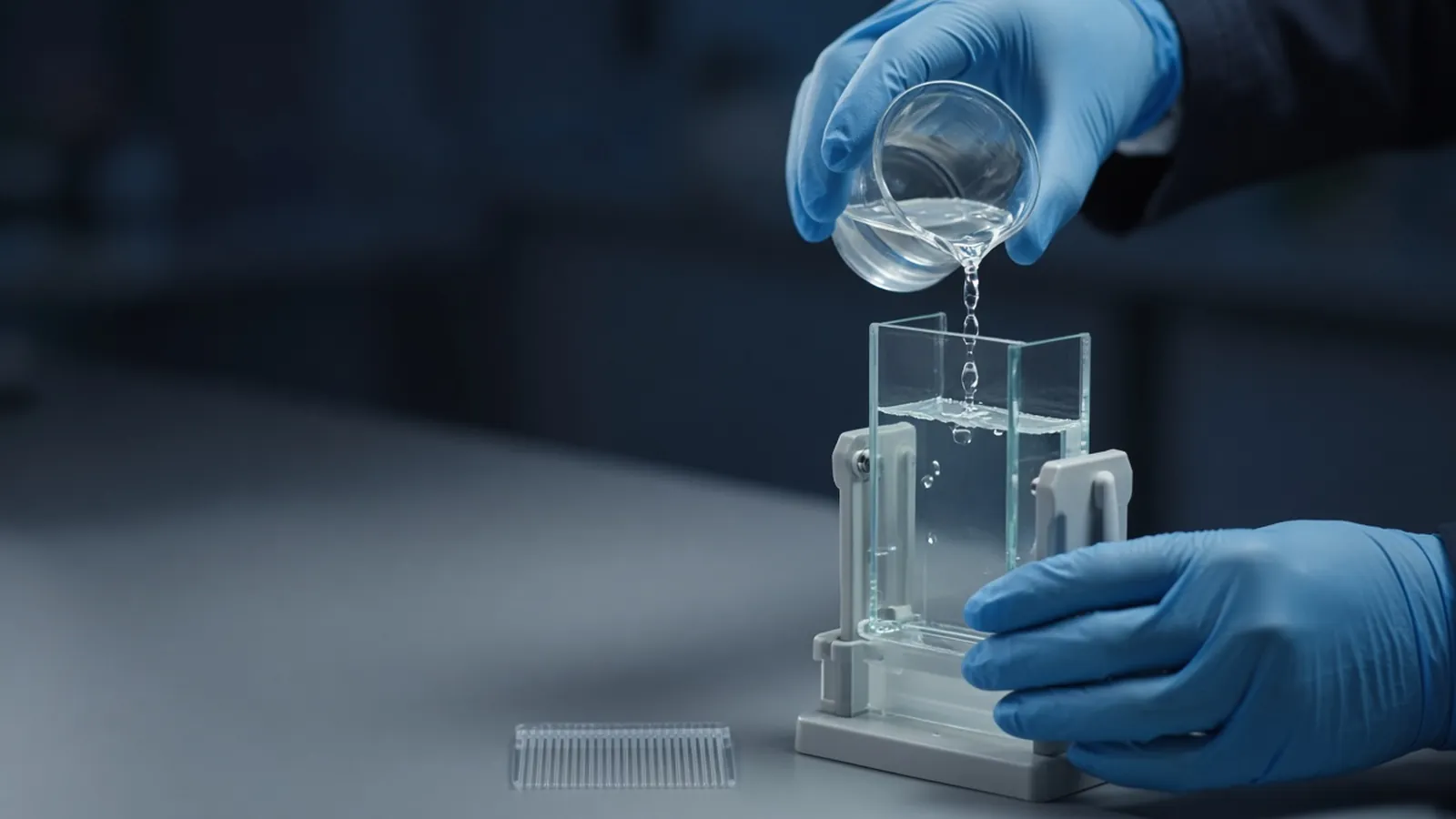
A useful protein-expression enquiry reads like a methods paragraph. It names the molecule, the host constraints, the evidence that will count as success, and the buffer the protein must finally sit in. A catalogue adjective cannot do that work. This overview is the question list to assemble before you ask anyone to express and purify a research protein. It does not invent a product code, and it does not set a price.
How a returned gel should be read is in reading a protein gel. How host constraints narrow the list is in expression hosts in outline. When to add an endotoxin line, and when to leave it out, is in endotoxin is a separate question from purity.
Sequence first, name second
Start with the amino-acid sequence. A public accession on UniProt is a good anchor if you also state the isoform and the residue numbers you want expressed. Domain fragments, secreted ectodomains, and full-length membrane proteins are different campaigns. Signal peptides that belong to the native protein may need to stay, to be replaced, or to be removed, depending on the host. Write that choice down. If you already hold a plasmid, say so, and say whether it has been sequenced. A map screenshot is weaker than the sequence file.
Tags are part of the molecule. Histidine tags for IMAC, GST or MBP for solubility and capture, and small epitope tags for detection each change purification and sometimes folding. State the terminus, the linker, and whether a protease site must be used to remove the tag. "His-tagged" without an end is an incomplete sentence. If the tag must remain because your assay detects it, say that too. Removing a tag and then asking for the tag as a detection handle is a contradiction the enquiry should not contain.
Mutations belong in the same paragraph as the wild-type sequence. A point mutant is a new protein. So is a fusion. Align what you send with what you will publish, so the tube and the figure match.
Host preference is a reason, not a logo
Say which host you prefer, and the reason: disulfide bonds, glycosylation, speed, or experience with that system. If you have no preference, say which constraints are mandatory and let the host follow, as the host outline describes. Bacterial expression of a heavily disulfide-bonded extracellular domain needs an explicit acceptance that inclusion bodies or a periplasmic route may be the outcome. Mammalian expression of a simple cytosolic protein needs an explicit reason, because the time and the yield profile differ.
Codon optimisation, if you want it, is a hypothesis about the DNA, not a promise of soluble protein. Say whether you need the natural coding sequence for a specific experiment. Silence on that point lets someone rewrite the gene in good faith and hand you a different nucleic acid than the one in your protocol.
Amount is a use
Describe what you will do with the protein. A pilot to see a band and try a pull-down might be a small mass. A series of binding curves or a batch of labelled protein might be more. Use words such as a small pilot quantity or a larger biophysical quantity, tied to the assay, and avoid turning the sentence into a commercial negotiation inside the scientific brief. The quote request is where the practical reply belongs. Do not invent a catalogue number to make the amount sound precise. If you know a mass range from a previous prep of the same construct, you may say what previously sufficed for that assay. That is experience, not a SKU.
Purity travels with amount. A large mass of a crude elution and a small mass of a single-band pool support different experiments. Ask for the purity evidence you will actually use, so nobody concentrates a dirty pool to hit a mass target.
Evidence you can look at
The default evidence is an SDS-PAGE image with a marker, the fraction named, and enough of the neighbouring fractions or the lysate to show enrichment. State whether the sample should be reduced. A single cropped band with no marker is not the evidence to request. If identity matters beyond "a band at the expected size", ask for intact mass, and say the expected mass including the tag and any modifications you intend. Peptide mapping is a different, heavier ask. Request it when a band and an intact mass would still leave a dangerous ambiguity, not as decoration.
Function is evidence when the protein must do something. Name the assay in plain language: it must bind this partner, or it must turn over this substrate, under a buffer you specify. A binding protein with no binding test can be a pure, inactive polypeptide. An enzyme with only a gel can be the same. If you cannot send a protocol, send the substrate class and the readout. Keep the assay description at decision level.
Quantification method belongs in the evidence list. A Bradford BSA-equivalent and an A280 from a coefficient are different numbers. Say which one you want reported, in line with how laboratories estimate protein concentration.
Endotoxin, only as its own line
Add an endotoxin question only when the biological readout is sensitive to lipopolysaccharide. Name the assay class you expect, such as LAL or recombinant factor C, and what decision the number supports in your research. Leave the line off when the protein will be used in a biochemical assay that is indifferent to endotoxin. Removal can lose protein and change the buffer. It should be a requested process, not a default adjective. Nothing in this list is a clinical release certificate.
The buffer is part of the product
The downstream assay fails in the wrong buffer even when the protein is excellent. Write pH, the buffer ion, salt, glycerol if you need it, reducing agent if the protein requires it, and detergents that must be absent. A mass-spectrometry user should say so, because SDS and Tween are not innocent leftovers. A kinase assay may need a reductant the gel sample also uses, or may be killed by a protease inhibitor left over from lysis. State what must be present and what must be absent. Point at the habit in preparing a buffer and checking pH: pH with the temperature of measurement.
Storage is the last buffer question. State whether you can accept a frozen aliquot and at what temperature your freezer sits, following storing biological samples from fridge to freezer. A protein that must stay at 4 °C because freeze-thaw kills it is a different handoff from a protein that is aliquoted and frozen.
Branch when the brief is too thin to answer
If you lack the sequence, stop and retrieve it. An enquiry on a gene symbol produces the isoform the other person guesses. If you lack a host reason, send the disulfide and glycan constraints instead of a guess. If purity evidence and function disagree in your own mind, decide which one accepts the tube. A pure inactive protein and an impure active fraction are both legitimate requests. They are not the same request. If endotoxin status is unknown because the assay is new, say that the first delivery is for biochemistry and that a later lot may need an endotoxin class. Splitting the brief is cleaner than demanding every specification on a pilot.
| Field | A complete answer | Too thin to brief |
|---|---|---|
| Molecule | Sequence or accession, residues, mutations | Gene symbol only |
| Tag | Type, terminus, cleave or keep | "Tagged" |
| Host | Preference plus disulfide and glycan needs | "Whatever is easiest" with no constraints |
| Amount | Use in the assay | A catalogue code you made up |
| Evidence | Gel with marker; intact mass or activity if needed | "Pure" |
| Endotoxin | Required or not, and why | Assumed from a clean gel |
| Buffer | pH, salts, required additives, banned detergents | "PBS" when the assay is not PBS |
| Function | Bind, catalyse, or serve as antigen, as applicable | Silence, then a failed assay later |
What a thin reply should send you back to ask
If a response offers a host and no gel criterion, ask for the evidence. If it offers a mass and no buffer, ask which buffer. If it offers endotoxin language and you do not need it, remove it so the process stays matched to the assay. If it asks you for a SKU you do not have, return to the sequence. Research expression is specified by molecule and evidence.
Safety, ownership, and research use
Say whether the protein is toxic, infectious as a complex, or from a regulated organism. Institutional biosafety sits with the laboratory that will grow the host. This question list does not approve diagnostic production, clinical release, or work outside the approvals you already hold. Sequences from human donors can carry separate governance. Flag that governance in the brief so it is not discovered after the culture is growing.
Specification writing when the work happens elsewhere
A brief that leaves your building has to survive without your memory. Heat, delayed flights and a different word for the same buffer are ordinary. Write concentrations and pH in the file. Attach the sequence as text, not only as a photograph of a whiteboard. If a power cut or a shipment delay is likely to matter for a living starter culture, send DNA or a described plasmid rather than a thawed cell pellet, and say how the archive was stored.
Where the questions go
Gather the fields in the table and send them as one enquiry. The custom protein expression and purification page is the reference for discussing that scope. It is an enquiry path. The laboratory that takes the work is the one that will say what it can do. Buffer components and related reagent classes can be sourced against the reagents and chemicals catalogue. Submit the scientific brief with the quote request, including sequence, tag, host constraints, evidence, endotoxin yes or no, the assay buffer, and what the protein must do.
Assemble a protein expression enquiry a laboratory can answer
- 01Attach the sequence and the tag planInclude the amino-acid sequence or a public accession, and say whether a tag is required, which end it sits on, and whether it must be removed. A gene name alone leaves the construct undefined.
- 02State host, modifications, and the job the protein must doRecord disulfide and glycosylation needs, any host you prefer, and the activity or binding the protein must show. Yield follows that job.
- 03Name the purity evidence and the downstream bufferAsk for a gel with a marker, and for intact mass only if identity depends on it. Write the pH, salt, additives and detergent limits of the assay the protein will enter.
- 04Say whether endotoxin matters, as a use rather than a priceRequest an endotoxin assay class only when the biological readout is sensitive to it. Describe the amount as what the experiment will consume, and send the brief through the quote path.
Questions from the bench
Is a protein name enough to start an expression enquiry?
A name such as a gene symbol points at a family, not at a construct. Isoforms, domain boundaries and tags change the molecule. Attach the sequence or an accession and the exact residue range.
How do I describe the amount without discussing price?
Describe the use. Enough for a gel and a pilot binding assay is a different brief from enough for a biophysical campaign. The laboratory that replies can then talk about scale. The scientific sentence stays in mass and purpose.
Should every enquiry demand endotoxin removal?
No. Endotoxin testing and removal are extra processes that can lose protein. Ask for them when cells or another sensitive readout will see the sample. A gel specification does not include that number.
What purity evidence is reasonable to request up front?
A Coomassie-stained gel with a marker, loaded beside the stated fraction, is the usual first evidence. Intact mass is the right addition when you must show the chain is full length and the tag is on or off. Activity belongs in the brief when function is the acceptance test.
References
Manufacturer names identify published method classes. Trademarks remain with their owners. Catalogue records on this site are independent references for enquiry. They are not a statement of inventory, distribution rights or a supply commitment. This page is educational. It is not medical advice, a diagnostic protocol or a biosafety approval.
Catalogue
Related products and categories
These links follow the subject of the article into published manufacturer references. A listing is a reference for an enquiry, not a statement of stock or distribution rights.
Continue in this cluster
Related reading
Reading a protein gelHow to read a protein gel: what SDS-PAGE bands, smears, ladders and loading differences can support, and what they cannot identify.Expression hosts in outlineHow to choose E. coli, yeast, insect or mammalian expression from disulfide bonds, glycosylation and the yield the work needs.Endotoxin is a separate question from purityWhy a clean SDS-PAGE lane leaves endotoxin unmeasured, when an LAL-class assay is the right extra question, and why removal is its own process.