
guide
Preparing a buffer and checking pH
Prepare a buffer at a stated pH and temperature, record the salt form, and treat a drifting electrode or a bad slope as a failed control.
- Author
- EVRINTH Editorial Team
- Published
- 8 October 2026
- Updated
- 8 October 2026
- Reading time
- 11 min
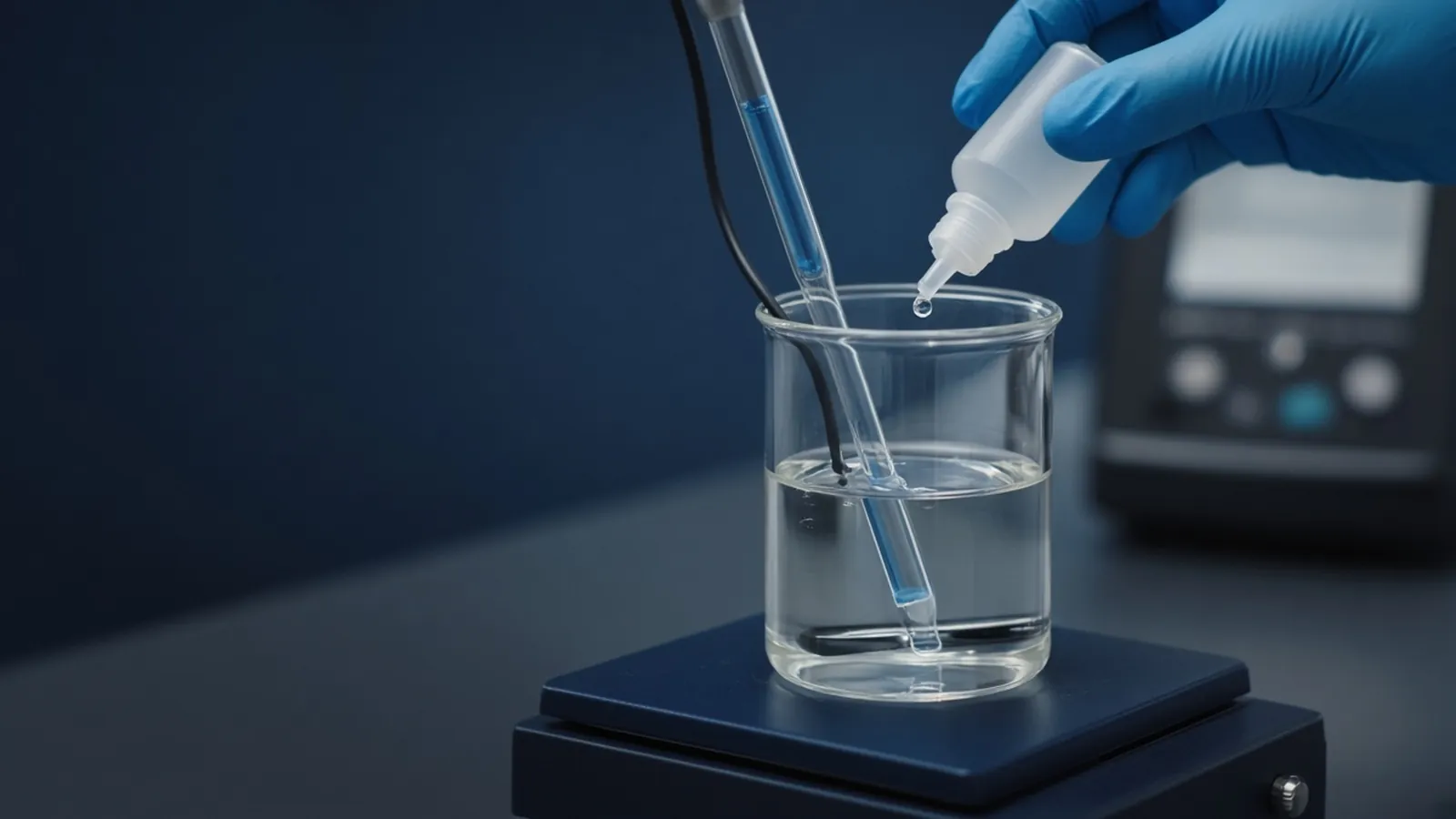
Preparing a buffer and checking pH is the quiet step that decides whether next month's assay is the same assay. A buffer is not a bottle of "pH 7.4" in the abstract. It is a weak acid and its conjugate base, in a named salt form, at a concentration, a temperature, and an ionic strength, made in a water grade you can defend. This page is the working guide. The reasons a water grade passes a meter and still ruins the buffer are in laboratory water types and where they fail.
Salts and acids are ordered from the reagents and chemicals catalogue. Mixing vessels are in beakers and flasks. The final volume belongs in volumetric glassware. Send the specification, including the salt form, with a quotation request.
Who this preparation is for
Use this workflow when an enzyme, a binding reaction, a chromatography mobile phase, or a culture reagent depends on pH or on the ions that travel with the buffer. The decision you are supporting is whether this batch may be used, and whether a later batch can be made again from the notes. If the downstream method only needs "some salt water" and nobody will interpret a rate, a coarser preparation can be honest. Write that down too, so the coarse bottle is not later promoted.
The equilibrium you are setting
A buffer resists pH change because added acid or base is consumed by the conjugate pair. Capacity is highest near the pKa of that pair and becomes poor more than about one pH unit away. Choosing a buffer whose pKa sits near the working pH is the first design choice. Tris, phosphate, acetate, and the family of zwitterionic buffers associated with Good each cover different windows and bring different side effects.
The Henderson–Hasselbalch relationship is the planning sketch: pH sits near the pKa when the two forms are present in similar amount, and it moves as their ratio moves. It is a sketch, not a licence to skip the meter. Activity coefficients, temperature, and the ionic strength of the real mixture move the pH you measure away from the textbook ratio. You still weigh, dissolve, and measure.
Ionic strength is the charge environment. It is not the pH. A 10 millimolar Tris hydrochloride and a 10 millimolar Tris hydrochloride plus 150 millimolar sodium chloride can be set to the same pH and behave differently in a nucleic-acid hybridisation or an ion-exchange step. Conductivity is one way to notice a gross salt error. It does not replace the pH reading, and the pH reading does not replace a conductivity specification when the method wrote one.
Salt form, water, and the order of operations
Write the hydrate on the recipe. Sodium phosphate dibasic anhydrous and its heptahydrate are different masses for the same molarity. Tris base and Tris hydrochloride are different starting points and leave you with a different counter-ion if you adjust them carelessly. "Phosphate buffered saline" from two laboratories is the same buffer only when both recipes name the salts.
Choose the water using the water page. Ordinary buffers tolerate a fresh analytical grade. A buffer that will touch a trace assay, a nuclease-sensitive enzyme, or a chromatograph needs the grade that assay already demanded. Equilibrate the water so you are not dissolving salts into a cold or hot aliquot and then measuring pH at yet another temperature.
Dissolve the components in a volume well short of the final volume. A common habit is to start near eighty percent of the final volume in a beaker that can be stirred. Let the salt dissolve completely. Hygrscopic solids that are still a slurry will finish dissolving later and shift both concentration and pH. Bring the solution to the temperature at which you will report the pH.
Calibrate the meter before you touch the sample with acid or base. Then adjust, slowly, with the acid or base that belongs in the recipe. For a Tris buffer, adding hydrochloric acid or starting from the hydrochloride salt is a composition decision, because sodium hydroxide would import sodium. Stir, wait, and believe the reading only after it has settled. Make up to the mark in a volumetric flask once the pH is right. If you adjust pH after making up to the mark, the concentration is no longer what you calculated.
The meter is a control, not a decoration
A pH electrode is a hydrogen-ion-selective glass and a reference junction. It works when the glass is hydrated, the junction is flowing, and the meter has just been taught what two or three standard buffers look like. Those standards should bracket the pH you are aiming at. A calibration at pH 4 and pH 7 is a weak preparation for a pH 10 buffer.
The slope of that calibration is the control. A healthy electrode has a slope near the theoretical Nernstian response. Laboratories set a window. If the slope is outside the window, stop. Replace the storage habit, the filling solution, or the electrode. Do not "make the buffer read 7.40" on a meter that cannot read the standards. You would be baking the electrode's error into every bottle.
Rinse between standards. Blot, do not wipe the bulb into a static charge. Keep the filling hole open during measurement if the electrode is built that way, and closed during storage if the instructions say so. Store the electrode wet, in its storage solution. Dry storage, and storage in ultrapure water, are how slopes die.
Temperature compensation on the meter corrects the electrode's electrical response. It does not cancel the chemistry of Tris. The buffer molecule itself changes pKa with temperature. Compensation is not a time machine that makes a room-temperature adjustment equal a cold-room adjustment. NIST's calibration resources are a public reminder that pH standards and the meters that read them belong to a metrology procedure. Use fresh standards. A beaker of pH 7 that has been open all week has been exchanging carbon dioxide with the room.
Branch points
If the slope fails, you do not have a pH yet. Stop the preparation, fix the meter, and restart the adjustment on a solution that has not been over-titrated back and forth. Each overshoot adds salt.
If the reading drifts and will not settle, suspect a blocked junction, a dried bulb, carbon dioxide dissolving into a weakly buffered or alkaline solution, or a magnetic bar warming the beaker. Alkaline buffers are especially eager to acidify in open air. Measure with the vessel covered as far as the electrode allows, and do not leave the bottle uncapped on the bench.
If the assay failed and the bottle still reads the target pH, suspect the salt form, the temperature difference between preparation and use, the water, or a contaminant the pH meter cannot see. Conductivity, if you have a meter and a historical value for that recipe, will catch a tenfold salt error. It will not catch a nuclease.
If you must autoclave the buffer, expect some compositions to shift. Tris moves. Sugars caramelise and do not belong in the autoclave with the salts if the method can add them afterwards through a filter. Recheck pH after the bottle has cooled to the reporting temperature. A reading taken in a hot bottle is a different number.
Choosing among common buffers
| Buffer class | Useful habit | A failure mode if you ignore it |
|---|---|---|
| Tris | Set pH at the temperature of use | A room-temperature pH 7.4 becomes a different pH in a warm assay |
| Phosphate | Convenient and comparatively quiet with temperature | Precipitates with calcium or magnesium and ties up metals an enzyme needed |
| Zwitterionic buffers such as HEPES | Useful near physiological pH with less temperature swing than Tris | Not automatically inert; check the assay, and do not assume the name is a method |
| Carbonate or very alkaline buffers | High pH windows | Carbon dioxide uptake drifts the pH while you watch |
Enzyme suppliers group buffers by method class. A page such as the NEB product catalogue is a way to see that an enzyme arrives with a buffer identity, not an invitation to copy a protocol verbatim. Public methods on protocols.io and Addgene show the same pattern: the buffer name is doing chemical work, and the author had a salt form in mind.
Failure modes that look like biology
A hygroscopic salt weighed slowly in humid air is heavier with water than the recipe assumed, so the molarity is low. Weigh promptly, keep the lid on the stock, and record the hydrate you opened, not the hydrate you wished you had ordered.
A buffer prepared in a flask that last held detergent will foam and may inhibit an enzyme. Rinse volumetric glass as glass, not as a dishwasher surprise. A metal spatula in a low-metal buffer is a quiet contamination. Use a clean plastic or a spatula the method allows.
Electrode drift across a morning makes every later bottle a little more wrong. Recalibrate on a schedule, not only when the number is inconvenient. Two operators with two meters should be able to agree within the laboratory's window. If they cannot, one electrode is telling a story.
Heat, humidity, and a laboratory that is not at 20 °C
Many printed recipes assume the pH was set near 20 or 25 °C. A bench at 30 °C is already a different Tris buffer. Write the temperature you measured in the notebook and on the label. If the assay runs at 37 °C, decide deliberately whether to set the pH at 37 °C or to set it at the bench and accept the known shift. Either policy is defensible. An unwritten policy is how replicates diverge between a cool morning and a hot afternoon.
Humidity cakes sodium hydroxide pellets and wets ammonium salts. A pellet that has liquefied on the watch glass is no longer a mass you can interpret. Discard it and take a fresh portion. Power cuts matter less for the buffer than for the meter: a meter that lost its calibration in a reboot needs the standards again before you sign the bottle.
Safety
Concentrated hydrochloric acid, sodium hydroxide, and glacial acetic acid injure eyes and skin and belong in a fume hood when you dilute them. Add concentrated acid to water, not water to a jug of acid. Wear eye protection. A squeeze bottle of a dilute adjusting solution is safer than a pasteur pipette of concentrate once you are near the target pH. This page is not a safety assessment for a particular chemical, and it is not medical advice if a splash reaches a person. Use the laboratory's spill and first-aid rules, and the safety data sheet for the chemical you actually opened.
Buffers for culture or for work with infectious material carry the biosafety rules of that material. Adjusting pH does not disinfect a solution that already contains an organism.
What to put in an enquiry
Ask for the chemical name, the salt form and hydrate, the purity grade, the package size, and a certificate of analysis. If you need a ready-made solution, specify concentration, pH, temperature of that pH, sterility, and any nuclease or endotoxin claim as separate lines. Ask whether the document reports how pH was measured. A sentence that only says "buffered" cannot be checked on receipt.
On receipt, confirm identity from the label and the certificate, look for a broken seal, and measure pH on a calibrated meter before a precious sample set depends on the bottle. File the result. The quotation can then be compared with what arrived, which is the point of writing the specification in the first place.
Prepare a buffer and accept the pH only after the meter is fit
- 01Write the recipe with the salt form and the temperatureRecord the chemical, the hydrate, the target concentration, the target pH, and the temperature at which that pH applies. Ten millimolar Tris is not yet a recipe.
- 02Calibrate the electrode with buffers that bracket the targetUse at least two fresh standard buffers, check the slope against the laboratory limit, and stop if the slope is outside that limit. Do not adjust a sample to compensate for a tired electrode.
- 03Dissolve, adjust, then make up to volumeDissolve the components in less than the final volume of a suitable water, equilibrate, set the pH, and only then bring the solution to the mark in a volumetric vessel. Adjusting after the mark changes the concentration.
- 04Label the temperature and file the water gradeWrite the pH, the temperature of measurement, the date, and your initials on the vessel. If the assay is sensitive, record whether the water was taken fresh from a polisher.
Questions from the bench
Why does a Tris buffer set at room temperature read differently in the cold room?
Tris has a large temperature coefficient, on the order of a few hundredths of a pH unit for each degree Celsius, with the pH falling as the solution warms. A buffer adjusted at 30 °C is not the buffer you will have at 4 °C or at 37 °C. Set the pH at the temperature of use, or record both temperatures and expect the shift.
Can conductivity replace a pH measurement?
No. Conductivity reports ionic content. pH reports the hydrogen-ion activity. Two buffers can share a pH and differ in salt enough to change an enzyme or a hybridisation. Use a conductivity meter when ionic strength is the specification, and a pH meter when pH is.
Should the electrode be stored in ultrapure water?
No. Low-ionic water leaches the glass and the reference junction, and the next calibration lies. Store the electrode in the solution named by its manufacturer, often a concentrated potassium chloride storage solution, and rinse it between standards with water before you blot it dry.
What belongs in a buffer-reagent enquiry?
Name the buffer, the salt form and hydrate, the concentration, the pH, the temperature of use, the volume, and whether it must be sterile, nuclease-controlled, or low in endotoxin. Ask for a certificate that states those items. Do not ask a seller to invent a pH that your electrode has not measured.
References
Manufacturer names identify published method classes. Trademarks remain with their owners. Catalogue records on this site are independent references for enquiry. They are not a statement of inventory, distribution rights or a supply commitment. This page is educational. It is not medical advice, a diagnostic protocol or a biosafety approval.
Continue in this cluster
Related reading
 Laboratory water types and where they failResistivity, organic carbon and endotoxin answer different questions. A water grade fails when the assay cares about a contaminant the meter cannot see.A glossary of solution termsDecide which number a recipe means before you weigh a salt: molarity or molality, which percent, normality, buffer capacity, osmolality, or hydrogen-ion activity.
 Acids bases and the fume hoodDilute a concentrated acid or base for buffer work inside a fume hood, and keep that chemistry out of the laminar-flow hood shown with culture medium.