
Pillar guide
Laboratory water types and where they fail
Resistivity, organic carbon and endotoxin answer different questions. A water grade fails when the assay cares about a contaminant the meter cannot see.
- Author
- EVRINTH Editorial Team
- Published
- 8 October 2026
- Updated
- 8 October 2026
- Reading time
- 11 min
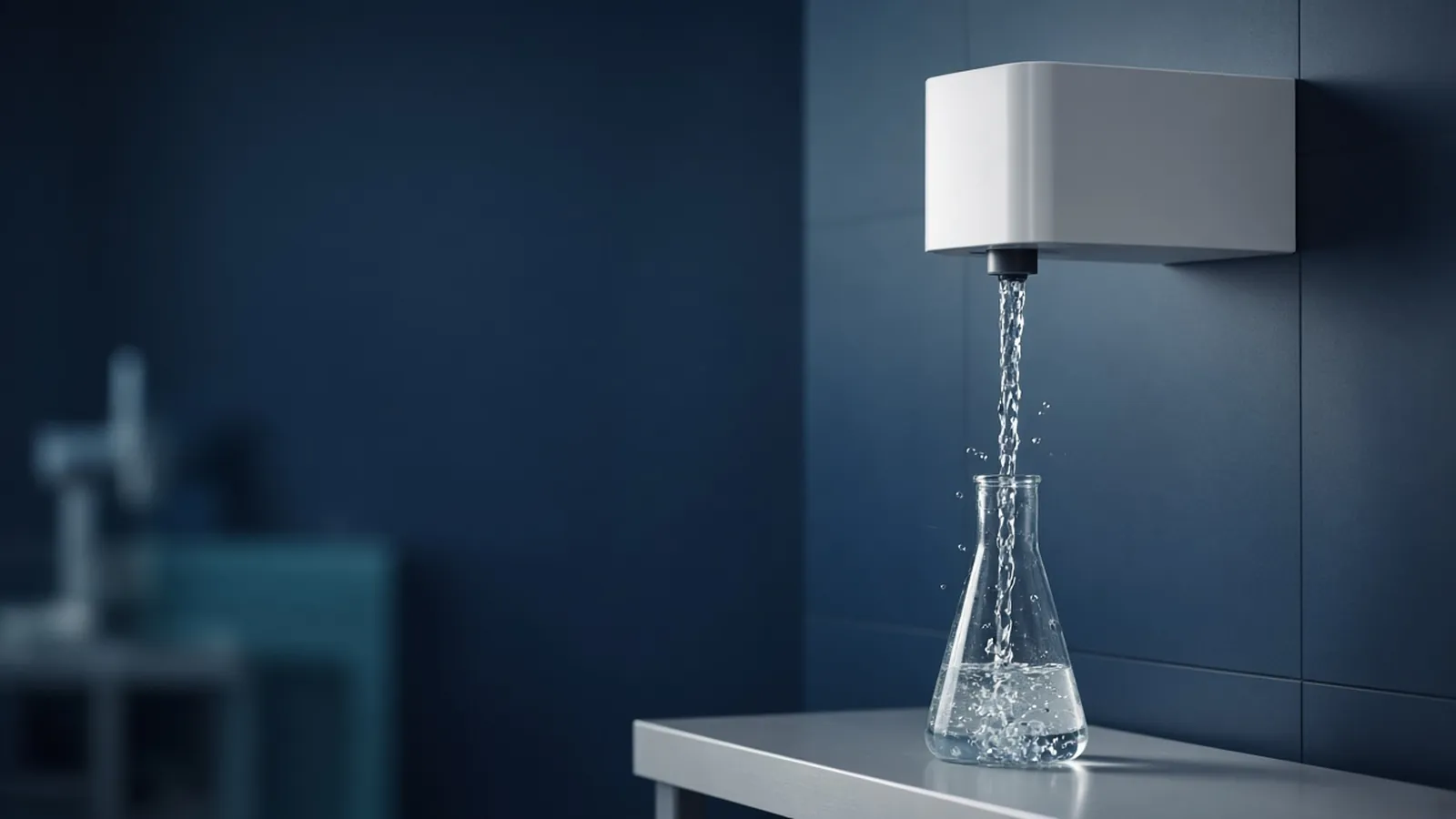
Laboratory water types and where they fail is a practical question, not a branding question. Every molecular recipe, every buffer, and every HPLC mobile phase begins with water that someone judged "good enough". The judgement is only as good as the contaminant it considered. Resistivity, organic carbon, particles, microbes, nucleases and endotoxin are different measurements. A water grade fails when the assay cares about one of them and the laboratory only monitored another.
This page is the cluster's reference for that choice. The next decision, how to turn acceptable water into a buffer with a recorded pH, is preparing a buffer and checking pH. Salts and ready solutions sit in the reagents and chemicals catalogue. Vessels that will not recontaminate a careful dispense sit with beakers and flasks. Specify the grade in a quotation request. A catalogue word such as ultrapure is not a certificate.
The decision this page supports
Before you fill a flask, name the failure you are trying to prevent. A trace-metal digest fails from ions. A reversed-phase chromatogram fails from organics that ghost as peaks. A PCR blank fails from DNA or from an inhibitor. A mammalian culture fails from microbes or endotoxin. A pH buffer fails when the water's own acidity, or a dirty electrode, moves the number. One carboy cannot honestly wear all of those warranties unless someone measured them.
Published grade names, including the families in ASTM water specifications and ISO water grades, are shorthand for bundles of those measurements. Use the bundle as a shopping language. Then check which lines of the bundle your assay actually needs. Copying "Type I" onto a bottle label, without the resistivity, the organic-carbon figure, or the microbial claim, is how two laboratories disagree about the same jug.
What each measurement can see
Electrical resistivity, often quoted near 18.2 megohm-centimetres at 25 °C for highly polished water, reports ionic content. The water's own dissociation sets a ceiling. Temperature moves the number, so a meter that does not state the temperature is not comparable with a specification written at 25 °C. Resistivity collapses when salts, carbon dioxide, or a dirty container add ions. It stays impressively high in the presence of many uncharged organics, of endotoxin, and of a nuclease that is busy destroying an RNA assay. The meter is not lying. It was asked a narrow question.
Total organic carbon reports how much carbon can be oxidised to a measured form. It is a sum, not an identity. A low figure can still hide a small amount of one compound that your detector sees, and a higher figure can be harmless bicarbonate chemistry depending on how the instrument counts it. Use it as a trend and as a specification for chromatography and for trace organic work. Do not use it as a sterility test.
Particles and colloids are a filtration and a counting problem. Bacteria and moulds are a culture or an inline-sanitisation problem. Endotoxin, the lipopolysaccharide from Gram-negative bacteria, is a specific biological assay. RNase and DNase are activity tests. DNA contamination is a blank amplification. None of these appear on a resistivity display.
A pH meter is the wrong referee. Ultrapure water is poorly buffered and poorly conducting, so the electrode drifts, and dissolved carbon dioxide pulls the reading acidic. A noisy pH is what pure water often looks like. Judge the water by the measurements above, then use the pH meter on the buffer you prepare, which is a different and better-posed measurement.
Grades in plain language
Feed water is whatever the building supplies. It may be municipal water or a borewell. Hardness, chlorine or chloramine, silica, iron and a microbial load decide how fast a purifier fails. Feed water is for washing glass that will later be rinsed, and for filling a still or a reverse-osmosis unit. It is not a reagent.
Reverse-osmosis water, often grouped with the coarser laboratory grades, has had a large fraction of ions and organics rejected by a membrane. It is the usual feed to a polisher and a fair rinse for ordinary glassware. Its resistivity is far from the ultrapure ceiling. Using it to make a trace standard or a PCR master mix is a common false economy.
A general analytical grade, the sort of water many laboratories still call distilled or deionised, is fit for many buffers, for preparing uncomplicated reagents, and for rinsing volumetric glass before an ordinary titration. It will not satisfy a method that wrote down a Type I resistivity and a low organic-carbon limit.
Point-of-use ultrapure water is polished by ion exchange, and often by ultraviolet oxidation and a final filter, until resistivity and organic carbon meet a tight specification. It is fit for HPLC blanks, for atomic spectroscopy, for many molecular-biology reagents, and for standards, provided the extra hazards of that assay were also specified. It is meant to be used as it is dispensed. The polish is real and fragile.
Clinical and culture work add further lines: sterility, a low microbial count, and sometimes a low endotoxin limit. A resistivity certificate does not supply those lines. Enzyme vendors publish water expectations inside a method class rather than as a universal jug. Treat a supplier page such as the NEB product catalogue as a map of those classes, not as a recipe to copy.
Where each type fails
Ultrapure water fails in a carboy. Carbon dioxide from the air dissolves, resistivity falls, and the pH of anything weakly buffered moves. Plasticisers and detergents left in a "clean" bottle add organics the polisher had already removed. A warm night grows a biofilm that tomorrow's resistivity might only partly confess, because the organisms and their endotoxin are not a salt. The honest habit is a fresh dispense into a rinsed flask for the sensitive batch, and a labelled bottle with a short life for work that can tolerate the drift.
Reverse-osmosis water fails upward. People promote it because it is plentiful. Chromatography baselines rise. Enzyme assays pick up metals. The failure looks like a bad column or a bad enzyme until someone prepares the same buffer from polished water and the problem shrinks.
Feed water fails the purifier rather than the assay directly. Hard water scales a membrane and exhausts cartridges. Chlorine damages some membranes unless carbon treatment sits upstream. Silica can break through and matter to a trace analysis. If you do not know the feed, you do not know the running cost or the failure date of the skid. That belongs in the enquiry, as a measured note, not as a guess.
Stored distilled water fails the microbiology of the container. A carboy with a biofilm will seed every buffer prepared from it. The buffer then fails a culture, or it fails a PCR, and the argument starts at the enzyme. Smell, haze, and a slimy neck are late signs. A laboratory that needs sterile water either buys a sterile claim it can file, filter-sterilises into a sterile vessel, or autoclaves a clean vessel and accepts what the autoclave puts back.
Polished water also fails the pH electrode. Storing a glass electrode in ultrapure water leaches the bulb and the junction. The meter then mis-sets every buffer. Store the electrode in the solution its maker specifies. The water system is not an electrode cupboard.
Inline monitors fail when they are believed past their calibration. A resistivity cell and an organic-carbon lamp are instruments. NIST's index of documentary calibration procedures is a reminder that meters themselves have procedures. A green light on an unmaintained skid is a lamp, not a result.
| Water you have | What a pass can support | A failure that still gets through |
|---|---|---|
| Feed or tap | Washing, and feed to a purifier | Any reagent use |
| Reverse osmosis | Rinsing, feed to a polisher, rough media | Trace ions, organics, nucleases |
| Analytical or distilled, fresh | Many buffers and general reagents | HPLC blanks, endotoxin, PCR contamination |
| Type 1 at the dispenser | Ion-sensitive and many molecular uses | Endotoxin, RNase, or DNA if those were never tested |
| Same Type 1 after a day in a bottle | Work you have shown can tolerate the drift | The specification printed on the dispenser |
What to do when the blank fails
Change one variable. Collect a fresh dispense into a flask that was rinsed with that same dispense. If the blank recovers, the stored bottle or the dirty vessel was the source. If it does not, read the polisher. Resistivity below the laboratory's limit, or organic carbon above it, means the cartridge, the lamp, or the sanitisation cycle is due. Idle loops grow. After a weekend or a power cut, follow the rinse-to-quality step before a sensitive run.
If resistivity is fine and a nuclease-sensitive assay still fails, stop arguing with the conductivity cell. Test a certified nuclease-free water as a control, or treat the labware. Tips and tubes are part of the water system once the liquid touches them. Addgene's protocols and methods filed on protocols.io assume a water quality the author had. When you import a method, import the water line too, or write down the substitution.
Do not "fix" a high blank by diluting it with more of the same water. You are diluting signal and keeping the contaminant.
Heat, hard feed water, and rooms that lose power
Warm laboratories speed microbial growth in polishers, in filters, and in stored bottles. A system that recirculates is safer than a dead leg of tubing, and a dead leg should be on the maintenance list. After a power cut the ultraviolet lamp and the recirculation pump have been off. The first water out of the tap is not yesterday's water. Rinse to the specification.
Hard feed water is common, and it is a design input. If the feed is a borewell, say so when you ask for a system. Scale, iron and silica decide the pretreatment. A skid sized for a soft municipal supply will spend its life in alarm on a hard one. Humidity does not ruin resistivity by magic, but it does wet labels, swell carbon beds that were left open, and encourage people to leave carboys uncapped "just for a minute". Cap them, and still prefer a fresh dispense for the assay that cares.
Safety and the limit of the claim
Ultrapure water is not a hazard in the toxic sense, and it is not sterile because it is resistive. Do not inject it, do not call it pyrogen-free without an endotoxin result, and do not use a research water claim as a clinical manufacturing claim. This page is not a pharmacopoeia method and not a validation package.
Hot stills and ultraviolet lamps are the practical hazards. Let a still cool before you refill it. Shield your eyes from an exposed ultraviolet source. A leaking skid is a slip hazard and an electrical one. Follow the service rules for sanitising chemicals. They are often more hazardous than the water.
What to put in an enquiry
Write the feed you have, the volume per day, the assays, and the numbers you need: resistivity at a stated temperature, organic carbon, microbial or endotoxin limits, and a final filter rating if particles matter. Ask how the unit indicates that it is out of specification, and what the rinse procedure is after idle time or a power cut. Ask for the document that will ship with the installation, not for a verbal "Type I".
Send that note through the quote form. Pair it with the vessels and the salts you will actually use. The water is only a reagent once it is in a named flask, on the way into a named buffer.
Match a water grade to the contaminant the assay can see
- 01Name the contaminant that would ruin the resultWrite whether the assay fails from ions, organic carbon, particles, nucleases, DNA, microbes, or endotoxin. A single word such as pure is not a specification.
- 02Pick a grade whose certificate speaks to that contaminantUse resistivity for ionic load, a total-organic-carbon figure for oxidisable carbon, and a specific test for endotoxin or nucleases. Do not promote rinse water into a trace assay because the carboy is convenient.
- 03Take polished water at the point of useDispense Type 1 water into a rinsed vessel when you need it. Water that sat overnight in a bottle has already met carbon dioxide, the container, and whatever grew in it.
- 04Treat a failed blank as a water investigationIf the assay blank is high, change the vessel, rinse the dispenser to quality, and repeat the blank. Do not add a second aliquot of the same stored water and hope the signal dilutes.
Questions from the bench
Is 18.2 megohm-centimetre water suitable for every assay?
It is suitable for assays that fail when ions are present, and only at the moment it leaves a polisher that is actually reaching that resistivity. Organics, endotoxin, RNase and particles can all be present in water that still reads well. Match the extra specification to the assay.
Why does ultrapure water give a noisy pH reading?
A pH meter needs a little conductivity to behave, and pure water has almost none. Dissolved carbon dioxide also moves the reading. pH is a poor release test for laboratory water. Use resistivity, organic carbon, or the assay blank instead.
Can stored water from a carboy be used to prepare a buffer the next day?
Only if you have decided that the drift is acceptable for that buffer. Carbon dioxide lowers resistivity and pulls pH, and a warm carboy grows microbes. Sensitive work should start from a fresh dispense. The buffer page covers how that water then meets a pH electrode.
What should a water-system enquiry include?
Include the feed source, any hardness or chlorine notes you have measured, the daily volume, and the assays the water must survive. Ask for resistivity, organic carbon, and endotoxin or microbial claims only where you need them, and ask how the unit is rinsed after it has been idle.
References
Manufacturer names identify published method classes. Trademarks remain with their owners. Catalogue records on this site are independent references for enquiry. They are not a statement of inventory, distribution rights or a supply commitment. This page is educational. It is not medical advice, a diagnostic protocol or a biosafety approval.
Catalogue
Related products and categories
These links follow the subject of the article into published manufacturer references. A listing is a reference for an enquiry, not a statement of stock or distribution rights.
Continue in this cluster
Related reading
 Preparing a buffer and checking pHPrepare a buffer at a stated pH and temperature, record the salt form, and treat a drifting electrode or a bad slope as a failed control.A glossary of solution termsDecide which number a recipe means before you weigh a salt: molarity or molality, which percent, normality, buffer capacity, osmolality, or hydrogen-ion
 Acids bases and the fume hoodDilute a concentrated acid or base for buffer work inside a fume hood, and keep that chemistry out of the laminar-flow hood shown with culture medium.