
application
Acids bases and the fume hood
Dilute a concentrated acid or base for buffer work inside a fume hood, and keep that chemistry out of the laminar-flow hood shown with culture medium.
- Author
- EVRINTH Editorial Team
- Published
- 8 October 2026
- Updated
- 8 October 2026
- Reading time
- 9 min
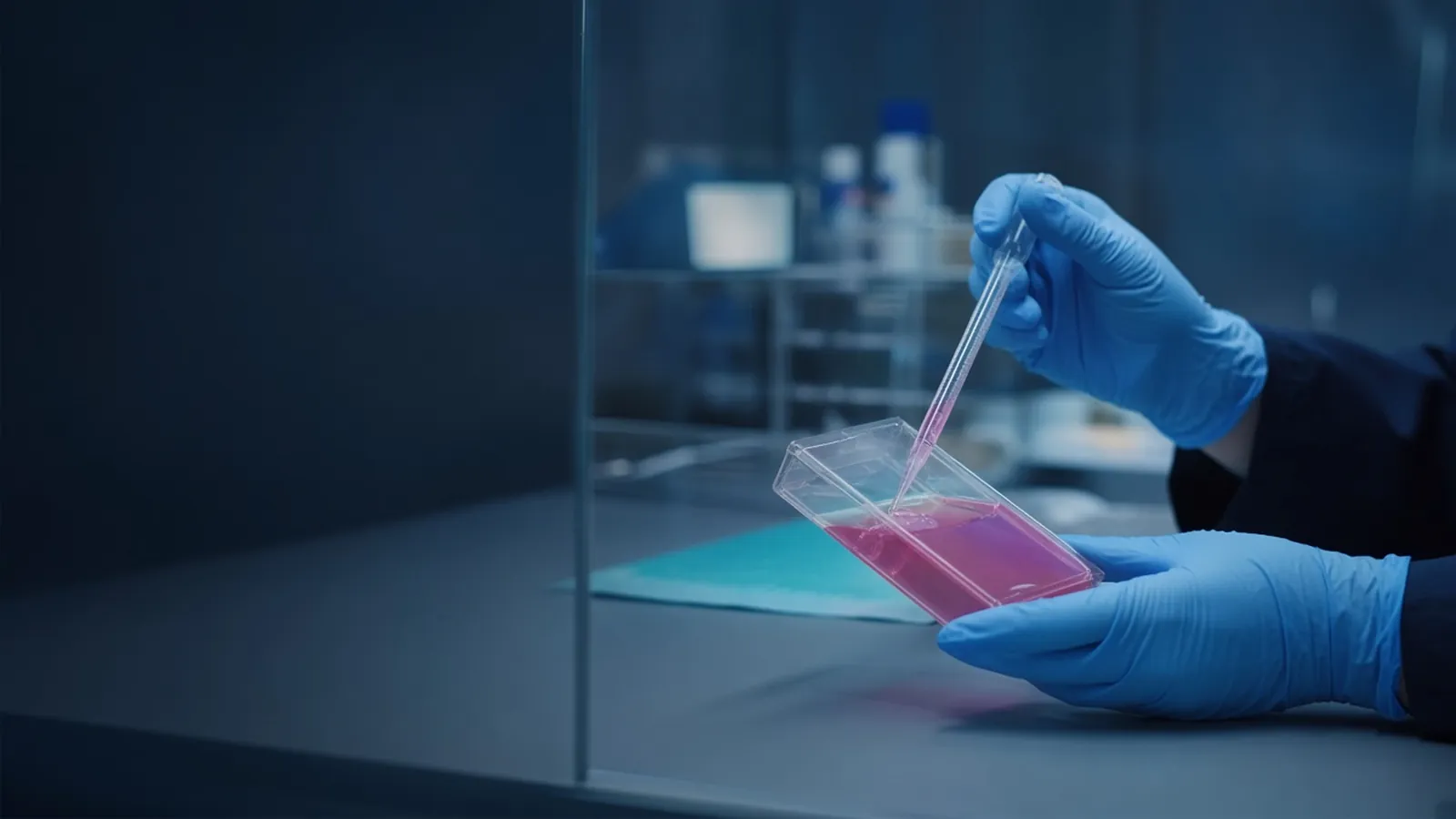
The photograph at the top of this page shows gloved hands aspirating pink culture medium from a flask inside a laminar flow hood. That is a coherent place for the medium. It is not a place for a bottle of concentrated hydrochloric acid, glacial acetic acid, or sodium hydroxide. This application follows one real task, making a dilute acid you will later use dropwise to set a Tris buffer, and it keeps that task in a chemical fume hood. The mismatch with the photograph is the lesson.
Once the dilute bottle exists, the pH adjustment itself is the workflow in preparing a buffer and checking pH. The water you dilute into is chosen with laboratory water types and where they fail. Why a biosafety cabinet is not a chemical hood is explained in working inside a biosafety cabinet, and the wider bench rules sit in biosafety basics for research benches. Concentrated reagents are specified from the reagents and chemicals catalogue. The dilution vessel should be something you can afford to dedicate to acids, from beakers and flasks. The identity and the concentration go on a quotation request.
The task, split across two rooms
You need a dilute hydrochloric acid, on the order of 1 molar or weaker, in a squeeze bottle or a beaker, so that pH adjustment of a buffer is done with drops rather than with the concentrated bottle. The concentrated bottle stays in the fume hood for the dilution and then goes back to its tray. The dilute solution, if your procedure allows it outside the hood, is what travels to the pH meter. Nothing in that split requires the culture hood. The pink medium in the photograph stays on its own bench, with its own gloves, and the acid does not cross the floor in an open beaker to meet it.
If the same afternoon also needs dilute sodium hydroxide, make it as its own dilution, in its own vessel, with the same hood rule. Do not make both in one beaker. Do not store the wand of an acid wash bottle in a base beaker because the bench is crowded.
What the laminar-flow hood is doing in the photograph
A laminar-flow hood of the clean-bench type protects the work by pushing filtered air across the flask and out toward the operator. That is useful for a sterile medium when the assessment says a clean bench is the right cabinet. It is the opposite of what you want for a volatile acid. Vapour and aerosol leave with the air, toward the person whose hands are in the photograph. Even a cabinet that looks similar and is in fact a biosafety cabinet is still the wrong tool: its fans and HEPA filters are there for biological aerosols, not to swallow corrosive vapour. Fumes attack metal, seals, and filter media, and the cabinet's certification does not make it a fume hood.
A chemical fume hood pulls air from the room, across the work, and out through a duct. The sash is a physical barrier as well as an airflow valve. Use the sash height the hood was tested at. A hood with the sash fully open, or with the fan failed, is not doing that job. If the airflow alarm sounds, or a power cut stops the fan, close the concentrated bottle and stop. Do not finish a dilution in a dead hood because the calculation is already written.
OSHA's laboratory standard is one public statement of the idea that a laboratory chemical procedure belongs in a chemical hygiene plan. Your institution's plan is the one that applies. This article does not replace it and does not approve the dilution for any particular room.
Add acid to water
Put on the eye protection and the gloves your procedure names for that acid before you open the bottle. Concentrated hydrochloric acid and glacial acetic acid fume as soon as the cap is loose. Sulfuric acid is the dramatic heat case. Have the receiving vessel already charged with water, stirred if you have a stir plate that can live in the hood, and large enough that the acid is the smaller volume. Add the acid slowly, down a rod or down the wall, and let the heat dissipate. The dense acid mixes into a volume that can absorb the heat of dilution. The reverse, water into a jug of concentrated acid, can boil locally and throw liquid out of the jug.
Bases follow the same direction for the same reason. Sodium hydroxide and potassium hydroxide pellets go into water. A splash of water onto a watch-glass of pellets has nowhere to put the heat, and the pellets are hygroscopic enough to have become a slurry if the lid was left off. Weigh them in the hood, into a vessel that already contains water, or weigh a closed container by difference so you are not waving a wet pellet. Ammonium hydroxide is a fume problem even when the heat is modest. It belongs in the hood with the cap returning promptly.
The dilute acid you carry to the buffer should be labelled with the name, the approximate concentration, the date, and your initials. "HCl" on an unlabelled squeeze bottle is how the wrong bottle meets a culture flask. At the meter, add drops, stir, and wait, as the buffer page describes. If you are still far from the target, you are allowed to go back to the hood and make the dilute stronger within the procedure. You are not allowed to carry the concentrated bottle to the meter because the drops feel slow.
Hydrofluoric acid is not this task. It is not diluted with the hydrochloric habit, it is not a fume-hood footnote, and many research laboratories are not set up for it at all. If a method mentions it, stop and use the institution's specific procedure. This page will not supply one.
The branch when the buffer does not need a concentrate
Many Tris adjustments can be done entirely with a dilute acid you already have, or by starting from Tris hydrochloride so that less strong acid is required. Prefer that branch when the recipe allows it. Less concentrated acid in the hood means less fume and a smaller heat pulse. The recipe still needs the salt form written down, because starting from the hydrochloride is a composition choice, not only a safety choice.
If the calculation says you need a large volume of acid to reach the pH, the buffer pair is probably far from the ratio you intended. Stop and check the salt form and the formula weight before you empty the bottle. A wrong hydrate will make you add acid until the beaker is mostly acid. That is a documentation failure, and the hood will not fix it.
| Step | Where it happens | What goes wrong in the other room |
|---|---|---|
| Open the concentrated acid or base | Fume hood, sash at the tested height | A laminar-flow hood blows the vapour toward the operator |
| Add acid to water already in the vessel | Fume hood, slowly, with eye protection | Water added to concentrated acid can boil and spit |
| Dissolve hydroxide pellets | Pellets into water, in the hood | Water poured onto pellets heats a small pile |
| Dropwise pH adjustment | Bench, with the dilute bottle, meter calibrated | The concentrated bottle at the meter is an unnecessary open fume |
| Culture medium | The laminar-flow hood in the photograph | Acid in that hood threatens the person and the cabinet |
When something goes wrong
A spill of dilute acid on the bench is still the laboratory spill procedure, not a hero moment with a handful of bicarbonate. Neutralising a concentrated spill by pouring base onto it can boil. Follow the safety data sheet and the procedure you were trained on. A splash to skin or eyes is an emergency procedure, not a paragraph you reread while the clock runs. Know where the eyewash is before you open the bottle.
A bottle that has fumed until the label is gone gets a new label or it gets retired. An unlabelled acid next to an unlabelled base is how the order of addition becomes a guess. If the dilute acid's concentration is now uncertain because the bottle sat uncapped and concentrated by evaporation, remake it. Do not "correct" a buffer with an unknown acid and then write a pH as if the salt form were known.
If the only available hood is the culture hood in the photograph, you do not have a place to dilute concentrated acid today. Wait for a fume hood. Gloves and a sash do not make that cabinet a chemical hood.
Heat, humidity, and a fan that stopped
A hot room means the water you dilute into is already warm, so you have less margin before a sulfuric or a hydroxide dilution boils. Start with cooler water if the procedure allows, add more slowly, and use a larger water volume. Humidity liquefies sodium hydroxide, so a pellet mass from an open bottle is not the mass you calculated. Take a fresh portion from a closed container. When the power fails, fume hoods stop being fume hoods. Cap the concentrated bottle, lower the sash, and leave the dilution unfinished until airflow is back and someone has said the hood is fit to use. Do not carry the open bottle to a window and call the window a hood.
Scope
This is research handling guidance for preparing reagents. It is not an occupational approval, not a chemical-hygiene plan, and not medical advice. BMBL and the WHO laboratory biosafety manual govern biological safety decisions your institution makes about the culture in the photograph. They do not turn that cabinet into a place to pour acid. Concentrated corrosives stay in the chemical hood, in trays that can hold a leak, with caps that close.
What to specify when you buy
Ask for the chemical name, the concentration or the percent with its unit, the grade, and the package size you can handle in the hood you have. A large bottle you cannot lift safely into the hood is the wrong package. Ask for the safety data sheet. On receipt, check the label against the enquiry before the bottle joins the acid tray. The quotation request should be specific enough that glacial acetic acid and dilute acetic acid cannot be treated as one line.
Questions from the bench
Why not dilute the acid in the laminar flow hood in the photograph?
That hood is moving air to protect the culture medium from particles, and a laminar-flow clean bench sends air toward the person working in it. Acid vapour would ride that air out of the cabinet. A chemical fume hood is built to pull vapours away from the operator and out of the room. The photograph is the right scene for pink medium. It is the wrong scene for the concentrated bottle.
Is a biosafety cabinet close enough to a fume hood?
No. A biosafety cabinet is designed around biological aerosols and HEPA filtration, which is a different job from capturing corrosive vapours. Acid fumes can damage the filters and the cabinet, and they are not a biological hazard the HEPA was asked to solve. The biosafety-cabinet page describes that airflow. Do the dilution in a fume hood that your laboratory has certified for chemical work.
What does add acid to water change physically?
The heat of dilution is released into a large volume of water that can absorb it, and the dense acid sinks and mixes. Adding water to a jug of concentrated acid, especially sulfuric acid, dumps that heat into a small volume that can boil and spit. The same direction applies to solid sodium hydroxide or potassium hydroxide: pellets into water, not a splash of water onto a pile of pellets.
Does this page approve the dilution for my laboratory?
No. It is research handling guidance for the buffer bench. Your safety data sheet, your laboratory procedure, and your institution's safety rules approve or refuse the step. Hydrofluoric acid is outside this guidance entirely and is not diluted by the hydrochloric-acid habit. If a splash reaches a person, follow the laboratory emergency procedure, not a paragraph on a website.
References
Manufacturer names identify published method classes. Trademarks remain with their owners. Catalogue records on this site are independent references for enquiry. They are not a statement of inventory, distribution rights or a supply commitment. This page is educational. It is not medical advice, a diagnostic protocol or a biosafety approval.
Catalogue
Related products and categories
These links follow the subject of the article into published manufacturer references. A listing is a reference for an enquiry, not a statement of stock or distribution rights.
Continue in this cluster
Related reading
 Laboratory water types and where they failResistivity, organic carbon and endotoxin answer different questions. A water grade fails when the assay cares about a contaminant the meter cannot see.
 Preparing a buffer and checking pHPrepare a buffer at a stated pH and temperature, record the salt form, and treat a drifting electrode or a bad slope as a failed control.
 Working inside a biosafety cabinetHow a Class II biosafety cabinet moves air, how that differs from a chemical fume hood, and which habits keep cultures and workers protected.