
glossary
Freezing cells and recovery
A glossary of cryoprotectant, slow cooling and cold storage for research cell stocks, and the recovery mistakes that waste a vial.
- Author
- EVRINTH Editorial Team
- Published
- 8 October 2026
- Updated
- 8 October 2026
- Reading time
- 8 min
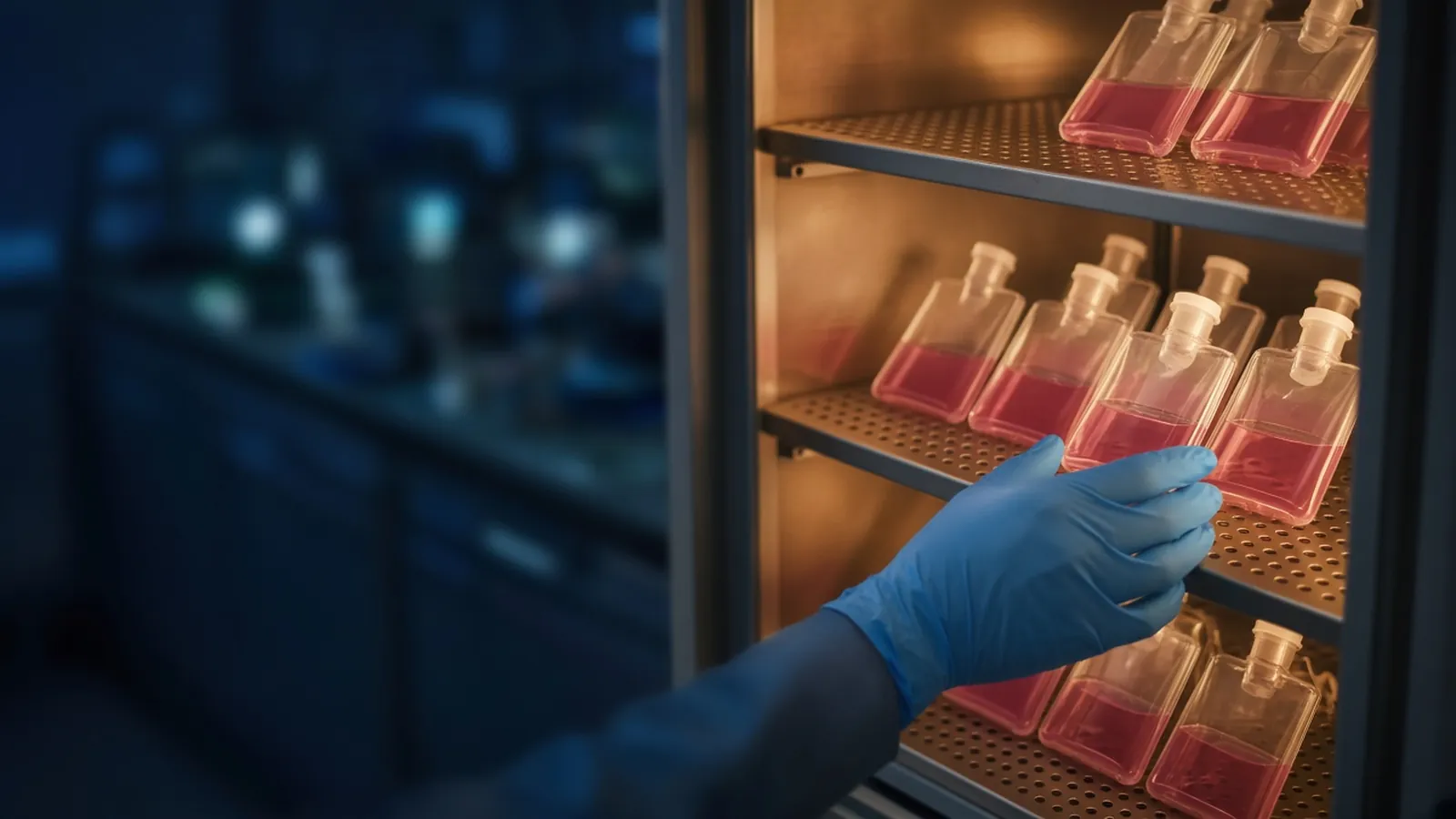
A frozen vial is a decision to pause a known passage before contamination, drift or a staff change spends it. The words around that decision are easy to swap and expensive to swap. This glossary fixes the words: cryoprotectant, cooling rate, where the vial lives afterwards, and what recovery is allowed to mean. The living culture those vials come from is described in mammalian cell culture for research labs. The temperature ladder from a refrigerator to colder storage is in storing biological samples from fridge to freezer. Nothing here is a manufacturing process for a therapy.
Cryoprotectant
A cryoprotectant is a solute that reduces the injury cells take from ice. Dimethyl sulphoxide, DMSO, is the usual class for mammalian lines. A typical research range is about five to ten percent by volume in a mixture of medium and, when the line uses it, serum. Follow the protocol for that line. More is not kinder. Less may not protect. Glycerol is a different cryoprotectant class, common for some bacterial stocks and for particular eukaryotic lines whose sheet names it. Do not substitute glycerol for DMSO because the bottle was closer.
DMSO is toxic to active cells at warm temperature. It also carries other solutes through skin, which makes it a chemical exposure hazard, not only a cell-culture ingredient. Gloves your chemical rules name are part of the method. The practical consequence in the cabinet is time. Once DMSO meets the cell suspension, you are on a short path: mix gently so you do not foam the protein, aliquot into labelled vials, and start cooling. A suspension that waits half an afternoon on the bench because the freezing container was in another room has already been injured. The freeze will then get the blame.
Controlled cooling and a passive container
Ice that forms too fast, or solutes that concentrate too brutally as water freezes, kills cells. Many mammalian protocols therefore cool slowly, often near one degree Celsius per minute, through the window where ice is forming, and only then place the vial into much colder storage. A controlled-rate freezer follows a programmed profile. A passive freezing container, often a bath of isopropanol around the vials inside a mechanical freezer, is built to approximate that slow step when it is filled and started as its instructions say. A container with the wrong solvent level, or vials started from a freezer that is already full of warm boxes, is not the rate printed on the lid. Read the insert. Do not invent a "close enough" fill.
The curve in the figure is a concept of that shape: a slow descent, then a transfer to a colder store. It is not a dataset from a particular run. Your logger, if you have one, is the dataset.
Vapour-phase nitrogen and a mechanical holding step
After the slow cool, long-term storage is usually far colder than a standard laboratory freezer. Liquid-nitrogen vessels, either in the vapour above the liquid or in the liquid itself, are the common archive. Vapour-phase storage is chosen by many laboratories because it stays extremely cold while reducing the chance that liquid nitrogen enters a poorly sealed vial and later explodes on warming. Liquid-phase storage is also used, under rules that include eye and hand protection and a restraint on how vials are sealed. The choice is institutional and physical, not a style preference.
A mechanical freezer near minus 80 Celsius often appears as a holding step between the slow cool and the nitrogen tank, or as a short local store. Storing biological samples from fridge to freezer explains why those setpoints are not interchangeable with nitrogen. This glossary will not assign a safe number of weeks at minus 80. Ask the protocol for that line, and write the date the vial moved. A vial that "has always been in the minus 80" has a history you do not know.
Recovery, as a set of words
Recovery is not "the cells grew eventually". In ordinary use it means four steps. Thaw quickly. Dilute the cryoprotectant at once so warm DMSO does not bathe active cells. Put the cells into the medium and vessel the line expects. Change or remove residual cryoprotectant on the schedule the protocol gives, often a medium change the next day if you did not centrifuge at thaw. A flask that attaches poorly can be a bad freeze, a bad thaw, an overgrown parent, or mycoplasma in the bank. Those causes are not the same, and adding serum until the flask looks crowded does not distinguish them.
Passage number on the new flask is the passage you froze, plus the fact of the thaw, recorded honestly. It is not a chance to reset the integer because the cells "feel young". If the bank was never tested for mycoplasma, recovery is also the moment the contamination re-enters the room. Quarantine a thaw you do not trust. Collection sheets such as the ATCC culture guides describe freeze and recovery expectations for lines they hold. Your sheet should be at least that explicit.
| Term | What it should mean | The mistake attached to it |
|---|---|---|
| Cryoprotectant | The named solute at the protocol's percentage | Swapping DMSO and glycerol, or doubling the percentage "to be safe" |
| Contact time | Minutes from mixing DMSO to the start of cooling | Leaving the suspension warm while you find labels |
| Slow cool | About one degree per minute where the protocol says so | Dropping vials straight into nitrogen or onto dry ice |
| Passive container | A device that only works when filled as designed | A half-empty solvent bath treated as equivalent |
| Holding step | A colder-than-fridge pause with a written duration | An untitled year at minus 80 |
| Vapour phase | Nitrogen storage above the liquid, under local safety rules | Calling any cold box "nitrogen" in the notebook |
| Recovery | Thaw, dilute, seed, remove residual cryoprotectant | Judging success by eventual growth with no record |
| Token or reference stock | Vials you return to, not the working flask | Freezing only after the culture has already drifted |
Failures, named as the glossary predicts
Vials that crack or pop on thaw were often sealed with liquid nitrogen inside, or overfilled so expansion had nowhere to go. Leave the headspace the vial was designed for, and follow your nitrogen rules. A bank with no passage numbers cannot be matched to a paper later. A bank made from an overgrown, untested flask copies that overgrowth into every future thaw. Freeze from a culture you would be willing to assay, at a passage you have written down, after the mycoplasma schedule your laboratory set. If recovery is poor, do not keep the three colonies that clung on and call them the line, unless the line is genuinely irreplaceable and you document the bottleneck as a genetic event.
Hazards that are not the cells
Nitrogen asphyxiates in a closed room, embrittles metal, and turns a bad vial into a projectile. Training, oxygen alarms where your assessment requires them, and eye protection are institutional. DMSO is a chemical. Isopropanol in a passive container is flammable. The WHO Laboratory Biosafety Manual belongs in the biological assessment for the line. It does not replace the physical assessment for the vessel. This glossary is not medical advice.
Cold-chain handoff
A dry-ice shipper, a vapour shipper and a minus 80 box are different objects. Write which one a vial left in, and what temperature it was received at, before it joins the local bank. A shipper that arrived warm is not "probably fine because the cells are hardy". In a hot loading bay the time from courier to tank is the whole method. A power cut on a mechanical holding freezer is an excursion with clock times. Nitrogen tanks that are not filled on a schedule become the same excursion more quietly. Specify the coolant and the maximum transit you are willing to accept before you call a shipment a bank.
What to put in an enquiry
State the cryoprotectant class the line sheet names, the vessel format of the vials, whether you need passive cooling containers or only consumables, and the storage temperature you are specifying. Ask for material compatibility in writing if a plastic must tolerate nitrogen temperatures. The laboratory consumables catalogue is the everyday class list. The academic research reference frames a wider university conversation. Use the quote request to ask whether a quotation is possible. A freezing method can be discussed from the line sheet. A catalogue class is not a cryoprotectant recipe and not a storage service.
Questions from the bench
Is dimethyl sulphoxide the only cryoprotectant?
No. DMSO is the common class for many mammalian lines, often somewhere near five to ten percent by volume. Glycerol is a different class used for some cells and more often for microbes. The line sheet names the class and the percentage. A neighbouring laboratory's vial label is not your recipe.
Can a minus 80 freezer be the archive?
Many protocols use it as a staging step after slow cooling, then move vials to colder nitrogen storage. How long a given line tolerates the staging temperature is a fact for that protocol, not a number this glossary can assign. Do not treat an undocumented year in a mechanical freezer as equivalent to a vapour-phase bank.
Why does warm DMSO matter before the vial is frozen?
DMSO protects against ice damage and it is harsh to metabolically active cells. Time spent warm, after the cryoprotectant is mixed and before cooling starts, is injury without the benefit of the freeze. Mix, aliquot and begin cooling promptly, on the clock the protocol gives.
Does a recovered flask prove the bank is clean?
It proves some cells reattached. It does not prove identity, mycoplasma status or that the passage number on the cap is the passage you froze. Test and authenticate on the schedule you set before that vial becomes the parent of every later experiment.
References
Manufacturer names identify published method classes. Trademarks remain with their owners. Catalogue records on this site are independent references for enquiry. They are not a statement of inventory, distribution rights or a supply commitment. This page is educational. It is not medical advice, a diagnostic protocol or a biosafety approval.
Catalogue
Related products and categories
These links follow the subject of the article into published manufacturer references. A listing is a reference for an enquiry, not a statement of stock or distribution rights.
Continue in this cluster
Related reading
Mammalian cell culture for research labsHow research labs keep mammalian cell culture workable: medium, aseptic technique, confluence, passage records and contamination checks.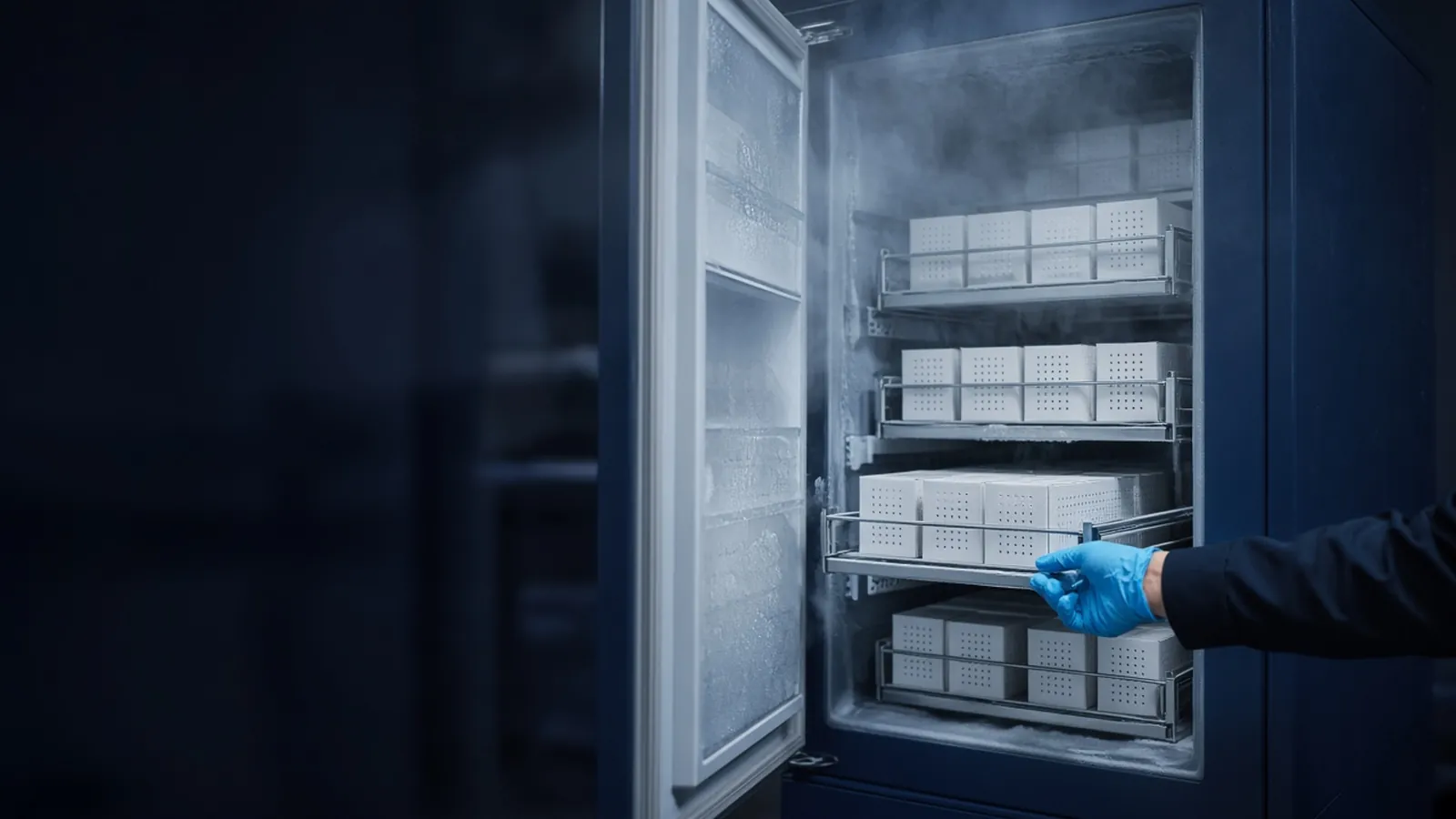 Storing biological samples from fridge to freezerFridge, minus-20, minus-80 and nitrogen storage slow different kinds of damage. A warm box is a quarantine decision, not a hope.A glossary of culture termsPairs of culture words that laboratories mix up, and the wrong next action each pair causes, from confluence versus density through to confluent versus