
glossary
Good's buffers and why the name is not a method
Good's buffers are a design family, not a procedure. Separate HEPES, MES, MOPS, and PIPES from metal binding, light reactions, and the pH you still measure.
- Author
- EVRINTH Editorial Team
- Published
- 8 October 2026
- Updated
- 8 October 2026
- Reading time
- 8 min
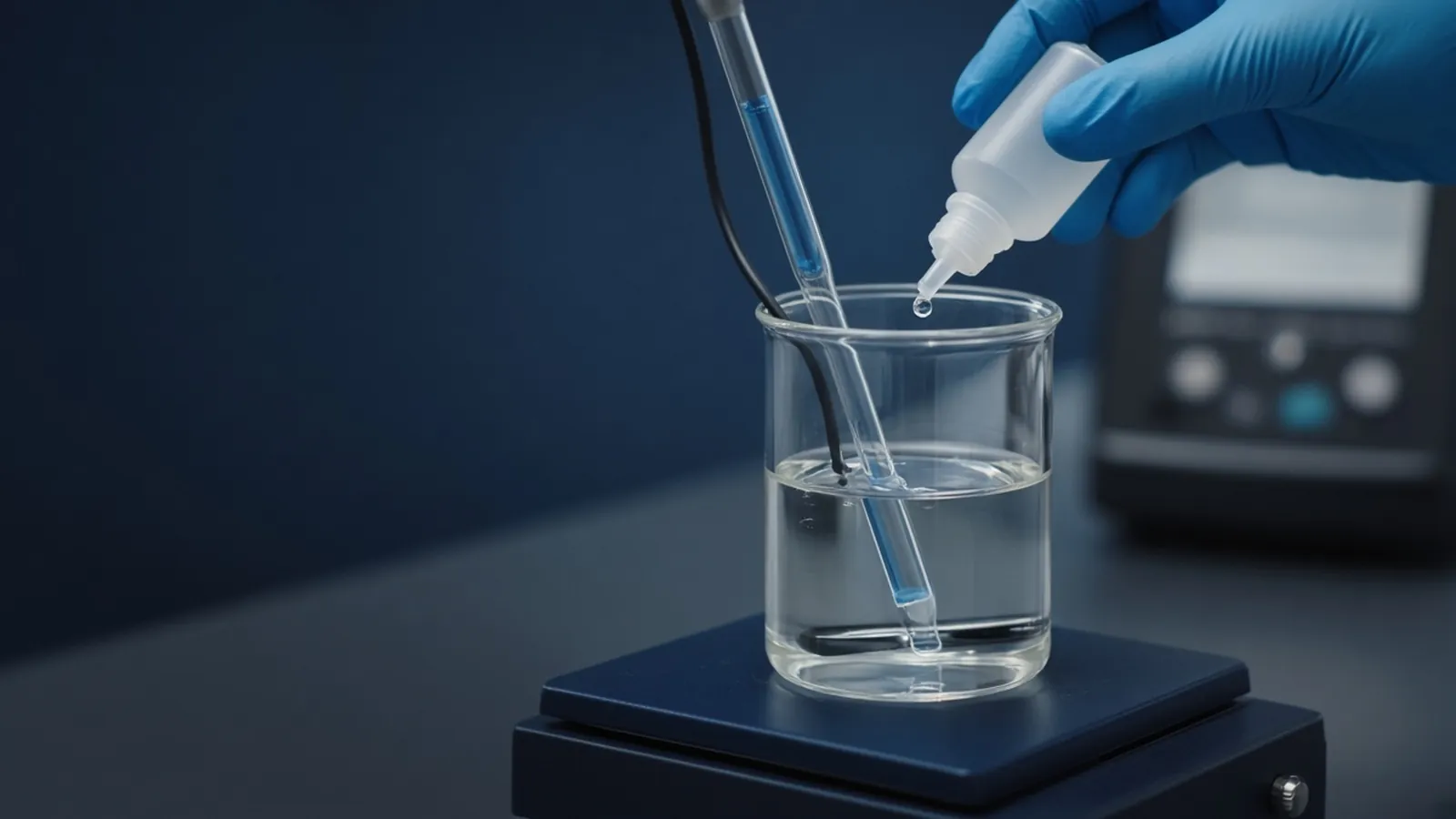
"Use a Good's buffer" sounds like an instruction in the way "run a Bradford assay" sounds like an instruction. It is not. It names a design family associated with Norman Good and co-workers, introduced in a 1966 paper on hydrogen-ion buffers for biological research and extended afterward. HEPES, MES, MOPS, and PIPES are members. The name does not choose among them, does not set the pH, and does not replace a meter. This glossary defines the words that get collapsed, and the confusion each one causes. The water you dissolve them in is laboratory water types and where they fail. The measurement habit is preparing a buffer and checking pH.
The solids are purchased from the reagents and chemicals catalogue under their chemical names. They are dissolved in beakers and flasks. An enquiry that says only "Good's buffer" should be rewritten before it becomes a quotation request.
Good's buffers
Good's buffers are the set of zwitterionic and related compounds selected to satisfy a published list of criteria for biological work: a pKa between about 6 and 8, useful solubility in water, poor penetration of biological membranes, modest influence of the buffer on salt effects, metal binding that is low or at least characterised, chemical stability, low optical absorbance so spectrophotometry stays clean, and a practical preparation. The criteria are a design brief. A bottle that meets the brief for pKa can still fail your assay on a criterion you weigh more heavily, such as a specific metal.
The confusion is to hear "Good's" as a method name that implies one recipe, one pH, and one concentration. There is no such recipe. There is a family.
pKa and the useful window
pKa is the pH where the buffer's two forms are present in similar amount and the capacity to resist added acid or base is highest. More than about one pH unit away, capacity falls off and you are mostly titrating water with extra steps. MES sits near pH 6.1, PIPES near 6.8, MOPS near 7.2, and HEPES near 7.5, with the exact figure depending on temperature and ionic strength. Those numbers are a map for choosing which member might suit a working pH. They are not a release specification. You still measure.
The confusion is to quote a handbook pKa as the pH of the solution you made. A solution of HEPES free acid in water is not at pH 7.5 until you have added the right amount of base and confirmed it with an electrode at a stated temperature.
Zwitterion
A zwitterion carries both a positive and a negative charge on the same molecule. Many Good's buffers are zwitterionic in the form that does the buffering, which is part of why they were expected to interact less strongly with membranes and with some proteins than a buffer that is a small primary amine. Charge state still depends on pH. "Zwitterionic" is not a synonym for "inert," and it is not a synonym for "no ionic strength." The counter-ions you add during titration, usually sodium or potassium, contribute to ionic strength in the ordinary way.
The confusion is to calculate ionic strength as zero because the buffer is zwitterionic. Count the ions that are actually free.
HEPES, MES, MOPS, and PIPES
These four are the members people mean most often. MES is the acidic end of the everyday set. PIPES and MOPS cover the region just below and around neutrality. HEPES covers the physiological region just above 7. Each is a different molecule with a different mass, a different pKa, and a different salt form on the label. Substituting one for another because all four are "Good's" moves the capacity window and can move the side reactions.
The confusion is a stock-room shorthand that files them as interchangeable white powders. The label, not the family name, is what you weigh.
Metal binding
One design goal was minimal binding of biologically important metals, especially compared with buffers that coordinate calcium, magnesium, copper, or iron more tightly. The family meets that goal unevenly. Some members bind metals strongly enough that a metalloprotein or a free-metal calculation will notice. Others are weak binders that still show up in careful binding studies. Tris, which is not a member of this family, is a clearer metal ligand and a useful contrast: people sometimes switch from Tris to HEPES specifically to reduce that binding, and they should treat the improvement as a hypothesis to confirm in the assay.
The confusion is the sentence "Good's buffers do not bind metals." The accurate sentence is that low binding was a selection criterion, that it is not equally true of every member, and that a critical metal activity still has to be checked.
Radicals, light, and riboflavin
Several buffers in this family, HEPES among them, can generate radicals when they are illuminated in the presence of riboflavin. Cell-culture media often contain riboflavin. A bottle of medium left in the light can accumulate reactive products that a freshly prepared enzyme buffer kept dark never sees. The practical response is the one the medium method already implies: limit light exposure, and do not assume a buffer is photochemically silent because it was expensive or because it is zwitterionic.
The confusion is to treat a light-dependent artefact as contamination from the water system, or the reverse, to blame riboflavin for a simple pH error. The controls are a foil-wrapped aliquot and a meter with a valid slope.
Buffer capacity
Capacity is the amount of acid or base the solution can accept before the pH moves substantially. It depends on the buffer concentration and on how close the working pH is to the pKa. A 5 millimolar HEPES at the edge of its window is a suggestion. A 50 millimolar HEPES near its pKa is a different reagent. Ultrapure water has essentially no capacity, which is why its pH reading is not a specification. Dissolved carbon dioxide will move a weak buffer faster than a strong one.
The confusion is to equate "it is a Good's buffer" with "it will hold pH." Concentration and pKa do that work.
The pH measurement that the name does not replace
A glass electrode still needs fresh standards that bracket the target, a slope near the Nernstian value of about 59 millivolts per pH unit at 25 °C, and storage in the manufacturer's solution rather than in ultrapure water. Temperature compensation corrects the electrode. It does not freeze the chemical pH of the buffer. HEPES moves less with temperature than Tris, and it still moves. Record the temperature.
The confusion is to skip calibration because the compound has a good reputation. Reputation is not a slope.
| Term | What it means here | The mix-up to avoid |
|---|---|---|
| Good's buffers | A design family from Good's criteria | Treating the name as one method or one pH |
| pKa | Where capacity is highest | Quoting pKa as the measured pH of your bottle |
| Zwitterion | Both charges on one molecule | Ignoring the counter-ions you added |
| HEPES, MES, MOPS, PIPES | Distinct members with distinct pKa values | Swapping powders because the family name matches |
| Metal binding | A criterion, met unevenly | Assuming every member leaves every metal free |
| Riboflavin and light | A radical side reaction for some members | Blaming only the water, or ignoring the light |
| Capacity | Concentration and closeness to pKa | Expecting a dilute solution to hold an alkaline drift |
How a preparation still runs
Pick the member whose pKa sits near the working pH. Write the salt form. Dissolve in less than the final volume of a water grade the assay can defend. Equilibrate to the reporting temperature. Calibrate the electrode. Adjust with the acid or base whose counter-ion you are willing to keep. Make to volume only after the pH is right. If the slope fails, stop and fix the electrode. If the assay then fails with a beautiful pH, look at metal binding, at light and riboflavin, at ionic strength from the titrant, and at the water. Conductivity will catch a gross salt error. It will not catch a radical.
Public protocols on protocols.io name HEPES or MOPS when they mean those chemicals. Copy that habit of naming the molecule. Leave the family name for the conversation about why those molecules exist.
Safety and research-use limits
These solids and the concentrated bases used to adjust them are laboratory chemicals. Wear eye protection and follow the safety data sheet. A buffer that meets Good's criteria is not sterile because it is zwitterionic, and it is not a biosafety control. Institutional rules govern infectious material. Nothing in the family name is a diagnostic or medical claim.
Naming things clearly in a shared store
In a warm, humid store the practical failure is mislabelled jars and damp solids, not the 1966 criteria. Keep lids on. Write HEPES or MES on the working bottle, plus the hydrate if there is one, the date, and the pH and temperature once it is a solution. A power cut is irrelevant to the powder and relevant to the meter: recalibrate before the next adjustment. Do not file four chemicals under one family nickname and expect the next person to guess.
What an enquiry should say instead of the nickname
Ask for the chemical name, the salt or free acid, the grade, and the package. If you want a prepared solution, state concentration, pH, temperature, and any sterility or nuclease line separately. You may say that you want a buffer from this design family only as context. The purchasable object is the named compound. On receipt, check the identity on the label against the certificate, then measure pH before the buffer meets a metal-dependent or light-exposed assay.
Questions from the bench
Does saying Good's buffer specify the pH?
It specifies a family of molecules chosen against a list of design criteria. HEPES, MES, MOPS, and PIPES sit at different pKa values. You still weigh a named chemical, set a pH at a stated temperature, and check a calibrated electrode.
Are Good's buffers free of metal binding?
Low metal binding was one of Norman Good's criteria, and the members meet it unevenly. Some bind copper or other metals enough to matter, and published work still argues about the borderline cases. If a free-metal activity is the point of the assay, test that assumption in your mixture.
Why do some media say to keep HEPES in the dark?
Some of these buffers form radicals when light and riboflavin are present together. That side reaction shows up in cell-culture media more than in a simple enzyme tube kept in a closed box. Follow the medium method, and do not treat the family name as a promise of photochemical silence.
References
Manufacturer names identify published method classes. Trademarks remain with their owners. Catalogue records on this site are independent references for enquiry. They are not a statement of inventory, distribution rights or a supply commitment. This page is educational. It is not medical advice, a diagnostic protocol or a biosafety approval.
Catalogue
Related products and categories
These links follow the subject of the article into published manufacturer references. A listing is a reference for an enquiry, not a statement of stock or distribution rights.
Continue in this cluster
Related reading
 Laboratory water types and where they failResistivity, organic carbon and endotoxin answer different questions. A water grade fails when the assay cares about a contaminant the meter cannot see.Preparing a buffer and checking pHPrepare a buffer at a stated pH and temperature, record the salt form, and treat a drifting electrode or a bad slope as a failed control.A glossary of solution termsDecide which number a recipe means before you weigh a salt: molarity or molality, which percent, normality, buffer capacity, osmolality, or hydrogen-ion