
troubleshooting
Graduated cylinders and their tolerance
Why two people disagree on a graduated cylinder, how meniscus and tilt create the error, and when the job belongs in a flask.
- Author
- EVRINTH Editorial Team
- Published
- 8 October 2026
- Updated
- 8 October 2026
- Reading time
- 7 min
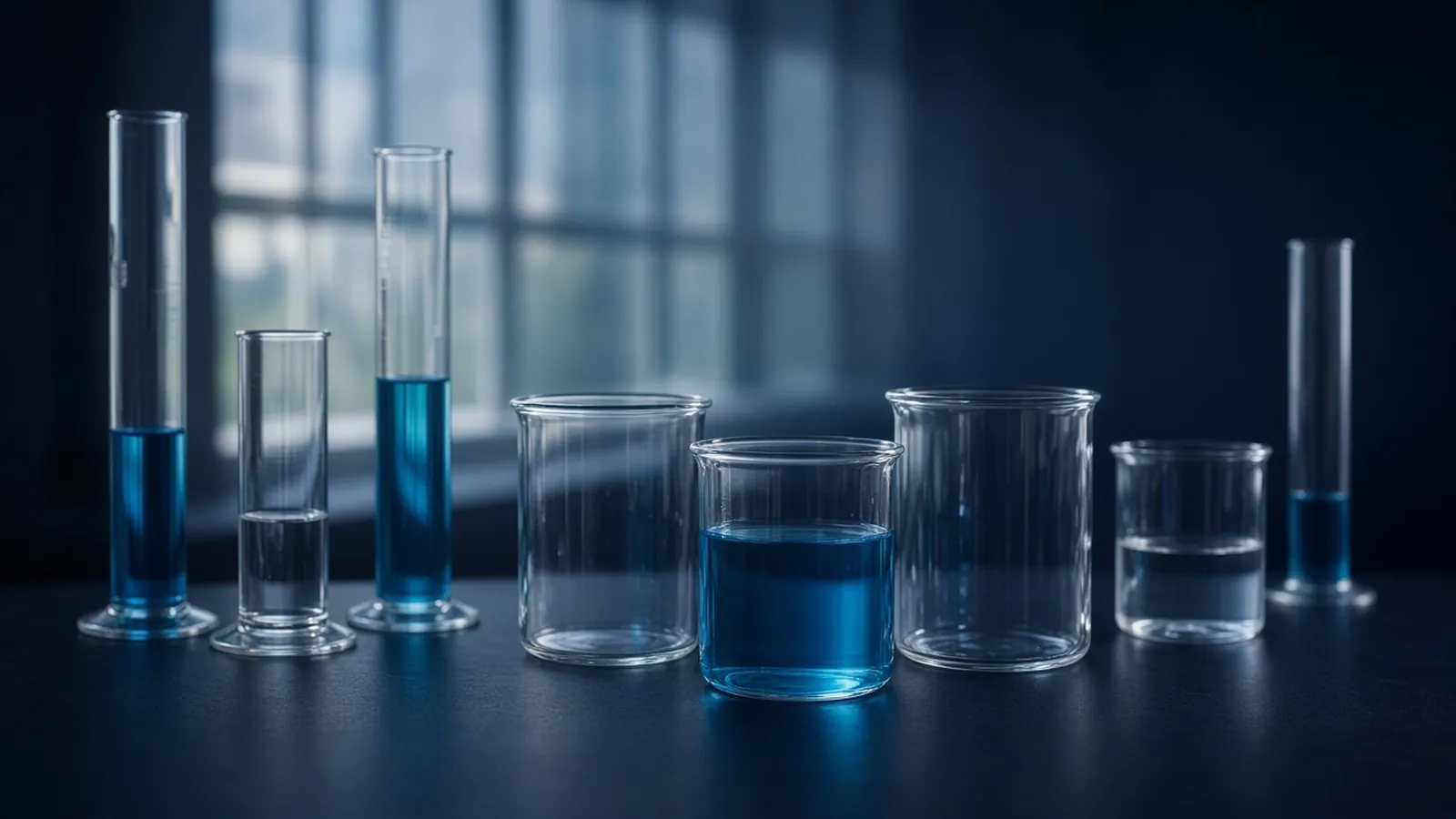
The symptom is a standard that will not repeat, or two careful people who cannot agree on the same cylinder. The cylinder is often innocent of mystery and guilty of being used past its tolerance. This troubleshooting note is for that disagreement. Cylinders sit between beakers and volumetric flasks in choosing laboratory glassware: useful for an approximate transfer, unfit for declaring a primary concentration.
What the symptom usually means
Start with how the volume was read, before you blame the glassblower. A cylinder has a wide enough bore that parallax is obvious once you look for it. Eye above the liquid, and the meniscus appears to sit on a lower line than it does. Eye below, and you over-read. The cylinder tilted in a hand changes the height of the liquid against the scale. The scale was printed for a vertical wall.
Next, ask whether this volume should have been a cylinder at all. Preparing "exactly 100 millilitres" of a stock in a cylinder imports the cylinder's tolerance into every later dilution. That tolerance is wider than a one-mark volumetric flask's. The standard that defines the cylinder says how wide. NIST's Office of Weights and Measures is the public route into how laboratories treat calibration. If the method needs flask tightness, the fix is a flask, not a steadier hand.
Likely causes and the next check
Parallax is the first check. Put the cylinder on a flat bench. Lower your eye, or raise the cylinder on a stand, until you look along the line. For aqueous solutions read the bottom of the meniscus. The top of the curve is the wrong edge for that convention and can differ by a noticeable fraction of a small cylinder.
The second check is to contain versus to deliver. Some cylinders are calibrated to contain (In). Some are calibrated to deliver (Ex), which assumes a drain. If you fill an In cylinder and pour it out, the receiving vessel does not get the full marked volume, because a film remains. If you use an Ex cylinder as if it contained its reading after a sloppy pour, you have double-counted the film. Read the letters on your cylinder.
The third check is dirt and etch. Detergent and grease distort the meniscus until it is not a clean curve. Alkali etch fades the printed lines so two readers interpolate differently. A chipped base makes the cylinder stand slightly off vertical. Any of those is a reason to wash properly or to retire the piece, not to average two guesses.
The fourth check is temperature. Cylinder calibrations also assume a reference temperature. A hot liquid from a drying step is not that liquid. Let it cool when the volume matters. For rough media preparation the effect can be smaller than other errors. For a standard, you should not be in the cylinder.
The fifth check is the wrong size. Reading 8 millilitres in a 500 millilitre cylinder uses the part of the scale where the subdivisions are coarsest relative to the volume you want. Use a cylinder whose top mark is near the volume you need, and accept that "near" is still approximate.
| What you see | Likely cause | Next check |
|---|---|---|
| Two readers, two volumes | Parallax or a tilted wall | Eye level, cylinder vertical, bottom of a clear meniscus |
| Pour-out does not match the fill | In versus Ex, or an incomplete drain | The letters on the cylinder and a timed drain if it is Ex |
| Line looks fuzzy or doubled | Grease, detergent, or etch | Clean rinse; retire if the scale is eaten |
| Standard will not repeat across days | Cylinder used as a flask | Remake in a volumetric flask at its reference temperature |
| Cylinder rocks on the bench | Chipped base or debris | Retire if the base is damaged |
After the reading is honest, the tolerance remains
A clean, level, eye-height reading still carries the cylinder's class tolerance, which is built wider than a flask's because of the geometry. Recording 47.5 when the subdivisions are 1 millilitre pretends the glass resolved a quarter. Interpolate only as far as the scale honestly allows, and write the method as approximate if that is what you did.
Plastic cylinders remove breakage and add a compatibility question. Polypropylene is a common aqueous choice. It can be harder to see a meniscus in, and it is not a solvent-proof default. Glass cylinders for solvent work should be a stated glass, with borosilicate preferred when the piece may be warmed. ASTM E438 is the specification language for those glasses. Soda-lime cylinders crack more readily from thermal shock and should not be promoted to a hot plate because they once measured water.
If the cylinder is the right tool and the volume still disagrees with a balance, check density and temperature before you send the cylinder for repair. A 100 millilitre water portion weighed on a balance is a useful sanity check when the method is allowed to use one. It is not a home-made recalibration you scribble onto the glass.
Subdivisions, class marks, and a check that is not a recalibration
A class printed on a cylinder, when one is printed, is the tighter or looser band in the cylinder's own standard. It is still a wider promise than a one-mark flask holding a single volume. Read the class off the glass. If no class is printed, do not invent one because the moulding looks sharp. Record the cylinder as an approximate transfer and move any concentration you must declare into a volumetric flask.
Subdivisions set the last honest digit. A cylinder marked every millilitre does not resolve a tenth of a millilitre. A digit past the subdivision turns a rough pour into a false standard. If two people must agree more tightly than those lines allow, a perfect meniscus reading still leaves you in the wrong vessel.
A balance can sanity-check a water portion when the method allows a mass and a temperature. Use that check to decide whether the reading technique is at fault. Do not scratch a new line on the glass and call the cylinder recalibrated. Recalibration is a recorded metrology activity. If a careful reading and a sane mass still disagree with a certificate you actually hold, retire that cylinder from any job that cited the certificate.
Safety
Cylinders full of solvent tip easily because they are tall. Use a carrier, and keep the volume in a tray the chemical requires. A broken cylinder is sharps plus whatever it held. Biological liquids make it a biosafety object under your rules, with the WHO biosafety manual and the CDC BMBL as background reading. This is not a diagnostic measuring procedure.
What to specify next time
Nominal capacity near the volume you actually dispense, glass or a named resin, to contain or to deliver, and the class if a certificate matters. Say plainly if the true standard is a volumetric flask, so the cylinder is not asked to impersonate one. The laboratory glassware catalogue and the volumetric glassware catalogue are the places to separate those lines, and the quote request is where the count of pieces goes.
Questions from the bench
Why is a cylinder less trustworthy than a volumetric flask of the same nominal size?
The cylinder is built to be read at many heights, with a wider bore than a flask neck, so each small height error is more volume. Its tolerance class, where one is printed, is wider than the tolerance of a one-mark flask used for a single volume. Use the cylinder to dispense an approximate portion. Declare a standard in the flask. The two tools are complementary, and swapping them changes the method.
Where on the meniscus should the eye sit?
For a clear aqueous liquid, read the bottom of the meniscus, with the cylinder vertical and your eye level with that curve. Looking down or up moves the apparent position onto the wrong line. Dark or opaque liquids can hide the bottom of the curve, and then you follow the convention stated for that vessel rather than inventing an edge. A cylinder held up in the air and tilted is a different volume from the one on the bench.
Does Class A on a cylinder mean the same tightness as Class A on a flask?
It means the tighter cylinder class in the standard that covers that cylinder, not the flask's tolerance copied across. Read the marking and, if the work needs the number, read the certificate. This article does not supply a millilitre table. If your specification says flask-like accuracy, a cylinder of any class is the wrong object to name.
Plastic or glass for a cylinder?
Glass, commonly borosilicate when you want better chemical and thermal behaviour, stays the default for many solvents. Plastic cylinders survive a drop better and can be clearer for teaching or field rough work if the resin tolerates the liquid. Either way the tolerance and the meniscus rules remain. A drop-proof cylinder is not a volumetric flask.
References
Manufacturer names identify published method classes. Trademarks remain with their owners. Catalogue records on this site are independent references for enquiry. They are not a statement of inventory, distribution rights or a supply commitment. This page is educational. It is not medical advice, a diagnostic protocol or a biosafety approval.
Catalogue
Related products and categories
These links follow the subject of the article into published manufacturer references. A listing is a reference for an enquiry, not a statement of stock or distribution rights.
Continue in this cluster
Related reading
Choosing laboratory glasswareHow to match borosilicate beakers, flasks and volumetric glass to the measurement you need, and when a printed line is only a guide.A glossary of labware termsDefinitions of the labware words that change a result: class marks, to contain and to deliver, joint size, resin, sterile and clean.Beakers are for handling not for accuracyWhy a beaker graduation is only a handling guide, and when a concentration other people will reuse belongs in a volumetric flask.