
protocol overview
Hot-start polymerases and primer-dimers
How a heat-released hot-start block limits extension during setup, and how a short no-template product on a gel is read as primer-dimer.
- Author
- EVRINTH Editorial Team
- Published
- 8 October 2026
- Updated
- 8 October 2026
- Reading time
- 9 min
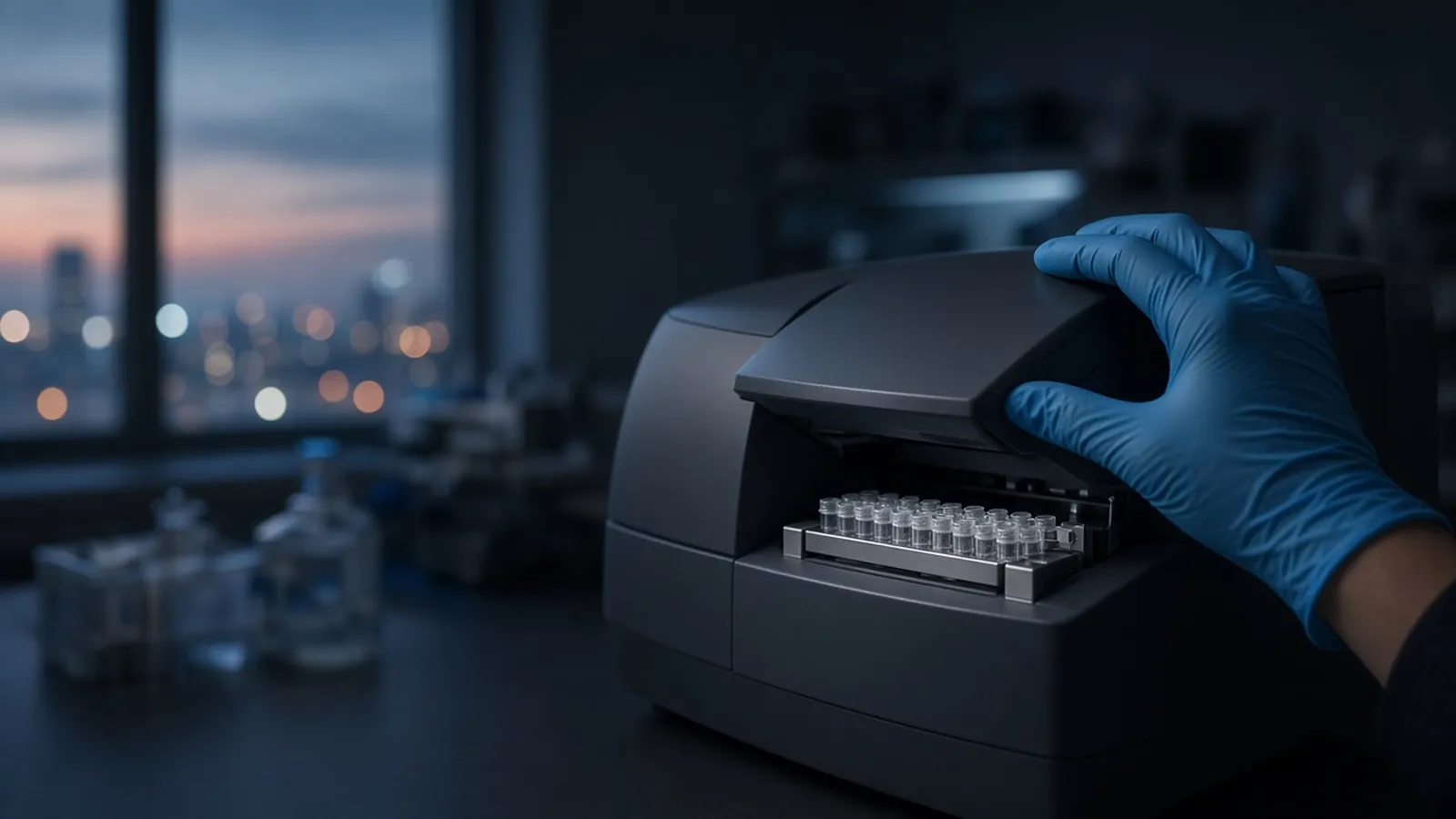
A hot-start polymerase is held inactive until a heat step releases the block. The point of that pause is the time you spend mixing primers, template and enzyme on the bench, when a cold polymerase would otherwise extend mis-paired 3-prime ends into molecules the later cycles can copy. Hot-start is a setup control. It is not a repair for a primer pair that likes itself. This overview is the staged way to use the enzyme class and then read a short product in the no-template lane. The cycle those tubes enter is explained in how polymerase chain reaction works.
Who needs the block, and what it will not fix
Use a hot-start class when the reaction is assembled at the bench rather than in a cold room with instant transfer to a pre-heated block, when the primers have any history of a low band, or when you are opening many tubes and the first one waits. Skip the romance of the label if the pair already produces a short product in a no-template control after a correct activation. In that case the dimers are forming during the cycles, which is exactly when the enzyme is supposed to be active.
Endpoint PCR reports presence and size. A hot-start mix does not make that report quantitative. It changes how much junk gets a head start before cycle one.
Three ways the enzyme is held shut
The block is a class. An antibody occupies the polymerase until the first denaturation unfolds the antibody, so the activation hold is often the initial denaturation, sometimes a little longer. A chemical modification has to be cooked off, and those cards often ask for several minutes near 95 Celsius. An aptamer is a nucleic-acid ligand that binds when the enzyme is cool and releases when it is hot. That release is typically reversible if the tube cools again.
Programme the hold on the card you opened. An antibody enzyme in a chemical-enzyme programme, or the reverse, looks dead or never really blocks. The polymerase under the block can still be Taq-like or proofreading. Hot-start chooses when extension is allowed. It does not choose fidelity.
Primers can still collide while the block is on. They cannot be extended into a covalent, amplifiable product until the enzyme wakes. A strong 3-prime overlap becomes DNA in the first active cycles, template or not.
What goes in the tube
The tube needs the blocked polymerase, the buffer and magnesium the card pairs with it, the four dNTPs, the two primers, and template only in the sample tubes. A complete mix already contains magnesium. A second dose, copied from an older recipe, changes specificity and can feed the dimer you hoped to avoid.
Each primer is commonly planned around 0.1 to 0.5 micromolar. Follow the mix. A lower primer concentration is a fair test when a short no-template band appears. It is not the same test as swapping hot-start class. A poor seal during the long hot hold lets water leave and both products change in the late cycles. Match the plate to the block.
Staged workflow
Assemble on a cold block even though the enzyme is hot-start. The block reduces extension. It does not freeze every side reaction, and a warm bench shortens the margin if the particular lot's inhibition is incomplete. Add template last, or in a separate area from the master mix, so amplicon from yesterday does not become today's template. Close the tubes and start the programme without a long wait at ambient temperature.
The programme opens with the activation hold from the card, then the usual denature, anneal and extend repeats. Do not delete the activation step because the rest of the programme also gets hot. Chemical modifications in particular may not come off in a short denaturation of a few seconds. After the last cycle, hold cold and go to a gel. Running the product out for days at room temperature is a contamination risk to the next setup, not a way to improve the band.
Include three lanes' worth of thinking even if you are in a hurry. A no-template control contains the master mix and water in place of sample. A positive control, when you have a trusted template, shows that activation and primers can succeed. The sample lanes are interpretable only after those two have been looked at. The logic of those controls is expanded in PCR controls and contamination control.
Branch on the first gel. Positive control right, no-template lane empty at both the amplicon size and the low end: the setup is behaving, and sample results can be read as presence or absence of that size. Positive control right, no-template lane showing a short band: the hot-start did its setup job and the pair still dimers during cycling. Samples that show only that short band are not positives. Samples that show a clear long band well above the short one can be used for a size call if you can cut or score without taking the dimer with you. No product in the positive control: check that the activation hold ran, then the enzyme lot, then the primers. A full-length band in the no-template lane is carry-over of old product, not a primer-dimer, and hot-start will copy it cheerfully once the block is released.
| What is in the no-template lane | How to read it | Next decision |
|---|---|---|
| Empty at the amplicon and at the bottom | Setup and pair did not create this product alone | Sample bands at the expected size can be scored |
| Short, fuzzy band only | Primer-dimer formed during cycling | Redesign if samples lack a separated amplicon |
| Band at the full expected size | Old amplicon got into the mix | Discard the working stocks and clean the setup |
| Short band plus sample amplicon well above it | Dimer competes, but the size gap is real | Use the long band only if you can separate it |
| Nothing anywhere, including the positive control | Activation, enzyme, or mix failed | Confirm the heat release before you reorder primers |
How the short product is identified
Run the agarose far enough, and at a percentage high enough, that a fragment of a few dozen base pairs is not still in the well and not piled up with the tracking dye in a way you cannot see. Many routine gels are poured to resolve a few hundred base pairs and then stopped early. A dimer hides in that habit. Use a marker that has a band at or below 100 base pairs so "low on the gel" is a measurement.
Primer-dimer is usually shorter than the amplicon you designed, diffuse, and present in the no-template lane. The amplicon should be absent from that lane. If you designed the product only a little longer than the primers, you cannot make this call. That is a design failure surfacing at the gel, not a hot-start failure.
Do not sequence a band you have not separated from the dimer and expect a clean read. Do not cut a gel slice that includes both. If the gap is too small, redesign until the gap is obvious.
When people mis-blame the enzyme
A pair that dimers after a correct activation will dimer in another hot-start brand if the 3-prime overlap is the cause. Redesign those ends, and keep a hot-start class so setup does not give the new pair a head start.
Missed activation imitates a dead enzyme. The positive control is blank until you notice the programme skipped the release hold. Chemical blocks are the strictest about that hold. After a reboot, confirm the first step finished.
A strong full-length band from too much template, or from old amplicon, means the enzyme is working and the input is not. A smear tracks the sample DNA. A dimer is short and it occupies the no-template lane. Extra cycles brighten the short product, because it finishes sooner and spends the primers. Fix the pair or the primer concentration.
Safety and a hot bench
Hot lids burn. Ultraviolet light at the gel damages eyes, skin and DNA. Use the shield and the stain note for the bottle you opened. Containment of an infectious template is an institutional decision. The WHO laboratory biosafety manual is background, not a permit, and this article is not a clinical method.
Supplier descriptions of room temperature assume a cooler bench than many labs actually have. Keep tubes on a cold block anyway. Ambient heat is not the programmed release. If a power cut stops the run during activation, set the plate aside and start again. Write the enzyme class and the hold next to the gel result.
What an enquiry should say
Ask for a polymerase by the behaviour you need: hot-start class, proofreading or not, and the amplicon length. Say whether primer-dimer has already been seen, and whether the activation programme is constrained by the cycler. Browse enzyme families in the molecular biology catalogue and send the requirement with the quote request. A catalogue family is not a single recipe. If the dimer problem appeared only after several primer pairs were combined, mention that in the multiplex PCR enquiry reference as a design question. The nucleic acid analysis pathway is the right wider label when the PCR is one step in a sample-to-gel path.
Read a short no-template product after a hot-start run
- 01Confirm the activation hold matches the enzyme cardWrite the initial heat step the hot-start class requires before any cycling. An antibody, a chemical block and an aptamer are not released by the same programme.
- 02Include a no-template control in the same master mixLeave out only the sample DNA. The control must see the same primers, nucleotides, magnesium and cycle count as the samples.
- 03Run the gel far enough to split short from longLoad a marker that includes fragments below 100 base pairs. Stop the run when a primer-length product would sit clear of the expected amplicon.
- 04Call the short band before you call the samplesA short product in the no-template lane is primer-dimer, including after a correct hot-start. Redesign the pair if that band is the only product the samples show.
Questions from the bench
Does a hot-start enzyme stop primer-dimers from forming?
It stops the polymerase from extending those dimers while you are still pipetting. Once the heat step releases the block, a pair with complementary 3-prime ends can still extend during the cycles. A hot-start reaction can show a short no-template band. That band is evidence about the primers.
What does a short band only in the no-template lane mean?
It means the primers made a small product without sample DNA. The band usually sits near the combined primer length and looks fuzzy. If the sample lanes also contain the expected amplicon well above it, you can sometimes use the long band. If the short band is all you have, the pair needs to change.
Why would a hot-start reaction give no product at all?
The usual miss is an activation hold that never ran, or that was too short for a chemical block. The enzyme is then still inhibited and looks dead. Check the programme against the card before you discard the lot. A failed positive control with a correct activation step points at the mix or the template instead.
Should I add more cycles to outrun a primer-dimer?
No. Extra cycles give the short product more chances to copy itself, and it copies efficiently because it is small. Reduce primer concentration as its own test, raise the annealing temperature, or redesign. Do not lengthen the programme and hope the amplicon catches up.
References
Manufacturer names identify published method classes. Trademarks remain with their owners. Catalogue records on this site are independent references for enquiry. They are not a statement of inventory, distribution rights or a supply commitment. This page is educational. It is not medical advice, a diagnostic protocol or a biosafety approval.
Catalogue
Related products and categories
These links follow the subject of the article into published manufacturer references. A listing is a reference for an enquiry, not a statement of stock or distribution rights.
Continue in this cluster
Related reading
How polymerase chain reaction worksHow PCR copies a chosen DNA segment: the temperature cycle, reagents, controls and what a band on a gel does and does not prove.A glossary of PCR termsPlan a PCR by defining amplicon, Tm, Ta, hot-start, plateau, master mix, NTC, inhibition, fidelity and multiplex before you mix.Choosing an annealing temperatureWhy annealing temperature is not the Tm printed on a tube, and how salt, magnesium, additives, and a short gradient locate the real window.